Best Knife Sharpening Steel and Alternatives for 2026
We evaluate honing rods and sharpening stones to help you choose the right tool for consistent, professional-grade kitchen knife edge maintenance.
By the Niche Picks editorsUpdated November 8, 20269 min readDrawn from our 33 research-based knife sharpening reviews
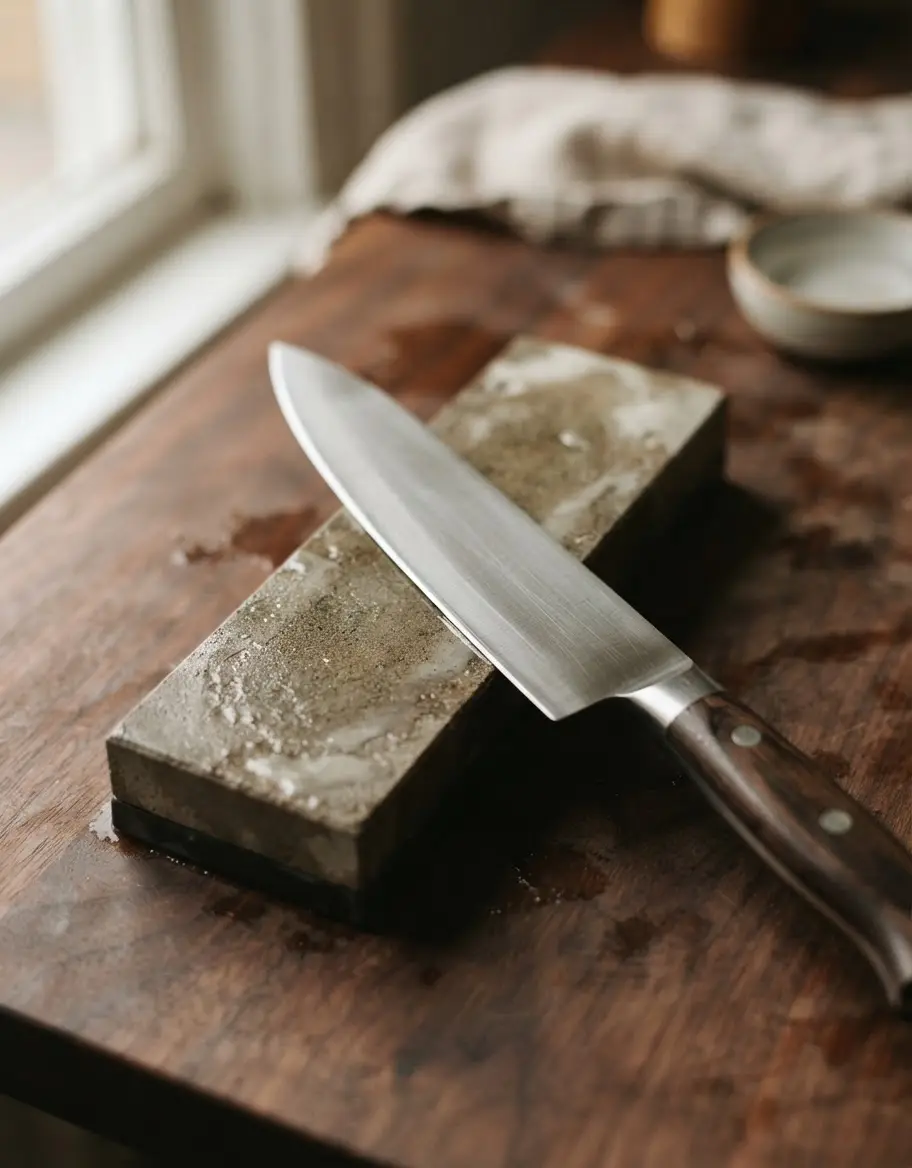
AI-generated editorial illustration; not a product or test photograph.
Short answer
For most home kitchens, a 1000/6000 grit combination waterstone is the gold standard for sharpening, while a dedicated honing steel serves only to realign a rolled edge. If you struggle with freehand angle control, consider a guided system like the Work Sharp Precision Adjust, which trades speed for repeatable, precise bevel geometry.
6
Product listings discussed; not hands-on tests
6/6
Discussed listings with a recorded price
$18.98–$129.95
Recorded listing price range; not a complete setup cost
Key takeaways
Honing rods align the blade's edge but do not sharpen it by removing metal.
A 1000/6000 grit combination stone covers almost every common kitchen sharpening need.
Guided sharpening systems are excellent for beginners seeking repeatable bevel angles.
Diamond-coated rods are abrasive sharpening tools, not true alignment steels.
Regularly sharpening your knives at home can save significantly on professional service fees.
Products discussed in this article
Editorial scores and recorded prices are reference points, not measurements of suitability for every use. Read each review's specifications and limitations.
Comparison of Recommended Sharpening and Honing Tools
Product
Type
Primary Use
Price
Whetstone 1000/6000
Waterstone
Sharpening
$39.99
Cutluxe Honing Rod
Honing Steel
Realignment
$29.99
Work Sharp Precision
Guided System
Precision Sharpening
$69.95
Work Sharp Elite
Guided System
Advanced Sharpening
$129.95
Kota Japan Rod
Diamond Rod
Fast Touch-ups
$18.98
Amazon Basics Stone
Waterstone
Sharpening
$25.00
Honing vs. Sharpening: Knowing the Difference
Understanding the distinction between these two maintenance tasks is critical for preserving your cutlery. Sharpening is a subtractive process where you remove a small amount of metal to restore a blunt edge to a sharp apex. This is typically accomplished using a 1000/6000 combination stone or an abrasive rod. In contrast, honing is a process of realigning the microscopic teeth along the edge of the blade that roll over during standard food preparation.
Honing does not grind away steel, meaning it should not be used to fix chips.
Sharpening is necessary when a blade can no longer slice through produce easily.
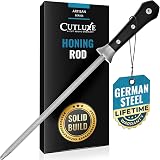
Many users mistakenly refer to every rod as a 'sharpening steel.' However, true honing steels are smooth or finely ribbed and lack the abrasive nature of grinding stones. If you use an abrasive diamond-coated rod, such as the Kota Japan 12 in. Sharpener, you are actively removing metal, which is a form of sharpening. If you only want to maintain a sharp edge, a Cutluxe Honing Rod is the proper choice for daily realignment. Misunderstanding these functions leads to common sharpening mistakes that can shorten the life of your expensive kitchen knives. Always prioritize the health of your blade by using the correct tool for the specific maintenance stage required. For further details on these distinctions, visit our sharpening FAQ or check out our buying tips. Proper blade hygiene is more than just making a knife sharp; it is about ensuring the structural integrity of the edge remains intact for years of service in the kitchen environment.
Why Choose a Guided Sharpening System?
For beginners, maintaining a consistent angle across a stone can feel daunting. Guided systems like the Work Sharp Precision Adjust or the Work Sharp Precision Adjust Elite solve this by securing the blade in a clamp, allowing the user to set a precise, repeatable bevel. By trading the raw speed of freehand work for mechanical accuracy, these tools ensure that you do not round off your edge through inconsistent movement.
Clamping keeps the blade fixed, preventing wobbles that lead to uneven edges.
Adjustable collars allow users to dial in specific angles for different tasks.
Consistent bevels result in a sharper knife that retains its edge for longer.
While traditionalists may prefer the tactile feedback of a whetstone, guided systems offer a shallower learning curve. You can learn more about this trade-off in our comparison article. These systems are particularly useful for those who do not want to spend hours mastering the muscle memory required for a perfect freehand edge. Because these devices are self-contained, they often include all the necessary abrasives to go from a dull blade to a razor-sharp finish without requiring separate setup gear. For those who prioritize precision over workflow speed, these guided units provide arguably the most consistent results currently available in the sharpening category. Using a digital gauge like the Klein Tools 935DAG allows even more control, verifying that your bevel matches the factory specs exactly. Ultimately, these systems remove the guesswork, providing peace of mind to home cooks who demand high performance from every knife in their collection without the risk of damaging the edge through poor manual technique.
Angle Awareness
When using a honing rod, aim for a consistent 15 to 20-degree angle per side. If you are unsure, resting the rod vertically on a cutting board can help maintain a stable, repeatable angle during your strokes.
The 1000/6000 Grit Standard for Kitchen Knives
If you prefer a manual approach, the 1000/6000 combination stone is widely regarded as the perfect pairing for almost any culinary task. The 1000-grit side is aggressive enough to set a new apex on a dull knife but fine enough to avoid unnecessary metal loss, while the 6000-grit side polishes the edge to a mirror-like finish, essential for clean push-cutting.
The 1000 grit is for setting the geometry and removing minor dullness.
The 6000 grit is for polishing and final edge refinement.
Standard kitchen steels rarely need more than this two-step progression. For those seeking the best whetstone options, look for corundum materials that offer consistent cutting. Remember that because these stones are abrasive, they will eventually 'dish' or become uneven, so having a flattening stone is essential for long-term ownership. Using a dull knife is often more dangerous than using a sharp one, which is why learning how to sharpen kitchen knives is a foundational skill for any cook. If you are uncertain about what you need, our guide on what grit do I need for dull knives can clarify whether you need a lower grit to start. With a consistent 1000/6000 workflow, you can maintain your entire kitchen drawer without needing professional help. Many budget-friendly kits, like the YeopAsda Whetstone Set, come with flattening stones, making them a one-stop shop for long-term maintenance. When you commit to this progression, you stop relying on 'magic' pull-through tools and start building actual craftsmanship in your kitchen care routine.
Longevity and Maintenance of Your Sharpening Gear
Your sharpening tools require their own maintenance to remain effective. Synthetic waterstones, such as those made of white corundum, naturally wear down or 'dish' as you grind your blades against them. This phenomenon happens because the bond holding the abrasive particles together eventually releases them to expose fresh, sharper grains. If you fail to flatten your stone, you will find yourself grinding the knife on a concave surface, which ruins the flatness of your blade's bevel.
Use a dedicated flattening stone or a lapping plate every few sharpening sessions.
Keep your waterstones clean by rinsing the abrasive slurry after every use.
Store stones in a dry place to prevent mold or structural degradation in the bamboo bases.
Diamond plates, like the SHARPAL 162N, offer an alternative for those who prefer to skip the flattening process. Because they use industrial diamond particles electroplated to a rigid steel substrate, they remain flat for their entire service life. However, even these require care; cleaning the plate with a soft brush removes metallic dust that can interfere with the abrasive efficiency. Honing rods also benefit from regular cleaning; microscopic metal shavings build up on the surface, which can lead to 'loading' where the rod loses its ability to grip the edge. Simply wiping the rod with a dry cloth after each session, as recommended for tools like the WÜSTHOF 9" Honing Steel, keeps the surface active. By treating your sharpening equipment with the same respect as your knives, you ensure that you always have access to a sharp, reliable edge without needing to replace your gear frequently. Consistent maintenance is the hallmark of an experienced cook who understands that tools perform best when kept in peak condition.
Don't Over-Hone
Honing is for maintenance, not repair. If your knife is truly dull, using a steel will not fix it and may even cause the thin metal at the apex to fold over more, making the knife perform worse.
Selecting the Right Abrasive for Your Steel
Not all kitchen knives are created equal, and the hardness of the steel plays a major role in how you should sharpen it. Western-style chef knives are often made of slightly softer, more ductile stainless steel, which responds exceptionally well to the gentle alignment provided by a honing rod. Conversely, modern Japanese knives are frequently hardened to a higher Rockwell scale (often 60+ HRC). These harder steels are prone to chipping if subjected to a rough, traditional steel; instead, they require the refined polishing of higher-grit waterstones.
Soft western steels benefit from regular maintenance with a 10-inch honing rod.
High-hardness Japanese steels require precise ceramic or corundum waterstones.
Avoid using aggressive pull-through sharpeners on high-performance blades to prevent unnecessary steel loss.
When choosing your equipment, consider the cumulative cost of ownership. While a cheap pull-through sharpener like the SHARPAL 191H seems inexpensive, the aggressive material removal significantly shortens the lifespan of your knife. A high-quality stone like the Shapton 1000 grit might have a higher initial price tag, but the controlled material removal and professional-grade finish make it a superior long-term value. If you are uncertain about the specific alloy of your blade, start with a medium grit (around 1000) and observe how the edge reacts. You can always refine the edge further with a 6000-grit side, but you cannot easily undo the damage caused by overly aggressive coarse sharpening. Researching your knife manufacturer's recommended sharpening angle and steel type can significantly improve your success rate. Our blog on buying tips provides further context on how to match your abrasive medium to your specific blade profile, ensuring your investment serves you for years.
Best Practices for Safe and Effective Results
Safety is paramount when working with sharp edges and abrasive surfaces. Always ensure your sharpening station is stable. If your stone or rod slides across the counter during a stroke, the risk of accidental slips increases exponentially. Many kits, like the HMPLL Stone Set, include non-slip silicone bases and bamboo bridges that lock the stone in place. If you are using a loose stone, consider placing a damp towel underneath it to provide grip.
Always move the blade edge-first against the stone to ensure proper burr formation.
Keep your fingers clear of the blade path at all times, especially when using small pocket sharpeners like the Fallkniven DC4.
Focus on light, consistent pressure rather than heavy, grinding force.
Technique is arguably more important than the cost of the tool. Even the most expensive waterstone will fail to produce a sharp edge if the angle is inconsistent. This is why many beginners benefit from an angle guide. These simple clips attach to the spine of the knife, maintaining a fixed angle relative to the stone surface. As you gain muscle memory, you can transition to freehand sharpening, but there is no shame in using guides to ensure perfect geometry. For those maintaining knives in the field, compact tools like the Work Sharp Guided Field Sharpener provide essential safety by including fixed angle references built directly into the chassis. Remember, the goal is to create a clean, sharp edge that requires minimal pressure to cut through food. When you sharpen correctly, the resulting edge is more predictable, significantly reducing the chance of the knife slipping off a slick surface like an onion or tomato. If you encounter difficulty, review our list of common mistakes to adjust your approach before attempting further sharpening.
Step by step
1Submerge your whetstone in water for 5–10 minutes if it is not a splash-and-go type.
2Secure the stone on a non-slip base or bridge to prevent movement.
3Place your knife edge against the 1000-grit side at a 15–20 degree angle.
4Maintain the angle as you sweep the blade across the stone toward the tip.
5Repeat the motion on the other side until a small burr forms along the edge.
6Switch to the 6000-grit side to polish and remove the remaining burr.
7Use a honing rod lightly between sharpening sessions to keep the apex aligned.
Quick checklist
Identify if your blade needs honing (alignment) or sharpening (grinding).
Select an abrasive medium (stones for sharpening, rods for maintenance).
Check if your stone requires a soak or is a 'splash-and-go' model.
Ensure you have a stable, non-slip base for safe sharpening.
Use an angle guide if you are not confident in your freehand technique.
Clean your rod regularly to remove metal particles that can scratch the edge.
Always perform passes with light, consistent pressure.
Frequently asked questions
How often should I hone my kitchen knife?
You should hone your knife every few uses or whenever you notice the blade losing its 'bite.' Because honing is a gentle process that realigns the edge without removing metal, it is safe to do this regularly to extend the time needed between full sharpening sessions.
Can I use a honing rod to sharpen a dull knife?
No, a traditional honing rod cannot sharpen a dull knife. Honing only straightens the microscopic edge that has rolled over. If the edge has lost its sharpness or has become rounded, you must use an abrasive sharpening stone or guided system to grind a new, sharp apex.
Is a diamond steel better than a standard honing steel?
They serve different purposes. A standard steel is for honing (realignment). A diamond-coated steel is actually a fine abrasive tool that removes metal to sharpen the blade. Use a standard steel for maintenance and a diamond rod if you need a quick edge touch-up.
Why does my knife have a burr after sharpening?
A burr is a tiny piece of metal pushed to one side of the edge during sharpening. It is a sign that you have reached the apex. Use a finer grit stone or a strop to remove the burr, which will result in a much sharper and smoother cutting edge.
What is the best way to clean a honing rod?
Wipe the rod with a damp, non-abrasive cloth after every use to remove the microscopic metal particles that accumulate during the honing process. Storing a clean rod prevents these metallic filings from transferring back onto your blade during the next use, which can cause micro-scratches.
Amazon links are affiliate links; we may earn a commission at no cost to you.
Shortlists in this category
Ranked lists from our knife sharpening reviews, limited to listings whose titles confirm the product type, with budget cuts where enough recorded prices sit on both sides of the line.
This page summarizes our research reviews of Amazon listings, listed specifications and captured buyer ratings. It is not a hands-on test. Scores are editorial assessments, not measured performance; prices are recorded snapshots and may change. A category can include both main products and accessories, so its overall price range is not the cost of a complete setup.
Most recent product record update: October 28, 2026. Individual records may be older; this is not a verification date for every claim. Prices on this page were read from the listings Nov 8, 2026 – Nov 11, 2026.
Choose the product type first. These groups require a match in the listing title; an import search term alone is not enough. Scores rank our recorded research assessments within each group, not independently measured performance.
Values are shown as recorded, without unit conversions or inferred compatibility. Not recorded means unknown, not absent. Prices are snapshots, not current offers. Editorial scores are research judgments, not lab results. Amazon links are affiliate links.
Before treating a comparison as complete
Which details are still unknown?
A specification appearing in a listing is not independent verification. These counts show which shortlisted records contain the same field; a blank record does not mean the product lacks the feature.
Item Dimensions L x W x H
Recorded for 2 of 2 shortlisted models
Present in every shortlisted record. Check units, exact variants and the current manufacturer documentation before relying on it.
Item Weight
Recorded for 2 of 2 shortlisted models
Present in every shortlisted record. Check units, exact variants and the current manufacturer documentation before relying on it.
Material Type
Recorded for 2 of 2 shortlisted models
Present in every shortlisted record. Check units, exact variants and the current manufacturer documentation before relying on it.
Values are shown as recorded, without unit conversions or inferred compatibility. Not recorded means unknown, not absent. Prices are snapshots, not current offers. Editorial scores are research judgments, not lab results. Amazon links are affiliate links.
A 1000/6000 combination stone covers almost every kitchen need.
Guided systems trade speed for repeatable angles — worth it early on.
Honing and sharpening serve different purposes; follow guidance for your blade steel and edge rather than assuming every knife needs a honing rod.
If a specification, certification or compatibility detail is absent, mark it as unknown and ask the seller or manufacturer. Do not substitute a star rating, an editorial score or a different model's specification.