 Whetstone Knife Sharpener – 1000/6000 Grit Sharpening Stone
Recorded price: $39.99 · Editorial score: 8.1/10
- Included Components
- Sharp
- Material Type
- Corundum
- Reason to pause
- Requires freehand angle discipline
Discover the best whetstone for kitchen knives, from classic 1000/6000 combinations to all-inclusive sharpening kits that deliver keen, polished edges.
By the Niche Picks editorsUpdated October 8, 20269 min readDrawn from our 32 research-based knife sharpening reviews
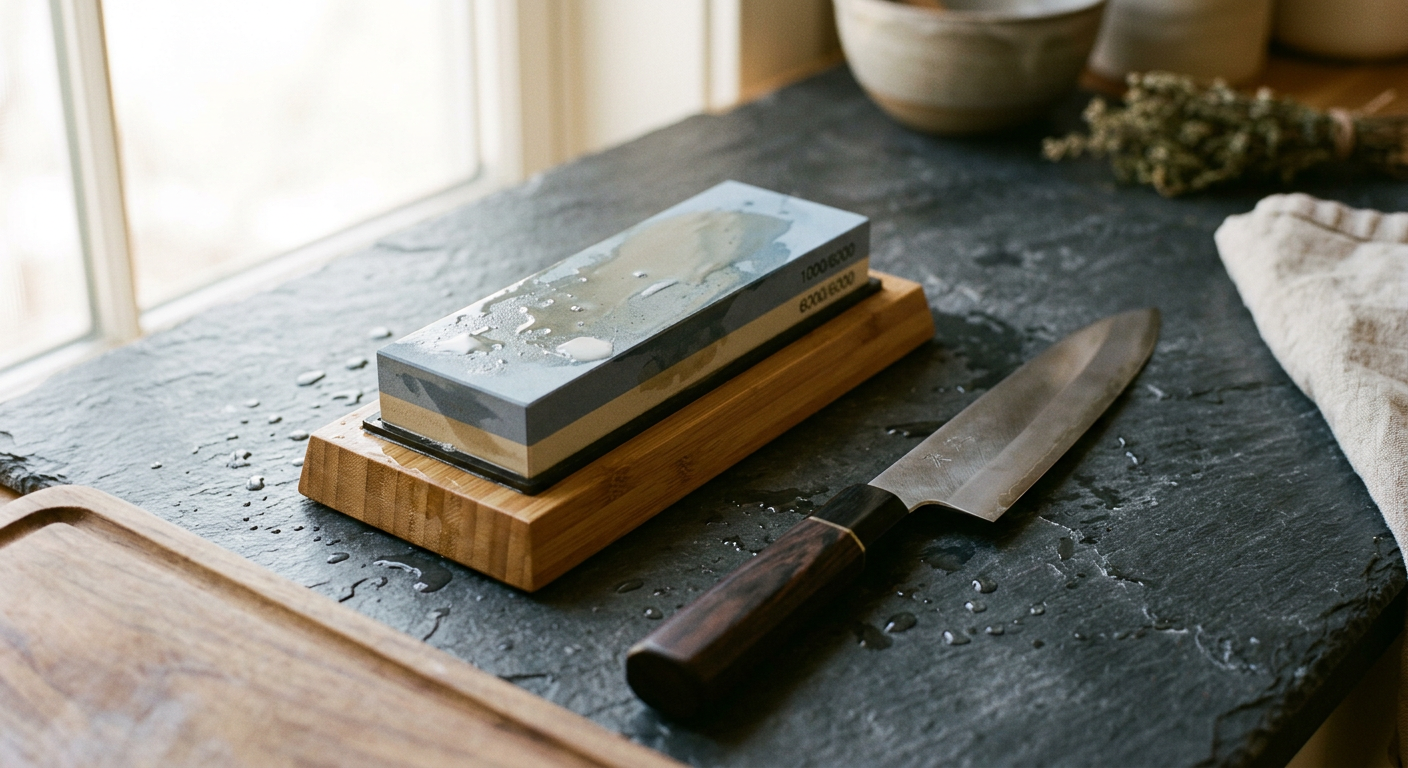
The best whetstone for most kitchen knives is a 1000/6000 combination water stone. A 1000-grit abrasive re-establishes a clean, sharp cutting apex without removing excessive steel, while a 6000-grit side deburrs and polishes the edge. For standard culinary maintenance, the Sharp Pebble 1000/6000 stone and the King KW65 offer the most reliable performance and value.
Editorial scores and recorded prices are reference points, not measurements of suitability for every use. Read each review's specifications and limitations.
Whetstone Knife Sharpener – 1000/6000 Grit Sharpening Stone4.6$39.99Our score 8.1/10Best for Standard two-sided freehand kitchen sharpening KW65 1000/6000 Grit Combination Whetstone with Plastic Base4.6$28.20Our score 7.9/10Best for Standard kitchen knife maintenance and edge refinement
 Whetstone Knife Sharpening Stone, Double-Sided 1000/6000 Grit with Angle Guide, Non-Slip Bamboo Base, Black & Grey4.5$22.90Our score 8.1/10Best for Entry-level kitchen sharpening on a budget
 Complete Knife Sharpening Stone Set – Dual Grit Whetstone 400/1000 3000/8000 Knife Sharpener with Leather Strop, Flattening Stone, Bamboo Base, 3 Non-slip Rubber Bases & Angle Guide4.5$29.99Our score 7.8/10Best for Budget-conscious users wanting an all-inclusive kit
 Whetstone Knife Sharpening Stone Set, Double-Sided Grit 400/1000 3000/80004.5$39.99Our score 7.8/10Best for Practicing multi-stage sharpening across wide grit ranges
| Product | Grit Rating | Material | Included Accessories | Price |
|---|---|---|---|---|
| Sharp Pebble 1000/6000 | 1000 / 6000 | Corundum (Aluminum Oxide) | Bamboo base, silicone holder, angle guide | $39.99 |
| King KW65 | 1000 / 6000 | Bonded Ceramic | Plastic base | $28.20 |
| Amazon Basics 1000/6000 | 1000 / 6000 | Synthetic Waterstone | Bamboo base, silicone gasket, angle guide | $22.90 |
| Complete MDS00A Set | 400/1000 & 3000/8000 | Corundum (Aluminum Oxide) | Bamboo base, flattening stone, angle guide, leather strop | $29.99 |
| YeopAsda YA-02 Set | 400/1000 & 3000/8000 | Synthetic Corundum | Bamboo base, flattening stone, angle guide, honing guide, strop, gloves | $39.99 |
Selecting the right abrasive begins with understanding grit progressions. Many multi-piece sharpening bundles feature grits ranging from 400 all the way to 8000, but a standard 1000/6000 combination stone reliably covers almost every kitchen need. Grits below 600 are reserved for coarse metal removal, such as grinding out significant blade chips or completely resetting a badly blunted secondary bevel.
A 1000-grit surface is the true workhorse of culinary cutlery care. It cuts fast enough to establish a clean apex and raise an even burr across typical kitchen stainless and carbon steels, yet it does not abrade steel aggressively enough to shorten your blade's lifespan prematurely. For everyday chopping of vegetables, proteins, and fibrous produce, a refined 1000-grit edge provides an aggressive "bite" that prevents the blade from sliding off slick foods.
Progressing to a 6000-grit surface refines the scratch pattern and removes the micro-burr left by the medium stone. At this level, the edge takes on a mirror-like polish that excels at delicate push-cutting, such as shaving delicate herbs or making clean sashimi cuts. Stepping beyond 6000 grit up to 8000 grit offers aesthetic appeal, but standard kitchen cutlery rarely requires it. Over-polishing can actually strip away the toothiness needed to bite into waxy bell pepper skins or tough tomato exteriors.
To master edge maintenance, consult our knife sharpening buyer's guide or explore common mistakes to avoid before setting up your first sharpening stone on the counter.
Read the reviews: Whetstone Knife Sharpener – 1000/6000 Grit Sharpening, KW65 1000/6000 Grit Combination Whetstone with Plastic
The Sharp Pebble 1000/6000 combination stone hits the established kitchen benchmark directly. Measuring 7.25 by 2.25 inches with a thickness of 1 inch, this dual-sided corundum block provides an ideal surface area for standard 6-to-8-inch chef knives. Weighing 2.1 pounds, the assembly has sufficient mass to remain planted when seated inside its silicone sleeve and elevated bamboo base.
The 1000-grit side removes moderate amounts of dull metal to re-establish a primary apex without overly aggressive stock removal. Flipping the block exposes the 6000-grit face, which refines scratch marks and aligns the edge to a mirror polish. Because it is a soaking synthetic waterstone, it requires full water submersion prior to use, generating an abrasive slurry that accelerates metal removal.
Included with the kit is an angle guide designed to clip onto the knife spine. While this plastic guide restricts travel near sweeping blade tips, it provides novices with a tactile reference to practice maintaining uniform bevels. At an asking price of $39.99 with more than 25,000 user reviews, it presents an accessible entry into traditional freehand waterstone maintenance.
Prospective buyers should note that this specific package omits a dedicated truing block. Because synthetic corundum softens and sheds particulate during use, the stone will naturally dish over extended sessions and eventually require an aftermarket flattening plate.
Read the reviews: Whetstone Knife Sharpener – 1000/6000 Grit Sharpening
The King KW65 represents a standard fixture in manual cutlery care. This bonded ceramic waterstone pairs a brown 1000-grit medium abrasive layer with a cream-colored 6000-grit polishing surface into an 8-by-2-inch block. Retailing at $28.20, it provides a cost-effective way to adopt the dual-grit kitchen standard without purchasing redundant single-grit blocks.
The 1000-grit face cuts effectively to apex moderately dull kitchen blades, raising a uniform burr across traditional Western and Japanese alloys without cutting harsh gouges. Moving to the 6000-grit finishing surface refines the apex, producing an edge suited for clean slicing. As a soaking waterstone, the King KW65 creates a rich cutting slurry that demands steady water application during use to prevent pore clogging.
The package includes an integrated plastic base designed to elevate the block above working counters for adequate knuckle clearance. However, the base offers modest elevation, meaning users with deep chef knives may prefer placing the unit over a sink bridge or a damp cloth on a cutting board.
Like many traditional Japanese waterstones, the softer binder will wear unevenly with heavy use. While it delivers excellent tactile feedback through the blade, budget for a flattening stone down the road to keep its sharpening surfaces flat and true.
Read the reviews: KW65 1000/6000 Grit Combination Whetstone with Plastic
For cooks testing the waters of freehand sharpening, the Amazon Basics DS-WSTAMZ003 provides the proven 1000/6000 grit configuration at an accessible $22.90 listed price. Measuring 8.4 by 3.6 inches with a total height of 1.8 inches, this double-sided waterstone delivers a generous working platform weighing 952.54 grams.
The dark grey 1000-grit face repairs working edges efficiently, stripping away microscopic dullness to form a consistent burr. Transitioning to the light grey 6000-grit surface smooths out scratches, preparing the apex for seamless cutting through produce. The assembly rests inside a black silicone gasket that catches runoff and prevents edge chipping, nesting inside an elevated bamboo block fitted with non-slip rubber footing.
The package also includes a clip-on blade guide. Guided systems trade speed for repeatable angles, which is worth it early on, though users must be careful not to trap grit between the guide and softer knife finishes to prevent cosmetic scratching.
While the manufacturer does not specify the exact mineral binder composition, user ratings averaging 4.5 across more than 1,500 reviews support its everyday utility. Check our knife sharpening category reviews or review how to sharpen kitchen knives to master steady hand movement on this bench stone.
Read the reviews: Whetstone Knife Sharpening Stone, Double-Sided
If you are rehabilitating severely neglected blades with chipped bevels, a two-grit stone may not offer enough coarse abrading power. That is where complete bundles come in. The Complete Knife Sharpening Stone Set (MDS00A) retails for $29.99 and provides two separate dual-sided corundum stones: a 400/1000 coarse block and a 3000/8000 polishing block, alongside a silicon carbide flattening stone and leather strop.
Similarly, the YeopAsda YA-02 kit ($39.99) packs a 5.8-pound assortment featuring 400/1000 and 3000/8000 waterstones, an angle guide, a honing guide for chisel blades, and a leather strop with green compound. In both setups, the coarse 400-grit face removes material quickly enough to reprofile blunt edges, repair micro-chips, and reset secondary bevels.
The critical advantage of these multi-stone packages is the inclusion of a dedicated flattening stone. Synthetic corundum blocks wear quickly under heavy grinding pressure. Having a coarse silicon carbide conditioning block in the box ensures you can true dished surfaces immediately without purchasing separate accessories.
However, working through four separate grits requires extra time and counter cleanup. For domestic kitchen cutlery, stopping at 3000 or 6000 grit maintains better functional cutting performance than jumping to an ultra-slick 8000-grit polish. Learn more by checking our guide on how to use a knife sharpener rod to maintain that edge between stone sessions.
Read the reviews: Complete Knife Sharpening Stone Set – Dual Grit, Whetstone Knife Sharpening Stone Set, Double-Sided
A fundamental rule in cutlery maintenance is that honing and sharpening serve completely different mechanical purposes. Honing realigns an edge without removing steel, whereas sharpening abrades metal to establish a brand-new cutting apex. Failing to distinguish between these processes can ruin edge geometry or strip away blade life unnecessarily.
During routine chopping, blade steel encounters hard cutting boards. This impact causes the microscopic apex to roll or deflect off-center. When a knife begins to feel dull after a few days of meal prep, the metal has often merely folded over rather than worn away. Running the blade along a dedicated steel honing rod pushes that ductile edge back into alignment without stripping steel from the blade face.
Conversely, a whetstone uses bonded abrasive particles to grind away damaged steel, thinning the bevel and exposing fresh material. You should only turn to your sharpening stones when honing fails to restore cutting performance, typically every three to six months for domestic kitchen knives.
Furthermore, not all knives respond well to standard honing steels. High-hardness Japanese blades (frequently heat-treated above 60 HRC) can chip or indent softer European steels, making a fine 6000-grit waterstone or a leather strop the preferred tool for daily realignment. To explore standalone sharpeners versus bench stones, see our roundup of the best knife sharpeners.
Beginners often hesitate to purchase whetstones due to the muscle memory required to maintain a consistent sharpening angle. Guided systems trade working speed for repeatable angles, making them well worth exploring if freehand consistency feels intimidating.
Clamp-and-rod systems, such as the Work Sharp Precision Adjust, secure the knife blade in a central vise while a guided abrasive rod controls the contact plane precisely across 15 to 30 degrees. This setup guarantees symmetrical bevels and eliminates angular guesswork. However, guided rigs feature smaller abrasive surfaces and require repositioning long chef knives to maintain consistent contact along curved tips.
In contrast, benchtop whetstones offer unmatched speed and surface clearance once proper technique is learned. A standard 7-to-8-inch waterstone allows broad, continuous sweeping passes that sharpen full-length slicing knives in a fraction of the setup time. You can adapt stroke angles dynamically along the curved sweep of a chef knife, thinning the behind-the-edge geometry with complete tactile control.
For those starting out on traditional stones, bundled clip-on angle guides act as an effective bridge. They seat on the blade spine to provide a static height reference, training your fingers to hold a stable 15-to-20-degree incline before transitioning to purely freehand sharpening.
Read the reviews: Whetstone Knife Sharpener – 1000/6000 Grit Sharpening, Complete Knife Sharpening Stone Set – Dual Grit
Because synthetic waterstones cut through sacrificial wear—shedding worn abrasive particles to expose sharp new mineral grains—the center of the stone inevitably wears faster than the edges. This process, known as dishing, rounds your sharpening plane. If left uncorrected, a dished stone creates convex, inconsistent edge bevels on your knives.
Maintaining a level surface requires regular flattening. After three to five sharpening sessions, wet your stone and rub it against a dedicated coarse silicon carbide flattening stone using overlapping circular passes. Bundles like the Complete Knife Sharpening Set (MDS00A) and YeopAsda YA-02 include these leveling blocks out of the box. You can verify flatness by drawing a light grid of pencil lines across the stone surface; when all pencil marks are evenly ground away, the stone is flat.
Proper drying and storage are equally important for synthetic waterstones. After sharpening, rinse all accumulated abrasive slurry under running water. Never expose damp stones to freezing temperatures or rapid direct heat, such as resting on radiators or in direct sunlight, as thermal expansion can fracture bonded minerals. Allow the stones to air-dry completely on an open rack for at least 24 hours before storing them in enclosed boxes to prevent mildew growth on included bamboo bases.
Read the reviews: Complete Knife Sharpening Stone Set – Dual Grit, Whetstone Knife Sharpening Stone Set, Double-Sided
Amazon links are affiliate links; we may earn a commission at no cost to you.
This page summarizes our research reviews of Amazon listings, listed specifications and captured buyer ratings. It is not a hands-on test. Scores are editorial assessments, not measured performance; prices are recorded snapshots and may change. A category can include both main products and accessories, so its overall price range is not the cost of a complete setup.
Most recent product record update: September 28, 2026. Individual records may be older; this is not a verification date for every claim.
Amazon links are affiliate links. We may earn a commission on qualifying purchases, at no extra cost to you.
A more useful shortlist
Choose the product type first. These groups require a match in the listing title; an import search term alone is not enough. Scores rank our recorded research assessments within each group, not independently measured performance.
Whetstone Knife Sharpener – 1000/6000 Grit Sharpening StoneRecorded price: $39.99 · Editorial score: 8.1/10
Whetstone Knife Sharpening Stone, Double-Sided 1000/6000 Grit with Angle Guide, Non-SlipRecorded price: $22.90 · Editorial score: 8.1/10
Complete Knife Sharpening Stone Set – Dual Grit Whetstone 400/1000 3000/8000 KnifeRecorded price: $29.99 · Editorial score: 7.8/10
Whetstone Knife Sharpening Stone, Double-Sided 1000/6000 Grit with Angle Guide, Non-SlipRecorded price: $22.90 · Editorial score: 8.1/10
Complete Knife Sharpening Stone Set – Dual Grit Whetstone 400/1000 3000/8000 KnifeRecorded price: $29.99 · Editorial score: 7.8/10
If a specification, certification or compatibility detail is absent, mark it as unknown and ask the seller or manufacturer. Do not substitute a star rating, an editorial score or a different model's specification.