Best Knife Sharpener: Top Picks for Kitchen Knives
A 1000/6000 whetstone is the best all-around kitchen sharpener, while a guided system is easier for beginners who need repeatable angles.
By the Niche Picks editorsUpdated October 7, 20269 min readDrawn from our 32 research-based knife sharpening reviews
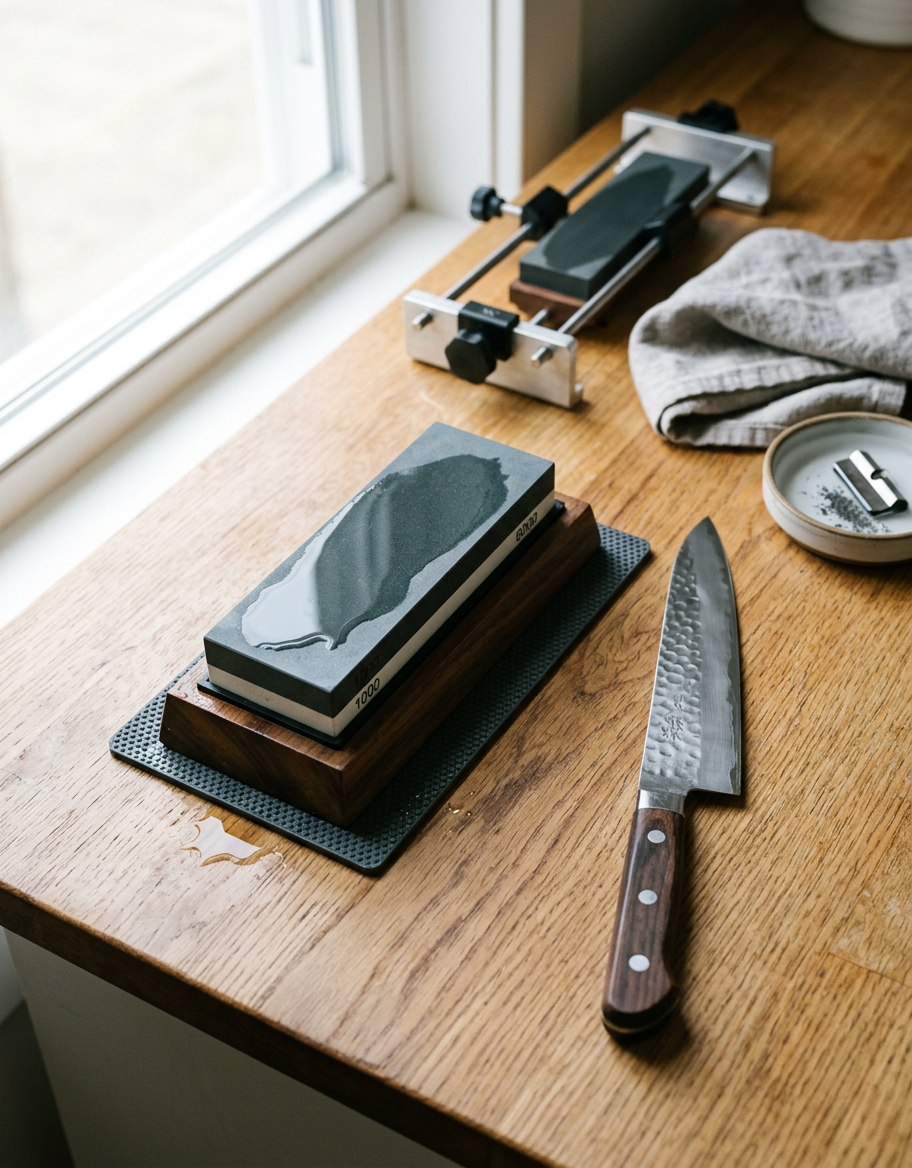
AI-generated editorial illustration; not a product or test photograph.
Short answer
The best knife sharpener for most home kitchens is a 1000/6000 combination whetstone, specifically the Amazon Basics Double-Sided 1000/6000 Grit Stone at $22.90. It covers routine sharpening and fine edge refinement in one tool. If holding a freehand angle is your biggest obstacle, choose the $69.95 Work Sharp Precision Adjust guided system instead.
5
Product listings discussed; not hands-on tests
5/5
Discussed listings with a recorded price
$22.90–$129.95
Recorded listing price range; not a complete setup cost
Key takeaways
A 1000/6000 stone covers routine sharpening and fine finishing for nearly every standard kitchen knife.
The Amazon Basics 1000/6000 stone is our best-value pick because it follows that useful grit progression at $22.90 and includes a base and angle guide.
Guided systems such as the Work Sharp Precision Adjust are slower to set up but make bevel angles more repeatable for beginners.
A honing rod realigns a rolled edge; it does not create a new edge on a dull or chipped knife.
Choose a coarse 400-grit stage only when you need to repair chips, reshape a neglected edge, or remove substantial metal.
Products discussed in this article
Editorial scores and recorded prices are reference points, not measurements of suitability for every use. Read each review's specifications and limitations.
Work Sharp Precision Adjust Knife Sharpener Kit69.95 USD
Work Sharp Precision Adjust Elite Knife Sharpener129.95 USD
162N Double-sided Diamond Sharpening Stone, 8 in. x 369.99 USD
Best knife sharpeners compared
Product
Listed price
Sharpening format
Abrasive progression
Best for
Amazon Basics 1000/6000 Stone
$22.90
Double-sided waterstone
1000 / 6000 grit
Entry-level kitchen sharpening on a budget
Whetstone 1000/6000 Stone
$39.99
Double-sided corundum waterstone
1000 / 6000 grit
Standard two-sided freehand kitchen sharpening
Work Sharp Precision Adjust
$69.95
Fixed-angle clamp-and-rod system
320 / 600 diamond; fine ceramic
Beginners wanting repeatable edge angles
Work Sharp Precision Adjust Elite
$129.95
Fixed-angle clamp-and-rod system
320 / 600 diamond; ceramic; leather strop
Controlled, highly refined edge profiling
Sharpal 162N Diamond Stone
$69.99
Double-sided diamond plate
325 / 1200 grit
High-hardness steels with zero stone maintenance
What is the best knife sharpener overall?
The Amazon Basics Double-Sided 1000/6000 Grit Whetstone is the best knife sharpener for most people because its grit pairing directly matches the practical needs of ordinary kitchen knives. The 1000-grit side restores a moderately dull edge and establishes an apex; the 6000-grit side refines that edge for clean slicing. At a listed $22.90, it is also notably less expensive than many complete sharpening systems.
This is a freehand waterstone, so it does require practice. The package includes a non-slip bamboo base, silicone holder, and clip-on angle guide, which provide a more approachable starting point than an unmounted stone. Its listed dimensions are 8.4 by 3.6 by 1.8 inches, and it weighs 952.54 grams. The abrasive mineral itself is not specified, so shoppers who require a particular stone composition should account for that unknown.
The important limitation is that no freehand stone makes angle control automatic. Use the guide as an initial reference, then develop consistent strokes and light pressure. For a full primer on choosing grits, stone types, and maintenance needs, see our knife sharpening buyer's guide and the dedicated Amazon Basics stone review.
A 4.5-star average from 1,575 ratings supports its strong value position, but ratings do not replace matching the tool to your own knives and technique. If you want mechanically controlled angles rather than freehand practice, a guided sharpener is the better fit.
Choose a 1000/6000 combination stone if your knives are normally maintained rather than deeply chipped or severely blunt. This two-stage format is efficient: 1000 grit is the working sharpening stage, while 6000 grit is a fine finishing stage. It avoids buying and storing separate stones while still offering the progression most kitchen users need.
Our step-up pick is the Whetstone Knife Sharpener 1000/6000 Grit Sharpening Stone, listed at $39.99. It uses corundum and measures 7.25 by 2.25 by 1 inch. The kit includes a silicone sleeve, bamboo base, and angle guide. At 2.1 pounds, the assembled setup has useful mass for staying put on the counter. It has a 4.6-star rating from 25,664 reviews, the largest review count among our primary picks.
The trade-off versus the lower-priced Amazon Basics option is not simply sharpness: both have the same essential 1000/6000 sequence. The Whetstone kit's case is stronger if you prefer its listed corundum construction and substantially larger buyer-feedback record. Neither kit includes a flattening tool, however. Waterstones wear unevenly with use, so their surface eventually needs flattening to remain level.
Read our Whetstone 1000/6000 review for its full details, then use our guide to sharpening kitchen knives before your first session. Do not buy a 400/1000 stone as your only kitchen setup unless you specifically accept a more toothy, less refined finish or already own a fine stone.
For beginners who cannot yet hold a steady sharpening angle, a guided system can be better than a whetstone. It trades fast setup and unrestricted blade movement for repeatable bevel geometry. That trade is worthwhile early on because inconsistent freehand angles can round an edge rather than sharpen it.
The Work Sharp Precision Adjust Knife Sharpener Kit is our top guided choice at $69.95. Its clamp-and-rod design holds the blade while a guided Tri-Brasive unit moves across the edge. It offers 15- to 30-degree adjustments in 1-degree increments and includes 320-grit diamond, 600-grit diamond, and fine ceramic sharpening surfaces. The system is intended for kitchen and pocket knives and has a 4.5-star rating across 11,551 reviews.
This design is not necessarily quicker than a stone. You must position and clamp the knife, then work each side with the guide rod. Long kitchen knives can flex in the clamp, and they take more patience than smaller, stiffer knives. The finish also stops at fine ceramic rather than including a documented 6000-grit polishing stage.
For many first-time sharpeners, those compromises are reasonable. You gain a controlled angle setting rather than relying on muscle memory immediately. See the complete Work Sharp Precision Adjust review and our roundup of common knife-sharpening mistakes, especially before changing an existing factory bevel.
When is the Work Sharp Precision Adjust Elite worth it?
The Work Sharp Precision Adjust Elite is worth its $129.95 listed price for buyers who specifically want a guided, more complete progression with a finishing strop. It retains the controlled clamp-and-rod approach of the standard Precision Adjust but expands the abrasive and finishing selection. That makes it the stronger guided pick for someone who wants edge profiling and refined deburring in one self-contained desktop system.
The Elite adjusts continuously from 15 to 30 degrees and uses a rotating clamp so the knife can be turned without unclamping between sides. Its listed progression begins with 320-grit diamond for profiling, moves through 600-grit diamond and ceramic, and includes a leather strop. It also includes a conical ceramic rod intended for serration scallops. The 14-by-6.75-by-5-inch, 3-pound format is more substantial than the standard model's lightweight chassis.
It is not the automatic best choice for a casual cook. A $22.90 to $39.99 1000/6000 stone can cover normal kitchen sharpening for much less, provided you can learn freehand technique. The Elite's main advantage is repeatability and its broader integrated finishing setup, not a claim that every kitchen knife needs multiple guided abrasives or a highly polished edge.
Long chef knives still require patient repositioning, and buyers should follow exact-model instructions for clamping and abrasive use. Learn more in our Precision Adjust Elite review, or browse all knife sharpening reviews if you are comparing systems rather than committing to one workflow.
Should you choose a diamond plate instead of a waterstone?
Choose a diamond plate when you prioritize a flat surface, no soaking, and fast cutting on demanding steels. The Sharpal 162N Double-Sided Diamond Sharpening Stone is the best fit here among our reviewed options. Its 8-by-3-inch steel plate carries 325-grit coarse diamond on one side and 1200-grit extra-fine diamond on the other, and its monocrystalline diamond surface is listed as permanently flat rather than requiring stone flattening.
The listed price is $69.99. That is a meaningful premium over a combination waterstone, but it includes a storage case with a non-slip base and an angle guide. It can be used dry or with water, which simplifies preparation and cleanup compared with a soaking waterstone. The 325-grit side is particularly relevant for minor chips, substantial dullness, or bevel changes; it is more aggressive than what routine kitchen maintenance usually demands.
Its 1200-grit side leaves a working, toothy edge rather than providing the finer 6000-grit finish offered by our top whetstone picks. Therefore, it is not the most direct choice for a shopper seeking the classic 1000/6000 kitchen progression. It is a better specialist choice for users who value durability, flatness, and aggressive cutting.
Before choosing any abrasive, identify whether the knife is simply dull, chipped, or suffering from a rolled edge. Our knife sharpening FAQ explains those distinctions, and our buying tips can help place this higher-cost option in a realistic budget.
What is the difference between honing and sharpening?
Sharpening removes metal to form a new cutting apex. Honing primarily realigns an edge that has rolled slightly out of line during ordinary cutting. They are related maintenance tasks, but a honing rod is not a replacement for a whetstone, diamond plate, or guided sharpener when a knife is truly dull, chipped, or damaged.
That distinction matters when shopping. A smooth or fine steel honing rod can be useful for suitable knives between full sharpening sessions, but it cannot restore a worn bevel. Conversely, a diamond-coated rod is abrasive and removes metal, so it acts as a sharpening tool rather than a traditional alignment steel. Do not assume that every knife needs a honing rod, either: blade steel, hardness, edge condition, and the manufacturer's guidance all matter.
For routine use, avoid treating aggressive abrasives as daily maintenance. Repeated unnecessary sharpening shortens the useful life of a blade because every sharpening session removes steel. Start by inspecting the edge and using the least aggressive tool that addresses the problem. A knife that still cuts poorly after careful honing usually needs actual sharpening; a chipped or severely blunt edge may require a coarse stage before 1000 grit.
Technique also matters for safety. Work on a stable surface, use controlled strokes, keep hands clear of the edge path, and follow the sharpener manufacturer's exact instructions. For rod technique and limitations, read how to use a honing rod. When in doubt, consult our best knife sharpeners overview before buying an accessory that does not solve your problem.
Quick checklist
Decide whether the knife is dull, chipped, or merely has a rolled edge.
Choose a 1000/6000 stone for routine kitchen sharpening and fine finishing.
Choose a guided system if repeatable angles matter more than setup speed.
Add a coarse stage only if you need edge repair or significant reprofiling.
Confirm the sharpener suits your knife length, stiffness, and manufacturer guidance.
Plan for flattening if you buy a waterstone without a flattening tool.
Use a stable counter setup and keep fingers away from the edge path.
Frequently asked questions
What grit knife sharpener is best for kitchen knives?
For most kitchen knives, a 1000/6000 combination is the most useful all-around grit pairing. The 1000-grit side restores a working edge on a moderately dull knife, while 6000 grit refines the edge afterward. A coarser 400-grit stage is best reserved for chip repair, serious dullness, or reshaping rather than routine maintenance.
Are whetstones better than pull-through knife sharpeners?
Whetstones generally offer more control over the edge and allow a useful progression such as 1000/6000 grit, but they require freehand angle discipline. Pull-through sharpeners prioritize convenience and fixed geometry, yet abrasive carbide stages can remove steel aggressively. For repeatable angles without freehand practice, a clamp-and-rod guided system is a more controlled alternative.
Is the Work Sharp Precision Adjust good for kitchen knives?
Yes, the Work Sharp Precision Adjust is designed for kitchen and pocket knives and is especially useful for beginners who want controlled, repeatable angles. It adjusts from 15 to 30 degrees in 1-degree increments and includes 320-grit diamond, 600-grit diamond, and fine ceramic surfaces. Long or flexible kitchen blades may take more patience in its clamp.
Do I need a honing rod if I own a whetstone?
Not necessarily. A honing rod can be useful for realigning a rolled edge between sharpening sessions on compatible knives, but it does not replace a whetstone when the knife is dull. Whether to use one depends on your blade steel, edge condition, and manufacturer guidance. Avoid assuming that every knife benefits from the same rod.
How often should kitchen knives be sharpened?
Sharpen when cutting performance shows that the edge is no longer doing its job, rather than following an arbitrary schedule. Frequent unnecessary sharpening removes steel. A knife with slight edge rolling may respond to appropriate honing, while a dull knife needs abrasive sharpening. Chips and substantial damage may require a coarser repair stage before normal sharpening.
Do waterstones need to be flattened?
Yes, waterstones can wear unevenly and develop a hollow, commonly called dishing. A flat surface helps you sharpen consistently, so inspect the stone periodically and flatten it when necessary. The Amazon Basics and Whetstone 1000/6000 kits do not include a flattening tool, while some larger bundled kits do. Follow the exact stone maker's maintenance guidance.
Amazon links are affiliate links; we may earn a commission at no cost to you.
Sources and limits
This page summarizes our research reviews of Amazon listings, listed specifications and captured buyer ratings. It is not a hands-on test. Scores are editorial assessments, not measured performance; prices are recorded snapshots and may change. A category can include both main products and accessories, so its overall price range is not the cost of a complete setup.
Most recent product record update: September 28, 2026. Individual records may be older; this is not a verification date for every claim.
Choose the product type first. These groups require a match in the listing title; an import search term alone is not enough. Scores rank our recorded research assessments within each group, not independently measured performance.
A 1000/6000 combination stone covers almost every kitchen need.
Guided systems trade speed for repeatable angles — worth it early on.
Honing and sharpening serve different purposes; follow guidance for your blade steel and edge rather than assuming every knife needs a honing rod.
If a specification, certification or compatibility detail is absent, mark it as unknown and ask the seller or manufacturer. Do not substitute a star rating, an editorial score or a different model's specification.


 Whetstone Knife Sharpening Stone, Double-Sided 1000/6000 Grit with Angle Guide, Non-Slip