How to sharpen kitchen knives
Sharpen kitchen knives by working a consistent bevel on a 1000-grit stone, refining it on a 6000-grit surface, and removing the burr before use.
Research-based article drawn from our 30 knife sharpening reviews. Updated September 2026.
Short answer
To sharpen kitchen knives, secure a sharpening stone, prepare it according to its manual, and work each bevel at the knife maker’s recommended angle. Start with 1000 grit, raise a small burr along the edge, then sharpen the other side. Refine on 6000 grit and remove the burr with light alternating strokes. Honing maintains an edge between sharpening sessions; it does not replace sharpening.
Our picks for “how to sharpen kitchen knives”
- 1
 Whetstone Knife Sharpener – 1000/6000 Grit Sharpening Stone4.6$39.99Our score 8.1/10
 - 2
 Work Sharp Precision Adjust Knife Sharpener Kit - Fixed Angle Sharpening System for Kitchen & Pocket Knives - Professional Guided Knife Sharpening Tool4.5$69.95Our score 8.1/10
 - 3
 KW65 1000/6000 Grit Combination Whetstone with Plastic Base4.6$28.20Our score 7.9/10
 - 4
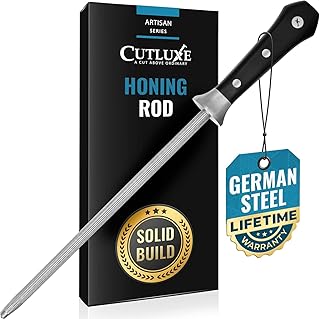 Cutluxe Honing Rod, 10" Knife Sharpener Steel – Honing Steel for Knives4.7GBP 22.27Our score 8.4/10
Choose the right method before you start
For routine kitchen sharpening, a 1000/6000 combination stone covers almost every need: the medium side establishes the edge, and the fine side refines it. This walkthrough is for ordinary double-bevel steel kitchen knives. Check your knife’s manual before working on serrated, ceramic, or single-bevel blades, which require different methods or equipment. Significant chips or a broken tip are good reasons to consult a professional.
Sharpening removes metal to create a fresh edge. Honing with a steel rod straightens a rolled edge rather than rebuilding a worn bevel. You need both sharpening and appropriate between-session maintenance, but check whether your knife maker recommends a steel rod for your blade.
Choose a bench stone if you want a straightforward kitchen setup and are willing to practice holding an angle. A guided system trades speed for repeatable angles, which can be worthwhile early on. Neither method benefits from rushing or heavy pressure.
Set up the stone and establish your angle
Start with a clean knife, good lighting, and a stable work surface. Secure the stone in a nonslip holder or on a damp towel so it cannot slide. Keep your fingers clear of the cutting edge and leave enough space to move the blade without striking nearby objects.
Read the stone’s instructions before adding water. Some water stones need soaking; others need only a splash. Do not assume one soaking time applies to every model, and do not add oil unless the manufacturer specifies it. The Shapton K0702 Blade, #1000, Medium, Orange is a splash-and-go option whose storage case also works as a holder. It is a single-grit stone, not a complete 1000/6000 progression.
Use the knife maker’s recommended sharpening angle rather than imposing one angle on every blade. Raise the spine until the bevel rests against the stone, then maintain that position throughout each stroke. Consistency matters more than repeatedly changing your wrist position to chase an exact number.
Read the reviews: K0702 Blade
Sharpen, refine, and remove the burr
Begin on the 1000-grit surface for routine dullness. Holding the bevel steady, make controlled passes that cover the full cutting edge, from heel to tip. Follow the blade’s curve without rounding the tip. Use moderate pressure initially, keeping fingertips on the blade face safely above the edge.
Work until a small burr forms along the opposite side. This is a thin lip of metal at the edge. Check cautiously by moving a fingertip from the blade face toward and just past the edge, never along it. Repeat on the other bevel until you have worked its full length. Do not rely on a fixed stroke count: different edges need different amounts of work.
Move to 6000 grit and repeat with lighter pressure, finishing with gentle alternating strokes to remove the burr. Wash and dry the knife, then test it with a controlled cut through food on a cutting board. If it still struggles, check for an incomplete edge or remaining burr rather than simply pressing harder.
Buy a simple setup and maintain it
The Sharp Pebble Whetstone Knife Sharpener – 1000/6000 Grit Sharpening Stone is a straightforward choice for this method. It combines sharpening and polishing surfaces, but you must supply a separate flattening tool. The King KW65 1000/6000 Grit Combination Whetstone with Plastic Base offers the same grit progression with an included plastic base; it lacks a coarse surface for chip repair.
If holding an angle proves frustrating, the Work Sharp Precision Adjust Knife Sharpener Kit offers clamp-and-rod angle repeatability. Its workflow is slower on long blades, and flexible kitchen knives can deflect under pressure. Follow the system’s manual for clamping, angle settings, and abrasive progression, using a light touch.
Between sharpening sessions, the Cutluxe Honing Rod, 10-inch, can realign rolled edges on suitable mid-hardness kitchen knives. It cannot restore worn-away bevels. For stone care, check flatness regularly and flatten according to the manufacturer’s instructions. Rinse away sharpening residue and let water stones dry thoroughly before storage. Check the manual for care requirements that differ by stone.
Read the reviews: Whetstone Knife Sharpener – 1000/6000 Grit Sharpening Stone, KW65 1000/6000 Grit Combination Whetstone with Plastic Base, Work Sharp Precision Adjust Knife Sharpener Kit, Cutluxe Honing Rod
Frequently asked
- What angle should I sharpen kitchen knives at?
- Use the angle recommended by your knife’s manufacturer; there is no single setting for every kitchen knife. Check whether a stated angle refers to each side or the total included angle. Maintaining the existing bevel consistently is generally a better starting point than attempting to change its geometry.
- How often should I sharpen my kitchen knives?
- Sharpen when cutting performance remains poor after appropriate honing, rather than following a rigid calendar. Frequency depends on use, cutting surfaces, and the blade. A knife that slips on food skins or needs increasing pressure deserves attention. Check the knife’s manual for maintenance advice, especially before using a steel honing rod.
- Do I need to soak a sharpening stone?
- Only soak a stone if its manufacturer instructs you to. Some water stones require soaking, while splash-and-go stones need water on the surface without a full soak. Other abrasive systems have different lubrication requirements. Check your specific stone’s manual for preparation, water use during sharpening, and drying instructions.
- How do I use a honing steel safely?
- Place the rod tip on a stable, nonslip surface and hold it vertically, keeping your hand behind the guard. Draw the blade down and across the rod from heel to tip with light pressure, alternating sides. Use your knife maker’s recommended angle and confirm that a steel rod suits the blade.