Design and build
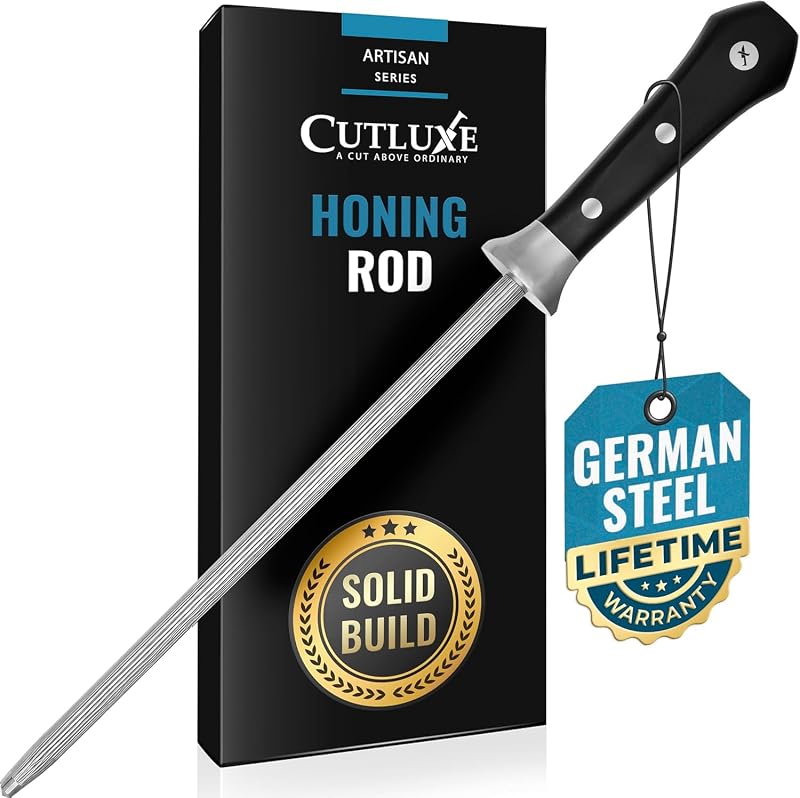
The Cutluxe Artisan Series ART-HON-10-1 relies on a conventional configuration: an extra-fine high carbon stainless steel rod mated to a contoured Pakkawood handle. At a total weight of 16 ounces, the tool has enough mass to sit comfortably in the hand during downward strokes. The rod surface features an extra-fine texture intended to push deformed edge metal back into alignment without unnecessarily stripping away blade stock. Measuring 10 inches along the usable steel, it provides sufficient clearance for smooth, unhurried passes with standard kitchen cutlery. The handle is symmetrical, catering equally to right- and left-handed grips, while a basic steel bolster separates the fingers from the active working surface. Cutluxe specifies rust and corrosion resistance through the high carbon stainless formulation, accompanied by a lifetime warranty covering material and workmanship defects. The build quality avoids ornamental excess, focusing strictly on balanced balance and steady manipulation on the cutting station.
Real-world performance
Evaluating a honing rod requires distinguishing edge realignment from material abrasion. The Cutluxe tool does not apex a bevel or create a new cutting edge; rather, it straightens microscopic roll caused by impact against cutting boards. In practical use, the 10-inch length allows complete heel-to-tip passes for knives up to eight inches long without running out of stroke travel. The extra-fine grit engages the micro-bevel evenly, providing tactile feedback that lets the user regulate pressure across the stroke. Maintaining consistent manual angles remains the responsibility of the operator, as this rod lacks mechanical angle guides. When applied regularly before prep work, the rod restores smooth push-cutting performance on working knives. However, heavily blunted or chipped blades will show zero improvement here, as proper edge restoration demands an abrasive 1000-grit bench stone or guided fixture to cut away fatigued metal.
Value for money
Retailing at $29.99, this honing steel sits firmly in the accessible utility tier of cutlery care tools. The price point is supported by solid fundamentals: a dense Pakkawood handle, resilient high carbon stainless steel, and a respectable aggregate rating of 4.7 out of 5 across more than 1,340 consumer reviews. While bare-bones utilitarian steels can be found at lower prices, Cutluxe offers a more substantial 16-ounce heft and an ergonomic profile that feels balanced during daily kitchen prep. The inclusion of a lifetime warranty against manufacturing defects adds commercial reassurance for domestic cooks. Given that regular honing extends the functional lifespan of any kitchen knife edge between stone sharpenings, the modest acquisition cost amortises readily across years of culinary upkeep. It represents a sensible investment for anyone needing to maintain everyday Western-style stainless kitchen cutlery without overspending.
Who should skip it
Cooks expecting this tool to restore a neglected, blunt knife should look elsewhere. Honing is not sharpening; if a blade will not slice through soft produce, an abrasive 1000/6000 combination water stone or a guided sharpening kit is mandatory to grind a fresh apex. Furthermore, owners of high-hardness Japanese knives—such as those forged from VG-10, SG2, or high-carbon white and blue paper steels exceeding 60 HRC—should approach this tool with caution. Hard, brittle edges are prone to micro-chipping against grooved steel rods, making smooth ceramic rods a safer choice for realignment. Finally, cooks working primarily with oversized 10- or 12-inch slicing and butcher knives may find the 10-inch rod restrictive, as efficient technique calls for a rod length equal to or greater than the knife blade. Buyers should measure their longest blades before committing.