Design and build
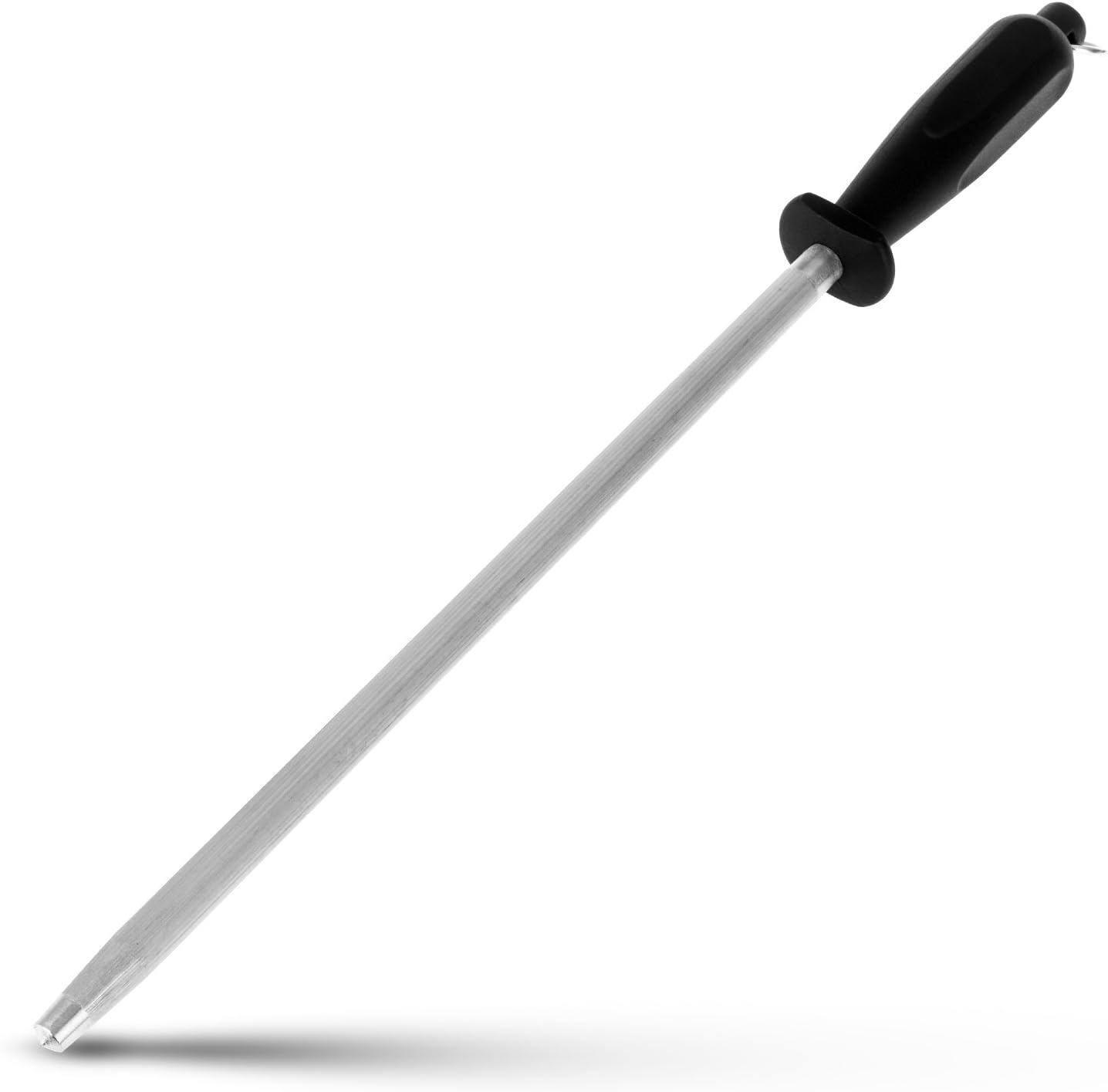
The ALLWIN-HOUSEWARE W honing rod is constructed around a carbon steel core finished with a brushed nickel-chrome plating. A critical point of friction in the product documentation is dimensional accuracy: while the product title designates this as a 12-inch tool, the specification sheet lists the size at 10 inches. Buyers handling long slicing blades should verify whether the working rod itself or the overall package measures the stated 12 inches. Mechanically, the tool incorporates a magnetized rod surface designed to attract microscopic steel particulate stripped during alignment. The black handle uses a textured surface to maintain purchase when hands are damp, terminating in an integrated hanging loop for commercial or wall storage. At the opposite end, a metal anti-slip tip permits the user to brace the rod vertically against a wooden cutting board, establishing a stable foundation to control edge angles during maintenance.
Real-world performance
Understanding this tool requires distinguishing honing from sharpening. The fine carbon steel surface removes negligible material; instead, it straightens the microscopic apex of a blade that has rolled over through prep work. On standard Western-style chef knives fabricated from moderately soft stainless steels, a dozen light, alternating passes against the rod quickly restore cutting ease across produce and proteins. The brushed surface provides uniform contact without aggressive gouging. However, the magnetized rod requires diligent cleaning; loose metal dust collects on the shaft and should be wiped clean with a dry cloth to prevent micro-scratching subsequent edges. For ultra-hard Japanese steels exceeding 60 HRC, this steel offers limited utility and risks micro-chipping the brittle edge. Within its intended context of everyday kitchen maintenance, the rod delivers predictable realignment when operated with consistent wrist angles.
Value for money
Priced at $14.99 with over 10,000 recorded consumer ratings averaging 4.5 out of 5, this honing steel occupies the lower tier of maintenance gear without presenting glaring functional flaws. Honing rods do not require exotic materials to perform plastic deformation on ductile steel edges, meaning expensive brand-name alternatives often offer marginal practical gains for typical home cooks. The unit includes functional features usually absent on baseline budget rods, notably the metal tip for vertical orientation and a magnetized core to contain swarf. When paired with an abrasive sharpening setup, such as a standard 1000/6000 grit waterstone or a basic guided system, this rod prolongs the working interval between abrasive reprofiling cycles. Provided the user treats it as a non-abrasive maintenance tool rather than a metal-cutting stone, the $14.99 expenditure represents an efficient allocation of kitchen maintenance capital.
Who should skip it
Prospective buyers managing genuinely dull, neglected, or chipped knives must bypass this rod until they acquire dedicated sharpening abrasives. Because this carbon steel rod merely burnishes and straightens existing geometry, running a completely blunt edge over it will yield no improvement in cutting performance. Cooks operating primarily with Japanese cutlery hardened beyond 60 Rockwell C should also skip this tool; hard, brittle steels require high-grit ceramic rods or synthetic waterstones to avoid edge fracture. Furthermore, cooks who frequently use 10-inch or 12-inch chef knives and long brisket slicers may find the potential 10-inch working length restrictive for full, single-stroke draws. Finally, individuals seeking a complete sharpening system should remember our buying rules: a 1000/6000 combination stone covers primary apex creation, while a honing steel serves only as intermediate daily maintenance.