Design and build
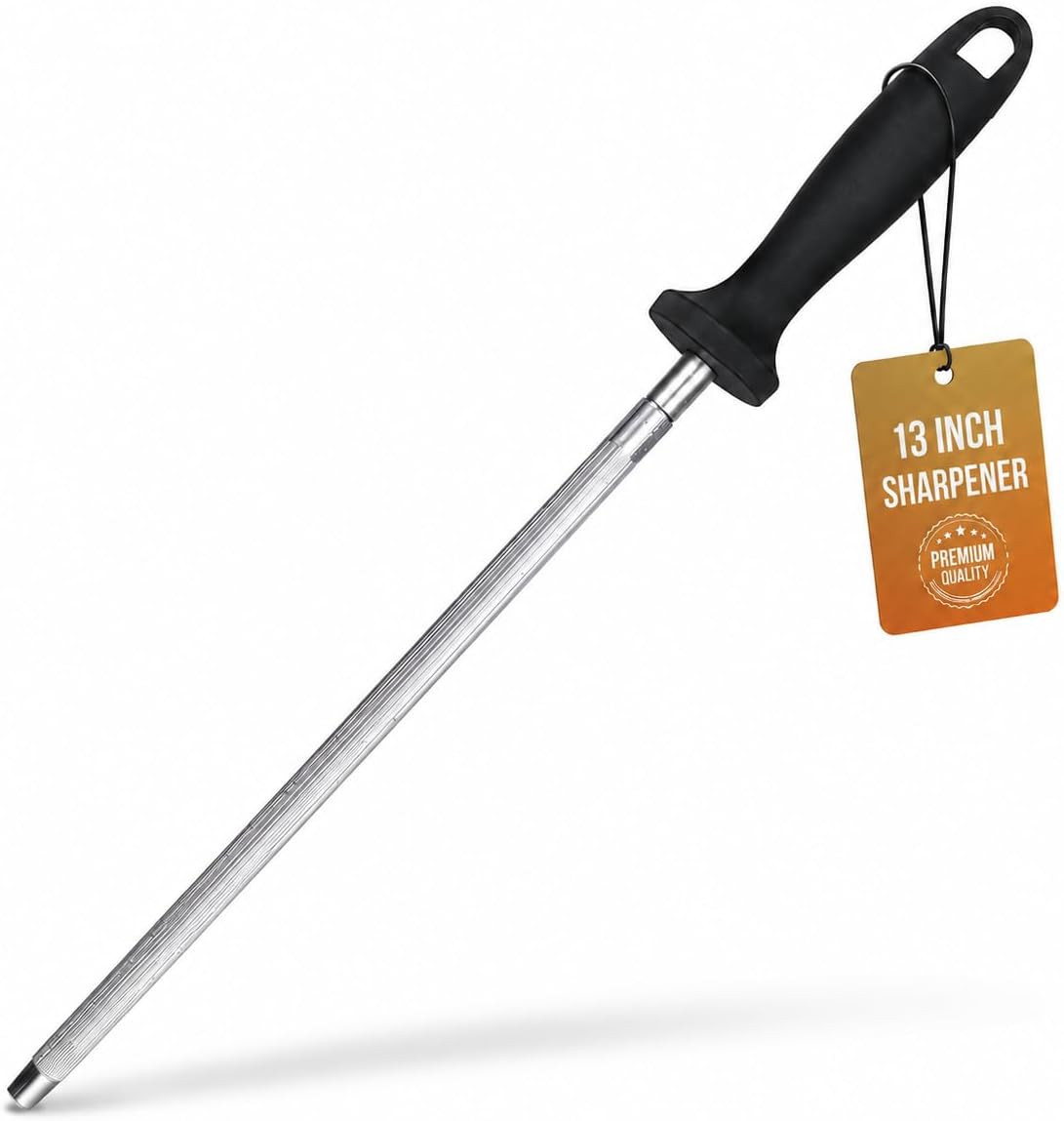
The FANERFUN model MD is designated as a 13-inch tool, though prospective buyers should note discrepancies in the official specification sheet, which erroneously lists dimensions of 1 by 1 by 1 inches. At a total weight of 3.2 ounces, the rod is notably lightweight for carbon steel hardware, reflecting a hollow plastic handle assembly and a relatively narrow core. The rod surface exhibits an ultra-fine longitudinal ribbing designed to grip and re-center folded steel at the blade edge. A metal hanging ring at the base of the handle accommodates hook storage near kitchen prep stations. While carbon steel provides standard serviceability for regular domestic cutlery, the manufacturer does not disclose the specific alloy or Rockwell hardness rating. Buyers must exercise care regarding exposure to moisture, as unplated carbon steel remains susceptible to surface corrosion if stored wet.
Real-world performance
In culinary tool maintenance, honing must never be conflated with sharpening. This rod removes negligible steel; instead, its textured surface acts to straighten microscopic teeth that have rolled off-center during board contact. When applied to standard German or entry-level Western cutlery, light and steady passes restore practical cutting bite cleanly. However, because it lacks mechanical angle aids, execution depends entirely on user discipline. Achieving repeatable 15- to 20-degree strokes requires a steady hand, and the low 3.2-ounce weight provides minimal mass to counterbalance blade pressure. On dull, heavily worn, or chipped knives, this tool produces no measurable cutting improvement. Similarly, high-hardness knives treated beyond 60 HRC will not respond predictably to micro-ribbed carbon steel and are better serviced via dedicated ceramic rods or fine abrasive benchstones.
Value for money
Priced at GBP 3.79, the FANERFUN honing steel sits at the absolute baseline of manual kitchen tools. Supported by a 4.4 out of 5 rating across more than 3,500 reviews, it performs the fundamental task of edge straightening without pretense. It is not an alternative to an abrasive benchstone, such as a 1000/6000 combination waterstone, nor can it match the repeatable geometry delivered by a guided sharpening rig. Nevertheless, culinary hygiene demands regular edge realignment between actual abrasive grindings to prevent premature edge destruction. At this sub-four-pound cost, the rod provides an inexpensive way to establish basic honing habits without committing substantial capital. Provided the user owns appropriate primary sharpening gear, this rod is an economical addition to a kitchen setup for routine daily upkeep.
Who should skip it
Buyers seeking to repair dull, rounded, or visibly chipped edges should skip this product entirely, as a honing rod cannot grind away steel to establish a fresh apex. Knife owners working with high-hardness Japanese cutlery—often heat-treated beyond 60 HRC—should also look elsewhere. Such brittle alloys risk micro-chipping against grooved carbon steel and respond better to ultra-fine ceramic rods or waterstones. Furthermore, cooks who struggle with manual angle consistency will find no mechanical assistance here; poor technique will round over an edge rather than straighten it. Those starting knife care from scratch should prioritize a dual-grit 1000/6000 stone for genuine edge creation or a guided system for repeatable angles before adding an unguided, lightweight steel to their collection.