How to use a honing rod
To use a honing rod, hold it vertically on a stable, nonslip surface and draw each side of the knife down it at the blade’s recommended angle, using light pressure.
Research-based article drawn from our 30 knife sharpening reviews. Updated September 2026.
Short answer
Hold the honing rod vertically with its tip secured on a nonslip surface and your fingers behind the handle guard. Set the knife against it at the angle recommended in your knife’s manual. Slowly sweep the blade down and across the rod, from heel to tip, alternating sides with light pressure. Honing maintains an existing edge; it does not replace sharpening.
Our picks for “how to use a knife sharpener rod”
- 1
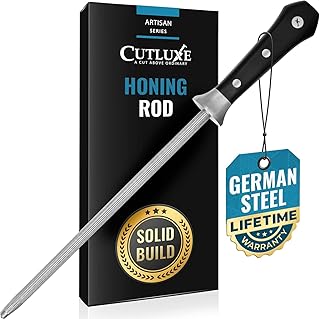 Cutluxe Honing Rod, 10" Knife Sharpener Steel – Honing Steel for Knives4.7GBP 22.27Our score 8.4/10
 - 2
 WÜSTHOF 9" Honing Steel4.7GBP 25.99Our score 7.8/10
 - 3
 Whetstone Knife Sharpener – 1000/6000 Grit Sharpening Stone4.6$39.99Our score 8.1/10
 - 4
 Work Sharp Precision Adjust Knife Sharpener Kit - Fixed Angle Sharpening System for Kitchen & Pocket Knives - Professional Guided Knife Sharpening Tool4.5$69.95Our score 8.1/10
First, check whether your rod hones or sharpens
A tool sold as a “knife sharpener rod” may be a steel honing rod or an abrasive sharpening rod. The distinction matters: a conventional steel rod primarily corrects a rolled edge, while ceramic and diamond abrasive rods can remove metal. Check the rod’s manual to identify its intended use and confirm that it suits your knife.
Honing is maintenance between sharpening sessions. It can help an otherwise sound edge that has rolled slightly, but it cannot rebuild a worn-away bevel or repair a chip. Sharpening removes material to establish an edge again. You need both functions in a complete maintenance routine, although the appropriate tools depend on the knife.
The Cutluxe Honing Rod is a dedicated 10-inch steel rod intended for regular maintenance of mid-hardness kitchen knives. Its protective bolster and comfortable handle are useful features, but technique still matters: pressing harder will not turn it into a tool for restoring a dull or damaged blade.
Read the reviews: Cutluxe Honing Rod
How to use a honing rod, step by step
Start with a clean knife and a clear work area. Place a folded, damp towel on a stable counter, then set the rod’s tip on it. Hold the rod upright, keeping the fingers of your holding hand behind its guard. This supported position makes slow, controlled strokes easier than working in midair.
Place the heel of the blade against the upper part of the rod, below the guard. Set the angle between the blade’s side and the rod according to your knife’s manual. Keep your wrist steady rather than changing the angle during the stroke.
Draw the knife downward while pulling it across the rod so contact travels from heel to tip. Keep the edge facing the direction of the downward stroke, and stop before the knife reaches the counter. Repeat on the opposite side of the blade.
Alternate sides using light pressure for a few controlled passes. Clean and dry the knife before cutting food. Follow the rod’s manual for its own cleaning and storage requirements.
Keep the angle steady and avoid forcing the edge
Consistency matters more than speed. Use the knife maker’s recommended honing angle rather than assuming every kitchen blade needs the same one. For knives with asymmetric or single-bevel edges, check the manual before using the alternating-side method. Also confirm compatibility before using a steel rod on particularly hard or thin-edged knives.
Use only light pressure. Do not strike the rod, saw back and forth, or imitate rapid airborne strokes. If a few careful passes do not improve cutting, stop and reassess rather than increasing force or continuing indefinitely. A worn edge needs sharpening, not more aggressive honing.
Rod length also affects how comfortably you can complete a heel-to-tip stroke. The WÜSTHOF 9-inch Honing Steel suits standard Western kitchen knives of moderate hardness, but its stroke is cramped for chef knives longer than 8 inches. The Cutluxe offers 10 inches of reach for common cutlery. Neither length removes the need to work slowly and keep the blade clear of your hands and countertop.
Read the reviews: WÜSTHOF 9" Honing Steel, Cutluxe Honing Rod
When honing is not enough, use a sharpening tool
After honing, assess the knife with a controlled cut through food on a cutting board. Do not run a finger along the edge. If the knife still slips on tomato skin or requires excessive force, it may need sharpening. Visible chips are another reason to stop relying on a honing rod.
For routine kitchen sharpening, a 1000/6000 combination stone covers almost every need. The Sharp Pebble Whetstone Knife Sharpener – 1000/6000 Grit Sharpening Stone pairs a 1000-grit side for establishing the edge with a 6000-grit side for polishing. It requires freehand angle control and separate flattening maintenance; no conditioning stone is included. Check its instructions for preparation and care.
If holding an angle is the main obstacle, the Work Sharp Precision Adjust Knife Sharpener Kit trades speed for repeatable angles. That trade can be worthwhile early on, although long blades take more time and flexible kitchen knives can deflect in the clamp. Use a light touch. Choose a sharpening tool to restore the edge, then use a compatible honing rod for maintenance between sessions.
Read the reviews: Whetstone Knife Sharpener – 1000/6000 Grit Sharpening Stone, Work Sharp Precision Adjust Knife Sharpener Kit
Frequently asked
- What angle should I hold my knife at on a honing rod?
- Use the honing angle recommended by your knife manufacturer; there is no single setting suitable for every blade. The relevant angle is between the blade’s side and the rod. Keep it consistent throughout the stroke, and check the manual for knives with asymmetric or single-bevel edges.
- How many times should I run a knife along a honing rod?
- Begin with a few light, controlled passes, alternating sides, then assess cutting performance. A fixed stroke count is less useful than a steady angle and gentle pressure. Follow any model-specific instructions. If cutting does not improve, stop rather than pressing harder; the edge may need sharpening instead.
- How often should I hone my kitchen knife?
- Hone as needed when cutting performance begins to decline slightly, provided the knife manufacturer recommends using a rod. Frequency depends on use and the blade, so avoid treating a calendar schedule as a requirement. If honing no longer helps, sharpening is the next step rather than increasingly frequent honing.
- Can a honing rod sharpen a very dull knife?
- A conventional steel honing rod cannot restore a worn-away bevel or repair chips. It maintains an existing edge by correcting rolling. Ceramic or diamond abrasive rods can remove metal, so check which type you own. For a genuinely dull knife, use an appropriate sharpening stone or guided sharpening system.