Fixed Angle Knife Sharpener vs Whetstone for Beginners
Compare fixed angle systems and traditional whetstones to discover which tool delivers better edge control, learning speed, and value for your cutlery.
By the Niche Picks editorsUpdated October 18, 20269 min readDrawn from our 30 research-based knife sharpening reviews
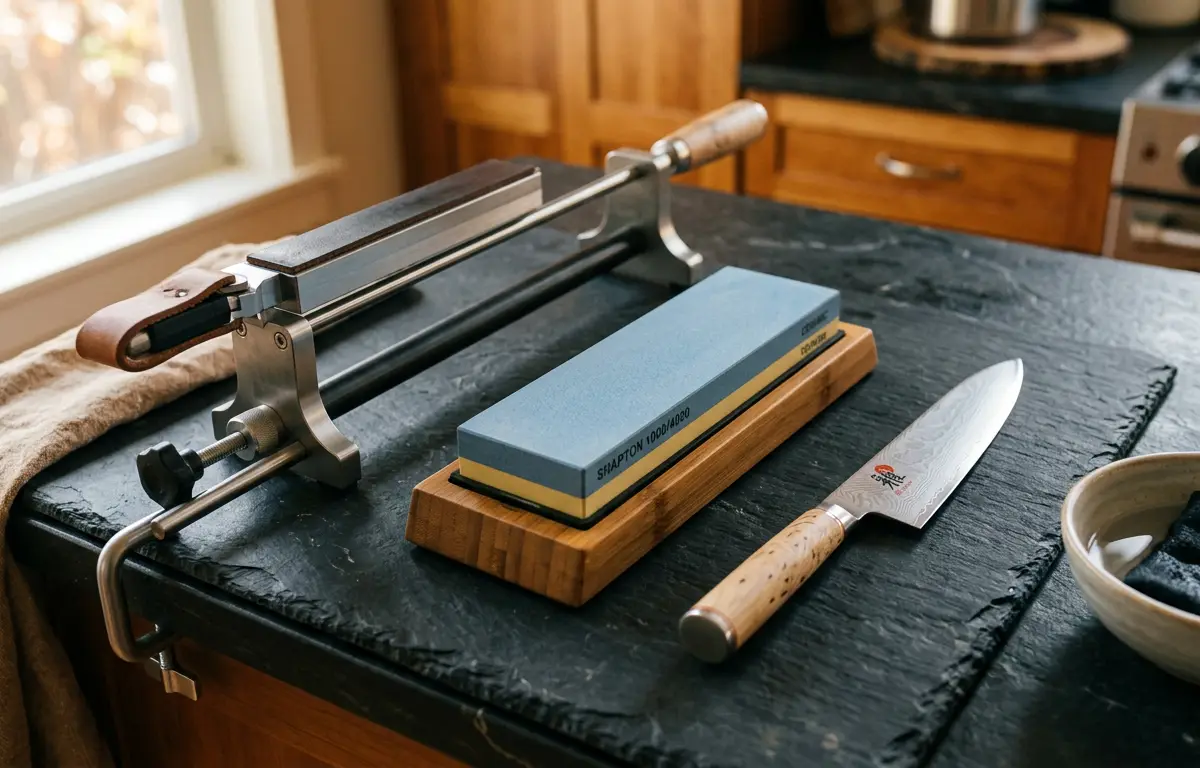
AI-generated editorial illustration; not a product or test photograph.
Short answer
For beginners, fixed angle sharpeners offer immediate success because guided systems trade speed for repeatable angles, eliminating freehand bevel guesswork. Conversely, a traditional whetstone requires manual angle discipline and practice, yet a 1000/6000 combination stone covers almost every kitchen need at a lower cost while servicing knives of any length without clamping restrictions.
5
Product listings discussed; not hands-on tests
5/5
Discussed listings with a recorded price
$22.90–$129.95
Recorded listing price range; not a complete setup cost
Key takeaways
Guided fixed angle systems mechanically enforce exact bevel angles from 15 to 30 degrees, preventing novice edge-rounding errors.
A standard 1000/6000 combination waterstone covers almost every kitchen task by providing an apex-setting face and a fine polishing surface.
Clamp-based guided rigs ensure symmetrical edges but require slower setups and can struggle with long or flexible chef knives.
Honing and sharpening serve different purposes; follow guidance for your blade steel rather than assuming every knife needs a rod.
Novices wanting foolproof, razor-consistent bevels immediately should choose a guided system, while patient cooks learn stones for lifelong versatility.
Products discussed in this article
Editorial scores and recorded prices are reference points, not measurements of suitability for every use. Read each review's specifications and limitations.
Comparison of Featured Fixed Angle Systems and Combination Whetstones
Product
Type
Price
Abrasive Range
Best For
Work Sharp Precision Adjust
Fixed Angle Guided Rig
$69.95
320 Diamond / 600 Diamond / Fine Ceramic
Beginners wanting repeatable edge angles
Work Sharp Precision Adjust Elite
Fixed Angle Guided Rig
$129.95
Diamond plates, ceramic, leather strop
Controlled, highly refined edge profiling
Lansky Deluxe System (LKCLX)
Fixed Angle Guided Rig
$42.76
70 / 120 / 280 / 600 / 1,000 Grit
Beginners seeking repeatable angles on small knives
Whetstone 1000/6000 Combination
Water Whetstone
$39.99
1000 Grit Medium / 6000 Grit Fine Polish
Standard two-sided freehand kitchen sharpening
Amazon Basics 1000/6000 Stone
Water Whetstone
$22.90
1000 Grit Medium / 6000 Grit Fine Polish
Entry-level kitchen sharpening on a budget
How Do Fixed Angle Sharpeners and Whetstones Actually Work?
Understanding the fundamental mechanics of knife sharpening begins with recognizing that establishing a sharp edge requires removing steel to apex two bevel faces symmetrically. Both fixed angle sharpeners and whetstones accomplish material abrasion, but they approach geometric control from opposite philosophies.
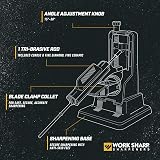
A fixed angle sharpener secures the blade spine in a mechanical clamp or vise and mounts abrasive stones to a rigid guide rod. By anchoring the abrasive carriage to an indexed chassis, the system enforces a strict geometric plane across every stroke. Systems such as the Work Sharp Precision Adjust provide a threaded collar adjustable in 1-degree increments from 15 to 30 degrees. This design ensures that every pass across the secondary bevel strikes the identical plane, eliminating human hand wobble and inadvertent edge rounding.
In contrast, bench stones represent freehand manual abrasion. A synthetic waterstone—such as the corundum blocks found in our guide to knife sharpening—sits statically on a countertop inside a non-slip silicone sleeve or bamboo base. The user holds the knife in both hands, setting and holding the tilt angle purely through wrist discipline and visual feedback while drawing the blade across the wet slurry. A standard combination stone pairs a 1000-grit shaping side to set a clean apex with a 6000-grit surface to polish and deburr. While stones allow fluid heel-to-tip passes along sweeping blade bellies, maintaining a consistent 15- or 20-degree incline requires practice and muscle memory that many beginners find intimidating.
Why Guided Systems Trade Speed for Repeatable Angles
The primary selling point of guided platforms is mechanical repeatability. For inexperienced users, the single most common failure point when working an edge is an unstable wrist. Rocking the knife up and down during a stroke convexifies the bevel, creating a blunted micro-radius instead of a crisp, acute cutting apex. Guided systems eliminate this failure mode entirely.
Guided systems trade speed for repeatable angles, which is well worth it early on for beginners seeking dependable results on pocket knives or everyday kitchen blades. On the Work Sharp Precision Adjust, you clamp the blade once, dial in your target angle, and sweep the integrated Tri-Brasive carrier—housing 320-grit diamond, 600-grit diamond, and fine ceramic surfaces—across the bevel. The rotating clamp mechanism indexes 180 degrees without unclamping, ensuring identical bilateral angles.
Similarly, the Lansky Deluxe System utilizes a multi-angle clamp with pre-machined guide holes to dictate the sharpening plane across five individual stones ranging from 70 to 1,000 grit. However, this repeatability comes at the expense of operational speed. Clamping the blade, squaring the spine, lubricating the hones, and repositioning guide rods requires noticeable assembly time. Furthermore, long slicing knives or flexible eight-inch chef blades can deflect under downward pressure at the tip, requiring careful blade support or unclamping and recentering the blade along different sections. For a wider perspective on guided options, consult our best knife sharpener overview.
Why a 1000/6000 Whetstone Covers Almost Every Kitchen Need
While mechanical rigs offer foolproof geometry, traditional bench stones remain the gold standard in commercial and home kitchens for overall versatility and blade accommodation. A 1000/6000 combination stone covers almost every kitchen need, offering a complete abrasive spectrum from functional sharpness to refined push-cutting polish.
Consider the classic Whetstone 1000/6000 Grit Stone, a dual-sided corundum block measuring 7.25 by 2.25 inches. The 1000-grit medium abrasive face cuts quickly enough to apex a moderately dull edge and establish a consistent burr without peeling away excess metal. Flipping the block reveals the 6000-grit fine polishing face, which strips the remaining micro-burr and refines the scratch pattern into a mirror-like edge ideal for push-cutting delicate vegetables and trimming proteins. A budget-friendly option like the Amazon Basics 1000/6000 Stone delivers that identical dual-grit ratio along with a silicone gasket and elevated bamboo platform.
Bench stones hold an undeniable physical advantage over clamped systems: they impose zero restrictions on blade length, thickness, or geometry. You can sharpen a tiny paring knife, an eight-inch Western chef knife, a flexible boning blade, or a heavy cleaver across the same unobstructed surface. Water stones produce an abrasive slurry that cuts smoothly across wide primary bevels. For beginners learning the motion, bundled clip-on plastic guides provide a physical reference angle on the spine, functioning as training wheels before transitioning to true freehand work. Explore our complete best whetstone guide to see how various stones perform.
Learning Curves Compared: Freehand Discipline vs Mechanical Setup
When evaluating the transition from dull cutlery to razor sharpness, the true divider between whetstones and guided rigs is the type of effort required from the operator.
With a whetstone, the challenge is physical discipline. Holding a blade at a consistent 15- or 20-degree angle requires stabilizing your wrists, applying light downward pressure, and matching blade curvature along the stroke. Novices frequently scratch blade faces by dropping the spine too low or blunt the apex by raising the angle too high. Mastering this motor skill generally demands several sessions of dedicated practice on inexpensive beaters before working on prized cutlery. However, once that muscle memory is established, sharpening on a stone is fast, rhythmic, and requires no mechanical assembly or teardown.
With a fixed angle system, the physical technique is trivial, but the operational barrier shifts to mechanical configuration. Securing a knife in a clamp requires centering the blade correctly to avoid asymmetrical edge angles. Users must ensure thumb screws are tight, the blade spine is parallel to the jaw line, and guide rods glide smoothly without binding. Upgraded platforms like the Work Sharp Precision Adjust Elite expand the abrasive selection with diamond plates, a ceramic rod, and a leather strop, but swapping and staging multiple components lengthens sharpening time compared to a simple bench block. For novice cooks who dread ruined bevels and want reliable factory edges on day one, trading setup time for foolproof repeatability is a sensible exchange.
Honing vs Sharpening: Distinguishing Steel Alignment from Metal Removal
A critical mistake novice sharpeners make is confusing daily edge maintenance with abrasive sharpening. Honing and sharpening serve completely different mechanical purposes, and you should follow specific guidance for your blade steel and edge profile rather than assuming every knife needs a honing rod.
Sharpening actively abrades steel away to create a new cutting apex. This is the explicit function performed by waterstones, diamond plates, and fixed angle abrasives. When an edge is worn flat or micro-chipped, only abrasive removal can re-establish sharp geometry.
Honing, by contrast, removes negligible metal. When you slice against a cutting board, ductile cutlery steel often rolls microscopically to one side without breaking off. A smooth or fine-grooved steel rod pushes that rolled metal back into vertical alignment, restoring cutting bite between full sharpening routines. However, not all knives tolerate steel rods. Traditional Western knives tempered between 56 and 58 HRC respond well to grooved steels, but harder Japanese culinary steels (often 60 to 65 HRC) are brittle and can chip or skid across a steel rod. On high-hardness steels, light passes across a fine 6000-grit whetstone or a leather strop serve as the proper maintenance method. Avoid confusing routine maintenance with true grinding by reviewing common sharpening mistakes.
Cost, Maintenance, and Long-Term Durability
Budget and ongoing maintenance requirements play a deciding role in choosing between these sharpening formats. A quality dual-grit waterstone represents an affordable, self-contained purchase. The Amazon Basics 1000/6000 Stone retails for $22.90, while the Whetstone 1000/6000 Kit sits at $39.99, bundling the stone, rubber collar, bamboo base, and an angle guide. Because waterstones operate solely with tap water, there are no ongoing fluid or consumable expenses.
However, waterstones wear unevenly. Softer corundum formulations shed abrasive to reveal fresh cutting edges, causing the center of the block to dish out over time. To maintain true planes, stones require periodic conditioning with a silicon carbide flattening plate. If your selected stone kit lacks a truing block, sourcing one adds a modest future cost.
Fixed angle sharpeners span a wider pricing spectrum. The base Work Sharp Precision Adjust lists at $69.95, while the abrasive-rich Precision Adjust Elite reaches $129.95. The compact Lansky Deluxe System lands in between at $42.76, providing five distinct alumina oxide and ceramic stones alongside specialized honing oil. Guided systems eliminate the need for flattening plates because their small diamond and ceramic stones resist dishing. However, they rely on moving mechanical parts—such as plastic chassis hinges, threaded collars, guide rods, and clamp pads—which can wear, bend, or require replacement after years of repetitive tension. Browse our full knife sharpening category for broader system pricing comparisons.
Choosing the right sharpener comes down to your cutlery inventory, your patience for learning technique, and the types of knives you maintain.
Choose a fixed angle sharpener if:
You want sharp, symmetrical bevels immediately without spending weeks practicing freehand stability.
You primarily sharpen pocket knives, hunting knives, or small-to-medium utility blades under seven inches.
You appreciate precise mechanical control and prefer dialing in documented degree angles (such as 15 degrees for kitchen knives and 20 degrees for outdoor blades).
You are willing to trade extra setup time for absolute angular consistency.
Choose a 1000/6000 combination whetstone if:
You primarily maintain eight-to-ten-inch chef knives, slicing blades, or flexible boning knives that flex or struggle in mechanical clamps.
You want a compact, self-contained sharpening station that requires no assembly, thumbscrews, or guide rods.
You want to master a traditional culinary skill that applies to any blade shape, regardless of thickness or geometry.
You want the lowest cost-to-performance ratio, obtaining coarse-to-polish capabilities for under $40.
Whichever path you select, mastering fundamental edge maintenance will transform your culinary prep and extend the working lifespan of every blade in your kitchen. To learn step-by-step techniques for using bench stones, read our walkthrough on how to sharpen kitchen knives or review our knife sharpening FAQ.
1Clean the blade thoroughly and color both secondary bevels with a dark permanent marker to track abrasive contact.
2Mount the blade securely in the clamp (if using a guided system) or soak your waterstone in tap water for 5 to 10 minutes.
3Select your target bevel angle: 15 to 17 degrees per side for Asian culinary cutlery, or 20 to 22 degrees for Western chef and outdoor blades.
4Begin sharpening on your medium abrasive (such as 1000 grit on a stone or 320/600 on a guided rig) with smooth, consistent passes.
5Work one side until you can feel a continuous microscopic burr raised along the entire opposite side of the cutting edge.
6Flip the blade (or rotate the guided indexing clamp) and repeat the identical stroke count to establish a symmetrical apex.
7Transition to the fine finishing abrasive (such as 6000 grit or fine ceramic) using light pressure to deburr and polish the edge.
8Test sharpness by cleanly slicing through folded paper or cleanly shaving produce without snagging.
Quick checklist
Identify your knife collection: measure blade lengths and identify flexible kitchen blades versus rigid pocket knives
Verify whether your cutlery steel responds best to 15-degree acute edges or durable 20-degree bevels
Determine whether you prefer mechanical clamp setup time or practicing manual angle discipline
Confirm that your stone selection includes both an apex-setting medium grit (around 1000) and a polishing grit (up to 6000)
Check if your sharpening setup includes a non-slip silicone holder or secure bench base
Inspect whether you need an auxiliary stone flattening plate to maintain flat waterstone surfaces
Distinguish between abrasive sharpening equipment and daily edge-realigning honing tools
Frequently asked questions
Can a beginner achieve razor sharpness faster with a fixed angle sharpener or a whetstone?
A beginner will achieve razor sharpness faster on a fixed angle sharpener. Guided systems mechanically lock in the bevel angle, preventing hand wobble and edge rounding. Whetstones require developing wrist discipline through practice before producing reliably consistent bevels.
Why is a 1000/6000 grit combination stone recommended for kitchen cutlery?
A 1000/6000 combination stone covers almost every kitchen need by balancing stock removal with edge refinement. The 1000-grit face repairs mild dullness and sets a clean apex, while the 6000-grit side strips the burr and provides a push-cutting polish.
Do fixed angle sharpeners work well on large chef knives?
Fixed angle systems can sharpen large chef knives, but they require patience. Clamps secure blades from a single central point, allowing long or flexible tips to flex under stroke pressure. Users must support the blade with their fingers or reposition the knife.
Is a honing steel a replacement for a sharpening stone?
No. Honing and sharpening serve different purposes. A honing steel straightens microscopic edge rolling on softer ductile steels without abrading material. Sharpening stones grind away steel to reform a blunt or chipped apex.
Do synthetic whetstones require ongoing maintenance?
Yes. Synthetic waterstones dish out in the center as abrasive grains shed during use. To keep the sharpening plane flat, owners must periodically true the block using a coarse silicon carbide flattening stone or diamond leveling plate.
Can clip-on angle guides turn a whetstone into a guided system?
Clip-on guides act as training wheels by maintaining a fixed spine height off the stone, helping novices visualize the sharpening plane. However, they lack adjustability for different blade widths and cannot easily follow dramatic blade sweeps near the tip.
Amazon links are affiliate links; we may earn a commission at no cost to you.
Sources and limits
This page summarizes our research reviews of Amazon listings, listed specifications and captured buyer ratings. It is not a hands-on test. Scores are editorial assessments, not measured performance; prices are recorded snapshots and may change. A category can include both main products and accessories, so its overall price range is not the cost of a complete setup.
Most recent product record update: September 16, 2026. Individual records may be older; this is not a verification date for every claim.
Choose the product type first. These groups require a match in the listing title; an import search term alone is not enough. Scores rank our recorded research assessments within each group, not independently measured performance.
Values are shown as recorded, without unit conversions or inferred compatibility. Not recorded means unknown, not absent. Prices are snapshots, not current offers. Editorial scores are research judgments, not lab results. Amazon links are affiliate links.
Before treating a comparison as complete
Which details are still unknown?
A specification appearing in a listing is not independent verification. These counts show which shortlisted records contain the same field; a blank record does not mean the product lacks the feature.
Item Dimensions L x W x H
Recorded for 2 of 2 shortlisted models
Present in every shortlisted record. Check units, exact variants and the current manufacturer documentation before relying on it.
Item Weight
Recorded for 2 of 2 shortlisted models
Present in every shortlisted record. Check units, exact variants and the current manufacturer documentation before relying on it.
Material Type
Recorded for 2 of 2 shortlisted models
Present in every shortlisted record. Check units, exact variants and the current manufacturer documentation before relying on it.
Values are shown as recorded, without unit conversions or inferred compatibility. Not recorded means unknown, not absent. Prices are snapshots, not current offers. Editorial scores are research judgments, not lab results. Amazon links are affiliate links.
A 1000/6000 combination stone covers almost every kitchen need.
Guided systems trade speed for repeatable angles — worth it early on.
Honing and sharpening serve different purposes; follow guidance for your blade steel and edge rather than assuming every knife needs a honing rod.
If a specification, certification or compatibility detail is absent, mark it as unknown and ask the seller or manufacturer. Do not substitute a star rating, an editorial score or a different model's specification.