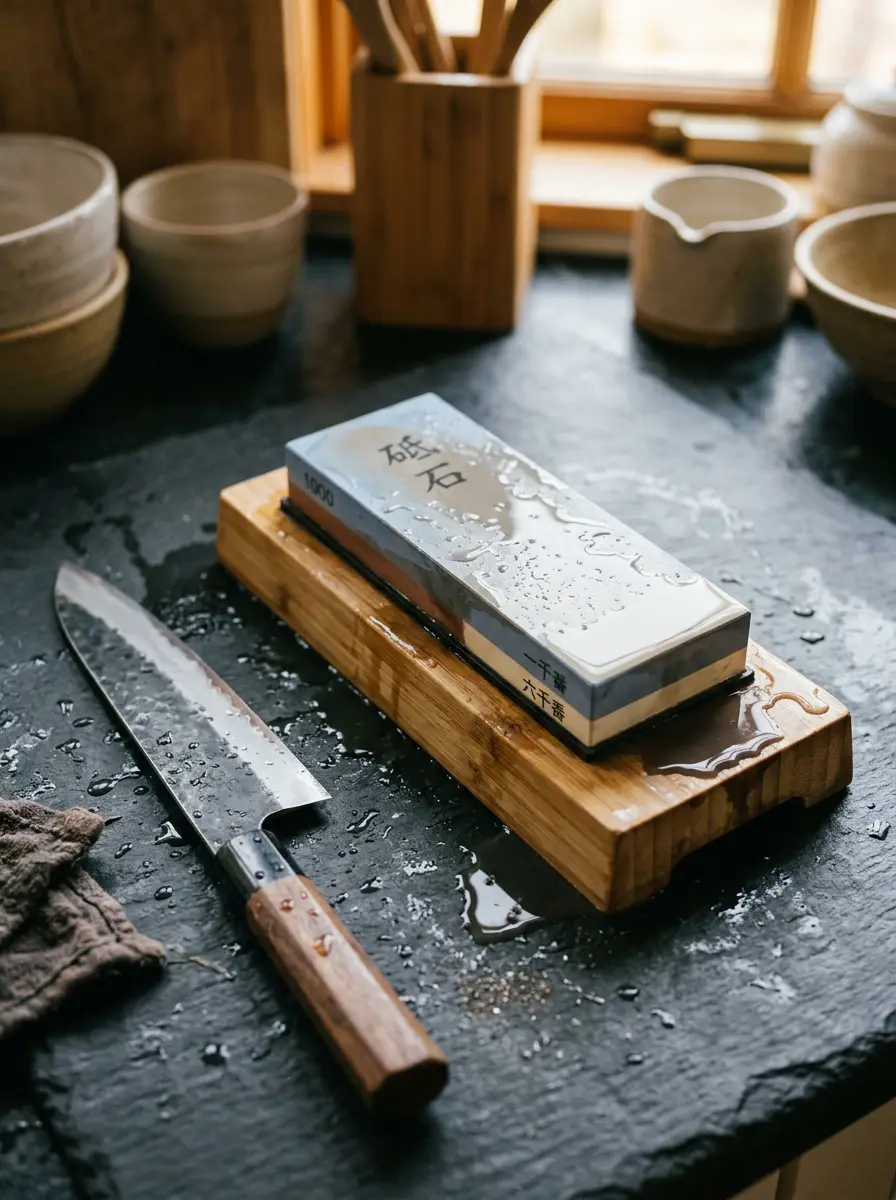
Discover the ideal whetstone grit progression to revive dull knives, reshape rolled bevels, and establish an enduring kitchen edge without wasting time.
By the Niche Picks editorsUpdated October 18, 20267 min readDrawn from our 30 research-based knife sharpening reviews
AI-generated editorial illustration; not a product or test photograph.
Short answer
To sharpen a dull knife, start with a medium grit around 1000 to apex the edge and remove metal cleanly. If the blade is severely blunted or nicked, use a coarse grit between 320 and 400 first. Finish on a fine stone around 6000 to polish and deburr. A classic 1000/6000 combination waterstone covers virtually every standard kitchen cutlery requirement.
5
Product listings discussed; not hands-on tests
5/5
Discussed listings with a recorded price
$22.90–$69.95
Recorded listing price range; not a complete setup cost
Key takeaways
A 1000-grit medium whetstone serves as the primary workhorse to reset a dulled cutting bevel.
Blades with visible chips or severe blunting require an initial 320-to-400-grit coarse stage.
A 1000/6000 combination stone reliably fulfills standard domestic culinary sharpening needs.
Guided sharpening jigs trade working speed for angle repeatability, making them ideal for novices.
Honing and sharpening serve distinct mechanical tasks; honing straightens an edge without removing steel.
Products discussed in this article
Editorial scores and recorded prices are reference points, not measurements of suitability for every use. Read each review's specifications and limitations.
KW65 1000/6000 Grit Combination Whetstone with Plastic28.2 USD
Work Sharp Precision Adjust Knife Sharpener Kit69.95 USD
Complete Knife Sharpening Stone Set – Dual Grit29.99 USD
Comparison of Reviewed Sharpening Stones and Systems for Dull Knives
Product
System Type
Grit Progression
Price
Best For
Whetstone 1000/6000 Kit
Dual-Sided Waterstone
1000 / 6000
$39.99
Standard two-sided freehand kitchen sharpening
Amazon Basics Combination
Dual-Sided Waterstone
1000 / 6000
$22.90
Entry-level kitchen sharpening on a budget
King KW65 Combination
Dual-Sided Waterstone
1000 / 6000
$28.20
Standard kitchen knife maintenance and edge refinement
Work Sharp Precision Adjust
Guided Fixed-Angle Rig
320 / 600 / Fine Ceramic
$69.95
Beginners wanting repeatable edge angles
Intelitopia Sharpening Set
Multi-Stone Bundle
400 / 1000 / 3000 / 8000
$29.99
Budget-conscious users wanting an all-inclusive kit
Which Grit Should You Use on Dull Knives?
When addressing a dull kitchen knife, abrasive selection depends entirely on the extent of the edge wear. For standard knives that slide off tomato skins or crush herbs, a 1000-grit medium waterstone is the essential starting point. At 1000 grit, the abrasive particles strip away worn steel fast enough to establish a new apex and produce a discernible burr without abrading unnecessary metal from the primary bevel. Skipping directly to fine polishing grits on a dull knife leads to wasted effort, as high-grit surfaces burnish rather than grind.
However, if a blade exhibits physical damage—such as micro-chips, flattened spots, or complete apex rounding—a 1000-grit abrasive acts too slowly. These neglected profiles demand a coarse stage between 320 and 400 grit to reshape the geometry before refining. Products like the Amazon Basics 1000/6000 Combination Stone demonstrate the foundational balance needed for normal culinary maintenance: the dark 1000-grit face reforms the cutting apex, while the light 6000-grit face removes abrasive scratches and deburrs.
Understanding the exact condition of your blade prevents over-grinding. While coarse stones remove stock aggressively, using them on knives that merely lack bite consumes blade lifespan prematurely. Learning how to sharpen kitchen knives begins with identifying whether your edge requires restorative bevel reprofiling or standard sharpening maintenance.
Why Is the 1000/6000 Grit Progression the Standard?
Within knife sharpening circles, the 1000/6000 combination is widely regarded as the ultimate pairing for culinary tools. A dual-sided waterstone combining these grits addresses the two mechanical phases of sharpening: establishing the cutting apex and refining the edge geometry.
The 1000-grit surface operates as the shaping foundation. It grinds away degraded metal along the apex to create a uniform, micro-serrated cutting edge with plenty of mechanical tooth. While a 1000-grit finish handles dense root vegetables and fibrous proteins serviceably, it leaves coarse micro-abrasions that can drag during push cuts. Transitioning to a 6000-grit stone refines the bevel, aligns the apex, and creates a polished finish that glides cleanly through delicate skins.
Options like the Whetstone 1000/6000 Sharpening Stone and the King KW65 1000/6000 Combination Whetstone embody this proven standard. The King KW65 bonds a ceramic 1000-grit brown face directly to a cream-colored 6000-grit surface, eliminating the clutter and expense of independent bench blocks. Sticking to this two-stage progression keeps maintenance straightforward. Moving into ultra-high grits like 8000 often removes useful bite from standard kitchen cutlery, making the knife slide off slick produce.
For a detailed overview of top-performing blocks across multiple abrasive types, consult our comprehensive best whetstone guide.
Coarse abrasives ranging from 320 to 400 grit are not intended for routine maintenance. Instead, they function strictly as repair and reprofiling stages. Subjecting a knife to repetitive coarse grinding removes excessive metal, shortening the functional life of the cutlery.
You should step down to a coarse abrasive only when encountering distinct edge failures:
Visible chips along the blade apex resulting from bones or hard cutting surfaces
Severely blunted edges where light reflects broadly across the entire cutting flat
Altering the factory edge angle to a more acute secondary bevel
Repairing broken or distorted blade tips
Bundles like the Intelitopia Complete Sharpening Stone Set package a 400-grit layer alongside a 1000-grit face specifically to handle preliminary stock removal on neglected cutlery. The coarse 400 side cuts rapidly through ductile steel, establishing a fresh baseline plane in dozens of passes rather than hundreds. Once a continuous tactile burr appears along the entire length of the blade on the coarse abrasive, you must immediately advance to the 1000-grit face to erase the deep scratch patterns.
Employing coarse grits without checking your progress risks asymmetrical bevels and unnecessary blade thinning. Beginners can consult our breakdown of common knife sharpening mistakes to avoid grinding down quality steel excessively during edge repair.
Should Beginners Choose Freehand Stones or Guided Systems?
While traditional waterstones offer unbeatable versatility and surface area, their primary drawback for beginners is the strict muscle memory required to maintain a uniform sharpening angle. If the blade rolls or wobbles across the stone, the apex becomes rounded rather than planar, defeating the purpose of abrasive sharpening.
Guided systems trade manual speed for mechanical angle repeatability, which is exceptionally valuable during early sharpening attempts. Fixtures such as the Work Sharp Precision Adjust Sharpener lock the blade into an indexing clamp, utilizing a guided rod to sweep abrasives across the bevel at exact, user-selected angles from 15 to 30 degrees. The Work Sharp system incorporates a Tri-Brasive carrier featuring 320-grit diamond for initial apex shaping, 600-grit diamond for refining, and a fine ceramic surface for deburring.
For novice sharpeners struggling with freehand consistency, a guided rig eliminates guesswork and prevents ruined bevel profiles. However, guided rigs feature smaller contact pads and slower workflows on long, flexible slicing blades compared to a broad 8-inch bench block. Many home sharpeners eventually graduate to bench stones after learning edge dynamics on a guided setup. Compare the core mechanical trade-offs further in our analysis of fixed-angle sharpeners vs whetstones.
A frequent misconception in blade care is conflating regular honing with true sharpening. These two maintenance routines address completely distinct edge mechanics, and using the wrong tool can damage your knife profile.
Sharpening is an abrasive subtractive process. When an edge dulls from prolonged friction, the microscopic metal apex wears flat. Whetstones, diamond plates, and abrasive guided rigs remove steel from both bevel faces to grind a new, razor-sharp intersection. Sharpening is required only periodically—typically every two to four months depending on kitchen workload.
Honing, by contrast, is primarily a non-abrasive or micro-abrasive alignment routine. During normal cutting against cutting boards, a thin knife edge rolls or bends microscopically off center. Passing the blade along a smooth or ultra-fine grooved steel rod pushes the bent teeth back into vertical alignment without removing material. Standard Western cutlery hardened below 58 HRC responds exceptionally well to routine honing, whereas hard Japanese alloys (60+ HRC) can chip if swiped improperly across a steel rod. Learn proper technique in our guide on how to use a honing rod.
If a knife feels blunt and running it down a rod fails to restore slicing ease, the edge is rounded, not merely bent. At that stage, you must transition back to a 1000-grit abrasive stone.
How Should You Care for and Flatten Your Whetstones?
Synthetic corundum waterstones operate by breaking down their bonding matrix during use, releasing dull abrasive grains to expose fresh, sharp mineral points. Because the middle section of the stone experiences the most blade contact, this sacrificial wear inevitably causes the center to hollow out—a defect known as dishing.
Attempting to sharpen knives on a dished stone destroys bevel consistency, rounding the cutting apex and preventing an even burr from forming along straight blade sections. Regular maintenance with a dedicated flattening stone or diamond truing plate is mandatory to restore a dead-flat working plane:
Draw a light grid of pencil lines across the working face of the dried stone.
Soak or splash the stone with water according to its formulation.
Rub a coarse flattening stone or diamond plate firmly over the face using circular motions.
Continue abrading until every trace of the pencil grid disappears evenly.
Kits like the Intelitopia MDS00A Set include a silicon carbide conditioning block specifically for this maintenance routine. Skipping stone flattening renders fine grit progressions ineffective. Always allow soaked waterstones to air-dry completely at room temperature before storing them away in enclosed packaging to prevent mold or structural fractures.
1Submerge your medium 1000-grit waterstone in clean tap water for 5 to 10 minutes until bubbles stop rising.
2Set the stone in its non-slip silicone boot and mount it on a flat benchtop platform.
3Establish your bevel angle (typically 15 to 20 degrees per side) and apply moderate downward pressure across the heel of the blade.
4Sweep the knife across the stone in smooth passes, working systematically from heel to tip while keeping the surface lubricated with water.
5Feel the unground side of the edge with your fingertips; once a continuous rough burr is detectable along the entire length, flip the knife and repeat on the other side.
6Switch to a fine 6000-grit stone, repeating the alternating strokes with progressively lighter pressure to sweep away the burr and polish the bevel.
7Wipe the blade clean on a towel, then draw it through a piece of scrap paper or soft produce to confirm smooth, snag-free cutting.
Quick checklist
Inspect the blade under direct light for reflective dull flats or edge chips
Select a 1000-grit medium stone for dull edges, or 320-400 for visible damage
Fully submerge soaking waterstones for 5 to 10 minutes until air bubbles cease
Secure the stone in a non-slip silicone holder and elevated base
Maintain a constant 15 to 20-degree bevel angle across every stroke
Check for a raised burr from heel to tip before turning the blade
Refine and deburr the edge on a 6000-grit fine finishing surface
Flatten your waterstones periodically to eliminate surface dishing
Frequently asked questions
Can I sharpen a very dull knife using only a 6000-grit stone?
No. A 6000-grit stone is designed for polishing, deburring, and micro-bevel refinement. Its fine abrasive particles remove metal far too slowly to apex a dull or rounded blade. Attempting to sharpen a blunt knife on a 6000-grit stone will take hours and lead to uneven edge geometry.
How do I know when to move from a 1000-grit to a 6000-grit stone?
You should only move to the 6000-grit stone after you have raised and verified a consistent, tactile burr along the entire length of the blade on both sides using the 1000-grit surface. The burr confirms that both bevels have met to form a sharp apex.
Do I need honing oil or water for synthetic whetstones?
Most modern synthetic corundum and ceramic bench stones are designed specifically as waterstones. They require either a brief 5-to-10-minute water soak or a surface splash. Never use petroleum-based honing oils on waterstones, as oil clogs the porous matrix and permanently ruins the stone's cutting action.
Why does my knife slice paper but struggle on tomato skins?
This usually occurs when an edge has been polished to an excessively fine grit (such as 8000+) without retaining any micro-serrations, or when a residual foil burr was left behind during sharpening. Finishing on a 3000 to 6000 grit preserves functional micro-teeth that bite into waxy skins.
How often should I sharpen my kitchen knives on whetstones?
Most home kitchen knives only require full whetstone sharpening every two to four months under normal domestic prep volume. Regular use of a honing steel between prep sessions straightens the edge, extending the interval between abrasive sharpening sessions on your stones.
Amazon links are affiliate links; we may earn a commission at no cost to you.
Sources and limits
This page summarizes our research reviews of Amazon listings, listed specifications and captured buyer ratings. It is not a hands-on test. Scores are editorial assessments, not measured performance; prices are recorded snapshots and may change. A category can include both main products and accessories, so its overall price range is not the cost of a complete setup.
Most recent product record update: September 28, 2026. Individual records may be older; this is not a verification date for every claim.
Choose the product type first. These groups require a match in the listing title; an import search term alone is not enough. Scores rank our recorded research assessments within each group, not independently measured performance.
Values are shown as recorded, without unit conversions or inferred compatibility. Not recorded means unknown, not absent. Prices are snapshots, not current offers. Editorial scores are research judgments, not lab results. Amazon links are affiliate links.
Before treating a comparison as complete
Which details are still unknown?
A specification appearing in a listing is not independent verification. These counts show which shortlisted records contain the same field; a blank record does not mean the product lacks the feature.
Item Dimensions L x W x H
Recorded for 2 of 2 shortlisted models
Present in every shortlisted record. Check units, exact variants and the current manufacturer documentation before relying on it.
Item Weight
Recorded for 2 of 2 shortlisted models
Present in every shortlisted record. Check units, exact variants and the current manufacturer documentation before relying on it.
Material Type
Recorded for 2 of 2 shortlisted models
Present in every shortlisted record. Check units, exact variants and the current manufacturer documentation before relying on it.
Values are shown as recorded, without unit conversions or inferred compatibility. Not recorded means unknown, not absent. Prices are snapshots, not current offers. Editorial scores are research judgments, not lab results. Amazon links are affiliate links.
A 1000/6000 combination stone covers almost every kitchen need.
Guided systems trade speed for repeatable angles — worth it early on.
Honing and sharpening serve different purposes; follow guidance for your blade steel and edge rather than assuming every knife needs a honing rod.
If a specification, certification or compatibility detail is absent, mark it as unknown and ask the seller or manufacturer. Do not substitute a star rating, an editorial score or a different model's specification.