How Much Coffee for Pour Over: A Simple Ratio Guide
Discover the golden ratio for pour over coffee to achieve consistent flavor balance and extraction quality every single morning.
By the Niche Picks editorsUpdated November 9, 20268 min readDrawn from our 31 research-based coffee gear reviews
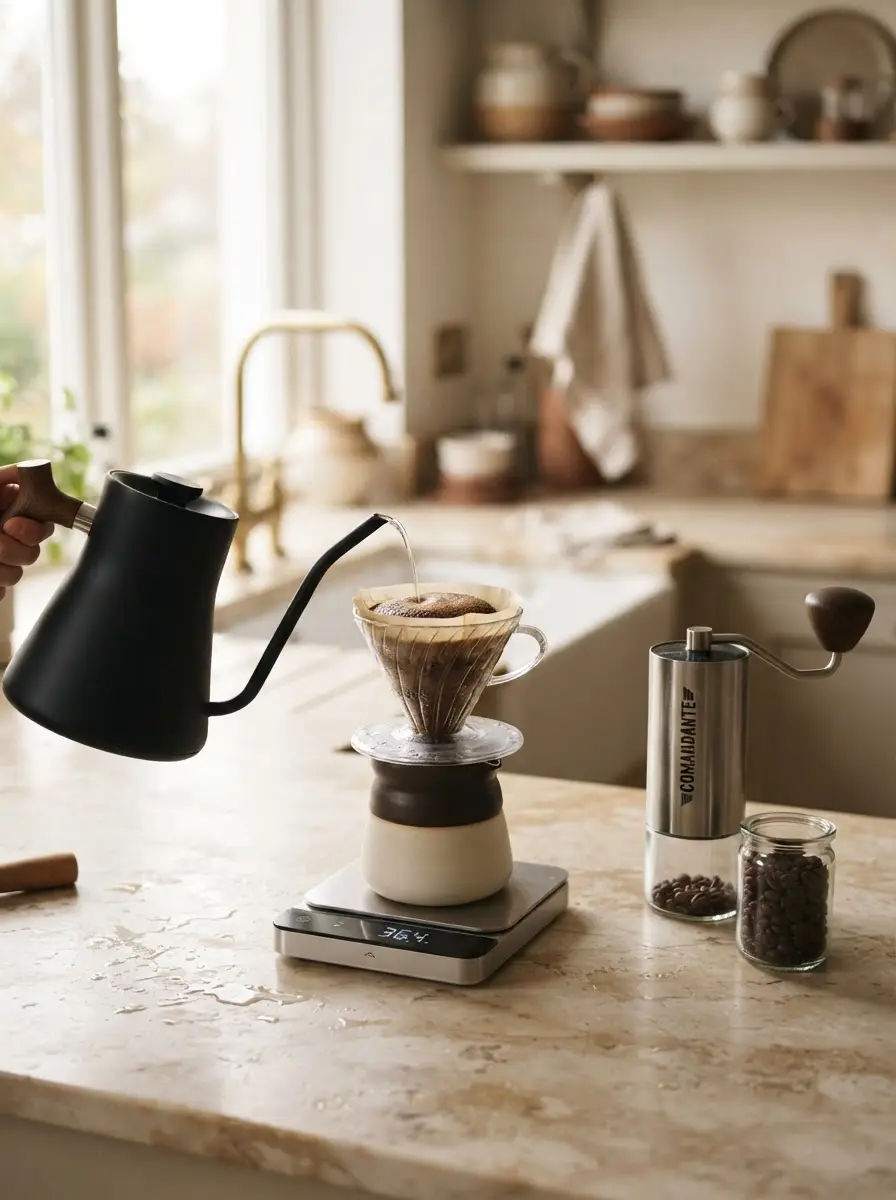
AI-generated editorial illustration; not a product or test photograph.
Short answer
For an optimal pour over, start with a golden ratio of 1:16, meaning one gram of coffee for every 16 grams of water. If you prefer a stronger cup, use a 1:15 ratio, while a 1:17 ratio yields a lighter, cleaner brew. Always use a scale to measure your grounds and water by weight rather than volume for repeatable results.
2
Product listings discussed; not hands-on tests
2/2
Discussed listings with a recorded price
$76.95–$109.99
Recorded listing price range; not a complete setup cost
Key takeaways
The 1:16 ratio is the industry-standard starting point for balanced pour over coffee.
Using a digital scale ensures precision that volume measurements cannot provide.
Consistent grind size is essential to match your chosen coffee-to-water ratio.
Your choice of beans and roast level may require minor adjustments to the starting ratio.
Proper filtration and water temperature further influence how your coffee extracts.
Products discussed in this article
Editorial scores and recorded prices are reference points, not measurements of suitability for every use. Read each review's specifications and limitations.
Cuisinart Coffee Grinder, Electric One-Touch Automatic5.8
Recorded price (USD)
Maestri House Burr Coffee Grinder, 80-Level$109.99
Cuisinart Coffee Grinder, Electric One-Touch Automatic$76.95
Comparison of Recommended Grinders for Pour Over Accuracy
Product
Burr Type
Adjustment Steps
Best For
Maestri House Burr Grinder
38mm Conical
80 Steps
Single-dose and precision
Cuisinart Burr Grinder
Flat Burr
18 Steps
Everyday batch drip
Why the Coffee-to-Water Ratio Matters
Achieving the perfect cup of pour over coffee is as much about science as it is about taste. The coffee-to-water ratio is the single most important variable for determining the strength and extraction level of your final beverage. A ratio of 1:16—approximately 60 grams of coffee per liter of water—is widely accepted as the ideal starting point. This ratio provides enough saturation for the water to dissolve the desired compounds without over-extracting bitter solids.
Start with 15-20 grams of coffee for a single-cup serving.
Use a kitchen scale to ensure accuracy across every brew cycle.
Adjust by small increments to find your personal preference for body and intensity.
When your coffee tastes thin or sour, it often indicates that your ratio is too lean or your water is moving through the grounds too quickly. Conversely, if the cup is astringent or intensely bitter, you may be using too much coffee or the grounds are sitting in the water for too long. Understanding these dynamics is a core component of coffee gear optimization. For those just beginning their journey, our coffee gear buyer's guide details how specific equipment choices, such as the Maestri House Burr Coffee Grinder, influence the efficiency of your extraction. By focusing on mass rather than standard volume scoops, you eliminate the inconsistency caused by bean density differences and roast-level expansion.
Even the most precise coffee-to-water ratio will fail if your grind size is inconsistent. Pour over brewing methods rely on a specific contact time between water and coffee. If your grind is too coarse, water will pass through too quickly, resulting in an under-extracted, watery cup. If it is too fine, the water will stall, leading to an over-extracted, bitter brew. A grinder that provides uniform particle distribution is therefore the most critical piece of coffee gear in your kitchen.
Medium-fine grind is generally best for manual pour over setups.
Avoid blade grinders as they create a mix of boulders and fines that interfere with even extraction.
Invest in a burr grinder to ensure particles are cut, not shattered.
For most home baristas, an entry-level burr mill like the Cuisinart Burr Grinder offers a significant improvement over blade-based models. While professional-grade equipment offers stepless adjustments for espresso, simple stepped burr grinders provide plenty of consistency for the relatively forgiving demands of pour over. We explore these differences in our coffee gear FAQ to help you decide if a simple upgrade is necessary for your current brewing setup. Remember that as beans age, they may require a slightly finer grind setting to maintain the same extraction efficiency, so keep a log of your favorite ratios and grind settings to stay consistent as you rotate through different coffee origins.
Measuring coffee by weight (grams) is far more accurate than using volume-based scoops. Coffee beans vary in density, so a scoop that weighs 15 grams today might weigh 18 grams tomorrow, ruining your ratio.
Mastering the Pour Over Technique
Once you have determined the correct weight of coffee for your ratio, the actual pour technique dictates how evenly those grounds extract. The process begins with the 'bloom,' where you add just enough water to wet the grounds and release trapped carbon dioxide. This gas, if not removed, creates a barrier that prevents water from fully contacting the coffee particles. After 30 to 45 seconds, continue adding water in steady, circular motions, moving from the center toward the edges of the filter.
The bloom phase should use roughly double the weight of your coffee in water.
Pour slowly to maintain a constant, gentle water level in the brewer.
Monitor your total brew time; aim for 3 to 4 minutes for a standard cup.
Proper technique bridges the gap between basic brewing and professional-level clarity. If you find your brews are frequently inconsistent, it is often a result of agitation or uneven temperature rather than the ratio itself. We recommend reviewing our best pour over coffee maker options if your current dripper lacks the thermal stability required for consistent results. Advanced enthusiasts may also find our how to brew pour over coffee guide useful for refining the pouring cadence. By controlling these variables—ratio, grind, and pour velocity—you turn an everyday ritual into a repeatable, high-quality extraction process that highlights the unique notes of your chosen beans.
Common Mistakes to Avoid
Even seasoned coffee lovers make common errors that degrade the quality of their pour over. One of the most frequent mistakes is using water that is either too cool or boiling hot. Aim for a water temperature between 195°F and 205°F. If the water is too hot, it can scorch the coffee; too cool, and it fails to extract the delicate oils and sugars that define a specialty cup. Another common pitfall is neglecting the quality of your equipment, which we address in our mistakes to avoid section. It is crucial to ensure your brewer and filters are clean before every use, as residual oils can go rancid and taint the flavor of fresh coffee.
Never use boiling water directly from the kettle.
Ensure your filter is thoroughly rinsed with hot water before adding grounds.
Don't let the coffee sit on a heating element after brewing.
Finally, consider the budget of your entire setup. Often, people overspend on expensive brewers while using a low-quality grinder, which creates a significant bottleneck. By reallocating a portion of your funds toward a high-quality burr grinder, you guarantee that the effort put into weighing your beans for the perfect ratio actually translates into a better cup. This balance is a central theme in our buying tips for home coffee enthusiasts. By focusing on these fundamentals, you avoid the most common frustration points and can focus on refining your technique to match your specific palate preferences.
Avoid Blade Grinders
Blade grinders pulverize beans unevenly, creating a mixture of dust and boulders. This makes it impossible to achieve a balanced extraction, regardless of your brewing ratio.
Refining Your Recipe for Specialty Beans
Not all coffee is roasted equally, and your ratio may need to change depending on the origin and roast profile of the beans you purchase. Light roasts are denser and often require a slightly higher water temperature and a finer grind to extract properly; a 1:17 ratio might highlight their delicate floral or fruity notes better than the standard 1:16. Dark roasts, being more porous and brittle, extract more readily. A slightly coarser grind and a cooler water temperature, or a slightly 'diluted' 1:15 or 1:16 ratio, can help prevent the excessive bitterness often found in over-extracted dark roasts.
Experiment with a 1:17 ratio for light, nuanced roasts.
Keep a brewing log to track changes in flavor as you adjust ratios.
Use fresh, quality whole-bean coffee to see the best results from your ratio.
If you find yourself frequently adjusting these variables, it is helpful to have a reliable grinder that allows for repeatable settings. While many espresso machines are the focus of best home espresso machines reviews, the importance of grinder quality remains universal. Whether you are brewing a drip coffee or an espresso, the principles of extraction uniformity stay consistent. For users balancing multiple brewing styles, our coffee grinder and espresso overview helps clarify why investing in a single, high-quality burr unit is often better than having multiple cheap grinders. Taking the time to calibrate your ratio for each specific bean will significantly improve your daily coffee experience and deepen your appreciation for the craft.
Advanced Equipment Considerations
When you have perfected your pour over ratio and technique, you might naturally look toward expanding your coffee preparation capabilities. Many enthusiasts eventually incorporate milk frothing or even making espresso without a machine into their repertoire. These activities rely on similar principles of precision, such as managing temperatures and grind particle sizing. Our best espresso grinder selections highlight options that can bridge the gap between filter-style grinding and the extreme fineness required for pressurized brewing.
Explore specialized accessories like gooseneck kettles for better pour control.
Evaluate your space and needs before purchasing integrated all-in-one machines.
As you grow your collection of gear, maintain a focus on the quality-to-price ratio. A well-maintained and properly adjusted grinder will serve you for years, while inexpensive accessories like handheld milk frothers can be replaced affordably if you decide to upgrade to a steam-wand system. We provide ongoing advice in our blog to help you navigate these future decisions, ensuring that every piece of gear you add serves a clear purpose in your brewing workflow. By adhering to these foundational standards, you ensure your coffee setup remains functional, efficient, and capable of producing cafe-quality results in the comfort of your own home.
Step by step
1Place your dripper and vessel on a scale and tare it.
2Add your ground coffee to the filter and tare the scale again.
3Pour water equivalent to twice the weight of the coffee to bloom.
4Wait 30 to 45 seconds for the coffee to degas.
5Pour the remaining water in slow, concentric circles.
6Allow the water to drain completely before removing the dripper.
Quick checklist
Select fresh, high-quality whole beans
Use a digital scale to measure coffee and water
Pre-heat your brewer and filter with hot water
Grind coffee immediately before brewing
Maintain water temperature between 195°F and 205°F
Execute a bloom phase for at least 30 seconds
Log your ratio and results for future reference
Frequently asked questions
What is the best ratio for beginners?
The 1:16 ratio is the most reliable starting point for beginners. It provides a balanced, approachable flavor profile that is neither too strong nor too watery, making it easy to troubleshoot your technique as you gain experience.
Does roast level change how much coffee I need?
Yes, roast level affects bean density. Lighter roasts are denser and may require slightly more coffee or a finer grind to reach the same intensity as darker, more porous roasts. It is best to experiment with small adjustments to find your ideal balance.
How do I measure water without a scale?
While volume measurements (like milliliters or cups) are possible, they are significantly less accurate than weight. If a scale is not available, use one level tablespoon of coffee per four ounces of water, but keep in mind that this method is prone to inconsistency.
What happens if my pour over is too bitter?
Bitterness often means the coffee was over-extracted. Try using a slightly coarser grind setting next time, or reduce your total brewing time. Additionally, ensure your water temperature is not too high, as excessive heat can pull out astringent compounds.
Why does my pour over taste weak?
A weak or sour cup usually indicates under-extraction. Try using a finer grind setting to slow the water flow, or increase the ratio of coffee to water slightly. Ensure your water is hot enough, ideally between 195°F and 205°F.
Amazon links are affiliate links; we may earn a commission at no cost to you.
Shortlists in this category
Ranked lists from our coffee gear reviews, limited to listings whose titles confirm the product type, with budget cuts where enough recorded prices sit on both sides of the line.
This page summarizes our research reviews of Amazon listings, listed specifications and captured buyer ratings. It is not a hands-on test. Scores are editorial assessments, not measured performance; prices are recorded snapshots and may change. A category can include both main products and accessories, so its overall price range is not the cost of a complete setup.
Most recent product record update: September 15, 2026. Individual records may be older; this is not a verification date for every claim. Prices on this page were read from the listings Nov 8, 2026 – Nov 10, 2026.
Choose the product type first. These groups require a match in the listing title; an import search term alone is not enough. Scores rank our recorded research assessments within each group, not independently measured performance.
Values are shown as recorded, without unit conversions or inferred compatibility. Not recorded means unknown, not absent. Prices are snapshots, not current offers. Editorial scores are research judgments, not lab results. Amazon links are affiliate links.
Before treating a comparison as complete
Which details are still unknown?
A specification appearing in a listing is not independent verification. These counts show which shortlisted records contain the same field; a blank record does not mean the product lacks the feature.
Included Components
Recorded for 2 of 2 shortlisted models
Present in every shortlisted record. Check units, exact variants and the current manufacturer documentation before relying on it.
Item Dimensions L x W x H
Recorded for 2 of 2 shortlisted models
Present in every shortlisted record. Check units, exact variants and the current manufacturer documentation before relying on it.
Material Type
Recorded for 2 of 2 shortlisted models
Present in every shortlisted record. Check units, exact variants and the current manufacturer documentation before relying on it.
For espresso machines, check temperature-control documentation and brewing workflow. A pump-pressure figure alone does not establish temperature stability or cup quality.
For grinders, confirm the stated brewing range, burr type and adjustment steps. Espresso and filter brewing need different settings; motor wattage alone does not establish grind consistency.
Price the machine, a grinder suited to your brewing method and required accessories separately. Check what is included before treating a listing price as a complete coffee setup.
If a specification, certification or compatibility detail is absent, mark it as unknown and ask the seller or manufacturer. Do not substitute a star rating, an editorial score or a different model's specification.