Learn how to brew pour over coffee with ideal water ratios, grind sizing, and pouring technique, plus the exact equipment required for consistent extraction.
By the Niche Picks editorsUpdated November 8, 20268 min readDrawn from our 31 research-based coffee gear reviews
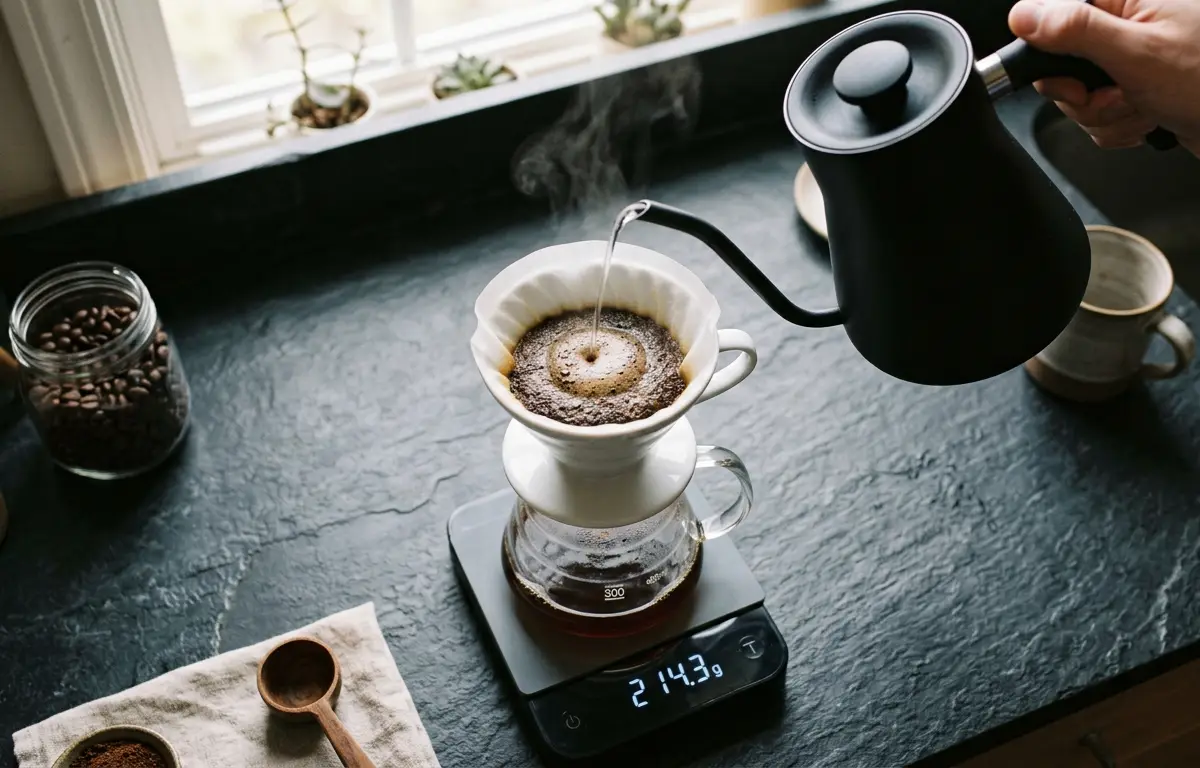
AI-generated editorial illustration; not a product or test photograph.
Short answer
To brew pour over coffee, place a paper filter in a dripper and rinse it with hot water. Add medium-coarse freshly ground coffee at a 1:15 to 1:17 coffee-to-water ratio. Pour double the coffee's weight in water just off the boil to bloom the grounds for 30 to 45 seconds, then pour the remaining water in steady, concentric circles.
4
Product listings discussed; not hands-on tests
4/4
Discussed listings with a recorded price
$20.44–$109.99
Recorded listing price range; not a complete setup cost
Key takeaways
Pour over extraction requires a consistent medium to medium-coarse grind to allow proper drainage without clogging.
A burr grinder is mandatory because spinning blade units create excessive fine particles that choke paper filters.
The initial bloom phase releases trapped carbon dioxide gas, ensuring water saturates every particle uniformly.
Target a standard brew ratio between 1:15 and 1:17 (roughly 15 to 17 grams of water for every 1 gram of ground coffee).
Budgeting for a capable burr grinder is as important as selecting the pour over brewing cone itself.
Products discussed in this article
Editorial scores and recorded prices are reference points, not measurements of suitability for every use. Read each review's specifications and limitations.
OXO Brew Conical Burr Electric Coffee Bean Grinder7.2
Maestri House Burr Coffee Grinder, 80-Level7.2
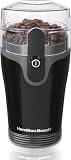
Hamilton Beach Fresh Grind Electric Coffee Grinder6.4
Cuisinart Coffee Grinder, Electric One-Touch Automatic5.8
Recorded price (USD)
OXO Brew Conical Burr Electric Coffee Bean Grinder$98.98
Maestri House Burr Coffee Grinder, 80-Level$109.99
Hamilton Beach Fresh Grind Electric Coffee Grinder$20.44
Cuisinart Coffee Grinder, Electric One-Touch Automatic$76.95
Grinders Reviewed for Manual Filter and Pour Over Preparation
Product
Mechanism
Settings
Power / Motor
Listed Price
OXO Brew Conical Burr
40mm Conical Steel Burrs
15 numbered (43 positions)
Electric (Timed)
$98.99
Maestri House Single-Dose
38mm Conical Burrs
80 stepped levels (0.02mm)
Rechargeable (1800mAh)
$109.99
Cuisinart Burr Coffee Grinder
Flat Burr Mill
18 stepped positions
150 watts
$76.95
Hamilton Beach Fresh Grind
Spinning Stainless Blades
1 timed setting
125 watts
$21.95
What is pour over coffee brewing?
Pour over coffee is a manual percolation method where hot water passes through a bed of ground coffee contained inside a filter cone. Unlike immersion methods such as the French press—where coffee grounds steep in water until separated—pour over brewing continuously introduces fresh water across the coffee bed. Gravity pulls the dissolved coffee solids and liquid through a paper or cloth filter directly into a mug or carafe below.
This continuous flow of fresh solvent creates a distinct sensory profile. The paper filtration traps insoluble bean fibers and coffee oils, resulting in a clean cup with pronounced clarity, lighter body, and distinct aromatic notes. Because you control every mechanical variable—including water temperature, flow rate, pouring pattern, and contact duration—pour over allows for unmatched precision.
However, this complete control means manual pour over is unforgiving of improper technique or mismatched equipment. Pouring water too quickly causes channeling, where liquid finds narrow paths of least resistance through the bed, leaving portions of coffee dry while over-extracting others. Conversely, pouring too slowly or using grounds that are pulverized too finely leads to extended contact time, which produces harsh bitterness and dry astringency. Learning the fundamentals through a detailed coffee gear buyer's guide helps establish repeatable routines before investing heavily in manual brewing equipment.
What equipment do you need for manual pour over?
A successful pour over setup requires a few essential pieces of gear working in harmony. While the dripper cone itself is the most visible element, the supporting accessories dictate your consistency and cup quality.
Pour over dripper and matching filters: Conical drippers (like the V60), flat-bottom wedge drippers (like the Kalita Wave), or integrated glass vessels require specific paper filters tailored to their interior ribbing and flow geometry.
A dedicated burr grinder: Coffee beans must be sheared into uniform particles rather than shattered. Units like the OXO Brew Conical Burr Grinder provide 40mm conical steel burrs with 15 primary settings and up to 43 positions, which comfortably cover manual filter brewing ranges.
A gooseneck kettle: Standard wide-spout tea kettles dump large volumes of water with excessive turbulence, disrupting the coffee bed. A narrow gooseneck spout gives you physical control over water volume and placement.
A digital gram scale: Volumetric measuring with spoons is unreliable because roast levels and bean densities vary widely. Measuring both dry coffee dose and pouring water by mass ensures strict ratio adherence.
Quality water: Brewed coffee is roughly 98 percent water. Using clean, filtered water heated between 195°F and 205°F ensures efficient extraction without off-flavors.
Before spending money on redundant accessories, consult our coffee gear FAQ to understand which components provide the highest return on cup clarity.
Pour 100ml of hot water through your empty paper filter and cone into your serving vessel before adding ground coffee. This washes away loose paper fibers and preheats the brewing chamber. Remember to discard this rinse water before brewing.
Why does grinder selection make or break pour over?
In filter brewing, grind consistency governs the drainage rate. When hot water hits the coffee bed, the water's descent through the filter is regulated entirely by the spaces between individual coffee particles. If your grinder produces inconsistent sizing, extraction collapses.
Budget blade appliances—such as the Hamilton Beach Fresh Grind priced around $21.95—rely on high-speed spinning blades powered by a 125-watt motor. Rather than cutting beans cleanly, blades smash beans unpredictably. This yields a bimodal distribution of microscopic dust (fines) mixed with large chunks (boulders). In a pour over cone, those fines immediately migrate to the bottom, blinding the paper filter's microscopic pores. The brew stalls, water pools on top, and the extended contact time leaches astringent compounds into your cup.
To prevent stalled brews, our buying rules prioritize burr geometry over raw motor wattage. Mechanical burrs, like the 38mm conical burr set on the Maestri House Burr Grinder, mill coffee between interlocking steel surfaces. This rechargeable unit offers 80 stepped settings adjusting in 0.02 mm increments, which provides uniform particle sizing for pour over and single-dose workflows. Alternatively, the Cuisinart Burr Coffee Grinder uses a 150-watt motor and an 18-position grind selector for under $80, offering an accessible mechanical burr entry point over blade choppers. Avoid the common mistakes to avoid by pairing your manual brewer with a legitimate burr mill from the start.
The brew ratio represents the relationship between dry coffee grounds and brewing water by weight. For manual pour over brewing, the specialty coffee standard falls between 1:15 and 1:17.
A 1:15 ratio (1 gram of coffee for every 15 grams of water) yields a richer, more concentrated beverage with pronounced body. Conversely, a 1:17 ratio (1 gram of coffee for every 17 grams of water) results in a lighter, more delicate cup where subtle floral or fruity tasting notes are easier to identify. For most beginner and intermediate brewers, a 1:16 ratio serves as the perfect starting benchmark.
To brew a standard 12-ounce morning mug (approximately 350 grams of water):
1:15 ratio: 23.3 grams of coffee to 350 grams of water
1:16 ratio: 21.8 grams of coffee to 350 grams of water
1:17 ratio: 20.5 grams of coffee to 350 grams of water
Always measure both coffee and water in grams using a digital scale. Volumetric measurements (such as tablespoons and fluid ounces) fluctuate depending on roast degree: a dark roast bean is less dense and physically larger than a light roast bean of the exact same weight. For broader advice on building a balanced station within your budget, visit our budget planner.
Avoid High-RPM Blade Mills
Inexpensive blade choppers shatter coffee into uneven dust and boulders. The resulting fine dust clogs the pores of pour over paper filters, stalling your brew and causing severe over-extraction.
How do you execute the bloom phase properly?
The bloom is the critical opening phase of pour over brewing. When whole coffee beans are roasted, carbon dioxide gas becomes trapped inside the cellular structure of the bean. During grinding, much of this gas is exposed, but significant residual volume remains trapped within the dry coffee bed.
If you pour your total water volume continuously from the start, this escaping carbon dioxide physically repels incoming water, creating bubbles and turbulent dry channels where water flows straight through without extracting coffee solids. To prevent this, you must bloom the bed by gently saturating the dry grounds with a controlled dose of hot water—typically double to triple the dry coffee weight (for example, 40 to 60 grams of water for a 20-gram dose).
Start your timer the moment water touches the coffee. Wet all grounds evenly in spiral motions, ensuring no dry pockets remain at the bottom of the cone. Allow the saturated bed to rest undisturbed for 30 to 45 seconds. During this window, you will observe the coffee swelling, rising, and bubbling as gas escapes. Once the bubbling subsides, the cell structure is open and receptive to even, uninterrupted extraction. If you are comparing different coffee preparation methods, browse our Coffee gear reviews for deep dives into alternative manual workflows.
How should you pour water through the coffee bed?
After the bloom completes at roughly 45 seconds, begin the primary pouring stages. Your pouring motion should be steady, calm, and deliberate, using a low flow rate from your gooseneck kettle.
Pour in slow, concentric circles starting from the center of the bed and spiraling outward toward the perimeter, stopping about half an inch before hitting the paper filter wall. Never pour directly onto the paper filter itself; doing so causes bypass, where clean water slides down the outside of the cone into your cup without extracting any coffee from the bed.
You can pour using one of two primary methods:
Continuous pour: Maintain a gentle, uninterrupted stream that matches the drainage rate of your filter, keeping the water level steady until you reach your target water mass around the 1:45 mark.
Pulse pouring: Divide your remaining water into two or three distinct stages (pulses). Pour 100 grams of water, allow the slurry to drain halfway down, and repeat until target weight is achieved.
Keep the kettle spout close to the water surface—roughly one to two inches above the slurry. Holding the spout too high induces unnecessary turbulence that disturbs the settled bed and splashes slurry against the upper walls of the filter.
How do you troubleshoot a bitter or sour cup?
Tasting your finished brew provides immediate feedback on your extraction efficiency. Pour over coffee will taste balanced, sweet, and articulate when extracted correctly. If the cup tastes unpleasant, adjust one variable at a time.
If your coffee tastes sour, salty, thin, or finishes rapidly without sweetness, the coffee is under-extracted. This occurs when water passes through the bed too quickly, pulling out fast-dissolving acids while leaving sweet sugars behind. To fix under-extraction, adjust your grinder finer, increase your water temperature slightly, or adopt pulse pours to extend the total contact time.
If your coffee tastes harsh, intensely bitter, drying, or astringent (reminiscent of over-steeped black tea), the coffee is over-extracted. This indicates water remained in contact with the grounds for too long, leaching heavy, bitter tannins. To fix over-extraction, adjust your grinder coarser, lower your kettle water temperature, or inspect your grinder for excess dust production. If your grinder steps are too broad, you can compare two products in our database to find units featuring tighter mechanical calibration.
Step by step
1Heat filtered water to 195°F–205°F (roughly 30 to 60 seconds off a rolling boil).
2Insert your paper filter into the dripper and thoroughly rinse it with hot water over your mug or server, then discard the rinse water.
3Weigh your whole bean coffee on a digital scale (for example, 20 grams) and grind it to a medium-coarse sand consistency using a burr grinder.
4Add the ground coffee to the rinsed filter, gently shake the dripper to level the bed, place the entire assembly on your scale, and tare to zero.
5Start your timer and pour 40 to 60 grams of hot water in circular motions until the entire bed is saturated; let it bloom undisturbed for 45 seconds.
6Pour additional water in steady, concentric circles starting from the center outward, avoiding the outer paper wall, until your scale reaches your target brew weight (e.g., 320 to 340 grams for a 1:16 ratio).
7Allow all water to draw down completely through the coffee bed by gravity (target total brew time: 2:45 to 3:30 minutes), compost the filter and grounds, and serve.
Quick checklist
Select freshly roasted whole bean coffee suited to your flavor preferences
Rinse the paper filter with hot water and discard the rinse liquid
Weigh out dry coffee beans on a digital gram scale (e.g., 20 grams)
Grind coffee to a medium-coarse consistency using a burr grinder
Heat filtered water to between 195°F and 205°F
Add grounds to filter, level the bed, and tare your digital scale to zero
Bloom with double the coffee weight in water for 30 to 45 seconds
Pour remaining water in gentle, concentric circles away from the filter walls
Frequently asked questions
What grind size is best for pour over coffee?
Pour over coffee requires a medium to medium-coarse grind, resembling coarse sea salt or rough beach sand. If the grind is too fine, water cannot pass through, causing the brew to stall and taste bitter. If it is too coarse, water rushes through too quickly, producing a sour, weak cup.
Why should I avoid using a blade grinder for pour over?
Blade grinders use spinning metal blades that smash beans unevenly, creating microscopic fines and large boulders simultaneously. The fines rapidly settle at the bottom of the filter, clogging the pores and stalling the water flow, which leads to harsh, astringent, and unpredictable extraction.
Can I brew pour over coffee without a gooseneck kettle?
Yes, but it is challenging. Standard wide-spout kettles pour heavy, turbulent streams that disrupt the coffee bed and wash grounds up the filter walls. A gooseneck kettle gives you pinpoint control over flow rate, stream velocity, and water placement.
What temperature should water be for pour over coffee?
Water should ideally be between 195°F and 205°F (90°C to 96°C). Lighter roasts benefit from higher temperatures near 205°F to assist extraction, while darker roasts extract more easily and taste sweeter around 195°F to 200°F.
How long should a complete pour over brew take?
A standard single-cup pour over typically takes between 2 minutes and 45 seconds to 3 minutes and 30 seconds from the initial bloom pour to the final drawdown. Times vary slightly depending on dripper geometry, batch size, and filter paper thickness.
Amazon links are affiliate links; we may earn a commission at no cost to you.
Shortlists in this category
Ranked lists from our coffee gear reviews, limited to listings whose titles confirm the product type, with budget cuts where enough recorded prices sit on both sides of the line.
This page summarizes our research reviews of Amazon listings, listed specifications and captured buyer ratings. It is not a hands-on test. Scores are editorial assessments, not measured performance; prices are recorded snapshots and may change. A category can include both main products and accessories, so its overall price range is not the cost of a complete setup.
Most recent product record update: September 22, 2026. Individual records may be older; this is not a verification date for every claim. Prices on this page were read from the listings Nov 8, 2026 – Nov 10, 2026.
Choose the product type first. These groups require a match in the listing title; an import search term alone is not enough. Scores rank our recorded research assessments within each group, not independently measured performance.
Values are shown as recorded, without unit conversions or inferred compatibility. Not recorded means unknown, not absent. Prices are snapshots, not current offers. Editorial scores are research judgments, not lab results. Amazon links are affiliate links.
Before treating a comparison as complete
Which details are still unknown?
A specification appearing in a listing is not independent verification. These counts show which shortlisted records contain the same field; a blank record does not mean the product lacks the feature.
For espresso machines, check temperature-control documentation and brewing workflow. A pump-pressure figure alone does not establish temperature stability or cup quality.
For grinders, confirm the stated brewing range, burr type and adjustment steps. Espresso and filter brewing need different settings; motor wattage alone does not establish grind consistency.
Price the machine, a grinder suited to your brewing method and required accessories separately. Check what is included before treating a listing price as a complete coffee setup.
If a specification, certification or compatibility detail is absent, mark it as unknown and ask the seller or manufacturer. Do not substitute a star rating, an editorial score or a different model's specification.