Coffee Grinder and Espresso: What You Need to Buy
For better home espresso, choose burr consistency and fine adjustment first, then pair it with a machine that manages brew temperature predictably.
By the Niche Picks editorsUpdated October 2, 20268 min readDrawn from our 26 research-based coffee gear reviews
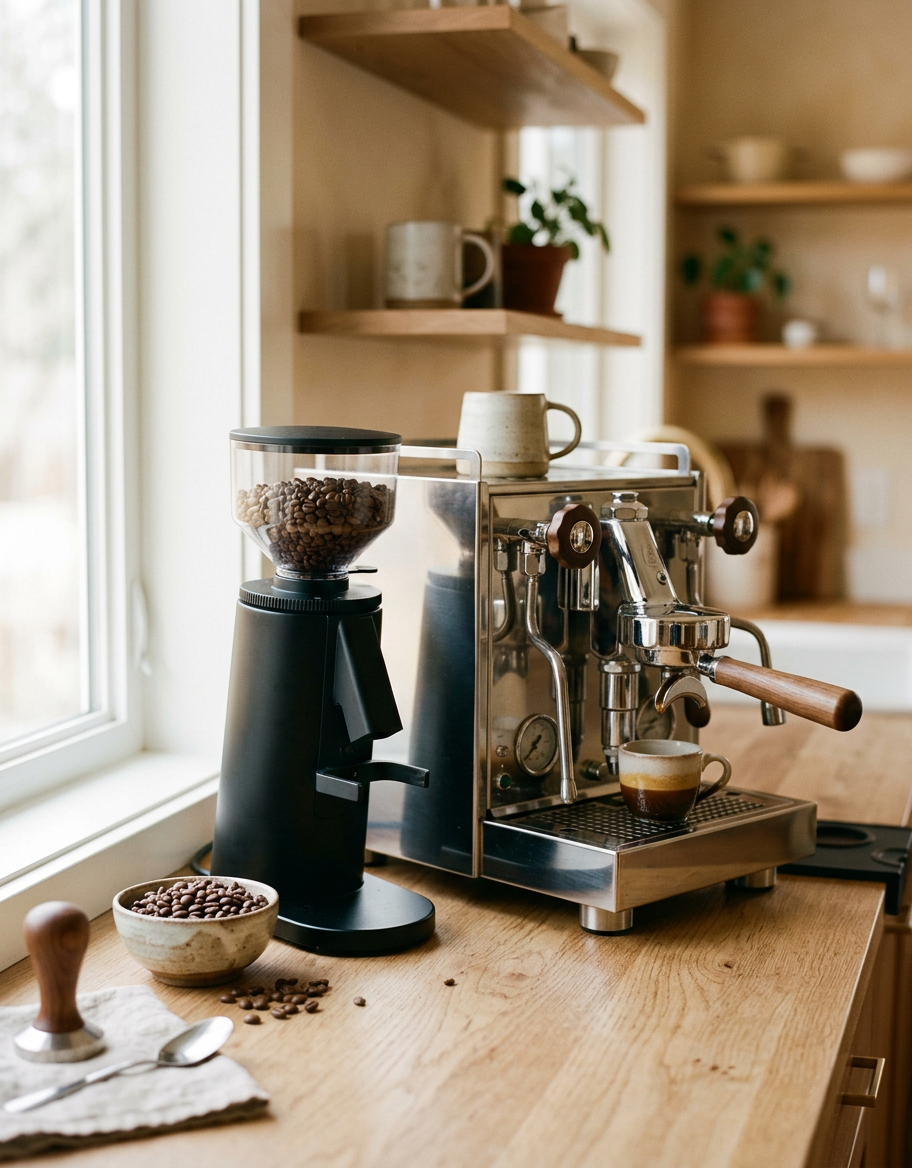
Short answer
A coffee grinder and espresso setup needs a burr grinder capable of fine, repeatable adjustment; inexpensive blade grinders are not suitable because they create an uneven mix of particles. Among our reviewed options, the Maestri House 80-Level Burr Grinder is the closest standalone starting point, while the Breville Barista Express combines a conical-burr grinder and espresso machine for convenience. For the best results, prioritize grinder adjustment precision and machine temperature stability over wattage or headline pressure.
- 80 settings
- The Maestri House grinder's stated number of stepped grind adjustments
- $109.99
- Listed price of the Maestri House single-dose burr grinder
- $689.99
- Listed price of the Breville Barista Express integrated espresso machine
Key takeaways
- A burr grinder is essential for espresso because uniform grounds make extraction more controllable than blade-chopped coffee.
- Stepless adjustment is preferable for espresso dial-in; even an 80-step grinder can leave a desired setting between clicks.
- The Breville Barista Express is a convenient integrated solution, but its stepped grinder limits fine tuning.
- Entry-level machines such as the CASABREWS CM5418 still benefit from a separate quality burr grinder despite their pressurized baskets.
- Do not judge espresso machines by a large pressure number alone; temperature stability has a greater effect on repeatable shots.
Our picks for “coffee grinder and espresso”
- 1
 Breville BES870XL Barista Express Espresso Machine, Brushed Stainless Steel4.4$689.99Our score 7.3/10Best for Convenient all-in-one home espresso setups
 - 2
 Maestri House Burr Coffee Grinder, 80-Level, Rechargeable, Single-Dose4.2$109.99Our score 7.2/10Best for Portable and low-retention home grinding
 - 3
 CASABREWS CM5418 Compact Espresso Machine with Milk Frothing Steam Wand4.3$139.99Our score 6.4/10Best for Space-constrained beginners learning milk drinks
- Breville BES870XL Barista Express Espresso Machine7.3
- Maestri House Burr Coffee Grinder7.2
- CASABREWS CM5418 Compact Espresso Machine with Milk6.4
- Breville BES870XL Barista Express Espresso Machine690
- Maestri House Burr Coffee Grinder110
- CASABREWS CM5418 Compact Espresso Machine with Milk140
| Product | Listed price | Relevant grinder setup | Espresso-related strength | Key limitation |
|---|---|---|---|---|
| Breville Barista Express BES870XL | $689.99 | Integrated conical burr grinder; stepped adjustment | Thermocoil espresso machine with dedicated milk steaming | Stepped grinder limits dial-in precision; thermocoil lacks dual-boiler temperature stability |
| Maestri House Burr Grinder | $109.99 | 38 mm conical burr; 80 stepped settings; single-dose | Burr geometry and espresso-capable positioning | Stepped adjustment can limit precise espresso dial-in |
| CASABREWS CM5418 | $139.99 | No integrated grinder stated | Compact semi-automatic machine with steam wand | Modest temperature stability; demands a separate quality burr grinder |
What coffee grinder do you need for espresso?
For espresso, buy a burr grinder rather than a blade grinder. Burrs crush beans through a controlled gap, while a spinning blade chops beans for as long as the button is held. That difference matters because espresso is a short, concentrated brew: a mixed bed of powder-like fines and oversized chunks will not flow or extract evenly.
The grinder also needs a sufficiently fine range and the ability to make very small changes. This is called dialing in: adjusting the grind to control how quickly coffee passes through the espresso puck and how the finished shot tastes. A minor change can matter, especially when beans age after opening or kitchen conditions change.
Our closest reviewed standalone option is the Maestri House Burr Grinder. It has a 38 mm conical burr and 80 stepped settings, with a single-dose, rechargeable design. It is a more appropriate espresso starting point than any blade model here, but its clicks can still limit precision when the ideal setting falls between two steps.
Avoid treating low price or motor wattage as indicators of espresso suitability. The Hamilton Beach, Amazon Basics, BLACK+DECKER, Wancle, and KRUPS models reviewed use blades, not burrs. Several explicitly cannot grind finely enough for espresso or lack a genuine adjustment system. See our broader Coffee gear buyer's guide for the traits that matter beyond a product's marketing language.
Read the reviews: Maestri House Burr Coffee Grinder, Hamilton Beach Fresh Grind Electric Coffee Grinder, KRUPS Precision Electric Coffee Grinders
Why are blade grinders a poor match for espresso?
Blade grinders are inexpensive and useful for spices or uncomplicated drip coffee, but they are not espresso grinders. Their stainless steel blades rotate and smash beans unpredictably. Holding the button longer may make the average grind look finer, but it does not calibrate particle size or remove the wide spread of large pieces and dust.
That uneven distribution creates two competing problems in an espresso basket. Fine particles can slow water dramatically and contribute harsh, over-extracted flavors, while larger pieces can extract too little. Changing dose or tamp pressure cannot turn this inconsistent starting point into a consistently dialed-in espresso grind.
The $21.95 Hamilton Beach Fresh Grind is rated for basic drip coffee and whole spices in our reviews and has one grind setting. The $20.79 Amazon Basics Fast Electric Grinder likewise has no grind-size adjustment mechanism. Neither is an espresso workaround. The same core limitation applies to the KRUPS Precision blade grinder, despite its 200 W motor: motor power is not the relevant measure of grind uniformity.
If you currently own a blade model, use it for spices, coarse casual brewing, or as a temporary backup rather than building an espresso purchase around it. A manual moka pot can make strong coffee with less demanding equipment, but it is not true espresso. Our guide to common coffee-gear mistakes explains why an apparent bargain can cost more in wasted beans and disappointing drinks.
Read the reviews: Hamilton Beach Fresh Grind Electric Coffee Grinder, Amazon Basics Fast Electric Coffee Grinder for Home Use, KRUPS Precision Electric Coffee Grinders
Is an all-in-one coffee grinder and espresso machine worth it?
An all-in-one machine is worth considering when counter space and a simplified morning routine matter most. The Breville BES870XL Barista Express combines a thermocoil espresso machine, an integrated conical burr grinder, and dedicated milk steaming in one appliance. At a listed $689.99, it eliminates the need to buy and position a separate grinder.
Its trade-off is adjustability. The built-in grinder uses stepped adjustment, so it cannot offer the unrestricted micro-adjustments of a stepless grinder. When a shot runs too quickly at one setting and too slowly at the next, you may need to compensate through dose rather than simply turning to an in-between grind setting. The thermocoil also requires deliberate flushing and does not offer dual-boiler temperature stability.
That does not make it a poor choice; it makes it a convenience-led espresso system. It is best for someone who values an integrated workflow, wants manual espresso and milk steaming, and accepts that dialing in has limits. The large review base can also be helpful for troubleshooting and routine questions.
Before buying an integrated machine, decide whether you value compactness or component-by-component upgrading more. A separate grinder can stay with you when you replace a machine, while an integrated grinder ties both decisions together. Compare the trade-offs in our home espresso machine reviews and the detailed Barista Express review.
Read the reviews: Breville BES870XL Barista Express Espresso Machine
Can a budget espresso machine make good use of a burr grinder?
Yes. A basic espresso machine benefits substantially from better grounds, even if its own temperature control and construction are modest. The CASABREWS CM5418 is a compact, 1,350 W semi-automatic machine listed at $139.99 with a milk-frothing steam wand. It is intended for space-constrained beginners and relies on pressurized filter baskets to help compensate for budget grinders.
Pressurized baskets can make brewing more forgiving, but they do not replace a burr grinder. They are designed to add resistance to the brew path, which can help produce a crema-like result when grounds are less than ideal. They cannot provide the same control over flavor and flow as fresh, evenly ground coffee in a properly dialed-in setup.
The CM5418's lightweight heating element limits temperature stability, so consistency across consecutive shots takes care. Let the machine fully warm up, keep your routine repeatable, and leave time between pulling a shot and steaming milk as needed. The listed 20-bar output pressure should not be the deciding specification; thermal behavior and grind quality are more important for repeated results.
For a strict initial budget, this machine plus a burr grinder is more rational than pairing it with a blade grinder. Still, the combined cost matters: the Maestri at $109.99 and CM5418 at $139.99 total $249.98 at their listed prices. Use our budget planner to account for coffee, a scale, cleaning supplies, and any accessories you need.
Read the reviews: CASABREWS CM5418 Compact Espresso Machine with Milk, Maestri House Burr Coffee Grinder
How should you budget for a coffee grinder and espresso setup?
A practical rule is to budget roughly as much for the grinder as for the espresso machine, particularly once you move beyond pressurized-basket beginner equipment. This does not mean every setup must split its spending exactly in half. It means the grinder is not an accessory: it is a primary control over extraction.
The reviewed prices show why this decision requires planning. The Maestri House Burr Grinder is listed at $109.99, and the CASABREWS CM5418 is $139.99, a relatively balanced entry pairing. By comparison, the Breville Barista Express is a $689.99 all-in-one option. It provides a cohesive starting system but its integrated stepped grinder is the bottleneck for micro-adjustment.
Be cautious with lower-cost electric burr grinders marketed broadly for coffee. The Cuisinart 18-position options and OXO Brew Conical Burr are meaningful upgrades from blade grinders for drip, pour-over, French press, and other filter methods, but our reviews find their stepped ranges too broad for reliable non-pressurized espresso dialing. A burr label alone is not an espresso guarantee.
Spend first on the capability you cannot readily improvise: uniform grinding and adjustment control. Then choose a machine with a workflow and temperature performance that fit how often you make drinks. For more decision frameworks, browse our coffee-gear buying tips or use our product comparison tool before committing.
Read the reviews: Maestri House Burr Coffee Grinder, Breville BES870XL Barista Express Espresso Machine
How do you dial in a grinder for espresso?
Dialing in means making repeatable changes until the coffee, dose, and machine produce a balanced result. Start with fresh whole beans, use the same basket and a consistent dose each time, then change one variable at a time. This method reveals whether a grind adjustment helped instead of creating several possible explanations for a different shot.
Begin around the grinder's espresso-fine range rather than at its absolute finest point. If coffee rushes through unusually fast and tastes thin or sour, move finer. If it barely flows or tastes harsh and dry, move coarser. These are general directional cues, not fixed recipes: basket design, dose, roast style, and coffee freshness all affect the correct setting.
A stepped grinder adds a constraint. With the Maestri's 80 settings or the Barista Express's stepped grinder, one click may be a larger shift than you need. When you encounter that situation, keep the setting fixed and make a small, measured dose adjustment rather than making multiple uncontrolled changes. Record the setting, dose, and outcome for future reference.
Keep the grinder and machine clean. Old grounds in a chute can mix with a fresh dose, while oils and scale can undermine a consistent machine routine. Follow your machine's instructions, and consult our guide on how to descale an espresso machine for the machine-maintenance side of the equation.
Read the reviews: Maestri House Burr Coffee Grinder, Breville BES870XL Barista Express Espresso Machine
Step by step
- 1Warm up the espresso machine according to its instructions and use fresh whole beans.
- 2Grind a measured dose with a burr grinder at an espresso-fine starting setting.
- 3Distribute and tamp the coffee consistently in the same basket.
- 4Pull a shot and observe its flow, then taste it after it cools slightly.
- 5Move the grinder finer if flow is too fast, or coarser if it is excessively slow or stalled.
- 6On a stepped grinder, use small dose changes when the next click is too large a correction.
- 7Write down the successful setting and dose, then clean retained grounds from the grinder as part of routine care.
Quick checklist
- Choose a burr grinder, not a spinning blade grinder, for espresso.
- Confirm the grinder can reach an espresso-fine range and offers usable small adjustments.
- Decide whether a separate grinder or an integrated all-in-one machine better fits your counter space and upgrade plans.
- Treat temperature stability as a priority over the maximum pressure printed on the machine.
- Budget for fresh whole beans, a scale, routine cleaning supplies, and water management.
- If buying a stepped grinder, plan to adjust dose carefully when two adjacent settings are too far apart.
- Check whether you need a steam wand for milk drinks or only black espresso-style drinks.
Frequently asked questions
- Can I use a blade grinder for espresso?
- No, not if you want repeatable espresso. Blade grinders chop beans into an inconsistent combination of fine dust and larger chunks, which promotes uneven extraction. The reviewed blade models also lack true calibrated adjustment. They are more appropriate for spices, casual drip coffee, or other low-precision tasks than for espresso.
- Is a burr grinder necessary for a home espresso machine?
- Yes, a burr grinder is the practical minimum for home espresso. It provides a more controlled particle size and lets you adjust the grind to alter shot flow. A pressurized basket can make a budget machine easier to use, but it cannot fully compensate for the inconsistency of blade-ground coffee.
- Is the Breville Barista Express grinder good enough for espresso?
- It can make the Barista Express a convenient complete home-espresso system because it is an integrated conical burr grinder. Its limitation is stepped adjustment, which restricts micro-tuning. It suits buyers who prioritize one-appliance convenience, but it is less flexible than a dedicated grinder with finer adjustment control.
- What is the best cheap coffee grinder for espresso in these reviews?
- The Maestri House Burr Grinder is the strongest reviewed standalone starting point for espresso at a listed $109.99. It uses a 38 mm conical burr and provides 80 stepped settings. However, its stepped design can still limit precise dialing in, so it is a budget-minded compromise rather than an unrestricted espresso solution.
- Can the OXO Brew Conical Burr Grinder make espresso?
- Our review considers the OXO Brew Conical Burr Grinder well suited to drip, pour-over, and French press, with stainless steel conical burrs and 43 micro adjustments. Its stepped increments are too broad to reliably dial in non-pressurized espresso, so it is not the best choice when espresso is your primary brew method.
- Should I buy an espresso machine or grinder first?
- If you already own a machine, upgrade the grinder first when it is a blade model or lacks an adequate fine range. Espresso quality depends heavily on controllable, uniform grounds. If you are buying both at once, allocate meaningful budget to each rather than spending nearly everything on a machine and pairing it with a basic blade grinder.
Sources
- Niche Picks review: Breville BES870XL Barista Express Espresso Machine
- Amazon listing and buyer reviews: Breville BES870XL Barista Express Espresso Machine
- Niche Picks review: Maestri House Burr Coffee Grinder
- Amazon listing and buyer reviews: Maestri House Burr Coffee Grinder
- Niche Picks review: CASABREWS CM5418 Compact Espresso Machine with Milk Frothing Steam Wan
- Amazon listing and buyer reviews: CASABREWS CM5418 Compact Espresso Machine with Milk Frothing Steam Wan
- Coffee gear buyer's guide
- How we research and score products
Amazon links are affiliate links; we may earn a commission at no cost to you.