Best Espresso Machine for Home: 5 Picks and Buying Advice
Compare five home espresso machines by workflow, temperature limitations, milk features, and total setup cost—not inflated pressure claims.
By the Niche Picks editorsUpdated September 30, 20269 min readDrawn from our 26 research-based coffee gear reviews
Short answer
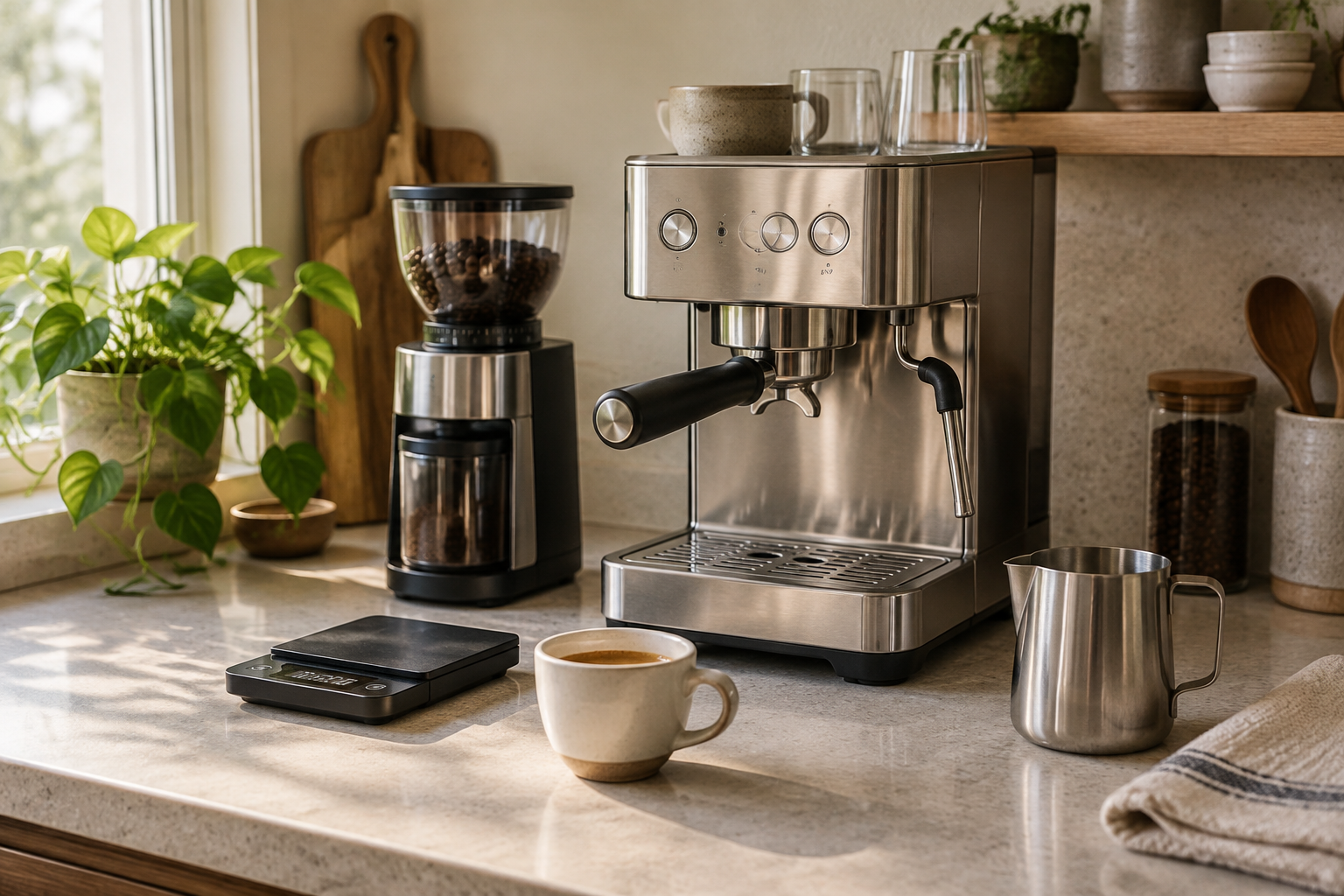
The Breville Barista Express BES870XL is our best espresso machine for home among the models reviewed here, thanks to its integrated conical burr grinder and dedicated milk steaming capability. Choose the Ninja Luxe Café Premier for multiple coffee styles or the CASABREWS CM5418 for a lower-cost starter machine, while budgeting for a separate burr grinder.
- $689.99
- Listed price of the Breville BES870XL with integrated burr grinder
- $95.98–$139.99
- Listed machine-only price range of our three budget picks
- 20 bar
- Advertised output pressure of both CASABREWS models—not proof of extraction quality
Key takeaways
- The $689.99 Breville Barista Express is our espresso-focused all-in-one pick, although its stepped grinder limits precise adjustments.
- The $599.00 Ninja Luxe Café Premier best suits households that want espresso, drip coffee, cold brew, and automated milk texturing.
- The CASABREWS CM5418, CASABREWS 3700 Essential, and CHULUX Slim prioritize affordability over thermal consistency.
- Temperature stability matters more than a machine's advertised maximum pump pressure.
- For a separate machine-and-grinder setup, budget roughly as much for the grinder as for the machine, prioritizing burr quality and fine adjustment.
- These recommendations are research-based, not hands-on test results, and apply only to the supplied reviewed products.
Our picks for “best espresso machine for home”
- 1
 Breville BES870XL Barista Express Espresso Machine, Brushed Stainless Steel4.4$689.99Our score 7.3/10Best for Convenient all-in-one home espresso setups
 - 2
 Ninja Luxe Café Premier 3-in-1 Espresso Machine, Drip Coffee, & Cold Brew4.3$599.00Our score 7.6/10Best for Households seeking multi-style coffee convenience
 - 3
 CASABREWS CM5418 Compact Espresso Machine with Milk Frothing Steam Wand4.3$139.99Our score 6.4/10Best for Space-constrained beginners learning milk drinks
 - 4
 CHULUX Slim Espresso Machine with Milk Frother for Home Cappuccino, Creamy4.5$95.98Our score 6.7/10Best for Small apartments prioritizing minimal counter use
 - 5
 CASABREWS 3700 Essential Stainless Steel Espresso Machine with Steam Wand4.2$99.99Our score 6.4/10Best for Budget espresso beginners on strict budgets
- Breville BES870XL Barista Express Espresso Machine7.3
- Ninja Luxe Café Premier 3-in-1 Espresso Machine7.6
- CASABREWS CM5418 Compact Espresso Machine with Milk6.4
- CHULUX Slim Espresso Machine with Milk Frother6.7
- CASABREWS 3700 Essential Stainless Steel Espresso6.4
- Breville BES870XL Barista Express Espresso Machine690
- Ninja Luxe Café Premier 3-in-1 Espresso Machine599
- CASABREWS CM5418 Compact Espresso Machine with Milk140
- CHULUX Slim Espresso Machine with Milk Frother96
- CASABREWS 3700 Essential Stainless Steel Espresso100
| Product | Listed price | Listed operation | Milk preparation | Main reviewed limitation |
|---|---|---|---|---|
| Breville Barista Express BES870XL | $689.99 | Manual | Dedicated milk steaming | Stepped grinder limits dial-in precision |
| Ninja Luxe Café Premier | $599.00 | Fully Automatic | Automated milk texturing | Espresso precision compromised for versatility |
| CASABREWS CM5418 | $139.99 | Semi-Automatic | Built-in steam wand | Limited thermal stability |
| CHULUX Slim | $95.98 | Manual | Milk frothing wand | Limited thermal mass and durability concerns |
| CASABREWS 3700 Essential | $99.99 | Semi-Automatic | Manual steam wand | Temperature swings and pressurized-basket dependence |
Which home espresso machine should you buy?
For an espresso-focused household starting without a grinder, the Breville Barista Express BES870XL is the most straightforward recommendation in this reviewed group. Its integrated conical burr grinder and milk steaming capability bring the essential functions into one machine. It is not a precision-first recommendation: the stepped grinder and thermocoil heating system remain meaningful compromises.
Your preferred drinks can change the answer:
- Choose the Breville for a manual espresso workflow with an integrated grinder.
- Choose the Ninja Luxe Café Premier when espresso shares the menu with drip coffee and cold brew.
- Choose the CASABREWS CM5418 for an affordable, compact introduction to milk drinks.
- Consider the CHULUX Slim when a narrow design is the priority.
- Consider the CASABREWS 3700 Essential when minimizing machine expenditure matters most.
These choices come from product specifications, listings, and the supplied research-based reviews, including buyer-feedback summaries—not hands-on testing. We prioritize temperature consistency, grinder suitability, milk preparation, and total setup cost rather than sorting solely by customer stars or review scores. A versatile appliance can score well without being our first choice for dedicated espresso.
The supplied information does not include measured brew-temperature traces, extraction comparisons, or verified long-term durability testing. Prices are the listed research figures, not guaranteed checkout prices. Our Coffee gear buyer's guide provides broader context for matching equipment to your brewing habits.
Read the reviews: Breville BES870XL Barista Express Espresso Machine, Ninja Luxe Café Premier 3-in-1 Espresso Machine, CASABREWS CM5418 Compact Espresso Machine with Milk
Why is the Breville Barista Express our top espresso-focused pick?
The Breville BES870XL Barista Express costs $689.99 in the supplied listing and combines a thermocoil espresso unit, an integrated conical burr grinder, and dedicated milk steaming capability. That combination makes it our strongest fit for someone who wants to learn home espresso without selecting a separate grinder immediately.
Its central advantage is convenience rather than uncompromised control. A conical burr grinder is a much more appropriate starting point for espresso than a blade grinder, and the established owner community is another benefit identified in the review. However, this is a manual workflow, not a promise of effortless results: grind adjustment and puck preparation still matter.
The biggest limitation is the grinder's stepped adjustment. When one setting runs too quickly and the next runs too slowly, you have fewer options than with a suitable stepless espresso grinder. The supplied review also identifies the thermocoil's temperature-stability limitations compared with a dual-boiler design. Do not interpret fast heating or a powerful electrical rating as proof of repeatable brewing temperatures.
Two other reviewed finishes are listed at $695.00 for Black Sesame and $699.95 for Black Truffle. Their supplied descriptions share the integrated conical grinder and thermocoil architecture; they do not establish a brewing-quality reason to pay more than the stainless model's listed price.
Read the Breville BES870XL review if you are deciding whether its integrated workflow outweighs the limitations of a stepped grinder.
Read the reviews: Breville BES870XL Barista Express Espresso Machine, Breville BES870BSXL Barista Express Espresso Machine, Breville BES870BTR Barista Express Espresso Machine
When is the Ninja Luxe Café Premier the better choice?
The $599.00 Ninja Luxe Café Premier is the better match when your household wants several coffee styles rather than an espresso-only routine. Its supplied description covers espresso, drip coffee, and cold brew, while the reviewed advantages include automated milk texturing and an integrated workflow that saves counter space.
That makes its appeal different from the Breville's. The Ninja is a multi-beverage convenience purchase; the Breville is our preference for an espresso-focused all-in-one setup with an explicitly documented conical burr grinder. At the listed prices, the Ninja costs $90.99 less than the stainless Breville, but price alone does not resolve which workflow suits you.
The Ninja listing describes operation as fully automatic and includes programmable functions, a timer, auto shut-off, a milk frother, and dishwasher-safe parts. Do not read “fully automatic” as evidence that every preparation or cleaning task is automated. Likewise, “dishwasher-safe parts” does not mean the entire appliance or every removable component belongs in a dishwasher.
The supplied review flags a trade-off between multi-format versatility and dedicated espresso precision. It does not provide measured temperature variation, so we cannot quantify that trade-off or claim a particular taste difference. The supplied fields also do not establish grinder geometry or adjustment details; verify those before comparing complete setup costs.
Our Ninja Luxe Café Premier review is the relevant next stop if automated milk preparation and drink variety matter more to you than fine-grained espresso control.
Read the reviews: Ninja Luxe Café Premier 3-in-1 Espresso Machine, Breville BES870XL Barista Express Espresso Machine
Which budget espresso machine is worth considering?
Three reviewed machines offer a lower entry price, but none earns a recommendation for high thermal consistency. Treat them as compromises for occasional espresso and milk drinks, not inexpensive equivalents of a precision-focused setup.
The CASABREWS CM5418 costs $139.99 and is our budget starting point for space-constrained beginners learning milk drinks. It has a compact footprint, a steam wand, and semi-automatic operation. The supplied review identifies pressurized filter baskets and modest temperature stability. A pressurized basket adds flow resistance at the basket outlet, making it more forgiving of imperfect grounds without correcting uneven extraction.
The CHULUX Slim costs $95.98 and is the small-apartment alternative. Its listing includes PID temperature control, pre-infusion, programmability, and a milk frothing wand. Those are useful listed features, but the review still flags limited thermal mass and durability concerns. A PID listing alone does not establish stable water temperature at the coffee puck, and the provided information gives no measured lifespan or exact dimensions.
The CASABREWS 3700 Essential costs $99.99 and suits buyers seeking a very low machinery outlay. It provides a manual steam wand and stainless steel exterior styling. Its reviewed weaknesses are temperature swings and reliance on pressurized baskets.
Both CASABREWS models advertise 20-bar output pressure; that number does not demonstrate superior espresso. None of these three is documented here as including a grinder, so plan for one separately. See our best espresso machine under $500 guide for more budget-focused context.
Read the reviews: CASABREWS CM5418 Compact Espresso Machine with Milk, CHULUX Slim Espresso Machine with Milk Frother, CASABREWS 3700 Essential Stainless Steel Espresso
How much should you spend on the grinder and complete setup?
For separate equipment, start by budgeting roughly as much for the grinder as for the espresso machine. This is a planning rule, not a requirement to match prices exactly. Its purpose is to prevent an expensive machine from being paired with a grinder that cannot provide consistent particles and sufficiently fine adjustments.
Burr geometry and adjustment resolution matter more than motor wattage. Burrs grind beans between shaped surfaces; blade grinders chop them with spinning blades. Stepless adjustment allows continuous changes rather than fixed clicks, which can help tune espresso flow. A well-designed stepped grinder can still work, but a large setting count alone does not prove adequate espresso control.
The $109.99 Maestri House grinder is the most relevant separately reviewed candidate here: it lists 38mm conical burrs, 80 stepped settings, and rechargeable single-dose operation. Its review still identifies adjustment limitations, and its nine listed customer reviews provide a small feedback base. Pairing it with the $139.99 CM5418 totals $249.98 before tax, beans, and other accessories—not a guarantee of precision espresso.
The $98.99 OXO conical burr grinder is reviewed as better suited to filter and immersion brewing, with steps too broad for reliable nonpressurized espresso adjustment. The inexpensive Hamilton Beach blade grinder is not an espresso recommendation.
No separately reviewed grinder here provides a documented stepless option we can endorse. Use the budget planner to account for the grinder, a scale, cleaning supplies, and any milk pitcher or tools not confirmed in the machine's package.
Read the reviews: Maestri House Burr Coffee Grinder, OXO Brew Conical Burr Electric Coffee Bean Grinder, Hamilton Beach Fresh Grind Electric Coffee Grinder
Which specifications actually improve home espresso?
Temperature stability deserves more attention than maximum pump pressure. Espresso extraction changes with water temperature, so repeatable brewing conditions help you distinguish a grind or recipe problem from a machine-temperature problem. A machine that heats quickly does not necessarily maintain the same brewing temperature throughout a shot or recover consistently between drinks.
A PID is a feedback controller that adjusts heater output toward a target temperature. Its presence is useful information, but sensor placement, heater design, water flow, and thermal mass also influence results. Similarly, the label “dual boiler” describes separate boilers for brewing and steaming; it is not by itself a measured performance result.
Traditional pump espresso is commonly brewed around 9 bar. An advertised 20-bar pump rating is not a promise that brewing at 20 bar improves flavor, nor does it establish the pressure actually reaching the coffee. Puck resistance, grind size, dose, and the machine's pressure regulation all matter.
Before buying, prioritize these questions:
- Does the grinder allow small, repeatable changes in the espresso range?
- Are the baskets pressurized, nonpressurized, or both?
- What recovery or cooling sequence does the manual require between brewing and steaming?
- Will the machine fit with enough clearance for refilling and maintenance?
The supplied listings do not establish exact dimensions or measured shot-to-shot temperatures for these picks. Verify missing information rather than filling gaps with marketing assumptions. Our guide to Coffee gear buying mistakes explains why impressive-looking numbers can distract from the specifications that affect daily use.
How do you get better results and keep the machine working?
Start with a repeatable routine before chasing upgrades. Allow the machine, portafilter, and cup to warm according to the manufacturer's guidance. Keep the basket dry before dosing, distribute grounds evenly, and tamp level. Use a scale to record both the dry coffee dose and beverage output, then change one variable at a time.
For a nonpressurized basket, a 1:2 brew ratio is a common starting point: 18 grams of coffee producing 36 grams of espresso, for example. That is a general recipe illustration, not a recommended dose for every machine here. Follow the basket's capacity and the machine manual, especially when using pressurized baskets.
Milk-drink buyers should also distinguish steam wands from handheld frothers. Steam heats milk while incorporating air; a handheld whisk agitates milk and generally produces a different foam texture. A cheap whisk is not a like-for-like replacement for a steam wand when your goal is fine microfoam.
After steaming, wipe the wand promptly with a suitable damp cloth and purge it as directed, keeping clear of hot surfaces and steam. Clean baskets and accessible coffee-contact surfaces routinely. Use backflushing only if the manufacturer specifies that the machine supports it.
Descaling frequency depends on water hardness, usage, filtration, and manufacturer instructions—not a universal monthly schedule. Follow the specified solution and procedure rather than improvising with household acids. Our espresso machine descaling guide explains the distinction between removing mineral scale and cleaning coffee oils.
Quick checklist
- Decide whether your main goal is straight espresso, milk drinks, or several coffee styles.
- Set a total budget that includes a suitable burr grinder unless an appropriate one is integrated.
- Check grinder adjustment resolution rather than relying on wattage or the number of settings alone.
- Confirm basket type, included accessories, and any recommended dose range.
- Measure counter space and overhead clearance; verify dimensions with the current listing or manual.
- Check the required sequence and waiting periods between brewing and steaming.
- Read cleaning, water-quality, and descaling instructions before purchase.
- Verify the current price, seller, warranty terms, and return policy.
Frequently asked questions
- What is the best espresso machine for a beginner at home?
- Among these reviewed machines, the Breville Barista Express BES870XL is our recommendation for a beginner who wants an integrated burr grinder and plans to learn espresso preparation. It costs $689.99 in the supplied listing. For a smaller machine budget, the $139.99 CASABREWS CM5418 offers a compact design and steam wand, but requires a separate grinder and brings greater temperature-stability compromises.
- Is the Ninja Luxe Café better than the Breville Barista Express?
- The Ninja is the better fit for a household prioritizing espresso, drip coffee, cold brew, and automated milk texturing. The Breville is our espresso-focused pick, with an explicitly documented integrated conical burr grinder. Neither is established here as the temperature-stability leader through measured testing. Their listed prices are $599.00 for the Ninja and $689.99 for the stainless Breville.
- Can a home espresso machine under $150 make good coffee?
- An inexpensive machine can be a reasonable introduction to espresso-style brewing and milk drinks, but expectations matter. The reviewed CHULUX and CASABREWS models cost $95.98–$139.99 and have documented thermal limitations. The CASABREWS reviews also identify pressurized-basket use. Consistent preparation and suitable grounds help, but these are not our recommendations for precision-focused, repeatable straight espresso.
- Do I need a separate grinder for an espresso machine?
- You need a suitable grinding solution, but not necessarily a separate appliance: the reviewed Breville Barista Express includes a conical burr grinder. For a machine without one, an espresso-capable burr grinder is the preferred approach. Blade grinders produce inconsistent particles. Preground coffee can be usable in some pressurized baskets, but it limits freshness and your ability to adjust extraction.
- Is a 20-bar espresso machine better than a 15-bar machine?
- Not on that specification alone. Advertised pump pressure is not the same as regulated brewing pressure at the coffee puck, and traditional pump espresso is commonly brewed around 9 bar. Temperature stability, grind quality, basket design, and pressure regulation matter more than choosing the larger number. The supplied 20-bar ratings do not establish superior performance.
- Does PID temperature control guarantee consistent espresso?
- No. A PID controller helps regulate temperature around a target, but overall consistency also depends on the sensor location, heater design, thermal mass, and water flow. The CHULUX Slim listing includes PID control, while its supplied review still flags thermal limitations. Without measured brewing-temperature data, that feature alone cannot establish performance relative to the other machines.
- Can a handheld milk frother replace an espresso machine's steam wand?
- A handheld frother can add airy foam to milk, but it is not an equivalent tool for heating and creating fine microfoam. The reviewed handheld whisks are described as producing coarse or airy foam rather than steam-wand-style texture. Choose a machine with suitable steaming or automated milk-texturing capability if milk texture is central to your purchase.
Sources
- Niche Picks review: Breville BES870XL Barista Express Espresso Machine
- Amazon listing and buyer reviews: Breville BES870XL Barista Express Espresso Machine
- Niche Picks review: Ninja Luxe Café Premier 3-in-1 Espresso Machine
- Amazon listing and buyer reviews: Ninja Luxe Café Premier 3-in-1 Espresso Machine
- Niche Picks review: CASABREWS CM5418 Compact Espresso Machine with Milk Frothing Steam Wan
- Amazon listing and buyer reviews: CASABREWS CM5418 Compact Espresso Machine with Milk Frothing Steam Wan
- Niche Picks review: CHULUX Slim Espresso Machine with Milk Frother for Home Cappuccino
- Amazon listing and buyer reviews: CHULUX Slim Espresso Machine with Milk Frother for Home Cappuccino
- Niche Picks review: CASABREWS 3700 Essential Stainless Steel Espresso Machine with Steam W
- Amazon listing and buyer reviews: CASABREWS 3700 Essential Stainless Steel Espresso Machine with Steam W
- Coffee gear buyer's guide
- How we research and score products
Amazon links are affiliate links; we may earn a commission at no cost to you.