How to descale an espresso machine (and how often)
Descale an espresso machine by following its manual’s procedure with an approved descaler, completing the required rinses, and repeating at the interval recommended for your water hardness and use.
Research-based article drawn from our 26 coffee gear reviews. Updated September 2026.
Short answer
To descale an espresso machine, first confirm that its manual permits home descaling. Mix the approved descaler at the specified dilution, run the prescribed descaling cycle or sequence, then rinse with fresh water exactly as directed. Follow the manufacturer’s schedule or descale alert; water hardness and usage determine how often treatment is needed.
Our picks for “how to descale espresso machine”


Before you start: descaling is not ordinary cleaning
Descaling treats mineral deposits in the machine’s water circuit. It is separate from removing coffee oils, cleaning baskets, and wiping or purging a steam wand. A cleaning reminder does not necessarily mean the machine needs descaling, and a cleaning tablet is not automatically a substitute for descaler. Check the manual to identify the correct maintenance task.
Find the instructions for your exact model before adding anything to the reservoir. Some machines have a dedicated descale program; others require a specific sequence, and some need professional attention rather than routine home descaling. Do not borrow another machine’s button sequence or chemical recipe.
Gather the manufacturer-approved descaler, fresh water, and a heat-safe collection container of the specified capacity. Read the descaler’s safety directions as well as the machine instructions. Keep children and pets away, and avoid contact with hot discharge or cleaning solution.
How to descale an espresso machine, step by step
First, prepare the machine as its manual directs. Empty the drip tray and reservoir, and remove coffee or a capsule if applicable. Check whether the tank’s water filter and the portafilter must be removed. Follow any instructions about cooling the machine before starting.
Next, mix the approved descaler with water using the specified dose and fill level. Stronger is not better. Place the collection container beneath the outlets identified in the instructions, then start the descale program or prescribed manual sequence.
Let the sequence finish, including any pauses. Route solution through the brew outlet, hot-water outlet, or steam circuit only when instructed. Do not substitute prolonged steaming, leave solution soaking overnight, or let the pump run dry.
Finally, discard the solution safely, rinse the reservoir, and complete every required fresh-water rinse. Restore any removed components as directed. Reset the maintenance reminder only after completing the procedure, and never drink the descaling or rinse water.
How often should you descale?
There is no single interval that suits every espresso machine. Start with the schedule in your manual and follow the machine’s descale reminder where provided. Harder water and heavier use generally call for more frequent attention than softer water and occasional use. A calendar rule should not override model-specific instructions.
If your machine has a water-hardness setting, test your supply using the method the manufacturer recommends and enter the result correctly. Check whether the schedule changes when using an approved water filter. Do not assume that any filtered water is softened water, or that a filter eliminates descaling altogether.
Keep a simple maintenance log with the date, treatment, and filter changes. If flow becomes unusually slow, heating changes, or the machine makes unfamiliar noises, consult its troubleshooting guidance rather than automatically adding more descaler. Those symptoms do not establish that scale is the cause. Stop and seek service if there is a leak or a persistent fault.
For reviewed machines, use the exact model’s instructions
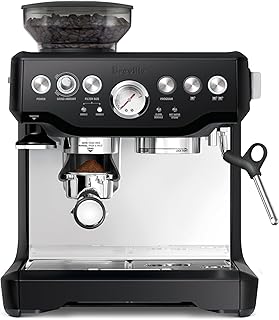
If you own the Breville BES870BTR Barista Express, use the instructions for that exact model. Our review identifies a thermocoil machine with an integrated conical burr grinder, but those features do not establish its descaler dose, button sequence, or rinse volume. Descaling the water circuit is also separate from maintaining the grinder.
The Breville BES870XL Barista Express likewise combines a thermocoil espresso unit with an integrated conical burr grinder. Do not assume that maintenance instructions found for another version are interchangeable; confirm them against your model number and manual.
The Ninja Luxe Café Premier offers espresso, drip coffee, and cold brew. That versatility does not tell you which maintenance program to run or which outlets it treats. Follow its own instructions rather than a generic espresso-machine sequence.
These are relevant reviewed machines, not reasons to replace a machine that needs routine maintenance. Our supplied review list contains no descaling products, so it does not support a specific descaler recommendation.
Read the reviews: Breville BES870BTR Barista Express Espresso Machine, Breville BES870XL Barista Express Espresso Machine, Ninja Luxe Café Premier 3
Frequently asked
- Can I use vinegar to descale my espresso machine?
- Use vinegar only if your machine’s manufacturer explicitly permits it and provides a dilution and procedure. Otherwise, choose the approved descaler. The same caution applies to homemade citric-acid mixtures: do not improvise concentration or soaking time. Compatibility and rinsing requirements differ, so check your exact model’s manual.
- Is backflushing the same as descaling?
- No. Backflushing is a separate cleaning procedure for compatible machines, commonly used to remove coffee residue from parts of the brew circuit. Descaling addresses mineral deposits in the water system. Only backflush if your manual allows it, using the specified accessories and cleaner; one task does not replace the other.
- How much water should I run through after descaling?
- Run the full fresh-water rinse sequence specified by your machine’s manual and the approved descaler instructions. There is no universal number of tanks that fits every machine. Do not judge completion by water clarity alone. If odor or residue remains, consult the instructions or manufacturer before brewing coffee.
- Do I still need to descale if I use filtered water?
- Possibly. Filtered water is not necessarily low in scale-forming minerals, and filtration does not automatically eliminate descaling. Follow your machine’s water-quality guidance, filter replacement schedule, and maintenance instructions. If it offers a hardness setting, use the recommended test and setting rather than assuming filtered water requires no treatment.