The Maestri House 80-Level is the only standalone grinder in our reviewed range with burrs and an espresso-oriented adjustment range.
By the Niche Picks editorsUpdated October 7, 20268 min readDrawn from our 30 research-based coffee gear reviews
AI-generated editorial illustration; not a product or test photograph.
Short answer
The best espresso grinder in our current reviews is the $109.99 Maestri House 80-Level Rechargeable Single-Dose Burr Grinder. Its 38mm conical burrs, 80 numbered stepped settings, and single-dose design make it substantially more suitable for espresso than blade grinders, but its stepped adjustment can still limit precise dial-in with non-pressurized baskets. We would not recommend the reviewed budget blade grinders for espresso.
1
Product listings discussed; not hands-on tests
1/1
Discussed listings with a recorded price
$109.99–$109.99
Recorded listing price range; not a complete setup cost
Key takeaways
Choose burrs over blades: uniform particle size matters far more for espresso than a grinder's advertised wattage.
The Maestri House MHCG02 is the only reviewed standalone burr grinder positioned for espresso, at a listed price of $109.99.
Its 80 settings move in 0.02 mm increments, but a stepped system can still leave you between ideal espresso settings.
Blade grinders from Hamilton Beach, Amazon Basics, BLACK+DECKER, Wancle, and KRUPS are not espresso-capable choices in our reviews.
For a new espresso setup, plan to spend roughly as much on the grinder as on the machine rather than treating the grinder as an accessory.
Products discussed in this article
Editorial scores and recorded prices are reference points, not measurements of suitability for every use. Read each review's specifications and limitations.
Best reviewed standalone espresso grinder comparison
Product
Listed price
Burrs
Adjustment
Workflow
Buyer feedback
Maestri House 80-Level
$109.99
38mm conical burr
80 stepped settings; 0.02 mm increments
Rechargeable single-dose with auto-stop
4.2/5 from 9 reviews
What is the best espresso grinder from our reviews?
The Maestri House Burr Coffee Grinder, 80-Level, Rechargeable, Single-Dose is our current top reviewed standalone pick for espresso. At $109.99, it has the core hardware espresso requires: a 38mm conical burr set rather than spinning blades, 80 numbered grind positions, and a single-dose workflow that lets you weigh beans before each shot.
It is not a no-compromise enthusiast grinder. The adjustment is stepped, not stepless, so a setting may run a shot too quickly while the next finer step runs too slowly. That limitation matters most with non-pressurized baskets, fresh beans, and machines that expose small changes in flow. Still, it is meaningfully better aligned with espresso than a blade mill, which cannot set or repeat a consistent burr gap.
The compact 4.02 by 2.6 by 7.28-inch body, rechargeable 1,800mAh battery, digital display, and auto-stop function make it particularly appealing to single-dose users with limited counter space. Its 4.2-star average comes from only 9 ratings, however, so long-term reliability has not been established by a large buyer-feedback sample.
Why does burr geometry matter more than motor wattage for espresso?
Espresso is unusually sensitive to grind consistency because water passes through a compact, pressurized coffee bed. The goal is a narrow range of particle sizes: particles that are too fine can slow flow and add harshness, while oversized particles can allow water to pass too quickly and leave the shot thin or sour. A burr grinder creates a controlled gap through which beans are cut; a blade grinder breaks beans by impact.
That distinction is why we do not treat wattage as a shortcut to espresso performance. A fast, powerful blade can still make a mixture of dust-like fines and large fragments. More run time makes the overall grind smaller, but it does not establish a repeatable grind size. It can also add frictional heat. A burr grinder gives the user an actual adjustment system and a more controlled distribution.
The Maestri House uses a 38mm conical burr set rotating at 120 to 160 RPM. Its low rotational speed is intended to minimize heat transfer during grinding. Those are better espresso-relevant facts than a headline motor-power number, though burr diameter alone does not guarantee cup quality.
Is an 80-step grinder precise enough for espresso?
It can be workable, but it is the Maestri House grinder's central compromise. The MHCG02 has 80 distinct positions, with review information describing 0.02 mm adjustment increments. That provides much more control than a one-button blade grinder and ample range for manual brewing methods. It may also suit an entry-level espresso machine using pressurized filter baskets, which are more forgiving of small grind variations.
For traditional espresso in a non-pressurized basket, the target moves as coffee ages, humidity changes, dose changes, and recipe preferences change. If the ideal burr gap falls between two clicks, you may need to compensate with dose or yield rather than simply making a tiny grind adjustment. That can work, but it is less direct than a true stepless or micro-adjustable system.
Do not confuse “fine enough” with “easy to dial in.” Some entry-level burr grinders offer a fine setting, yet broad stepped changes and excess fines can still make repeatable espresso difficult. The reviewed Cuisinart 18-setting burr mills and OXO stepped conical burr grinder are better suited to drip, pour-over, French press, and other filter-focused brewing than reliable non-pressurized espresso.
Which reviewed coffee grinders should espresso buyers avoid?
Avoid all of the reviewed blade grinders for genuine espresso: the Hamilton Beach Fresh Grind, Amazon Basics Fast Electric Grinder, BLACK+DECKER One-Touch, Wancle Electric Grinder, and KRUPS Precision Electric Grinder. Their low prices and large review totals can make them tempting, but none provides burr geometry or calibrated grind adjustment. Each relies on pulse duration as its only form of control.
The problem is not that blade grinders are useless. They can be sensible for spices, basic drip coffee, or an emergency kitchen backup. Their limitation is the broad mix of fines and boulders they produce. In espresso, that inconsistency promotes uneven resistance through the puck and makes it difficult to get the same shot twice.
We also would not put the reviewed OXO or Cuisinart electric burr grinders on a best-espresso-grinder shortlist. They are genuine burr machines, a clear structural improvement over blades, but their stepped systems are described in our reviews as too broad for dependable espresso dial-in. They are better buys when your main goal is filter coffee and you want an electric burr grinder below $100.
Spend where it changes extraction most. Use our budget planner to map the grinder, machine, beans, and necessary tools before buying, rather than putting the entire budget into a machine with impressive pressure claims.
How much should you spend on an espresso grinder?
A practical espresso rule is to budget roughly as much for the grinder as for the machine. It is not an absolute formula, but it prevents a common mismatch: pairing an expensive espresso machine with an inexpensive blade grinder that cannot control the variable that most directly governs flow through the coffee puck.
The Maestri House costs $109.99. That is a sensible proportional match for a basic espresso machine near the $100 range, particularly if that machine uses pressurized baskets. It is a less natural match for a more capable semi-automatic machine and a non-pressurized basket, where the stepped adjustment can become the limiting factor. In that situation, saving for a grinder with finer adjustment control is usually more productive than paying extra for pump-pressure marketing.
Also account for your workflow. This Maestri model is single-dose, so you add a measured portion of beans for each session rather than keeping a hopper filled. That reduces bean waste between coffees, but it is a different routine from a timed, hopper-fed grinder. Its rechargeable design avoids a permanent countertop cord but adds a battery as a long-term wear component.
A capable grinder is necessary, but it cannot compensate for every weakness elsewhere in an espresso setup. Use fresh whole beans, weigh the dose consistently, distribute and tamp evenly, and keep the machine thoroughly warmed according to its manufacturer instructions. Then change one variable at a time: grind setting first, followed by dose or beverage yield if necessary.
Machine temperature stability remains important. A high pressure figure on the box does not ensure a better shot; espresso generally extracts around 8 to 9 bars, while temperature consistency and controlled puck preparation have greater practical value. Entry-level machines can use pressurized baskets to tolerate less exact grinding, but that convenience should not be mistaken for the control of a well-dialed non-pressurized setup.
The Maestri House is also suited to users who want one compact grinder for espresso-adjacent coffee and pour-over. Its 80 settings broaden its usefulness beyond one brew method. Just keep expectations realistic: a flexible, cordless grinder at $109.99 is not the same as a dedicated stepless espresso platform.
Confirm that the grinder uses burrs, not spinning blades.
Decide whether you will use a pressurized or non-pressurized espresso basket.
Match the grinder budget roughly to the espresso-machine budget.
Choose stepped adjustment only if you accept possible compromises between settings.
Measure your available counter or cabinet space against the grinder's 4.02 by 2.6 by 7.28-inch dimensions.
Plan to weigh beans for a consistent single-dose workflow.
Check the exact-model manufacturer instructions for charging, cleaning, and burr removal.
Frequently asked questions
Can I use a blade grinder for espresso?
You can grind coffee with one, but we do not recommend a blade grinder for espresso. Blades create a broad mix of powder-like fines and coarse fragments, while espresso needs a controlled, repeatable particle size. Pulse timing is not a calibrated grind setting, so dialing in shots becomes unnecessarily difficult.
Is the Maestri House 80-Level grinder good for espresso?
It is the best fit among our reviewed standalone grinders because it has a 38mm conical burr set, 80 settings, and a single-dose format. Its limitation is the stepped adjustment: the 0.02 mm increments may not provide the exact micro-adjustment needed for demanding non-pressurized espresso.
How much does a good espresso grinder cost?
In our current reviewed selection, the espresso-oriented Maestri House costs $109.99. More important than a fixed dollar figure is the budget balance: plan to spend roughly as much on the grinder as on the machine, because grind uniformity and adjustment control strongly affect extraction.
Are conical burrs good for espresso?
Conical burrs can be appropriate for espresso because they cut beans through a defined gap rather than smashing them with blades. Burr type alone does not settle the question, though. Adjustment precision, particle consistency, and the ability to make small repeatable changes also determine how easy a grinder is to dial in.
Are 80 grind settings enough for espresso?
Eighty settings provide far more range than a basic blade grinder and may work well with forgiving, pressurized-basket machines. But the Maestri House uses discrete steps rather than stepless adjustment. For non-pressurized espresso, one step can still be too coarse a change when you are trying to control shot flow precisely.
Should I buy an espresso machine with a built-in grinder?
An integrated grinder saves space and simplifies workflow, but the reviewed all-in-one machines use stepped conical grinders that limit fine dial-in. A separate grinder gives you a clearer upgrade path and lets you prioritize adjustment precision independently. Choose an all-in-one mainly when compact convenience outweighs maximum control.
Amazon links are affiliate links; we may earn a commission at no cost to you.
Sources and limits
This page summarizes our research reviews of Amazon listings, listed specifications and captured buyer ratings. It is not a hands-on test. Scores are editorial assessments, not measured performance; prices are recorded snapshots and may change. A category can include both main products and accessories, so its overall price range is not the cost of a complete setup.
Most recent product record update: September 15, 2026. Individual records may be older; this is not a verification date for every claim.
Choose the product type first. These groups require a match in the listing title; an import search term alone is not enough. Scores rank our recorded research assessments within each group, not independently measured performance.
Temperature stability matters more than pressure numbers on the box.
Burr geometry and stepless adjustment beat motor wattage every time.
Budget roughly as much for the grinder as for the machine.
If a specification, certification or compatibility detail is absent, mark it as unknown and ask the seller or manufacturer. Do not substitute a star rating, an editorial score or a different model's specification.
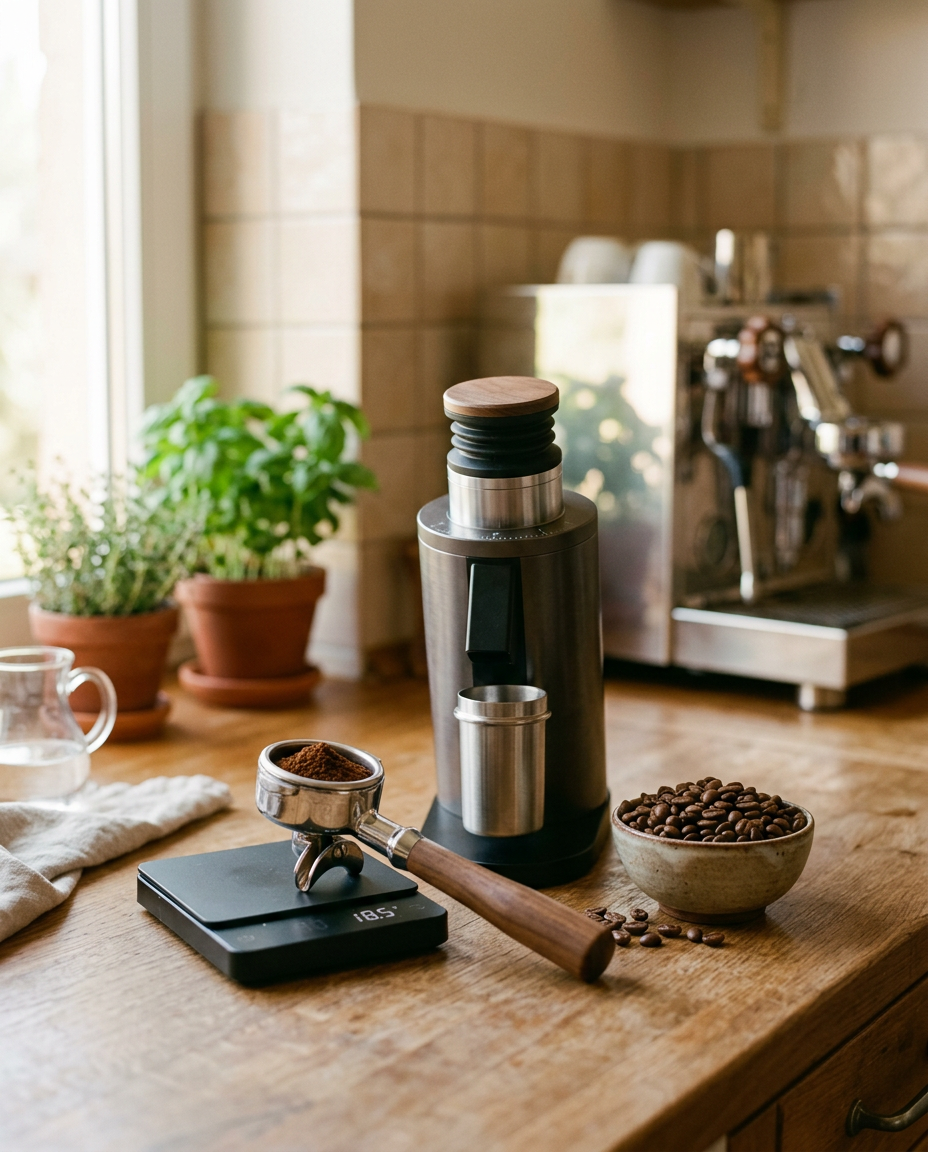
 Maestri House Burr Coffee Grinder, 80-Level, Rechargeable, Single-Dose