How to Use a Breville Espresso Machine: Step-by-Step
Learn the repeatable workflow for grinding, dosing, extracting, steaming milk, and cleaning a Breville home espresso machine.
By the Niche Picks editorsUpdated October 5, 20267 min readDrawn from our 30 research-based coffee gear reviews
Short answer
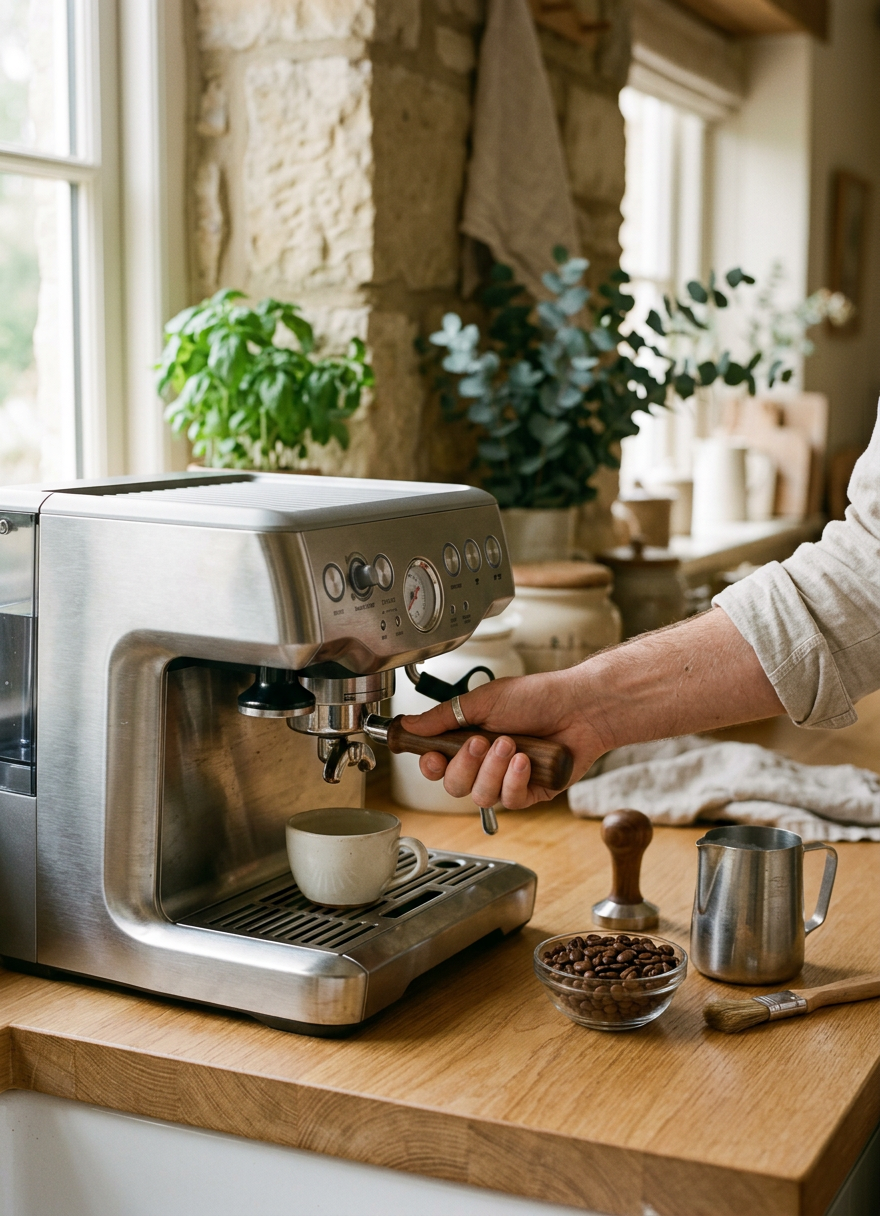
To use a Breville espresso machine, fill the water tank, warm up the machine and portafilter, grind fresh coffee into the basket, distribute and tamp level, then start the shot and stop it at your chosen yield. Adjust the grind one small step at a time when flow is too fast or too slow, purge the steam wand before and after milk, and clean the group area after brewing.
- 1,600 W
- listed wattage of the Breville Barista Express BES870XL
- $689.99
- listed price of the brushed stainless Barista Express BES870XL
- 8–10 bar
- commonly cited espresso extraction pressure range; higher pump claims are not automatically better
Key takeaways
- Warm the machine and portafilter before pulling a shot so the brew setup begins at a more consistent temperature.
- Use a burr grinder rather than a blade grinder, because espresso depends on a narrow and repeatable particle-size range.
- Change only one variable at a time—usually grind setting first—when dialing in a new coffee.
- A pressure number on a machine box matters less than stable brew temperature and a grinder that can make fine adjustments.
- Purge and wipe the steam wand immediately after every use to keep milk residue from baking onto the tip.
Our picks for “how to use breville espresso machine”
- 1
 Breville BES870XL Barista Express Espresso Machine, Brushed Stainless Steel4.4$689.99Our score 7.3/10Best for Convenient all-in-one home espresso setups
 - 2
 Breville BES880BSS Barista Touch Espresso Machine, Brushed Stainless Steel4.2$799.95Our score 7.9/10Best for Households wanting an integrated, automated setup
 - 3
 Maestri House Burr Coffee Grinder, 80-Level, Rechargeable, Single-Dose4.2$109.99Our score 7.2/10Best for Portable and low-retention home grinding
- Breville BES870XL Barista Express Espresso Machine7.3
- Breville BES880BSS Barista Touch Espresso Machine7.9
- Maestri House Burr Coffee Grinder7.2
- Breville BES870XL Barista Express Espresso Machine690
- Breville BES880BSS Barista Touch Espresso Machine800
- Maestri House Burr Coffee Grinder110
| Product | Listed price | Operation mode | Coffee-grinding setup | Relevant workflow note |
|---|---|---|---|---|
| Breville Barista Express BES870XL | $689.99 | Manual | Integrated conical burr grinder | Thermocoil system; stepped grinder limits micro-tuning |
| Breville Barista Touch BES880BSS | $799.95 | Fully automatic | Integrated stepped conical burr grinder | Automated milk frothing; shared housing combines grinder and machine |
| Maestri House Burr Grinder | $109.99 | Not listed | 38 mm conical burr; 80 stepped settings | Single-dose, rechargeable grinder; stepped settings can limit espresso precision |
What do you need before using a Breville espresso machine?
Start with fresh whole beans, clean water, a clean portafilter and basket, a towel, and a small milk pitcher if you plan to make milk drinks. The exact buttons and menus vary by model, so keep your model-specific manual nearby. The core workflow is the same across manual and more automated Breville machines: prepare coffee, brew, then clean.
The most consequential purchase is usually the grinder. Espresso needs finely ground coffee with a consistent particle size, and adjustments need to be repeatable. The Barista Express has an integrated conical burr grinder, which keeps the setup compact, but its stepped adjustment can make tiny dial-in changes harder. The Barista Touch also has an integrated stepped conical burr grinder. A separate burr grinder can be a practical upgrade when you want more control; our coffee grinder and espresso guide explains why burr design and adjustment range matter more than motor wattage.
Avoid using a spinning blade grinder for espresso. It chops beans into a mix of fine dust and large particles, making uneven extraction much more likely. For context, the rechargeable Maestri House grinder uses a 38 mm conical burr and has 80 stepped settings, though steps can still limit exact espresso dialing. See our Coffee gear buyer's guide for the wider setup decision.
- Fresh whole beans
- Filtered or otherwise clean-tasting water
- Burr-ground coffee suitable for espresso
- Portafilter, basket, tamper, and a clean cloth
- Milk pitcher if steaming milk
Read the reviews: Breville BES870XL Barista Express Espresso Machine, Breville BES880BSS Barista Touch Espresso Machine, Maestri House Burr Coffee Grinder
How do you set up and warm up the machine?
Fill the removable water tank with fresh water, reinstall it securely, turn the machine on, and allow it to complete its ready cycle. Put the empty portafilter into the group head while the machine warms. Warming the metal portafilter reduces the temperature shock that can occur when hot brew water first meets a cold basket.
Before adding coffee, run a brief blank shot through the locked-in empty portafilter. This warms the group and rinses away any residue from the prior session. Discard that water and dry the basket thoroughly. A wet basket can make grounds clump and stick to the metal, which makes even distribution more difficult.
The Barista Express is a thermocoil-based machine. That design offers convenient warmup, but its temperature recovery is less stable than a dual-boiler design. Give the machine a moment between back-to-back drinks, and use a brief flush deliberately rather than repeatedly flushing for long periods. With a single heating system, expect to brew and steam in sequence rather than at exactly the same time.
If your shot quality changes from one drink to the next, slow down and make the warmup and flush routine identical each time. Consistency in the routine helps identify whether a problem is the coffee, grind, dose, or temperature management. Our Barista Express review covers the all-in-one machine's strengths and constraints, while our espresso-machine mistakes guide identifies common setup errors.
Read the reviews: Breville BES870XL Barista Express Espresso Machine
How do you grind, dose, distribute, and tamp espresso?
Grind immediately before brewing. Set the portafilter under the grinder, grind into the basket, and aim for an even coffee bed. If grounds pile heavily on one side, gently settle or distribute them before tamping. The goal is not elaborate ritual; it is a level, evenly packed puck that presents consistent resistance to brewing water.
Place the portafilter on a stable surface, hold it level, and tamp straight down with firm, repeatable pressure. Finish with a level surface and brush loose grounds from the basket rim. Coffee trapped on the rim can interfere with the seal between portafilter and group head.
Use the basket intended for your coffee and workflow. A pressurized basket is more forgiving of pre-ground coffee and uneven grinding, while a non-pressurized basket reveals whether the grind and preparation are properly dialed in. It cannot correct an inconsistent grind. This is why a blade grinder is a poor partner for a Breville espresso machine, regardless of how long it runs.
For a new bag of beans, choose a reasonable starting grind, pull one shot, and adjust based on its flow and taste. Do not simultaneously change the grind, dose, tamp, and brew volume. That makes the result impossible to interpret. For a clear buying framework, read our home espresso machine guide and coffee gear FAQ.
Read the reviews: Breville BES870XL Barista Express Espresso Machine, Maestri House Burr Coffee Grinder
How do you pull and dial in an espresso shot?
Lock the prepared portafilter into the group head and begin brewing without unnecessary delay. Coffee begins reacting with moisture as soon as it is ground, so a long pause after grinding can make repeatability worse. Watch the flow, the volume in the cup, and the taste rather than relying on a single pressure-gauge reading.
If the shot rushes out quickly and tastes thin, sour, or weak, make the grind finer one small adjustment at a time. If it drips very slowly and tastes harsh, dry, or bitter, make the grind coarser. Let the grinder clear before evaluating the next change, and use the same dose and tamp while you test. Breville's integrated grinder is stepped, so there may be occasions when one setting is slightly fast and the next is slightly slow; use small dose changes only after you have found the closest sensible grind setting.
Pressure is not the primary goal. Proper espresso is typically extracted around 8 to 10 bar, and a large advertised pump-pressure number does not promise a better cup. Temperature stability and grind control deserve more attention. The Barista Express includes pre-infusion and pressure-gauge monitoring, useful feedback tools, but they do not replace a careful dial-in process.
Keep brief notes when changing coffees: bean name, grinder setting, dose, output, and taste. This turns dial-in from guesswork into a repeatable routine. For a comparison of setup paths, use our product comparison tool.
Read the reviews: Breville BES870XL Barista Express Espresso Machine
How do you steam milk on a Breville machine?
Brew the espresso first, then steam milk. Fill a cold metal pitcher only enough to leave room for expansion. Purge the steam wand briefly before placing it in the milk; this clears condensed water from the wand. Position the tip near the surface initially to introduce a small amount of air, then lower it slightly to create a rolling whirlpool that integrates the foam.
Stop steaming when the pitcher becomes too hot to hold comfortably for more than a moment. Turn the steam off before removing the wand from the milk, then wipe the wand immediately with a damp cloth and purge it again. These two post-steam actions are important: milk residue hardens quickly, and a blocked steam tip can reduce performance.
The Barista Express has dedicated milk-steaming capability, but its shared heater means it cannot brew and steam simultaneously. Plan your workflow accordingly. The Barista Touch adds automated milk frothing, which can reduce the amount of manual technique required, though it still benefits from prompt wiping and purging after each drink.
A handheld frother can aerate warm milk for casual drinks, but it does not use steam and generally will not make the tight microfoam used for latte art. If you mainly want automated convenience, compare the Breville options with our best espresso machine for home picks.
Read the reviews: Breville BES870XL Barista Express Espresso Machine, Breville BES880BSS Barista Touch Espresso Machine
How should you clean and maintain a Breville espresso machine?
After every drink, knock out the coffee puck, rinse the basket and portafilter, and run a short flush through the group head. Wipe the shower area if coffee grounds are visible. Never leave a used puck in the basket for hours: it dries, traps oils, and makes the next cleanup harder.
After steaming, wipe and purge the steam wand immediately. Empty and rinse the drip tray before it overflows, and refill the water tank with fresh water rather than continually topping up old water. These small habits protect flavor and make periodic deep cleaning less difficult.
Descaling is different from ordinary cleaning. Cleaning removes coffee oils and grounds; descaling removes mineral buildup created by water. The correct interval depends on local water hardness, machine use, and the machine's own maintenance prompts. Use a descaling product and procedure suitable for your machine, and follow the manual rather than improvising with harsh household chemicals.
For practical schedules and safe procedures, follow our guides on how to clean a Breville espresso machine and how to descale a Breville espresso machine. Regular maintenance is especially valuable for all-in-one machines because the grinder and brewing system share one countertop appliance.
Read the reviews: Breville BES870XL Barista Express Espresso Machine, Breville BES880BSS Barista Touch Espresso Machine
Step by step
- 1Fill the water tank, turn the Breville on, lock in the empty portafilter, and let the machine reach ready status.
- 2Run a short blank shot, discard the water, and dry the portafilter basket.
- 3Grind fresh beans into the basket, distribute the grounds evenly, and tamp level.
- 4Lock in the portafilter and begin brewing immediately; stop at your chosen beverage yield.
- 5Taste the shot and adjust the grind finer if it runs too quickly or coarser if it runs too slowly, changing only one variable at a time.
- 6For milk drinks, purge the steam wand, steam cold milk, then wipe and purge the wand again immediately.
- 7Knock out the puck, rinse the basket and portafilter, flush the group briefly, and empty the drip tray as needed.
Quick checklist
- Fill the tank with fresh water and confirm it is seated properly.
- Warm the machine with the portafilter locked in, then run a short blank flush.
- Dry the basket completely before grinding.
- Use freshly ground coffee from a burr grinder, not a blade grinder.
- Distribute the grounds evenly and tamp level before locking in the portafilter.
- Adjust one variable at a time if flow or flavor is off.
- Purge and wipe the steam wand immediately after steaming.
- Rinse the portafilter and basket and flush the group after the final shot.
Frequently asked questions
- How long should I let a Breville espresso machine warm up?
- Wait until the machine indicates it is ready, and warm the portafilter in the group head during that time. A short blank flush immediately before brewing helps warm the brewing path and rinse residual coffee. Thermocoil machines warm quickly, but a consistent warmup routine matters when you want repeatable shots.
- Why is my Breville espresso shot running too fast?
- The most likely correction is a finer grind, made one small step at a time. Also check that the basket is adequately filled for your recipe, the coffee bed is evenly distributed, and the tamp is level. Keep other variables unchanged while testing so you can tell whether the grind change solved the issue.
- Why is my Breville espresso shot bitter or slow?
- An overly slow shot can be caused by a grind that is too fine or a puck that creates excessive resistance. Try a slightly coarser grind first, then reassess. Bitter flavor can have several causes, so avoid making many changes at once; repeatable dose, distribution, and brew volume make diagnosis easier.
- Can I use pre-ground coffee in a Breville espresso machine?
- Yes, provided you use the appropriate basket and coffee ground for espresso. Pre-ground coffee is less flexible because you cannot adjust its grind when the shot runs too fast or too slow. A pressurized basket is generally more forgiving, while a non-pressurized basket depends more heavily on an accurate, consistent grind.
- Do I need a separate grinder for a Breville Barista Express?
- No. The Barista Express has an integrated conical burr grinder, so it is designed as a compact all-in-one setup. Its stepped adjustment can limit very fine dial-in changes, however. A separate capable burr grinder is worth considering if you want more control, and it should be prioritized over a blade grinder.
- How often should I clean and descale a Breville espresso machine?
- Rinse the portafilter and basket, flush the group, and wipe and purge the steam wand after each use. Descaling frequency depends on water hardness, usage, and the machine's maintenance prompts. Cleaning coffee oils and descaling mineral buildup are different tasks, so use the machine-specific procedure for each.
Sources
- Niche Picks review: Breville BES870XL Barista Express Espresso Machine
- Amazon listing and buyer reviews: Breville BES870XL Barista Express Espresso Machine
- Niche Picks review: Breville BES880BSS Barista Touch Espresso Machine
- Amazon listing and buyer reviews: Breville BES880BSS Barista Touch Espresso Machine
- Niche Picks review: Maestri House Burr Coffee Grinder
- Amazon listing and buyer reviews: Maestri House Burr Coffee Grinder
- Coffee gear buyer's guide
- How we research and score products
Amazon links are affiliate links; we may earn a commission at no cost to you.
More on Coffee gear
- How to Make Espresso Without a Machine
- Best Espresso Machine for Home: 5 Picks and Buying Advice
- The best espresso machine under $500
- Coffee Grinder and Espresso: What You Need to Buy
- How to Descale a Breville Espresso Machine Safely
- How to Clean a Breville Espresso Machine: Daily to Deep Clean
- Breville Barista Express Espresso Machine: Is It Worth It?
- How to descale an espresso machine (and how often)
- Coffee gear buyer's guide
- Coffee gear FAQ
- All coffee gear reviews