Best Pour Over Coffee Maker: Choosing Gear for Precision Brewing
Elevate your daily pour over with expert advice on pairing high-quality burr grinders with the right equipment for a balanced, cafe-quality cup at home.
By the Niche Picks editorsUpdated November 8, 202610 min readDrawn from our 31 research-based coffee gear reviews
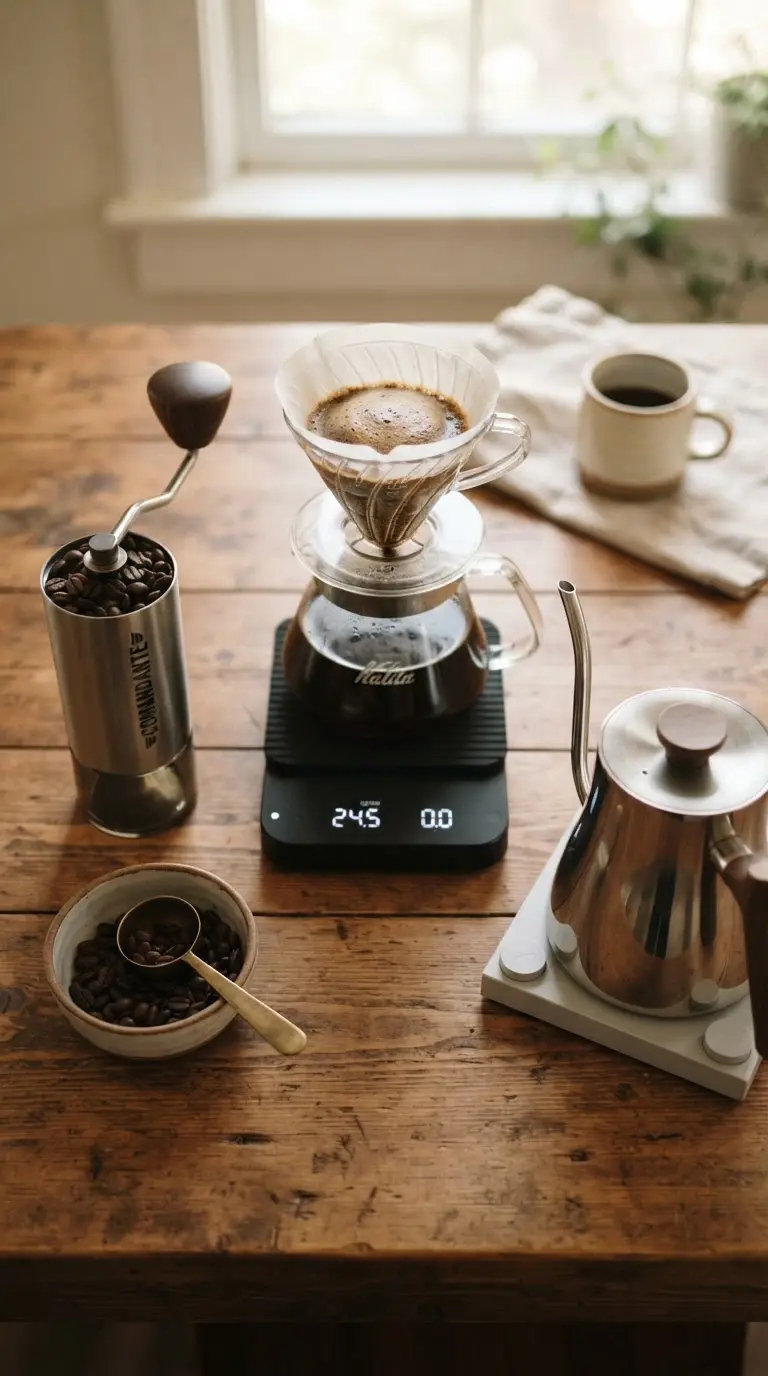
AI-generated editorial illustration; not a product or test photograph.
Short answer
The best pour over coffee experience is achieved by prioritizing a high-quality, stepless or micro-stepped burr grinder over the brewer itself. While the dripper matters, uniform particle size is the foundation of flavor clarity, preventing the bitterness caused by uneven extractions from blade-based mills. Invest in a dedicated burr grinder to ensure your beans are consistently prepared for manual extraction.
6
Product listings discussed; not hands-on tests
6/6
Discussed listings with a recorded price
$17.99–$599.00
Recorded listing price range; not a complete setup cost
Key takeaways
Prioritize burr geometry over motor wattage to achieve a uniform particle size that prevents over-extraction.
Match your grinder budget to your brewing machine's cost to ensure a balanced setup that avoids performance bottlenecks.
Avoid blade grinders entirely, as they create a bimodal distribution of fines and boulders that ruins flavor balance.
Manual pour over methods benefit significantly from a gooseneck kettle, which allows for precise water placement and flow control.
Select modular equipment over all-in-one machines if you want to prioritize long-term maintenance and upgrade paths.
Products discussed in this article
Editorial scores and recorded prices are reference points, not measurements of suitability for every use. Read each review's specifications and limitations.
Comparison of Recommended Coffee Grinding and Brewing Hardware
Product
Burr Type
Grind Adjustment
Best For
Maestri House
38mm Conical
80-Level
Single-dose
OXO Brew
40mm Conical
15 Primary
Filter/Pour Over
Ninja Luxe
Conical
25-Setting
Multi-beverage
CASABREWS CM5418
N/A
N/A
Compact Espresso
Belly Moka
N/A
Manual
Stovetop
CASABREWS 3700
N/A
N/A
Entry Espresso
Why Grind Quality Is the Foundation of Pour Over
The quality of your pour over coffee is inextricably linked to the consistency of your grind. Unlike automated drip machines, manual pour over methods expose the coffee grounds to a stream of water that requires specific flow resistance. If your grinder produces a mix of micro-fine dust and large bean fragments—a common issue with blade-based units like those in our Coffee gear archives—the water will channel unevenly. The fines extract almost instantly, leading to bitter astringency, while the coarse boulders leave the cup tasting weak and sour. This is a central mistake to avoid when building your initial setup.
To achieve the clarity and nuance expected from a pour over, you must utilize a burr grinder. Burr geometry is significantly more important than raw motor wattage. A quality burr set, such as the 38mm conical burrs found in the Maestri House Burr Coffee Grinder, shears beans cleanly rather than shattering them. This uniform particle distribution ensures that the extraction rate is consistent throughout the entire bed of coffee. By investing in a dedicated burr mill, you take the first step toward master-level brewing, moving beyond the limitations of basic impact grinders that are ill-suited for precision manual techniques. For more insight into why this matters, check out our guide on Coffee Grinder and Espresso dynamics.
Consistency in particle size allows you to dial in the perfect flavor profile for your chosen beans. If you are struggling to get a balanced cup, your grinder is almost certainly the primary bottleneck. Most budget-conscious buyers find that moving from a spinning blade to a controlled burr system results in the single biggest jump in taste quality. Once your grind is sorted, you can focus on water temperature and pour technique to refine your daily ritual. We suggest exploring our broader Coffee gear reviews to see how different grinders perform against various extraction benchmarks.
A recurring theme in our expert analysis is the importance of a balanced financial allocation for your coffee setup. It is common for consumers to spend the vast majority of their budget on a shiny machine while neglecting the grinder, yet the grinder is ultimately responsible for the uniformity of the brew. Our Budget planning philosophy dictates that you should allocate roughly equal amounts to your brewer and your grinder to avoid performance gaps. For instance, pairing a premium, feature-heavy machine like the Ninja Luxe Café Premier with a subpar blade grinder wastes the potential of that machine's thermal and pressure capabilities.
When you build a pour over setup, you have more flexibility than with espresso, but the need for a quality grinder remains absolute. If you are shopping on a tighter budget, look for entry-level burr mills that provide at least 15 to 40 steps of adjustment, such as the OXO Brew Conical Burr Grinder. These units provide enough precision to distinguish between settings for a pour over, a Chemex, or a French press. We advise readers to avoid over-spending on high-wattage spice grinders that lack proper burr calibration. Investing in a grinder with repeatable steps is a foundational move that pays for itself over time by minimizing wasted beans and consistently producing superior cups. For further advice on avoiding common pitfalls, refer to our mistakes to avoid list.
Remember that accessories like scales, gooseneck kettles, and filters are also part of your total cost. A balanced setup might feature a reliable burr grinder, a manual dripper, and a decent scale, which collectively deliver a higher quality cup than an expensive, all-in-one appliance paired with inconsistent pre-ground beans. Your goal is to create a system where each component supports the extraction process, not one that forces you to compensate for lack of precision. Check our blog for more tips on how to allocate your funds effectively.
Consistent coffee starts with consistent habits. Use a digital scale to weigh both your coffee dose and your water to ensure the same brew ratio every single morning.
Is An All-in-One Machine Right for Your Kitchen?
Many consumers are tempted by the efficiency of all-in-one platforms, such as the CASABREWS 3700 Essential or various Breville models. These machines offer a unified footprint that combines grinding, brewing, and often milk frothing into one compact chassis. For a household that values speed and minimal counter clutter, these integrated solutions can be very effective. However, they carry an inherent risk: if the grinder portion of the unit fails or reaches its performance limit, you are left with a machine that no longer meets your needs, often requiring you to purchase a separate, better grinder anyway.
Integrated machines are perfect for users who want a "set it and forget it" workflow. They often include helpful automation, such as built-in timers or volumetric dosing, which makes repeating a morning routine simple. If you enjoy the hands-on aspect of manual brewing, these machines might feel too restrictive, as they often lack the ability to adjust grind settings with the granularity of a high-end standalone burr mill. For users who want to explore the nuances of different beans or roast profiles, a modular approach—where you select your brewer and your grinder separately—offers the greatest long-term satisfaction. You can find more details in our Best home espresso machines roundup to see how these integrated systems compare to dedicated setups.
Before deciding, consider the total longevity of your equipment. A dedicated burr grinder built for longevity, maintained according to manufacturer instructions, will likely outlast the integrated grinders found in consumer-grade espresso or drip machines. This is a critical factor for those who view coffee gear as a long-term investment rather than a disposable appliance. For more help on selecting the right tools, our blog provides tips on how to evaluate gear longevity before you buy. Remember to consult manufacturer manuals regarding regular cleaning, as stale grounds affect flavor in any machine.
While manual pour over relies heavily on your technique, the temperature stability of the water you use is paramount. Coffee grounds extract compounds differently based on the water temperature; too low and the cup lacks sweetness, too high and it may turn harsh. Machines like the CASABREWS CM5418 use thermoblock or heating systems that, while convenient for espresso, demonstrate the importance of thermal mass in extraction. For manual pour over enthusiasts, this means your kettle selection is not just about the spout—it is about heat retention. A heavy stainless steel gooseneck kettle will stabilize temperatures far better than a thin plastic vessel.
Maintaining a consistent temperature across the entire pour process is essential. If you allow the water to cool significantly between your bloom phase and your main pours, the extraction profile will be uneven, resulting in a cup that feels "confused" or muddled. This is why many enthusiasts use thermometers alongside their scales. When comparing brewers, consider the material properties. Ceramic retains heat well but takes time to preheat, while thinner metal drippers heat up quickly but lose heat just as fast. A proper routine includes a "rinse and preheat" step, where you pour hot water through the filter and the empty dripper before adding your grounds. This ensures that your brewing vessel does not rob the water of its heat during the first few seconds of contact.
As you refine your setup, look at our Best home espresso machines as a baseline for how thermal engineering affects flavor. Even in a simple manual dripper, the same physics apply: if the water loses energy, the extraction stalls. By standardizing your preheat procedure and using a consistent, high-quality grind, you bridge the gap between amateur home coffee and the results found in specialty cafes. For beginners, we recommend starting with simple, reliable tools found in our Coffee gear category.
Blade-style grinders shatter beans rather than shearing them, leading to an uneven extraction of fines and boulders that makes a balanced cup impossible to achieve.
Manual Brewing vs. Stovetop Concentration
For those who prefer a more concentrated cup, moka pots like the Belly Moka 3-Cup offer an alternative to traditional pour over. While these are not strictly "pour over" makers, they follow similar principles: they require a specific grind size and rely on the user to manage the heat source. Stovetop brewers generate pressure through vapor displacement, which demands a finer, more uniform grind than the coarser setting needed for a standard pour over dripper. If your grinder is not up to the task, you will notice that the moka pot produces more sediment, which can lead to a muddy, gritty mouthfeel.
When using a moka pot, heat management is your primary control variable. Just as you regulate the pour rate in a manual dripper to manage extraction time, you must regulate the burner output to ensure the water moves through the coffee at a steady, controlled rate. Scorching the beans is a common error; it happens when the heat source is too high, causing the water to boil rapidly and burn the grounds before they can properly bloom or extract. Using pre-heated water in the base of the moka pot can reduce the time the coffee grounds spend exposed to heat, which significantly improves the final flavor.
Whether you stick to a classic dripper or opt for a moka-style concentration, the mantra remains the same: grind matters most. A high-quality burr grinder allows you to switch between these methods by simply adjusting the step. If you enjoy experimenting with different brewing formats, it is even more critical to avoid the low-cost, high-fines blade grinders listed in our mistakes to avoid section. Investing in a solid, versatile burr mill from our Coffee gear list provides the flexibility to explore these different styles without sacrificing the clarity of your cup.
The longevity of your coffee gear is almost entirely dependent on your maintenance schedule. Coffee beans contain volatile oils that, when exposed to oxygen and light, eventually turn rancid. When these oils accumulate in your grinder, they coat the burrs and contaminate every fresh batch you grind with stale, bitter flavors. We recommend a dry cleaning routine: use a stiff brush to clear the burrs of any loose grounds after every few uses. Do not use water or soap on your burrs, as this can cause corrosion and rust, particularly in carbon steel sets. For more on maintenance, read our tips on how to clean a Breville espresso machine as a reference for general hygiene.
If your machine has a hopper, empty it regularly rather than storing beans in it for weeks. Light and air accelerate the aging of coffee beans, making it harder to extract the flavor profiles you actually paid for. Store your beans in opaque, airtight containers in a cool, dark place. This simple habit preserves the freshness of your coffee for much longer, ensuring that when you do grind it, you are starting with the highest quality material possible. If you are using a machine like the CASABREWS 3700 Essential, the same logic applies to the water tank; ensure it is emptied and wiped down to prevent mineral build-up or bacterial growth.
Finally, treat your equipment with the respect it deserves as a mechanical tool. Most entry-level appliances are made with plastic housings that can become brittle if dropped or handled roughly. When locking a portafilter or a grind hopper, ensure it is properly aligned to prevent stripping the threads or cracking the mounting tabs. By following these basic handling steps, you ensure your investment provides consistent, delicious coffee for years. Check our guide on coffee gear for more in-depth advice on keeping your setup running like new.
1Start with high-quality, freshly roasted whole beans for maximum flavor.
2Weigh your beans precisely using a digital scale before grinding.
3Set your burr grinder to the appropriate size for your pour over dripper.
4Preheat your dripper and carafe with hot water to maintain temperature stability.
5Place a paper filter in the dripper and rinse it thoroughly to remove paper taste.
6Add your ground coffee and perform a 30-second bloom with a small amount of water.
7Pour the remaining water in steady, concentric circles to maintain a consistent bed.
8Allow the coffee to fully draw down before removing the dripper and serving.
Quick checklist
Clear adequate space for a dedicated grinder and a brewing station.
Select a conical or flat burr grinder with at least 15-40 grind settings.
Verify that your chosen brewer supports your preferred brewing method.
Invest in a precise digital scale for accurate bean and water measurement.
Purchase a gooseneck kettle to control water flow and temperature.
Schedule a regular cleaning routine for your burrs and brewing vessel.
Frequently asked questions
Why shouldn't I use a cheap blade grinder for pour over?
Blade grinders shatter beans into an unpredictable mix of large chunks and fine dust. This unevenness causes 'channeling' in a pour over, where water passes too quickly through boulders and over-extracts the fines. The result is a cup that tastes simultaneously sour and bitter, lacking the clarity a burr grinder provides.
How much should I spend on a grinder?
We recommend the rule of thumb: spend roughly as much on your grinder as you do on your brewing device. If you invest in a $200 brewer, a $100-$200 dedicated burr grinder is a balanced investment that will ensure you aren't bottlenecking the performance of your machine.
What is the difference between conical and flat burrs?
Conical burrs are generally more efficient and tend to produce a wider particle distribution, often creating a bit more sweetness and body in the cup. Flat burrs typically offer more precision and clarity, which can highlight delicate acidity. For home pour over setups, both styles are excellent if properly manufactured.
Do I need a gooseneck kettle?
A gooseneck kettle is highly recommended for pour over methods because it allows you to control the flow rate and placement of the water precisely. This control is crucial for maintaining a steady extraction and preventing the grounds from being disturbed too aggressively during the brewing process.
How often should I clean my grinder?
You should clean your grinder's burrs whenever you notice oil buildup or a decline in grind consistency, typically once every few weeks for heavy daily users. Avoid using soap; use a dry brush or a specialized grinder cleaning pellet to remove stale coffee residue without damaging the motor or internal electronics.
Amazon links are affiliate links; we may earn a commission at no cost to you.
Shortlists in this category
Ranked lists from our coffee gear reviews, limited to listings whose titles confirm the product type, with budget cuts where enough recorded prices sit on both sides of the line.
This page summarizes our research reviews of Amazon listings, listed specifications and captured buyer ratings. It is not a hands-on test. Scores are editorial assessments, not measured performance; prices are recorded snapshots and may change. A category can include both main products and accessories, so its overall price range is not the cost of a complete setup.
Most recent product record update: September 22, 2026. Individual records may be older; this is not a verification date for every claim. Prices on this page were read from the listings Nov 8, 2026 – Nov 10, 2026.
Choose the product type first. These groups require a match in the listing title; an import search term alone is not enough. Scores rank our recorded research assessments within each group, not independently measured performance.
Values are shown as recorded, without unit conversions or inferred compatibility. Not recorded means unknown, not absent. Prices are snapshots, not current offers. Editorial scores are research judgments, not lab results. Amazon links are affiliate links.
Before treating a comparison as complete
Which details are still unknown?
A specification appearing in a listing is not independent verification. These counts show which shortlisted records contain the same field; a blank record does not mean the product lacks the feature.
Material
Recorded for 2 of 2 shortlisted models
Present in every shortlisted record. Check units, exact variants and the current manufacturer documentation before relying on it.
Power Source
Recorded for 2 of 2 shortlisted models
Present in every shortlisted record. Check units, exact variants and the current manufacturer documentation before relying on it.
Voltage
Recorded for 2 of 2 shortlisted models
Present in every shortlisted record. Check units, exact variants and the current manufacturer documentation before relying on it.
Wattage
Recorded for 2 of 2 shortlisted models
Present in every shortlisted record. Check units, exact variants and the current manufacturer documentation before relying on it.
Values are shown as recorded, without unit conversions or inferred compatibility. Not recorded means unknown, not absent. Prices are snapshots, not current offers. Editorial scores are research judgments, not lab results. Amazon links are affiliate links.
For espresso machines, check temperature-control documentation and brewing workflow. A pump-pressure figure alone does not establish temperature stability or cup quality.
For grinders, confirm the stated brewing range, burr type and adjustment steps. Espresso and filter brewing need different settings; motor wattage alone does not establish grind consistency.
Price the machine, a grinder suited to your brewing method and required accessories separately. Check what is included before treating a listing price as a complete coffee setup.
If a specification, certification or compatibility detail is absent, mark it as unknown and ask the seller or manufacturer. Do not substitute a star rating, an editorial score or a different model's specification.