How Accurate Are GPS Running Watches? A 2026 Editor Guide
Discover how satellite technology dictates your pacing data and learn why dual-band GNSS is the definitive upgrade for serious training accuracy.
By the Niche Picks editorsUpdated November 9, 20267 min readDrawn from our 31 research-based running shoes & watches reviews
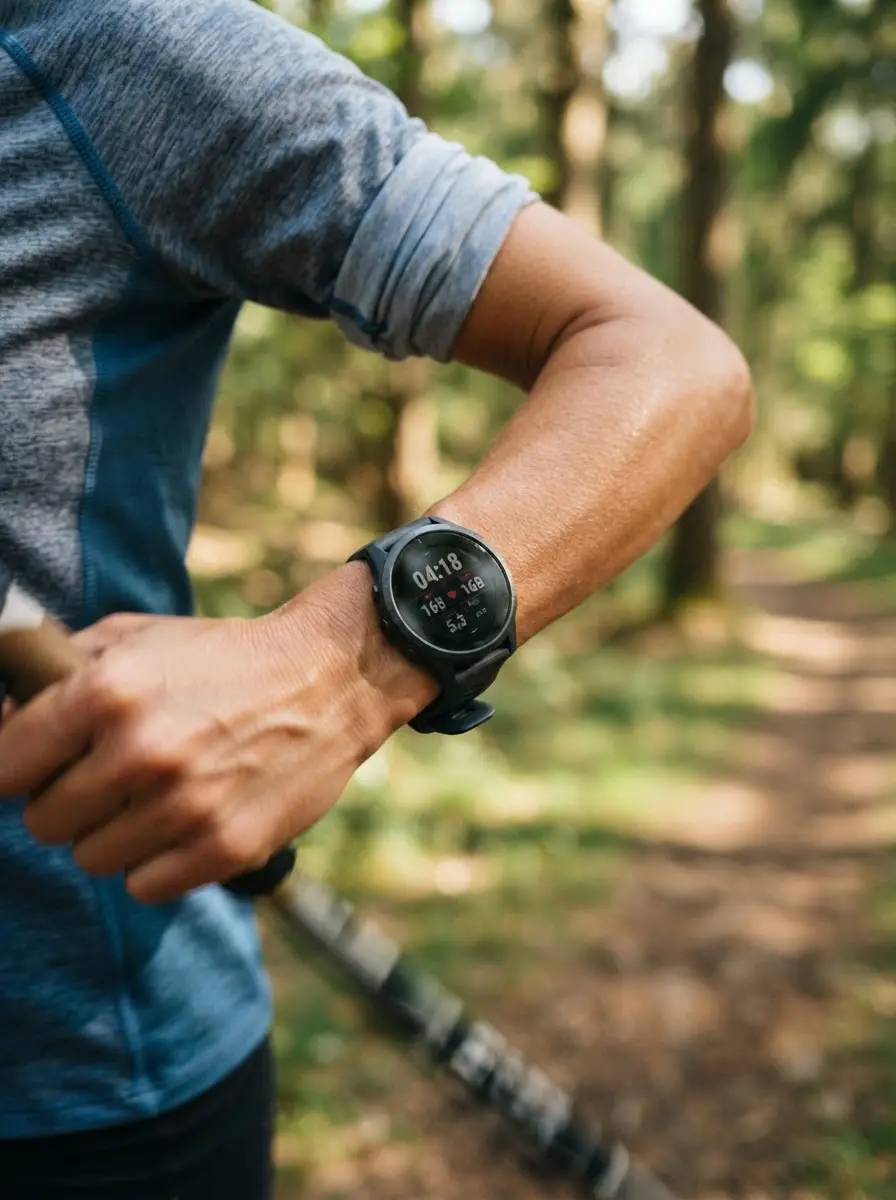
AI-generated editorial illustration; not a product or test photograph.
Short answer
GPS running watches generally provide reliable distance and pace tracking in open environments, but accuracy degrades in urban canyons or heavy forest cover. True positional precision depends heavily on hardware, with dual-band GNSS technology currently serving as the industry benchmark for minimizing track drift and signal loss compared to standard single-frequency receivers.
4
Product listings discussed; not hands-on tests
4/4
Discussed listings with a recorded price
$41.99–$191.00
Recorded listing price range; not a complete setup cost
Key takeaways
Standard single-frequency GPS watches are sufficient for open road running but struggle near tall buildings or dense foliage.
Dual-band GNSS is the primary hardware upgrade required to significantly improve positional accuracy in complex environments.
GPS watch accuracy is also affected by atmospheric conditions, satellite visibility, and the quality of the watch's internal antenna.
Reliable pacing metrics often require a combination of satellite data and wrist-based accelerometers for smoother real-time feedback.
Our reviews indicate that entry-level watches rely on older single-band chips, which are prone to minor path smoothing and distance deviations.
Products discussed in this article
Editorial scores and recorded prices are reference points, not measurements of suitability for every use. Read each review's specifications and limitations.
Comparison of GPS running watches based on core metrics and tracking capabilities.
Product
Price
Display
Satellite Type
Battery Life
Garmin Forerunner 55
$161.99
Transflective
Single-Band
2 weeks
moutarlier Watch
$41.99
AMOLED
Single-Band
Varies
EZON T031
$49.99
LCD
Single-Band
6 hours
Garmin Forerunner 165
$191.25
AMOLED
Single-Band
11 days
Why Does Satellite Tracking Accuracy Vary?
GPS tracking is never perfectly linear because it relies on signals bouncing between orbiting satellites and the receiver on your wrist. In an ideal environment, such as a wide-open track or a rural road with no overhead obstructions, even entry-level devices like the Garmin Forerunner 55 can record distance with high consistency. The core challenge arises when these signals are interrupted. When you run near skyscrapers—often called 'urban canyons'—the watch receives reflected signals rather than direct ones, which manifests as jagged, unrealistic pathing on your digital map.
The quality of the receiver chip determines how quickly a watch locks onto a signal.
Dense tree cover can scatter satellite signals, leading to pace 'smoothing' where the watch fails to record sudden speed changes.
Atmospheric conditions, such as heavy cloud layers, can occasionally interfere with signal strength.
Most budget-friendly options, such as the moutarlier GPS watch, utilize standard multi-system GPS. While these are perfectly serviceable for casual fitness tracking, they lack the sophisticated filtering algorithms found in top-tier performance devices. Understanding these limitations is critical before choosing your next training partner; you can find more context in our Running shoes & watches FAQ.
The single most significant technical leap in recent years is the transition to dual-band GNSS. While standard GPS watches listen to signals on one frequency (L1), dual-band watches track both L1 and L5 frequencies. This allows the watch to discard erroneous 'multipath' signals—the ones bouncing off buildings or mountains—and prioritize the strongest, most accurate data points. This distinction is the key to true elite-level performance tracking.
Dual-band GNSS enables higher precision in environments where standard watches fail.
It helps maintain consistent pace readings during intervals in challenging terrain.
The hardware improvement often commands a higher price point, making it a feature for serious training.
Our Best Running Watches guide highlights how these features correlate with training goals. If you are a runner who trains in a city or heavily forested area, skipping dual-band technology often results in frustration regarding distance accuracy. Even intermediate models like the Garmin Forerunner 165 provide excellent ecosystem tools, yet they highlight how mid-tier price points sometimes still exclude this high-precision hardware in favor of other features like AMOLED displays.
Always wait at least 30 seconds after the watch signals a 'GPS Ready' state before beginning your run to ensure a more accurate starting position.
How to Manage Pacing Expectations
Runners often scrutinize their watches for 'instantaneous pace' accuracy, but it is important to understand that no GPS device is perfectly instantaneous. Every watch uses software algorithms to average out speed fluctuations over several seconds to prevent the screen from jumping wildly. When your watch shows a sudden pace spike that you don't feel in your legs, it is usually a momentary GPS drift rather than a sudden change in performance.
Trust the cumulative lap distance more than the live pace display for effort management.
Use custom data screens to show 'Lap Pace' rather than 'Current Pace' for better stability.
Recognize that watches with slower processors may take longer to react to speed changes during interval training.
If you find your current device is frequently inaccurate, consider if you are running in areas prone to interference. Our Running shoes & watches buyer's guide covers how to assess your specific training environment. For those just starting out, simplicity is often better; simple models like the EZON T031 focus on basic logs without the complexity that leads to frequent troubleshooting in newer, feature-heavy smartwatches.
Beyond satellite accuracy, the physical construction of your watch impacts its long-term reliability. Waterproofing ratings like 5ATM are standard in many GPS devices, allowing you to use them in the rain or while swimming, but internal sealing can degrade over time due to pressure changes or chemical exposure in hot showers.
Always rinse your watch with fresh water after runs to prevent salt buildup from sweat.
Avoid pressing buttons while submerged to protect the internal seals.
Use the charging port protection if provided to avoid galvanic corrosion.
Many runners underestimate how much wear and tear a watch goes through, especially during long-distance prep. While you prepare, it is essential to look at the broader picture of your gear. Check our buying tips to ensure your watch choice aligns with your training volume. Remember that if you rely on Garmin Forerunner 55 vs 165 for Beginner Runners comparisons, realize that the difference in satellite hardware is just one piece of a much larger puzzle involving screen quality and battery efficiency.
If you train primarily in dense city centers, even the most expensive single-band watch will experience 'track drift.' Look specifically for dual-band GNSS models if this is a primary training environment.
Avoiding Common Mistakes in Watch Usage
One of the most frequent mistakes is assuming that a more expensive watch is automatically 'more accurate' in every scenario. Sometimes, a high-end watch with massive topographical maps will struggle just as much as a basic one if both rely on single-band GPS. Always read our mistakes to avoid to ensure you are not misinterpreting your data.
Do not assume that a higher price equals better GPS sensitivity.
Avoid starting your run immediately after the watch finds a signal; giving it an extra 30 seconds can significantly improve track start-point accuracy.
Do not rely on heart rate data from the watch as an absolute clinical measure; it is an estimate.
Accurate data helps you monitor your progress, but don't let it override how your body feels. If you are rotating your running shoes, keep an eye on your training load rather than just the mileage on your watch, as seen in our How Long Do Running Shoes Last? A 2026 Replacement Guide. Balancing your gear, including your bone conduction headphones, allows for a safer and more enjoyable training block without constant, unnecessary adjustments.
For many, the question is not just about accuracy, but about whether they need a dedicated GPS device at all. If you are just starting your journey, Do I Need a GPS Watch for Running? is a vital read. You might find that a simple stopwatch or a phone app is sufficient for the first few months of training. However, if you are looking to move into structured workouts with specific pace targets, the benefits of a watch become clearer.
Watches provide instant feedback that a phone in a pocket cannot match.
Dedicated devices are often lighter and more robust than phones.
The ecosystem (apps and performance insights) helps track long-term progress.
When choosing your gear, always align your budget with your goals by using a budget planner. If you choose a simpler model, you save funds that can be better spent on high-quality footwear, which has a more direct impact on your immediate health and injury prevention. Always compare products if you are stuck between two models, ensuring you get the features that actually matter to your daily routine rather than the marketing fluff that often surrounds new electronic releases.
1Stand in an open area with a clear view of the sky before starting your run.
2Wait for the GPS indicator to stabilize and turn green.
3Avoid starting immediately; give the hardware a moment to triangulate signal strength.
4Use a 'lap pace' data field instead of 'current pace' for more consistent feedback.
5Sync your watch with the companion app after the run to correct minor pathing errors.
6Review your GPS track against known distances to verify device consistency over time.
Quick checklist
Verify if your local running routes have high-rise buildings or dense foliage.
Determine if you need dual-band GNSS for professional-grade accuracy.
Check the battery life against your longest expected weekly training sessions.
Ensure the interface (buttons vs. touchscreen) fits your environment (e.g., rain or sweat).
Compare the weight and bulk of the watch to your personal wrist preference.
Read individual product specs to see if standard GPS is sufficient for your current mileage.
Frequently asked questions
Why does my watch map show me running through buildings?
This is called 'multipath error.' It occurs when GPS signals bounce off tall structures before reaching your watch, causing the device to miscalculate your exact coordinate. This is a common limitation of standard single-frequency GPS hardware in urban environments.
Is dual-band GNSS worth the extra cost?
If you run in cities with high-rise buildings or in deep, forested valleys, dual-band GNSS is absolutely worth the investment. For runners who stick to open suburban roads or tracks, standard single-band GPS is usually accurate enough.
Do I need to calibrate my GPS watch?
Most modern GPS watches calibrate themselves automatically by connecting to satellite networks. However, running at a consistent, known pace for a few minutes can help the internal accelerometer refine its data if you lose GPS signal in a tunnel.
Why is my current pace jumping around?
Instantaneous pace is the most volatile metric on a watch. GPS signals have inherent jitter, and watch software attempts to smooth this out. If it is jumping, it's often due to environmental interference, not a malfunctioning watch.
Should I trust my watch distance over track markers?
Generally, no. Running track markers are fixed and highly accurate. GPS watches will often add extra distance due to the way they track your path around curves. Use the track's known distance for your pacing workouts rather than your watch's GPS reading.
Amazon links are affiliate links; we may earn a commission at no cost to you.
Shortlists in this category
Ranked lists from our running shoes & watches reviews, limited to listings whose titles confirm the product type, with budget cuts where enough recorded prices sit on both sides of the line.
This page summarizes our research reviews of Amazon listings, listed specifications and captured buyer ratings. It is not a hands-on test. Scores are editorial assessments, not measured performance; prices are recorded snapshots and may change. A category can include both main products and accessories, so its overall price range is not the cost of a complete setup.
Most recent product record update: November 8, 2026. Individual records may be older; this is not a verification date for every claim. Prices on this page were read from the listings Nov 8, 2026 – Nov 12, 2026.
Choose the product type first. These groups require a match in the listing title; an import search term alone is not enough. Scores rank our recorded research assessments within each group, not independently measured performance.
Values are shown as recorded, without unit conversions or inferred compatibility. Not recorded means unknown, not absent. Prices are snapshots, not current offers. Editorial scores are research judgments, not lab results. Amazon links are affiliate links.
Before treating a comparison as complete
Which details are still unknown?
A specification appearing in a listing is not independent verification. These counts show which shortlisted records contain the same field; a blank record does not mean the product lacks the feature.
Drop and stack height matter more to your legs than foam branding.
Dual-band GNSS is the real accuracy upgrade in running watches.
If you rotate shoes, use pairs that suit your gait and training; there is no universal one-day recovery requirement for every midsole.
If a specification, certification or compatibility detail is absent, mark it as unknown and ask the seller or manufacturer. Do not substitute a star rating, an editorial score or a different model's specification.