 Garmin Forerunner 55, GPS Running Watch with Daily Suggested Workouts, Up to 2 Weeks
Recorded price: $164.90 · Editorial score: 7.9/10
- Compatible with Vehicle Type
- Car
- Screen Size
- 1.04 inches
Comparing Garmin's entry-level running watches to help new runners choose between straightforward battery longevity and modern AMOLED features.
By the Niche Picks editorsUpdated October 12, 20268 min readDrawn from our 30 research-based running shoes & watches reviews
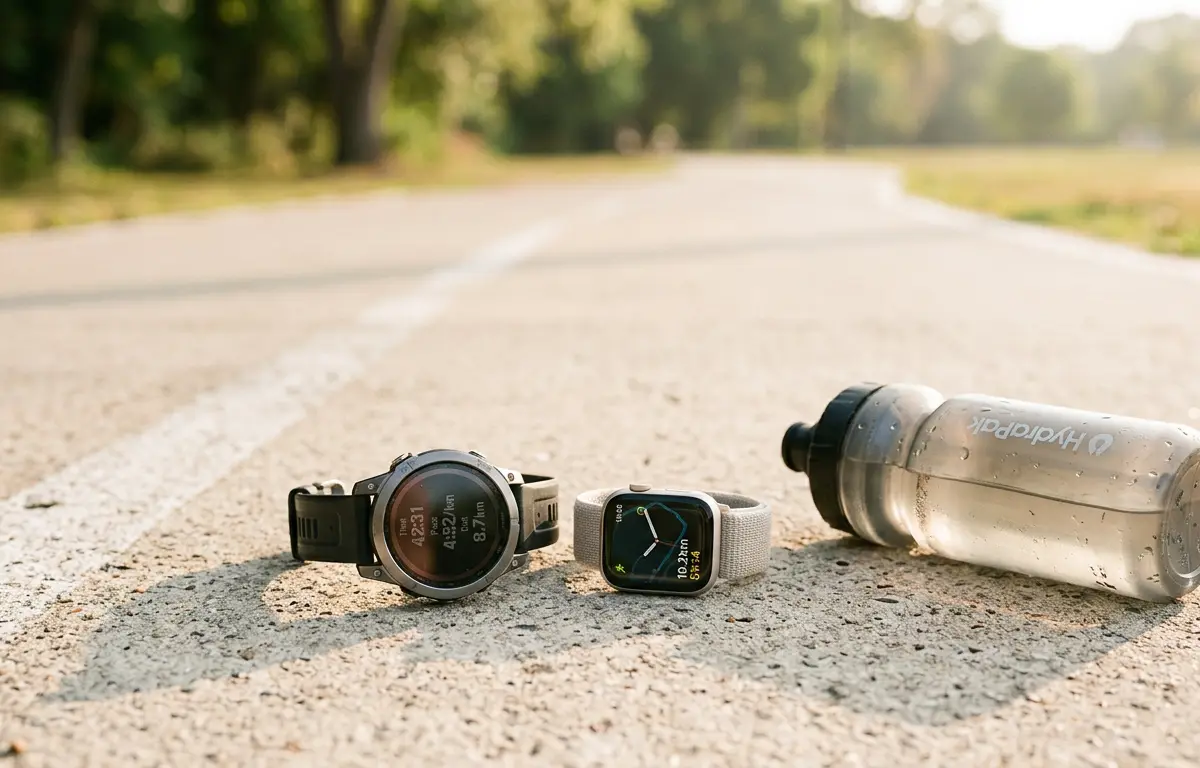
For beginner runners, the Garmin Forerunner 55 provides essential pacing tools and up to two weeks of battery life for $164.90, making it an ultra-reliable budget pick. However, the $199.00 Garmin Forerunner 165 is the superior overall value, offering an AMOLED touchscreen, HRV status, and morning reports for just $34 more, despite both relying on standard single-frequency GPS.
Editorial scores and recorded prices are reference points, not measurements of suitability for every use. Read each review's specifications and limitations.
Garmin Forerunner 55, GPS Running Watch with Daily Suggested Workouts, Up to 2 Weeks of Battery Life, Black - 010-02562-004.4$164.90Our score 7.9/10Best for Runners needing dependable fundamental pacing metrics Garmin Forerunner® 165, Running Smartwatch, 43mm, Black4.6$199.00Our score 8/10Best for Daily runners wanting modern training interfaces
| Product | Price | Display Type | Smartwatch Battery | GPS Battery | Key Features |
|---|---|---|---|---|---|
| Forerunner 55 | $164.90 | 1.04-in Transflective MIP (208 px) | Up to 2 weeks | Up to 20 hours | Daily suggested workouts, PacePro, 5 buttons, single-band GPS |
| Forerunner 165 | $199.00 | AMOLED Touchscreen | Up to 11 days | Up to 19 hours | HRV status, morning report, training effect, Garmin Pay, 43mm case |
When taking up road running, selecting a dedicated GPS tracker often comes down to choosing between simplicity and modern hardware. The Garmin Forerunner 55 represents the classic formula: lightweight construction, push-button controls, and a display engineered for direct sunlight. It strips away distractions so you can focus entirely on pacing, distance, and interval execution. With a listed price of $164.90, it remains one of the most accessible dedicated sports watches available for new athletes building their aerobic base.
Conversely, the Garmin Forerunner 165 bridges the gap between a pure fitness tool and a modern daily smartwatch. Priced at $199.00, it introduces a 43mm fiber-reinforced polymer build equipped with a vivid AMOLED touchscreen alongside five traditional physical buttons. This hybrid control setup allows you to swipe through daily statistics while retaining physical buttons to pause splits when your hands are sweaty. It also expands recovery analytics with features like Heart Rate Variability (HRV) status and morning reports.
To make an informed decision, visit our running shoes and watches category or review the buyer's guide. If your primary goal is an affordable, unpretentious wrist computer that requires minimal charging and tells you your mile splits, the Forerunner 55 handles the fundamentals admirably. If you want a display that looks like a contemporary smartwatch and provides deeper daily recovery context, the extra $34 investment for the Forerunner 165 pays off immediately in daily usability.
The visual interface marks the most dramatic practical difference between these two devices. The Garmin Forerunner 55 utilizes a 1.04-inch transflective memory-in-pixel (MIP) display running at a 208-pixel resolution. Transflective screens rely on ambient sunlight to brighten the screen, meaning the brighter the afternoon sun, the clearer your pacing data appears. However, in dim lighting, the display looks muted and requires the dedicated backlight button. Interaction is handled exclusively via five tactile chassis buttons, avoiding unwanted screen skips when running in heavy rain.
The Forerunner 165 replaces that utilitarian panel with an AMOLED display built directly into its 43mm case. This upgrade brings vibrant colors, high contrast, and smooth animations to your wrist. Pacing graphs, heart rate zones, and daily suggested workouts pop with clarity whether you are running at dawn or glancing at your wrist during a workday. The addition of a responsive touchscreen makes navigating menu widgets, sleep charts, and notifications far more intuitive than repeatedly tapping side pushers.
Crucially, the Forerunner 165 does not abandon mechanical controls. It retains the five physical pushers found on the Forerunner 55, ensuring that if you are wearing gloves or sprinting through downpours, you can trigger laps without touching the glass. For beginners who plan to wear their fitness watch all day, the Forerunner 165 feels significantly more modern. You can browse our mistakes to avoid guide to see why buying an outdated display interface can sometimes lead to premature buyer regret.
A core benchmark in modern sports technology is satellite accuracy. Our buying criteria emphasize that dual-band GNSS represents the real accuracy upgrade in running watches. Dual-frequency technology receives multiple satellite signals simultaneously, cutting through atmospheric interference and multipath signal reflection caused by skyscrapers or dense forest canopies. However, buyers should understand that neither the Forerunner 55 nor the Forerunner 165 features dual-band GNSS.
Both watches rely on standard single-frequency GPS systems. The Forerunner 55 utilizes built-in GPS capable of logging steady splits, supporting PacePro strategies, and delivering accurate track profiles in open suburban or park environments. However, if your typical running route cuts between downtown high-rises or through heavily wooded river trails, you will occasionally see minor track smoothing, corner-cutting, or small instantaneous pace jumps on the map.
The Forerunner 165 shares this exact single-band operational baseline. While its newer positioning architecture locks onto signals quickly, it does not provide the pinpoint geometric precision reserved for premium models commanding double the price. For beginners running on neighborhood roads, local tracks, or recreational bike paths, standard single-frequency tracking is more than adequate to monitor weekly volume and 5K training blocks.
Understanding these hardware boundaries prevents unrealistic expectations. If you need absolute satellite perfection in dense metropolitan cities, you must look higher up the product ladder. But if you primarily run in open environments, both devices will accurately record your distance, average pace, and milestone split times without noticeable issue.
Battery performance determines how often your device lives on your wrist versus sitting on a charging stand. Because the Garmin Forerunner 55 relies on an energy-efficient transflective display and lightweight software across 32 MB of internal memory, it achieves outstanding battery efficiency. In standard smartwatch mode, the Forerunner 55 delivers up to two full weeks of continuous operation. When running with active continuous GPS tracking, the battery provides up to 20 hours of operation, easily accommodating multiple weeks of beginner workouts on a single charge.
The Forerunner 165 requires more power to illuminate its AMOLED display, but its battery life remains practical. It provides up to 11 days in standard smartwatch mode and up to 19 hours of continuous GPS activity. While 11 days is less than the Forerunner 55's 14-day mark, it still outpaces traditional smartwatches that require daily charging. For beginners logging three to four 30-minute runs per week, the Forerunner 165 requires plugging in only once every week and a half.
In terms of daily physical wear, both watches utilize fiber-reinforced polymer chassis paired with standard silicone bands and secure tang buckles. The Forerunner 165 sits at 43mm with a water resistance rating of 50 meters, making it safe for swimming, rainstorms, and post-workout showers. The Forerunner 55 features a slightly smaller, featherweight footprint that disappears under long sleeves. If absolute battery duration is your priority, the 55 takes the win; if you do not mind plugging in twice a month, the 165 is effortless to maintain.
Both watches excel at guiding new runners through structured training blocks, but their analytical depth differs noticeably. The Forerunner 55 comes preloaded with Garmin Coach, daily suggested workouts, PacePro pacing strategies, and standard recovery hour recommendations. Based on your recent runs, the watch calculates estimated race finish times and suggests specific rest intervals before your next hard effort. It also tracks wrist-based optical heart rate and provides cadence data to help improve your stride efficiency.
The Forerunner 165 takes those foundational training tools and layers on modern physiological tracking. Its key software addition is Heart Rate Variability (HRV) status, which monitors autonomic nervous system recovery during sleep to tell you if your body is ready to train or struggling with accumulated fatigue. Each morning, the watch delivers a comprehensive Morning Report summarizing your sleep score, HRV baseline, weather forecast, and daily workout recommendation.
Additionally, the Forerunner 165 calculates Training Effect, differentiating between aerobic base building and anaerobic threshold development so you understand how each workout impacts your cardiovascular system. It also includes incident detection for emergency contacts and contactless Garmin Pay for running without a wallet. When following a training plan, getting proper feedback on your rest days is just as critical as logging miles. Beginners who want clear, holistic guidance on when to push and when to back off will find the Forerunner 165's feedback loop significantly more helpful.
Evaluating cost against everyday utility is essential when building your running setup. At a recorded price of $164.90, supported by an aggregate 4.4 out of 5 stars across 6,222 reviews, the Garmin Forerunner 55 provides exceptional utility per dollar. It eliminates the fragile touchscreens and one-day battery spans common among low-cost lifestyle smartwatches, giving you a focused, durable pacing computer that lasts up to two weeks between charges.
Meanwhile, the Garmin Forerunner 165 retails at $199.00 with an aggregate rating of 4.6 out of 5 stars across 4,905 reviews. The price difference between the two models is roughly $34. For that modest margin, the Forerunner 165 provides an AMOLED touchscreen, a modernized 43mm case, HRV status tracking, the morning report, and training effect insights. If you plan to wear your running watch continuously as your everyday timepiece, that $34 upgrade represents immense long-term value.
To balance your gear budget effectively, explore our budget planner or read our running shoes and watches FAQ. Runners on an uncompromising budget who want a dedicated workout tracker will be completely satisfied with the Forerunner 55. However, the majority of beginners will find the Forerunner 165 to be the smarter long-term purchase, as its superior display and deeper physiological recovery metrics keep you engaged throughout your training journey.
Amazon links are affiliate links; we may earn a commission at no cost to you.
This page summarizes our research reviews of Amazon listings, listed specifications and captured buyer ratings. It is not a hands-on test. Scores are editorial assessments, not measured performance; prices are recorded snapshots and may change. A category can include both main products and accessories, so its overall price range is not the cost of a complete setup.
Most recent product record update: September 14, 2026. Individual records may be older; this is not a verification date for every claim.
Amazon links are affiliate links. We may earn a commission on qualifying purchases, at no extra cost to you.
A more useful shortlist
Choose the product type first. These groups require a match in the listing title; an import search term alone is not enough. Scores rank our recorded research assessments within each group, not independently measured performance.
Garmin Forerunner 55, GPS Running Watch with Daily Suggested Workouts, Up to 2 WeeksRecorded price: $164.90 · Editorial score: 7.9/10
If a specification, certification or compatibility detail is absent, mark it as unknown and ask the seller or manufacturer. Do not substitute a star rating, an editorial score or a different model's specification.