For most drip, pour-over, and French press drinkers, the OXO Brew Conical Burr Grinder is the strongest reviewed choice; espresso shoppers should note its stepped limits.
By the Niche Picks editorsUpdated October 7, 20269 min readDrawn from our 30 research-based coffee gear reviews
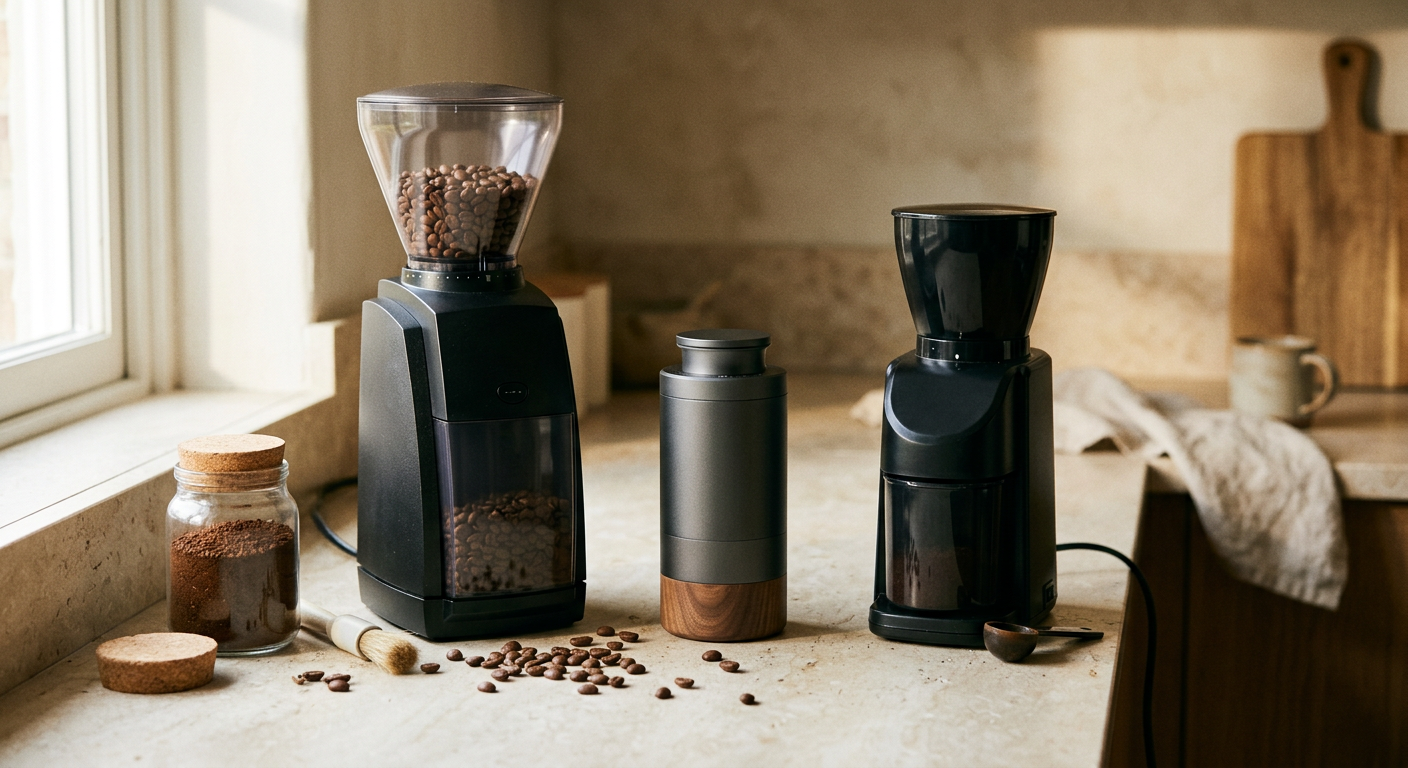
AI-generated editorial illustration; not a product or test photograph.
Short answer
The best burr coffee grinder in our reviews is the $98.99 OXO Brew Conical Burr Grinder for drip, pour-over, and French press. Its 40 mm stainless-steel conical burrs and up to 43 stepped positions offer a meaningful consistency upgrade over blade grinders. For portable single-dose grinding, consider the $109.99 Maestri House 80-Level, but neither pick offers stepless adjustment for precise non-pressurized espresso dial-in.
3
Product listings discussed; not hands-on tests
3/3
Discussed listings with a recorded price
$72.99–$109.99
Recorded listing price range; not a complete setup cost
Key takeaways
The OXO Brew is our top reviewed burr grinder for filter and immersion brewing because it combines 40 mm conical burrs with up to 43 stepped positions for $98.99.
Burrs matter because they set a mechanical grinding gap; blade grinders rely on timing and create a wider mix of fines and large particles.
The Maestri House is the portable single-dose alternative, with a 38 mm conical burr, 80 settings, and rechargeable cordless operation.
All three shortlisted grinders use stepped adjustment, so none is the ideal answer for meticulous non-pressurized espresso dialing.
The $72.99 Cuisinart DBM-8P1 is a lower-cost electric burr option for everyday batch drip and French press, not precision brewing.
Match grinder spending to the brewer where practical: a capable burr grinder has more effect on repeatability than motor wattage alone.
Products discussed in this article
Editorial scores and recorded prices are reference points, not measurements of suitability for every use. Read each review's specifications and limitations.
OXO Brew Conical Burr Electric Coffee Bean Grinder7.2
Maestri House Burr Coffee Grinder, 80-Level7.2
Cuisinart Electric Burr Coffee Grinder, 18 Settings5.9
Recorded price (USD)
OXO Brew Conical Burr Electric Coffee Bean Grinder98.99 USD
Maestri House Burr Coffee Grinder, 80-Level109.99 USD
Cuisinart Electric Burr Coffee Grinder, 18 Settings72.99 USD
Best reviewed burr coffee grinders: key differences
Product
Listed price
Burr and adjustment
Bean capacity
Best for
OXO Brew Conical Burr
$98.99
40 mm stainless-steel conical burrs; up to 43 stepped positions
12 oz (340 g)
Filter and immersion brewing on a budget
Maestri House 80-Level
$109.99
38 mm conical burr; 80 stepped settings
Not listed
Portable and low-retention home grinding
Cuisinart DBM-8P1
$72.99
Burr mill; 18-position selector
3.2 oz listed
Everyday batch drip and French press
What is the best burr coffee grinder overall?
The $98.99 OXO Brew Conical Burr Electric Coffee Bean Grinder is the best burr coffee grinder in this group for most people making drip coffee, pour-over, Chemex-style coffee, or French press. It uses 40 mm stainless-steel conical burrs rather than impact blades, holds up to 12 ounces (340 g) of beans, and has 15 numbered settings with subdivisions for up to 43 positions.
Those details address the core job of a grinder: producing a more controlled particle size than a blade mill. The OXO’s stepped adjustment is not a flaw for every brewer. For filter and immersion ranges, its reviewed performance indicates adequate particle uniformity, while the stainless-steel grounds cup is designed to reduce static. The timer-based dosing system is straightforward, although it is not a scale-based dosing system.
The important limitation is espresso. One click can make a meaningful difference when dialing in a non-pressurized espresso basket, and the OXO’s steps are too broad to make that process reliably precise. It is therefore a better buy for filter coffee than for an espresso-focused setup.
A burr grinder mills beans between two burr surfaces set at a chosen gap. A blade grinder uses a fast-spinning blade to strike and shatter beans, so run time becomes the only practical proxy for grind size. That distinction is why burr geometry and adjustment range matter more than the wattage printed on a box.
The goal is not simply to make coffee grounds smaller. It is to make a batch with a narrower spread of particle sizes. Very small fines can extract rapidly, while oversized chunks extract more slowly. When both are abundant in the same brew, the cup can combine harshness from over-extracted fines with weak or sour notes from under-extracted larger pieces. Paper filters can hide some inconsistency in ordinary drip coffee, but they cannot make a blade grinder repeatable.
Every grinder in this shortlist uses burrs. The OXO uses 40 mm stainless-steel conical burrs; the Maestri House uses a 38 mm conical burr; and the Cuisinart DBM-8P1 is a burr mill with an 18-position selector. That alone makes them more appropriate coffee tools than the blade grinders in our reviews, but burr design and adjustment still determine their limits.
For more equipment context, browse all Coffee gear reviews and avoid common setup errors in our coffee gear mistakes guide. A useful rule of thumb is to reserve roughly as much budget for the grinder as for the brewer, especially when the brewer has the control to reveal grind inconsistency.
Is the Maestri House the best portable burr grinder?
For someone who values cordless, single-dose convenience, the $109.99 Maestri House Burr Coffee Grinder is the most distinctive option in our reviewed group. It is a compact 4.02 by 2.6 by 7.28 inches, stainless-steel-bodied grinder with a 38 mm conical burr, a digital display, auto-stop, an 1,800 mAh battery, and 80 stepped settings. Its single-dose workflow means you add the measured beans you intend to grind instead of maintaining a filled hopper.
The grinder’s low-speed direct-current motor is listed at 120 to 160 RPM. In our research, that design is intended to keep heat transfer low during grinding. A magnetic lid and magnetically aligned catch cup support its travel-friendly format, while the stated below-60 dB operation may matter in shared homes or early-morning kitchens.
There are two reasons not to treat it as an automatic all-purpose winner. First, its 80 positions remain stepped, despite the relatively fine 0.02 mm stated increments. That gives it useful flexibility for AeroPress, pour-over, and pressurized-basket espresso, but it may still leave an espresso shot running too fast at one setting and too slow at the next. Second, its 4.2-star rating is based on only 9 reviews, which is not enough feedback to establish long-term reliability.
Use our budget planner to put its $109.99 cost alongside your brewer, and consult the Coffee gear FAQ if you are deciding between portability, hopper capacity, and adjustment precision.
Best for: portable, low-retention single dosing
Listed price: $109.99
Burr and adjustment: 38 mm conical burr; 80 stepped settings
Key trade-off: rechargeable battery and stepped espresso adjustment
Is the Cuisinart DBM-8P1 a good budget burr grinder?
The $72.99 Cuisinart DBM-8P1 is a reasonable low-cost electric burr grinder for everyday batch drip and French press, provided expectations remain modest. It has an 18-position grind selector, a removable hopper and grounds chamber, and a timed system for 4 to 18 cups. These features make it easier to repeat an everyday routine than a one-button blade grinder.
Its value is strongest for shoppers moving up from blade grinding rather than for buyers assembling a high-precision coffee bar. The burr mill mechanism offers an immediate functional improvement over blade chopping, but the reviewed design uses broad stepped changes and produces more fines than specialized precision grinders. That can muddy a filter brew, especially toward the extreme ends of its advertised range. It is not a serious solution for dialing in non-pressurized espresso, where small changes in burr spacing can substantially change flow.
Capacity information merits a quick check before purchase. The product specification lists a 3.2-ounce hopper capacity, while other product documentation cited in our review differs. Verify the current manufacturer listing if a large hopper is essential to your household routine.
At $72.99, the DBM-8P1 is the least expensive complete burr grinder in this shortlist. It makes sense alongside a modest automatic drip machine, not as the weak link beneath a premium espresso machine. If you are also choosing a brewer, compare the trade-offs in our best home espresso machines coverage and espresso machine under $500 guide.
Best for: batch drip and French press on a tighter budget
Listed price: $72.99
Adjustment: 18 stepped positions
Main caveat: more fines and insufficient adjustment precision for espresso
Can any of these burr grinders make proper espresso?
They can grind coffee fine enough to be used with some espresso setups, but none is the clear recommendation for precise non-pressurized espresso. The reason is adjustment resolution, not motor wattage. Espresso dialing-in often requires very small grind changes to control shot flow. Each shortlisted model uses a stepped adjustment system: up to 43 positions on the OXO, 80 settings on the Maestri House, and 18 positions on the Cuisinart DBM-8P1.
The Maestri House gives the most adjustment positions here and is the strongest of the three for a user who also wants portability or a single-dose workflow. Even so, its reviewed verdict identifies stepped adjustment as a potential limitation for delicate espresso dialing. The OXO likewise has steps too broad for reliably dialing in non-pressurized espresso. The Cuisinart’s 18 steps are the most restrictive choice for that task.
A pressurized basket can be more forgiving of imperfect grind size than a non-pressurized basket, but it does not turn broad adjustment steps into espresso-level control. If you are shopping for espresso gear, budget for the grinder before being swayed by a machine’s pump-pressure figure. Temperature stability in the machine and a controllable grind are more consequential for consistency.
Start with brew method, then choose adjustment style, workflow, capacity, and budget. Do not start with wattage. Wattage alone does not describe burr geometry, particle distribution, adjustment increments, retention, or whether the grinder can be tuned to your brewer.
For a household that mainly makes drip coffee, pour-over, or French press, the OXO is the most balanced choice here: its 12-ounce hopper, 40 mm conical burrs, and up to 43 stepped positions fit those methods well. For coffee drinkers who weigh a single dose each time, value a compact footprint, or may travel with the grinder, the Maestri House’s cordless single-dose format is more suitable. For the lowest initial cost among these three, the Cuisinart offers basic electric burr grinding, but its broad 18-step range and higher-fines limitation set a clear ceiling.
It also helps to account for the total coffee system. A $100 grinder is sensible beside an entry-level drip brewer, but an expensive espresso machine paired with a basic stepped burr grinder may leave little room for the precise dial-in that machine could otherwise support. Spend where the largest constraint is.
Before committing, read our coffee gear buying tips, then use the product comparison tool to place price, footprint, hopper style, and adjustment type side by side. Finally, consult the exact-model manufacturer instructions for cleaning, disassembly, and any approved burr-maintenance procedure; do not assume that one grinder’s cleaning method applies to another.
Name your primary brew method: drip, pour-over, French press, or espresso.
Choose burr grinding rather than a blade grinder if repeatable particle size is a priority.
For non-pressurized espresso, prioritize a grinder with finer adjustment than the stepped models in this shortlist.
Decide whether you want a hopper for stored beans or a single-dose workflow for each brew.
Measure available counter space, including overhead clearance for removing a hopper.
Set a grinder budget that is roughly comparable to your brewer budget where practical.
Verify current capacity, included items, cleaning instructions, and warranty terms on the exact model before purchase.
Frequently asked questions
Is a burr coffee grinder really better than a blade grinder?
Yes, for coffee quality and repeatability, a burr grinder is generally the better tool. Burrs create a controlled mechanical gap, while a blade grinder chops by impact and relies on timing. That makes burr grinders better suited to repeatable drip, pour-over, French press, and espresso preparation. The improvement still varies with burr design and adjustment quality.
What is the best burr grinder under $100?
In our reviews, the $98.99 OXO Brew Conical Burr Grinder is the strongest under-$100 choice for drip, pour-over, and French press. It has 40 mm stainless-steel conical burrs, a 12-ounce hopper, and up to 43 stepped grind positions. Its limitation is espresso: the adjustment steps are too broad for reliable non-pressurized espresso dialing.
Is the OXO Brew Conical Burr Grinder good for espresso?
The OXO can be used for coffee ground at its finer end, but it is not our precision espresso recommendation. Its 43-position adjustment is stepped, and a single setting change can be too large when attempting to control espresso shot flow in a non-pressurized basket. It is a more natural fit for filter and immersion brewing.
What does single-dose coffee grinding mean?
Single-dose grinding means weighing or measuring the beans for one brew and loading only that amount into the grinder, rather than storing a larger supply in a hopper. The Maestri House uses this approach. It can suit people who switch coffees, want to limit bean waste, or prefer a compact grinder, though it does not automatically make a grinder stepless.
How many grind settings do I need?
The right number depends on the brew method and the size of each adjustment step. For drip coffee, pour-over, and French press, the OXO’s up to 43 stepped positions offer useful range. Espresso is more demanding because very small grind changes can alter flow. More settings help, but stepless or micro-adjustable control is more important than a large number alone.
Should I buy a grinder or upgrade my coffee machine first?
If you currently use a blade grinder or buy pre-ground coffee, upgrading to a capable burr grinder is often the more fundamental change. The grinder determines particle size and repeatability before water reaches the brewer. For espresso, pair that with a machine that offers reasonable temperature consistency; high advertised pump pressure alone is not a substitute for either factor.
Amazon links are affiliate links; we may earn a commission at no cost to you.
Sources and limits
This page summarizes our research reviews of Amazon listings, listed specifications and captured buyer ratings. It is not a hands-on test. Scores are editorial assessments, not measured performance; prices are recorded snapshots and may change. A category can include both main products and accessories, so its overall price range is not the cost of a complete setup.
Most recent product record update: September 22, 2026. Individual records may be older; this is not a verification date for every claim.
Choose the product type first. These groups require a match in the listing title; an import search term alone is not enough. Scores rank our recorded research assessments within each group, not independently measured performance.
Temperature stability matters more than pressure numbers on the box.
Burr geometry and stepless adjustment beat motor wattage every time.
Budget roughly as much for the grinder as for the machine.
If a specification, certification or compatibility detail is absent, mark it as unknown and ask the seller or manufacturer. Do not substitute a star rating, an editorial score or a different model's specification.


 OXO Brew Conical Burr Electric Coffee Bean Grinder - 12 Oz, Silver