Best Portable Solar Generators: Reviews & Buying Guide
Compare top-rated solar generators and power stations to find the ideal portable energy solution for your home backup and camping needs.
By the Niche Picks editorsUpdated November 8, 20269 min readDrawn from our 30 research-based portable power stations & solar reviews
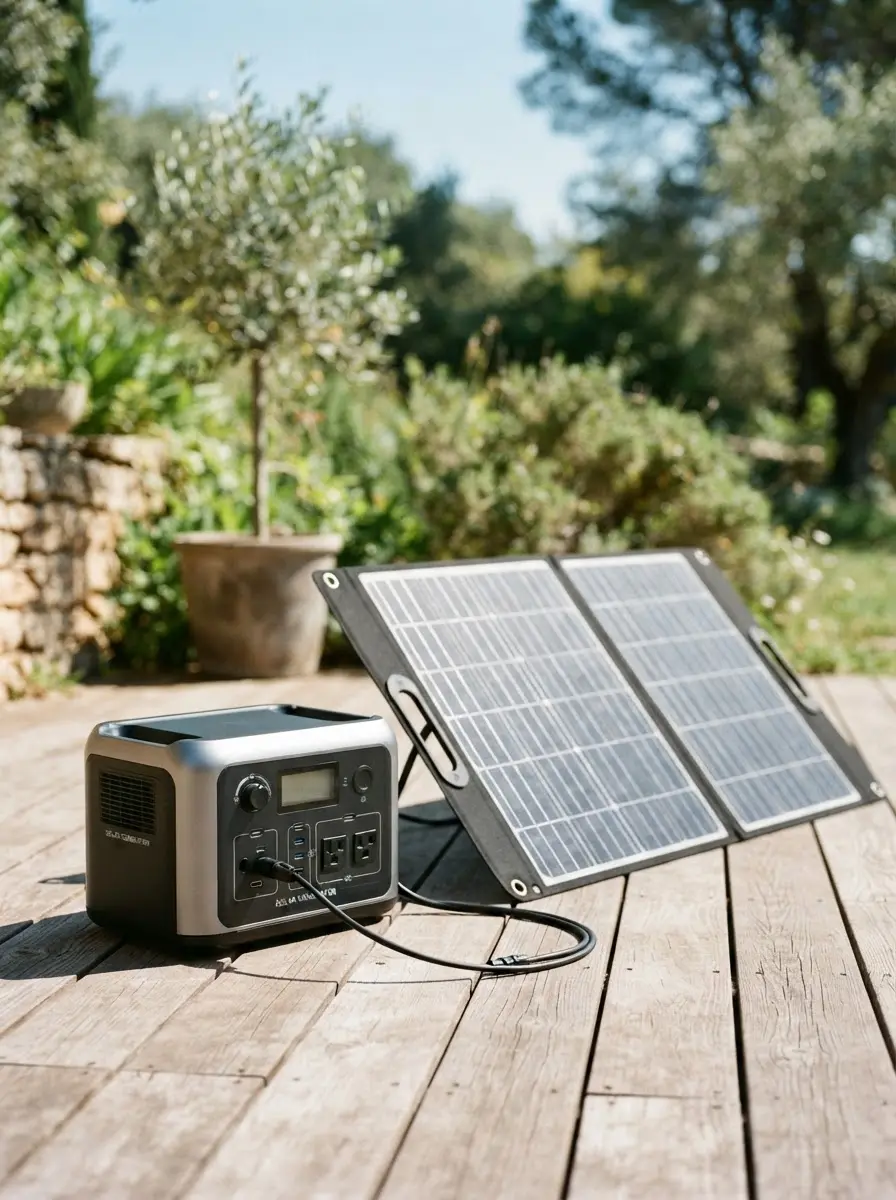
AI-generated editorial illustration; not a product or test photograph.
Short answer
The ideal solar generator balances continuous inverter wattage with high-cycle LiFePO4 battery longevity. For home backup, the Jackery Explorer 1000 v2 provides 1,500W of reliable continuous output, while the Anker SOLIX C1000 and BLUETTI AC180 offer exceptional value and cycle life for frequent, demanding off-grid applications.
6
Product listings discussed; not hands-on tests
6/6
Discussed listings with a recorded price
$89.99–$879.00
Recorded listing price range; not a complete setup cost
Key takeaways
Focus exclusively on continuous output wattage rather than peak surge to ensure your appliances stay powered.
LiFePO4 battery chemistry is now the industry standard, offering 3,000 to 4,000 charge cycles compared to older 500-cycle alternatives.
Real-world solar intake typically reaches only 70-80% of the panel's rated capacity due to heat and atmospheric factors.
Turnkey solar generator bundles simplify compatibility but standalone modular systems allow for larger capacity and faster charging.
Always factor in a 10-15% conversion loss when calculating the usable runtime for your specific device load.
Products discussed in this article
Editorial scores and recorded prices are reference points, not measurements of suitability for every use. Read each review's specifications and limitations.
BLUETTI AC180 Portable Power Station 1152Wh 1800W8.4
Anker SOLIX C1000 Portable Power Station with Car8.7
FlexSolar 100W Foldable Portable Solar Panel Charger8.5
ZOUPW 450W Portable Solar Panel N-Type 16BB for Power8.1
Recorded price (USD)
Jackery Explorer 1000 v2 Portable Power$559.00
Jackery Solar Generator 1000 v2 and 200W Solar$879.00
BLUETTI AC180 Portable Power Station 1152Wh 1800W$499.00
Anker SOLIX C1000 Portable Power Station with Car$479.99
FlexSolar 100W Foldable Portable Solar Panel Charger$89.99
ZOUPW 450W Portable Solar Panel N-Type 16BB for Power$499.99
Power Station Specifications and Capability
Product
Capacity
Continuous Output
Chemistry
Best For
Jackery 1000 v2
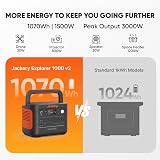
1070Wh
1500W
LiFePO4
Home backup
Jackery 1000 v2 Bundle
1070Wh
1500W
LiFePO4
Turnkey backup
BLUETTI AC180
1152Wh
1800W
LiFePO4
High-cycle power
Anker SOLIX C1000
1056Wh
1800W
LiFePO4
Emergency backup
FlexSolar 100W Panel
N/A
100W
N/A
Compact solar
ZOUPW 450W Panel
N/A
450W
N/A
Rapid solar
Why Continuous Wattage Defines Performance
When navigating the market for a portable solar generator, it is easy to be misled by high 'peak' or 'surge' wattage numbers. In reality, the continuous running wattage is the only metric that determines which domestic appliances can be safely sustained. A 1,500W surge rating often implies that a device can withstand a momentary spike for milliseconds—such as a motor starting—but it does not mean the unit can power a 1,500W space heater or a high-capacity induction cooktop indefinitely.
Essential domestic items like refrigerators, CPAP machines, and power tools have high startup requirements but lower running demands.
Resistive heating elements, including kettles and hair dryers, consume constant high wattage and will likely trigger a system-wide shutdown if they exceed your unit's continuous limit.
Always check the 'Running Wattage' label on your appliances before planning your home emergency backup strategy.
The Jackery Explorer 1000 v2 is a prime example of performance-focused engineering, delivering a legitimate 1,500W of continuous power that reliably manages full-size home essentials. By prioritizing this continuous output over flashy marketing claims, you ensure that your backup system remains functional during a blackout. For users who need even higher sustained performance, the BLUETTI AC180 provides an 1,800W continuous threshold, catering to more demanding kitchen appliances and tools. Consult our comprehensive power stations and solar guide to align your appliance needs with your power station's capabilities to avoid common pitfalls.
The most significant evolution in portable energy is the industry-wide adoption of lithium iron phosphate (LiFePO4) battery cells. Older systems often relied on nickel manganese cobalt (NMC) formulations, which, while energy-dense, typically faced severe capacity degradation after 500 to 800 charge cycles. In contrast, LiFePO4 chemistry offers a massively superior lifecycle, frequently rated for 3,000 to 4,000 cycles before falling to 70 or 80 percent of original capacity. This endurance turns a portable power station into a long-term utility asset rather than a short-lived gadget.
LFP batteries feature better thermal stability, which provides an added safety layer during operation in hot environments or heavy-load conditions.
A 4,000-cycle lifespan effectively means that even if you cycle the battery daily, it remains reliable for nearly a decade of heavy usage.
The Anker SOLIX C1000 exemplifies this value, pairing high-capacity LFP cells with a cost-effective price point that makes it a leader in the mid-capacity segment.
When calculating your budget, it is often more economical to spend slightly more on an LFP-based station than a cheaper NMC unit that will eventually require replacement. The amortized cost-per-cycle for LFP technology is drastically lower, ensuring your investment serves you well through years of camping, travel, and unexpected power interruptions. For more details on how these chemistries impact safety and longevity, review our frequently asked questions or explore the latest portable power station rankings. Choosing the correct battery foundation is the single most important decision for long-term satisfaction.
Inverter conversion overhead typically consumes 10-15% of your stored energy. Always plan your appliance usage for 85% of the total rated watt-hours.
Maximizing Solar Harvest in Real-World Conditions
Solar replenishment efficiency is subject to the realities of physics, meaning panels rarely achieve their nameplate power rating in actual field deployment. Factors like atmospheric haze, ambient temperature, cable resistance, and the exact sun-incidence angle can reduce energy intake to roughly 70-85 percent of the stated rating. A 200W panel, therefore, might realistically produce between 140W and 170W under typical, clear-sky conditions. Managing these expectations is critical for users attempting to maintain their portable power station entirely off-grid.
Use panels with high-efficiency N-type cells or ETFE coatings, such as the FlexSolar 100W or the ZOUPW 450W, to minimize losses.
Ensure your solar array is positioned on a flat, unobstructed surface with the correct tilt to capture the maximum photons throughout the day.
If you are building a larger array, ensure that your power station's MPPT (Maximum Power Point Tracking) controller is rated to handle the total voltage and current of your combined solar chain.
For those seeking a seamless, out-of-the-box experience, Jackery Solar Generator 1000 v2 bundles are designed to eliminate compatibility guesswork by pairing the station with official, matched solar arrays. This approach is ideal for beginners or those who want to minimize the time spent troubleshooting connectors and voltage drop. However, for more advanced setups, you might choose to mix and match high-wattage panels like the 450W ZOUPW unit to rapidly replenish massive battery banks. Avoid common solar mistakes like leaving panels in partial shade, which can dramatically degrade output across the entire system. Always prioritize efficient cabling and reliable connectors to keep your energy flow consistent.
One of the most common mistakes when selecting a power station is assuming the stated capacity is the absolute amount of energy available for your devices. Every power station consumes energy during the conversion from DC battery storage to AC household power, as well as for cooling and monitoring circuits. This 'conversion overhead' typically equates to a loss of 10-15 percent of the total capacity. If you have a 1,000Wh unit, you should plan for roughly 850Wh of actual, deliverable energy to avoid running your station down to a critical low-battery state during an emergency.
Check the 'Watt-Hour' (Wh) capacity on the unit's label; this is your total bank volume before losses.
Always add a 20 percent safety margin to your calculations to account for this overhead and to preserve battery longevity by avoiding frequent deep discharges.
For those who primarily power USB devices, prioritize stations with high-output USB-C Power Delivery (PD) ports, as they allow you to skip the inefficient AC inverter entirely.
Understanding these figures is fundamental to what size portable power station you need. If your goal is a multi-day backup for core essentials, you need enough capacity to manage both the surge requirements and the sustained energy consumption of your equipment. For a smaller mobile solution, consider units like those found in our best portable power stations for camping list. By balancing total bank size against your specific appliance needs, you prevent the risk of losing power when you need it most. Always consult the manufacturer’s specifications for both battery capacity and rated efficiency to ensure your real-world expectations are grounded in technical reality.
Resistive heating elements can trigger instant over-voltage protection. Never exceed the continuous wattage rating defined by the manufacturer.
Safety and Maintenance Protocols
Maintaining your solar generator ensures that it remains a reliable tool for years. Proper maintenance starts with storage: keep your units in cool, dry environments. Lithium-based batteries, regardless of their LFP or NMC status, dislike extreme heat and prolonged storage at zero or maximum charge. Ideally, maintain your station at a 50-80 percent charge level during storage periods to maximize the health of your internal cells. Periodically cycle your battery—discharging and recharging once every few months—to ensure internal monitoring systems remain accurate.
Ensure all port covers are secured during storage to prevent dust and moisture buildup, especially in models featuring IP-rated enclosures.
Clean your solar panels regularly with a damp, non-abrasive cloth to prevent dirt and debris from causing 'hot spots' that can reduce photon conversion efficiency.
Inspect your cables for any signs of insulation fraying or pin corrosion; this is particularly important for stations operating in high-demand environments like off-grid sheds or RVs.
Safety is paramount when handling high-amperage DC systems. Always follow the manufacturer’s specific maintenance instructions found in the user manual. If you have questions about safety standards or certification requirements, our FAQ page covers common inquiries regarding UL listings and electrical integrity. Never attempt to service the battery pack yourself, as these are solid-state units containing high-voltage components that present significant injury risks. By treating your solar generator as an essential piece of electrical infrastructure, you protect your investment and ensure that it functions correctly the next time you lose power. Proper care during these minor maintenance windows will pay dividends in the form of consistent, long-term output.
Choosing between a compact all-in-one solar generator and a modular power system is a trade-off between convenience and scalability. An all-in-one unit—like the Anker SOLIX C1000—integrates the battery, inverter, and charge controller into a single, portable chassis. This is the gold standard for simplicity. It is perfect for weekend camping, tailgating, or short-term home emergencies where portability and ease of use are the primary concerns. You simply unbox it, plug in a panel, and it works. However, these systems are inherently limited by their factory-set battery size and inverter ceiling.
All-in-one units are generally faster to deploy but cannot grow if your power needs expand in the future.
Modular systems—where you pair a standalone inverter, like those from the Renogy P2 series, with separate battery banks and charge controllers—offer virtually unlimited customization.
If you are outfitting a remote cabin or a long-range overland vehicle, a modular setup allows you to upgrade batteries or add more solar input without discarding the entire system.
Consider your specific deployment model. Are you moving the gear frequently? Then the Jackery Explorer 1000 v2 is likely the best choice due to its lightweight, compact form factor and simple operation. Are you building a permanent off-grid house backup? Then explore standalone components to build a robust, repairable system. Our blog provides further insight into balancing these design philosophies against your specific lifestyle. Regardless of your choice, ensure that the final setup follows standard electrical safety practices and that all components are properly rated for your local climate and power requirements. The right system for you depends on how often you expect your power requirements to evolve over the coming years.
1Identify all appliances needed during an emergency.
2Determine the total simultaneous running wattage required.
3Choose a station that exceeds this total running wattage.
4Select a unit with LiFePO4 cells for maximum cycle life.
5Add a solar array based on realistic 75% yield expectations.
6Configure your system to prioritize charging from solar inputs.
7Periodically test the unit during low-demand months.
Quick checklist
Sum the continuous wattage of all essential devices.
Select LiFePO4 chemistry for long-term lifecycle value.
Verify your station supports pass-through charging for emergencies.
Match solar panel voltage/amps to the station's controller.
Confirm the total weight is appropriate for your storage plan.
Check for high-speed USB-C PD ports to charge modern tech efficiently.
Read the owner's manual for recommended storage battery levels.
Frequently asked questions
How long will my solar generator last in a blackout?
Run time depends on your total load (in watts) and battery capacity (in watt-hours). A 1,000Wh station powering a 100W device will run for approximately 8-9 hours, after accounting for a 10-15% conversion loss. Divide the usable capacity (Wh * 0.85) by your total device wattage to estimate your specific runtime.
Why is LiFePO4 preferred for home backup?
LiFePO4 (LFP) chemistry is significantly more stable and long-lasting than older nickel-manganese-cobalt (NMC) batteries. While NMC units often degrade after 500-800 cycles, LFP cells are rated for 3,000 to 4,000 cycles. This makes them much more cost-effective and reliable for multi-year usage as a home backup system.
Do I need to buy panels from the power station brand?
Not necessarily, but using panels from the same manufacturer simplifies the setup by ensuring plug-and-play compatibility with standard DC inputs and built-in MPPT controllers. If buying third-party panels, you must verify the voltage and amperage range matches your station's input limit and obtain the correct adapter cables.
What is the difference between continuous and surge wattage?
Continuous wattage is the power the inverter can provide indefinitely until the battery is depleted. Surge wattage is a temporary, short-duration power allowance used primarily to start appliances with motor compressors. Always size your system based on the continuous wattage requirement of your devices.
Can I use these generators inside my house?
Yes, because portable power stations use battery systems, they produce no emissions, exhaust fumes, or fire hazards typical of gas generators. This makes them ideal for indoor use, though they should always be placed on a flat surface in a well-ventilated area to prevent internal heat buildup.
Amazon links are affiliate links; we may earn a commission at no cost to you.
Shortlists in this category
Ranked lists from our portable power stations & solar reviews, limited to listings whose titles confirm the product type, with budget cuts where enough recorded prices sit on both sides of the line.
This page summarizes our research reviews of Amazon listings, listed specifications and captured buyer ratings. It is not a hands-on test. Scores are editorial assessments, not measured performance; prices are recorded snapshots and may change. A category can include both main products and accessories, so its overall price range is not the cost of a complete setup.
Most recent product record update: October 3, 2026. Individual records may be older; this is not a verification date for every claim. Prices on this page were read from the listings Sep 15, 2026 – Nov 12, 2026.
Compare the same kind of portable power stations & solar
Choose the product type first. These groups require a match in the listing title; an import search term alone is not enough. Scores rank our recorded research assessments within each group, not independently measured performance.
Values are shown as recorded, without unit conversions or inferred compatibility. Not recorded means unknown, not absent. Prices are snapshots, not current offers. Editorial scores are research judgments, not lab results. Amazon links are affiliate links.
Before treating a comparison as complete
Which details are still unknown?
A specification appearing in a listing is not independent verification. These counts show which shortlisted records contain the same field; a blank record does not mean the product lacks the feature.
Output Wattage
Recorded for 2 of 2 shortlisted models
Present in every shortlisted record. Check units, exact variants and the current manufacturer documentation before relying on it.
Power Source
Recorded for 2 of 2 shortlisted models
Present in every shortlisted record. Check units, exact variants and the current manufacturer documentation before relying on it.
Voltage
Recorded for 2 of 2 shortlisted models
Present in every shortlisted record. Check units, exact variants and the current manufacturer documentation before relying on it.
Values are shown as recorded, without unit conversions or inferred compatibility. Not recorded means unknown, not absent. Prices are snapshots, not current offers. Editorial scores are research judgments, not lab results. Amazon links are affiliate links.
Values are shown as recorded, without unit conversions or inferred compatibility. Not recorded means unknown, not absent. Prices are snapshots, not current offers. Editorial scores are research judgments, not lab results. Amazon links are affiliate links.
Compare the stated cycle life, capacity retention and warranty; LiFePO4 often has a cycle-life advantage, but model and operating conditions matter.
Continuous output watts, not surge, decides what you can run.
Check real solar input range — panels rarely hit rated numbers.
If a specification, certification or compatibility detail is absent, mark it as unknown and ask the seller or manufacturer. Do not substitute a star rating, an editorial score or a different model's specification.