Our top camping picks balance usable watt-hours, continuous AC output, LiFePO4 longevity, carry weight, and realistic solar recharging.
By the Niche Picks editorsUpdated October 7, 20269 min readDrawn from our 30 research-based portable power stations & solar reviews
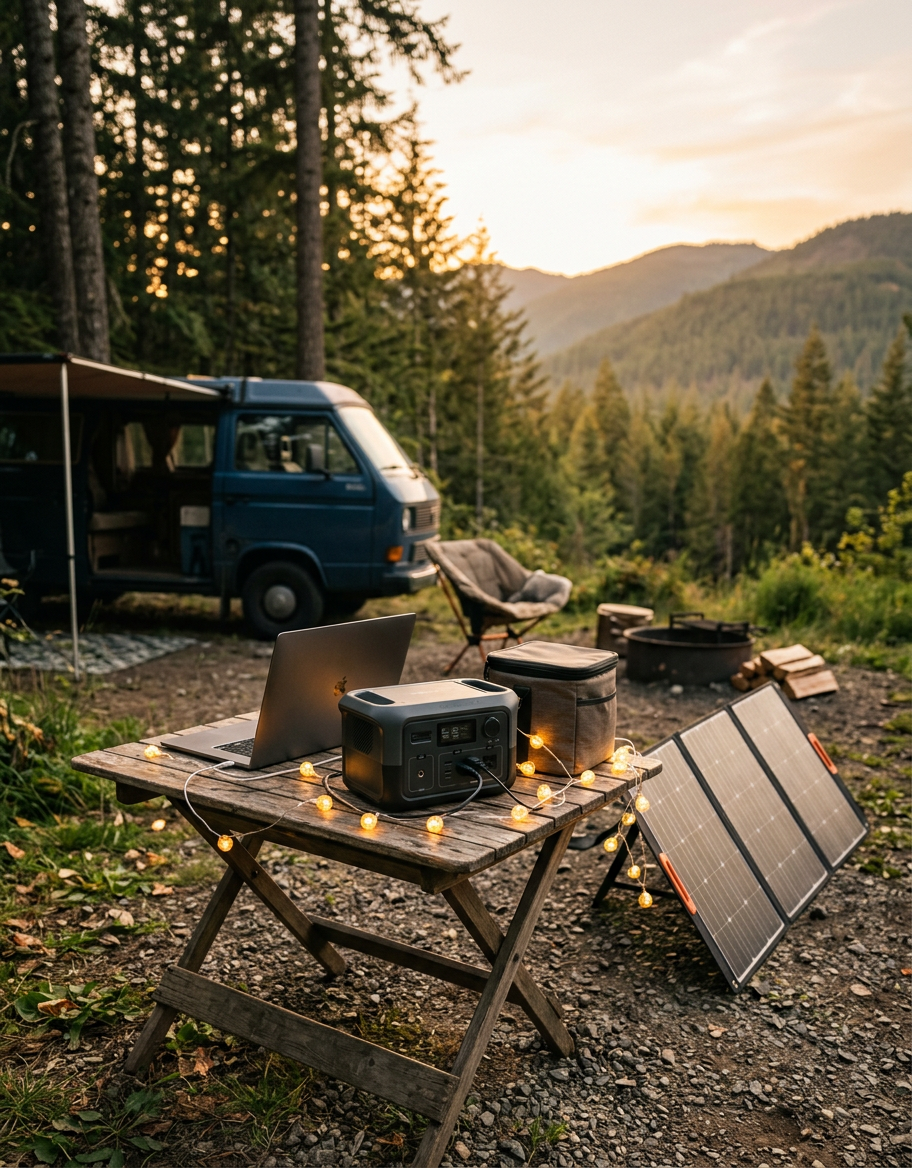
AI-generated editorial illustration; not a product or test photograph.
Short answer
The Anker SOLIX C1000 is our best portable power station for camping because it combines 1,056Wh of LiFePO4 storage, 1,800W continuous AC output, a 600W solar input ceiling, and a listed $449.98 price. For lighter trips, the BLUETTI Elite 30 V2 offers a more packable 288Wh/600W alternative, while the ALLWEI 300W is the value choice for low-draw electronics.
5
Product listings discussed; not hands-on tests
5/5
Discussed listings with a recorded price
$128.99–$559.00
Recorded listing price range; not a complete setup cost
Key takeaways
For most car campers, about 1,000Wh provides a more useful reserve than a sub-300Wh station when powering a cooler, lights, laptops, and phones.
Continuous watts—not surge watts—determine whether a power station can keep an appliance running.
LiFePO4 models lead this shortlist for stated cycle life, but retention thresholds and warranties are not consistently published for every model.
A 600W solar-input ceiling can recharge a 1kWh-class station much more practically than a small 60W or 100W panel, although actual output is lower outdoors.
Sub-300Wh stations are easier to carry, but their limited energy reserve makes them best for electronics, lighting, and modest 12V loads.
Products discussed in this article
Editorial scores and recorded prices are reference points, not measurements of suitability for every use. Read each review's specifications and limitations.
Anker SOLIX C1000 Portable Power Station with Car8.7
BLUETTI AC180 Portable Power Station 1152Wh 1800W8.4
Jackery Explorer 1000 v2 Portable Power8.2
BLUETTI Elite 30 V2 Portable Power Station 288Wh 600W8.5
ALLWEI Portable Power Station 300W, 256Wh Solar7.9
Recorded price (USD)
Anker SOLIX C1000 Portable Power Station with Car449.98 USD
BLUETTI AC180 Portable Power Station 1152Wh 1800W449 USD
Jackery Explorer 1000 v2 Portable Power559 USD
BLUETTI Elite 30 V2 Portable Power Station 288Wh 600W279.99 USD
ALLWEI Portable Power Station 300W, 256Wh Solar128.99 USD
Best portable power stations for camping: key published specifications
Product
Listed price
Capacity
Continuous output
Battery/cycle information
Solar input
Anker SOLIX C1000
$449.98
1,056Wh
1,800W
LiFePO4; 3,000 cycles to 80%
Up to 600W
BLUETTI AC180
$449.00
1,152Wh
1,800W
LiFePO4; thousands of cycles stated
Up to 500W
Jackery Explorer 1000 v2
$559.00
1,070Wh
1,500W
LiFePO4; 4,000 cycles to 70%
Not stated in reviewed specifications
BLUETTI Elite 30 V2
$279.99
288Wh
600W
LiFePO4; exact cycle/retention figure not stated
Not stated in reviewed specifications
ALLWEI 300W
$128.99
256Wh
300W
LiFePO4; 3,000 cycles stated
Maximum input not stated
What is the best portable power station for camping?
The Anker SOLIX C1000 is our best overall pick for camping. At a listed $449.98, it pairs 1,056Wh of LiFePO4 battery capacity with an 1,800W continuous pure-sine-wave AC output. That is a meaningful step up from compact 300W stations: it gives car campers much more flexibility for a portable refrigerator, cooking-related loads within its continuous limit, charging tools, and the normal mix of lights and personal electronics.
Its other camping-friendly strength is the stated 600W solar input. A larger input ceiling does not make sunlight stronger, but it allows a suitably sized compatible panel array to replenish the battery more effectively than a station limited to low solar input. Anker rates the cells for 3,000 cycles to 80% capacity. The unit also has 11 outputs and includes a 12V car charging cable.
The tradeoff is portability. A 1kWh-class power station is best carried from vehicle to campsite rather than packed on foot. If your trip is only about phones, camera batteries, LEDs, and a laptop, a smaller station costs less and occupies less cargo space. Start with our power-station size guide before paying for capacity you will not use.
The C1000 is the most balanced option here, not an automatic answer for every camper. It does not include a solar panel, and our reviewed information does not state its warranty term. Confirm the current package, solar connector requirements, and exact manual for the model you buy.
Which camping power station is best for higher-demand appliances?
Choose the BLUETTI AC180 if your campsite power plan needs the greatest continuous AC output per dollar in this group. Its listed price is $449 for 1,152Wh of LiFePO4 storage and an 1,800W continuous pure-sine-wave inverter. That continuous rating—not a temporary surge or power-lifting number—is the figure to compare against the wattage printed on your appliance.
The AC180 is rated for up to 500W of solar input. BLUETTI estimates a 2.8- to 3.3-hour solar refill under ideal laboratory conditions, but open-air charging can take closer to four or five hours when panel output is affected by heat, sun angle, and atmospheric conditions. A realistic camping setup leaves enough daylight and panel capacity to recover only the energy you plan to use.
Its principal compromise is weight: 37.4 pounds. Fixed molded handles can make loading manageable, but this is a vehicle-camping station, not a casual walk-to-the-beach option. It is also not the best way to power every high-watt appliance indefinitely; 1,152Wh will drain quickly at an 1,800W load.
For a closer look at capacity, outputs, and solar planning, see our BLUETTI AC180 review and the broader portable power stations and solar guide. The reviewed specifications identify LiFePO4 chemistry and thousands of cycles, but do not give a specific cycle-retention threshold or warranty length, so those details should be verified before purchase.
What is the best lightweight 1kWh option for car camping?
The Jackery Explorer 1000 v2 is the better fit when you want around 1kWh of capacity but place a high value on easier vehicle loading. It stores 1,070Wh, supplies 1,500W continuous output, and weighs 23.8 pounds. Its folding handle sits flush for packing, a useful design detail when space is limited in a trunk or SUV.
At its listed $559 price, the Jackery costs more than the Anker SOLIX C1000 and BLUETTI AC180. However, it has unusually clear longevity information in the reviewed specifications: its LiFePO4 cells are rated for 4,000 charge cycles before reaching 70% capacity. That makes it compelling for campers who expect to recharge and use their station frequently over several seasons. It also includes three AC outlets, two 100W USB-C ports, USB-A, a 12V car socket, and an LED light.
The 1,500W continuous ceiling is ample for many camping appliances, but it is lower than the 1,800W output of the Anker and BLUETTI picks. Panels are sold separately, and the reviewed information does not specify a solar-input maximum or warranty term. Those omissions mean it is difficult to make a direct solar-speed or warranty comparison.
Read our Jackery Explorer 1000 v2 review for the full breakdown. If you prefer a matched panel-and-station package, the separately reviewed Jackery 1000 v2 bundle includes a 200W panel, though its listed $879 price is substantially higher.
What is the best compact power station for tent camping?
The BLUETTI Elite 30 V2 is the compact pick for campers who need more output than the usual 300W mini station. It has a 288Wh LiFePO4 battery, a 600W continuous inverter, nine outputs, and a listed $279.99 price. At 9.5 pounds and 9.8 by 7 by 6.6 inches, it is appreciably easier to move around camp than the 1kWh-class models.
The 600W continuous rating is its key advantage. It can run heavier field electronics and small tools that may exceed the limits of a 300W unit. Still, battery capacity matters as much as inverter size: 288Wh is not a large energy reserve. Running close to 600W drains it rapidly, so this is better for intermittent loads, a 12V portable refrigerator, laptops, lighting, and mobile-device charging than for all-day high-draw AC use.
Its 140W USB-C Power Delivery port can charge a compatible laptop directly, avoiding the extra conversion losses of using an AC wall brick. The LFP battery chemistry is described as having strong cycle endurance, but the reviewed information does not state an exact cycle count, capacity-retention target, solar input limit, or warranty period. Treat all four as questions to resolve with current manufacturer documentation.
For campers deciding whether smaller is actually better, compare expected device wattage and overnight watt-hours, then review these common power-station buying mistakes. A compact station saves carrying effort only if its capacity matches the trip.
The ALLWEI Portable Power Station 300W is the budget camping choice for modest electrical needs. Its listed $128.99 price buys 256Wh of LiFePO4 storage, 300W of continuous pure-sine-wave AC output, a 60W USB-C Power Delivery port, and a 6.4-pound carry weight. That combination is well suited to phones, lights, cameras, drones, a laptop, and low-draw 12V equipment.
The limits are straightforward. Its 300W continuous inverter cannot support heating appliances, and it has just one AC outlet. A 256Wh battery also should not be treated as a full-weekend reserve for an AC cooler or several users. Our review estimates roughly three to five hours with a 60W laptop or a typical 40W 12V cooler, with the result varying by load and conversion overhead.
For long-term value, ALLWEI states 3,000 cycles for its LiFePO4 cells. The reviewed details do not specify the remaining capacity at that point, and no warranty term is recorded, so it cannot win a warranty comparison. It has an integrated MPPT controller and can combine AC and solar charging, but a maximum solar-input wattage is not stated.
It is a good first station when your camping routine is electronics-focused and your budget is fixed. For a bigger buying picture, browse all portable power station and solar reviews and use our budget planner to account for panels, cables, and any appliance upgrades—not just the station itself.
How should campers size a power station and solar panel?
Start with two separate calculations: watts tell you whether the station can run an item, while watt-hours tell you how long it can run it. Add the continuous wattage of devices that will operate simultaneously, then leave headroom below the station’s continuous inverter rating. Do not size around a surge figure; surge capacity only addresses short startup demand.
Next, estimate daily energy. Multiply each device’s watts by the hours you expect to use it. A 40W cooler running for 10 hours uses about 400Wh before losses, while a 10W LED light for five hours uses 50Wh. Inverter use introduces conversion losses, so do not expect every stored watt-hour to reach an AC appliance.
Solar is a recovery tool, not a promise of rated output. The Anker SOLIX C1000 accepts up to 600W of solar input, while the AC180 accepts up to 500W. A panel array must be compatible with the station’s accepted voltage, current, and connector requirements. Even then, portable panels rarely produce their nameplate wattage in real camping conditions because heat, partial shade, clouds, cable losses, and imperfect angle reduce output.
A 200W folding panel is a practical scale for a 1kWh station, but its real contribution depends on sun hours and compatibility. The reviewed Renogy 200W panel is designed for 500Wh to 1,500Wh stations and is expected to produce roughly 150 to 170W in clear midday conditions when oriented well. Read our portable solar generator guide before pairing third-party equipment, and always check the exact-model instructions.
List every device you plan to power and add the wattage of devices that may run at the same time.
Choose capacity in watt-hours based on estimated daily energy use, not only the number of outlets.
Compare continuous AC output, not surge or power-lifting figures.
Prioritize a LiFePO4 model when frequent cycling and stated long-term battery life matter.
Check the published cycle count and the capacity-retention threshold; they are not the same measurement.
Verify the exact solar input voltage, current, watt limit, and connector before ordering a panel.
Confirm the current warranty, included cables, charging modes, weight, and dimensions for the exact model.
Frequently asked questions
How many watt-hours do I need for camping?
For phones, lights, and occasional laptop charging, roughly 250Wh to 300Wh can be enough for a short trip. For a portable refrigerator, multiple people, or several days without vehicle charging, around 1,000Wh is more practical. Estimate each device’s watts multiplied by planned hours of use, then allow for conversion losses.
Is a 300W power station enough for camping?
A 300W station is enough for low-draw electronics, lighting, camera batteries, laptops, and many modest 12V devices. It is not appropriate for appliances that continuously draw more than 300W, including most heating devices. Capacity also matters: a 256Wh to 288Wh station can be depleted relatively quickly under sustained loads.
Can a portable power station run a camping refrigerator?
It can if the refrigerator’s running watts and startup demand stay within the station’s specifications. A 1,000Wh-class model offers substantially more runtime margin than a 256Wh model. Check the refrigerator’s power label, use the station’s continuous output rating, and remember that runtime depends on compressor cycling, ambient temperature, and battery losses.
How fast will a 200W solar panel charge a portable power station?
It will not normally deliver a full 200W in the field. The reviewed Renogy 200W panel is expected to provide roughly 150 to 170W under clear midday skies when oriented properly. Charging time also depends on the station’s solar-input limit, battery state, cable losses, weather, panel angle, and partial shade.
Is LiFePO4 better for a camping power station?
LiFePO4 is often advantageous for campers who cycle a station regularly because the reviewed LiFePO4 models publish multi-thousand-cycle ratings. For example, the Anker SOLIX C1000 is rated for 3,000 cycles to 80%, while the Jackery Explorer 1000 v2 is rated for 4,000 cycles to 70%. Weight, capacity, output, and warranty still matter.
Should I buy a solar generator kit for camping?
A matched kit simplifies panel compatibility, but it is not always the best value. Choose one if you want fewer connector and specification questions. If buying separately, verify the power station’s accepted solar voltage, current, input wattage, and connector. A panel with a higher rating than the station can accept will not charge it faster past that input limit.
Amazon links are affiliate links; we may earn a commission at no cost to you.
Sources and limits
This page summarizes our research reviews of Amazon listings, listed specifications and captured buyer ratings. It is not a hands-on test. Scores are editorial assessments, not measured performance; prices are recorded snapshots and may change. A category can include both main products and accessories, so its overall price range is not the cost of a complete setup.
Most recent product record update: October 3, 2026. Individual records may be older; this is not a verification date for every claim.
Compare the same kind of portable power stations & solar
Choose the product type first. These groups require a match in the listing title; an import search term alone is not enough. Scores rank our recorded research assessments within each group, not independently measured performance.
Compare the stated cycle life, capacity retention and warranty; LiFePO4 often has a cycle-life advantage, but model and operating conditions matter.
Continuous output watts, not surge, decides what you can run.
Check real solar input range — panels rarely hit rated numbers.
If a specification, certification or compatibility detail is absent, mark it as unknown and ask the seller or manufacturer. Do not substitute a star rating, an editorial score or a different model's specification.


 Anker SOLIX C1000 Portable Power Station with Car Charging Cable, 1,056Wh