The best portable power stations
The Anker SOLIX C1000 Gen 2 is our best portable power station for mid-capacity backup, while the BLUETTI AC180 offers strong value and the Anker C1000 expansion bundle suits longer outages.
Research-based article drawn from our 29 portable power stations & solar reviews. Updated September 2026.
Short answer
The best portable power stations on our list are the Anker SOLIX C1000 Gen 2 for balanced mid-capacity backup, the BLUETTI AC180 for value, and the Anker C1000 with BP1000 for extended runtime. Choose the BLUETTI Elite 30 V2 for compact electronics power or the Jackery Solar Generator 1000 v2 bundle for an included solar panel.
Our picks for “best portable power stations”
- 1
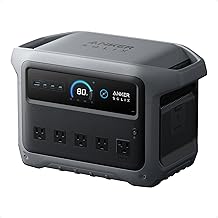 Anker SOLIX C1000 Gen 2 Portable Power Station4.7$499.99Our score 8.8/10
 - 2
 BLUETTI AC180 Portable Power Station 1152Wh 1800W LiFePO4 Solar Generator4.6$449.00Our score 8.4/10
 - 3
 Anker SOLIX C1000 Power Station and BP1000 Expansion Battery, 2112Wh, 1800W4.7$799.99Our score 8.8/10
 - 4
 BLUETTI Elite 30 V2 Portable Power Station 288Wh 600W LFP Solar Generator4.5$279.99Our score 8.5/10
 - 5
 Jackery Solar Generator 1000 v2 and 200W Solar Panel,1070Wh,1500W AC4.5$879.00Our score 8.3/10
Best balanced pick: Anker SOLIX C1000 Gen 2
The Anker SOLIX C1000 Gen 2 is our balanced choice for short residential blackouts and vehicle-based camping. At the supplied price of $499.99, it earns our score of 8.8/10 and combines a mid-capacity format with long-life LiFePO4 cells. It makes sense for buyers seeking a standalone station rather than a two-unit backup system.
The main reservation is specification clarity. The supplied listing gives 2000W output, but our review notes advise verifying the continuous inverter limit and actual solar charging input before purchase. Do not treat an advertised wattage as confirmation that every appliance will run; compare the manual’s continuous rating with your combined loads and check startup requirements separately.
Portability also needs perspective: its noticeable weight calls for deliberate transport planning. Choose it for car-accessible power and occasional home backup, rather than assuming it will be comfortable to carry long distances.
Read the reviews: Anker SOLIX C1000 Gen 2 Portable Power Station
Best value for home backup: BLUETTI AC180
The BLUETTI AC180 is the value-oriented choice for buyers who want substantial storage and a clearly stated continuous output. Its supplied price is $449.00, with 1152Wh capacity, an 1800W continuous inverter and LiFePO4 cells. Our score is 8.4/10. That combination suits frequent cycling, home backup and demanding field power without the expense of a bundled solar panel.
Our review identifies induction burners and power tools as suitable loads, but that is not a guarantee for every appliance. Check the individual device’s running watts and startup demand, and keep simultaneous loads within the station’s limits. A high-output inverter determines what can run; battery capacity determines how long it can run.
The trade-offs are weight and separate solar purchases. Panels and adapters are not included at this price. Before adding either, check the manual’s solar voltage range, current limit, wattage ceiling and connector requirements rather than buying on panel wattage alone.
Read the reviews: BLUETTI AC180 Portable Power Station 1152Wh 1800W LiFePO4 So
Best for longer outages: Anker SOLIX C1000 with BP1000
The Anker SOLIX C1000 and BP1000 Expansion Battery package is our pick when runtime matters more than a single-unit footprint. The supplied $799.99 bundle provides 2112Wh of storage and 1800W of continuous output, earning our score of 8.8/10. Its LiFePO4 cells support thousands of cycles, making it a sensible option for regular home backup or extended off-grid use.
The extra storage is the reason to buy this package. It does not mean unlimited appliance power: the 1800W continuous inverter remains the boundary for sustained combined loads. Prioritize essential devices and check each appliance’s requirements rather than treating the bundle as whole-home backup.
Two units also require substantial carrying effort and storage space. Replenishing this much capacity off-grid needs significant solar panel capacity and realistic expectations about available sunlight. Check the station’s permitted solar input before choosing panels; storage capacity alone does not tell you how quickly a system can recharge.
Read the reviews: Anker SOLIX C1000 Power Station and BP1000 Expansion Battery
Best compact choice: BLUETTI Elite 30 V2
The BLUETTI Elite 30 V2 suits field electronics and camping buyers who need useful output in a compact station, not extended household runtime. It combines a 288Wh LFP battery with 600W continuous output at a supplied price of $279.99. Our score is 8.5/10. Its long-cycle chemistry is particularly relevant if the station will be charged and discharged regularly.
The distinction between watts and watt-hours is especially important here. The inverter can support a 600W continuous load, but the small battery cannot sustain it for long: our review notes that consumption at that level exhausts the reserve in under thirty minutes. Lower-demand electronics are a better match when runtime is the priority.
Choose this model for its compact profile and output capability, not as a substitute for a larger backup battery. Before connecting tools or electronics, check their running and startup requirements against the manual, and allow for energy losses when estimating runtime.
Read the reviews: BLUETTI Elite 30 V2 Portable Power Station 288Wh 600W LFP So
Best included-panel package: Jackery Solar Generator 1000 v2
The Jackery Solar Generator 1000 v2 with 200W Solar Panel is the straightforward choice for buyers who want a matched station-and-panel purchase. The supplied $879.00 package combines 1070Wh of storage, a 1500W continuous AC inverter and an official 200W panel. It earns our score of 8.3/10 and suits medium-scale emergency preparedness, camping and road trips.
Convenience is its strongest argument. The matched panel removes the compatibility guesswork associated with assembling a third-party setup. The trade-offs are a higher upfront cost and the packing space needed for the panel. Check appliance requirements before relying on the 1500W inverter for household backup.
A 200W panel rating is not a promise of constant 200W charging. Panels rarely deliver their rated output in everyday conditions, so do not estimate recharge time from nameplate wattage alone. Follow the manual for setup, use unobstructed sunlight and account for changing weather when planning off-grid replenishment.
Read the reviews: Jackery Solar Generator 1000 v2 and 200W Solar Panel
Frequently asked
- What size portable power station do I need for home backup?
- Start by adding the running watts of devices you need simultaneously, then check their startup demands. Choose sufficient continuous output before comparing storage capacity. For runtime planning, divide capacity in watt-hours by average load in watts, allowing for losses. Check the manual for model-specific limits.
- Is LiFePO4 better than NMC for a portable power station?
- For frequent cycling and home backup, LiFePO4 is the preferred chemistry in our buying rules because its cells last several times longer than NMC. That does not make every LiFePO4 station equally suitable: output, capacity and carrying weight still matter. Follow the manual’s charging and storage guidance.
- Can a portable power station run a refrigerator?
- Yes, if its continuous output covers the refrigerator’s running demand and it can accommodate the compressor’s startup requirement. Runtime also depends on battery capacity and the refrigerator’s cycling behavior. Check the refrigerator’s requirements and the station manual rather than assuming that a headline wattage guarantees compatibility.
- Can I use any solar panel with a portable power station?
- No. Check the station manual’s solar input voltage range, maximum current, wattage limit and connector requirements against the panel’s specifications, including open-circuit voltage. A connector adapter alone does not establish electrical compatibility. Also allow for real-world generation below the panel’s rated output when planning recharge times.