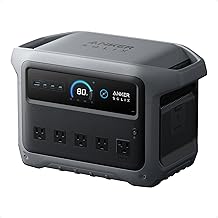
 Anker SOLIX C1000 Gen 2 Portable Power Station
Recorded price: $499.99 · Editorial score: 8.8/10
- Wattage
- 2000 watts
- Power Source
- Battery Powered
- Reason to pause
- Noticeable weight requires dedicated transport effort
The best home solar generators pair roughly 1kWh or more of LiFePO4 storage with enough continuous AC output for carefully managed essential loads.
By the Niche Picks editorsUpdated October 7, 20268 min readDrawn from our 30 research-based portable power stations & solar reviews
For most home backup needs, the Anker SOLIX C1000 with BP1000 is our top pick because it combines 2,112Wh of LiFePO4 storage with 1,800W continuous output and 600W solar input. For a simpler, lower-cost setup, the 1,056Wh Anker SOLIX C1000 and 1,152Wh BLUETTI AC180 offer strong 1,800W output, while Jackery’s 1000 v2 bundle includes a matched 200W panel.
Editorial scores and recorded prices are reference points, not measurements of suitability for every use. Read each review's specifications and limitations.
 Anker SOLIX C1000 Power Station and BP1000 Expansion Battery, 2112Wh, 1800W4.7$799.99Our score 8.8/10Best for Serious home backup and extended off-grid living
 Anker SOLIX C1000 Portable Power Station with Car Charging Cable, 1,056Wh4.7$449.98Our score 8.7/10Best for Weekend camping and modest home emergency backup
 BLUETTI AC180 Portable Power Station 1152Wh 1800W LiFePO4 Solar Generator4.6$449.00Our score 8.4/10Best for High-cycle home backup and demanding field power
 Jackery Solar Generator 1000 v2 and 200W Solar Panel,1070Wh,1500W AC4.5$879.00Our score 8.3/10Best for Turnkey medium-scale home emergency preparednessAnker SOLIX C1000 Gen 2 Portable Power Station4.7$499.99Our score 8.8/10Best for Mid-capacity home backup and outdoor power
| Product | Listed price | Capacity | Continuous AC output | Solar input | Stated cycle life / retention |
|---|---|---|---|---|---|
| Anker SOLIX C1000 + BP1000 | $799.99 | 2,112Wh | 1,800W | Up to 600W | Over 3,000 cycles; retention threshold not stated |
| Anker SOLIX C1000 | $449.98 | 1,056Wh | 1,800W | Up to 600W | 3,000 cycles to 80% |
| BLUETTI AC180 | $449.00 | 1,152Wh | 1,800W | Up to 500W | Thousands of cycles; retention threshold not stated |
| Jackery Solar Generator 1000 v2 + 200W panel | $879.00 | 1,070Wh | 1,500W | 200W panel included | 4,000 cycles to 70% |
| Anker SOLIX C1000 Gen 2 | $499.99 | 1,024Wh | 2,000W | Not stated in our review | 4,000 cycles to 80% |
The Anker SOLIX C1000 plus BP1000 expansion battery is the best solar generator for home backup in this group. At a listed $799.99, it combines 2,112Wh of LiFePO4 battery storage with an 1,800W continuous inverter, 11 output ports, and solar input up to 600W. That is a more credible starting point for keeping a deliberately limited set of household essentials powered than the sub-300Wh camping stations in our reviews.
Its principal limitation is also important: 1,800W is the sustained ceiling, and 2,112Wh is finite stored energy. A full-size microwave, shop equipment, or other heavy loads near that ceiling can empty the battery in roughly 58 minutes according to our review. It is better approached as an essential-load backup system than as a substitute for whole-house standby power.
The modular two-unit design can make handling easier than one large battery block, but it also creates a two-piece footprint. Anker rates its LiFePO4 cells for more than 3,000 cycles; the stated retention percentage at that threshold is not available in our review. Solar panels are not included, so plan for an appropriately sized, voltage-compatible array if solar charging matters.
Start with our portable power stations and solar buyer's guide before choosing a capacity. It explains the distinction between inverter power, battery capacity, and solar input—three numbers that are often confused in generator listings.
Read the reviews: Anker SOLIX C1000 Power Station and BP1000 Expansion
The Anker SOLIX C1000 is the value pick for many households: its listed $449.98 price buys 1,056Wh of LiFePO4 storage, 1,800W continuous pure-sine-wave AC output, 11 outlets, and a 600W solar-input circuit. Anker rates the cells for 3,000 cycles to 80% capacity retention. It also includes AC and 12V car charging cables, though a solar panel is a separate purchase.
This is enough power for many individual essential appliances, but capacity determines how long they operate. At a continuous 1,800W draw, our review estimates roughly 35 to 40 minutes of runtime after inverter losses. Lower, intermittent loads stretch the available energy much further. Avoid planning around the quoted 2,400W SurgePad figure: the normal continuous rating is the usable appliance-planning number.
A 600W solar input is a meaningful advantage for an outage kit, but it does not mean you will see 600W all day. Panel angle, temperature, haze, cable losses, and cloud cover reduce real collection. A realistic plan includes enough panel wattage and clear sun hours to refill only the energy you expect to use.
Use our power-station size guide to total the watts and watt-hours of your priority devices. For broader context on current models, see the best portable power stations.
Read the reviews: Anker SOLIX C1000 Portable Power Station with Car
Yes. The BLUETTI AC180 is a strong choice when you want 1,800W of continuous output, 1,152Wh of capacity, and a LiFePO4 platform at a listed $449.00. It accepts up to 500W of solar input, and its capacity is slightly larger than the standalone Anker SOLIX C1000 reviewed here. BLUETTI describes the battery as providing thousands of cycles, although our review does not record an exact cycle count, capacity-retention point, or warranty term.
The 1,800W pure-sine-wave inverter is the relevant rating for sustained appliance use. BLUETTI says it can support standard kitchen hardware such as microwaves, blenders, and slow cookers within its 15-amp aggregate limit. Do not treat the optional 2,700W power-lifting mode as conventional 2,700W household output: it works by lowering line voltage and is not intended for sensitive electronics.
Its 500W maximum solar input is well matched to a substantial portable array. Even so, the review’s ideal-condition estimate of 2.8 to 3.3 hours for a solar refill should not be treated as an everyday field expectation; four to five hours is more realistic when an array operates near its rating. Panels and adapters are sold separately.
If you are deciding between 1,800W models, use our product comparison tool to put capacity, continuous wattage, solar input, and stated cycle data side by side. Also review these solar generator buying tips before buying panels.
Read the reviews: BLUETTI AC180 Portable Power Station 1152Wh 1800W
The Jackery Solar Generator 1000 v2 bundle is the simplest turnkey option reviewed for a medium-scale home emergency kit. At a listed $879.00, it includes the 1,070Wh Explorer 1000 v2 power station and a matched 200W solar panel. That removes the most common solar-shopping complication: confirming panel connectors, voltage limits, and adapter requirements across separate brands.
The station supplies 1,500W continuous AC output and 3,000W surge output. Plan around 1,500W, not 3,000W. This output level can support selected larger appliances, but simultaneous high-draw heating loads can trigger overload protection. The 1,070Wh battery provides approximately two hours at moderate heavy draws in our review; runtime will vary with the actual load and conversion losses.
Jackery specifies LiFePO4 cells rated for 4,000 cycles to 70% capacity. Of the home-capable picks here, that is the clearest stated cycle-and-retention specification. Our review does not record a warranty term, so verify current exact-model coverage before purchasing. The included panel is rated at 200W, but solar charging takes longer than AC charging and field output will fall below nameplate power.
For a deeper explanation of array size, shading, and portable-panel tradeoffs, read how to choose a portable solar generator. This bundle is particularly appealing for buyers who value compatibility certainty over the lowest possible upfront cost.
Read the reviews: Jackery Solar Generator 1000 v2 and 200W Solar
Choose the Anker SOLIX C1000 Gen 2 when your essential-load plan genuinely needs more than 1,800W of continuous output but you still want a roughly 1kWh-class portable station. It lists 1,024Wh capacity, 2,000W continuous output, a 3,000W surge threshold, and a $499.99 price. In our review, the LiFePO4 battery is rated for 4,000 cycles to 80% remaining capacity.
That additional 200W can matter when a load combination is close to the threshold, but it does not turn a 1,024Wh battery into a long-duration whole-home system. Our review estimates approximately five to six hours for a 150W desktop workstation after ordinary inverter losses. A 2,000W load would consume stored energy far more quickly. Prioritize a refrigerator, router, lights, phone charging, or a work setup rather than attempting to power every circuit.
The model includes a sub-10-millisecond UPS transfer rate in the reviewed specifications, which may help prevent interruptions for appropriate connected equipment. Confirm the exact device’s instructions and compatibility before relying on any portable station as UPS power. Our review does not record the unit’s solar-input limit or a warranty term, so those are items to confirm before selecting it specifically for solar recharging.
For a broader selection of reviewed systems, visit all portable power stations and solar reviews. For planning errors that can waste money or cause overloads, see our guide to solar power-station mistakes to avoid.
Read the reviews: Anker SOLIX C1000 Gen 2 Portable Power Station
Size a home solar generator with two separate calculations: watts and watt-hours. Watts measure instantaneous power demand. Add the running watts of everything you expect to operate at once, then choose a station whose continuous AC rating exceeds that total with reasonable headroom. Watt-hours measure stored energy. Multiply each device’s watts by the hours you expect to use it, then add the results to estimate the battery capacity you need.
For example, a 1,056Wh to 1,152Wh station is often a practical short-outage tier for carefully managed essentials, while the 2,112Wh Anker bundle has more reserve for extended use. These are planning categories, not promised runtimes: AC conversion, battery temperature, charging behavior, and the actual appliance draw all affect results.
Solar is a recharge path, not an unlimited power source. A station accepting 500W or 600W solar can take advantage of a larger array than a 200W-panel bundle, but panels rarely produce their laboratory rating outdoors. Keep them unshaded, aim them toward the sun, and confirm that panel open-circuit voltage, operating voltage, current, connector, and polarity fall within the station manufacturer’s exact limits.
Portable power stations generally power devices plugged directly into their outlets. Do not connect one to household wiring, a wall outlet, or a breaker panel unless the manufacturer expressly supports the setup and it is installed with the required transfer equipment by a qualified professional. For more answers, consult our portable power station FAQ.
Read the reviews: Anker SOLIX C1000 Power Station and BP1000 Expansion, Anker SOLIX C1000 Portable Power Station with Car, BLUETTI AC180 Portable Power Station 1152Wh 1800W
Amazon links are affiliate links; we may earn a commission at no cost to you.
This page summarizes our research reviews of Amazon listings, listed specifications and captured buyer ratings. It is not a hands-on test. Scores are editorial assessments, not measured performance; prices are recorded snapshots and may change. A category can include both main products and accessories, so its overall price range is not the cost of a complete setup.
Most recent product record update: October 3, 2026. Individual records may be older; this is not a verification date for every claim.
Amazon links are affiliate links. We may earn a commission on qualifying purchases, at no extra cost to you.
A more useful shortlist
Choose the product type first. These groups require a match in the listing title; an import search term alone is not enough. Scores rank our recorded research assessments within each group, not independently measured performance.
Anker SOLIX C1000 Gen 2 Portable Power StationRecorded price: $499.99 · Editorial score: 8.8/10
Anker SOLIX C1000 Portable Power Station with Car Charging Cable, 1,056WhRecorded price: $449.98 · Editorial score: 8.7/10
BLUETTI AC180 Portable Power Station 1152Wh 1800W LiFePO4 Solar GeneratorRecorded price: $449.00 · Editorial score: 8.4/10
Jackery Solar Generator 1000 v2 and 200W Solar Panel,1070Wh,1500W ACRecorded price: $879.00 · Editorial score: 8.3/10
Anker SOLIX C1000 Power Station and BP1000 Expansion Battery, 2112Wh, 1800WRecorded price: $799.99 · Editorial score: 8.8/10
If a specification, certification or compatibility detail is absent, mark it as unknown and ask the seller or manufacturer. Do not substitute a star rating, an editorial score or a different model's specification.