Comparing the ELEGOO Saturn 4 Ultra and Mars 5 Ultra: optical resolution, build envelopes, tilt-release mechanics, and workshop workspace requirements.
By the Niche Picks editorsUpdated October 24, 20269 min readDrawn from our 30 research-based maker tools reviews
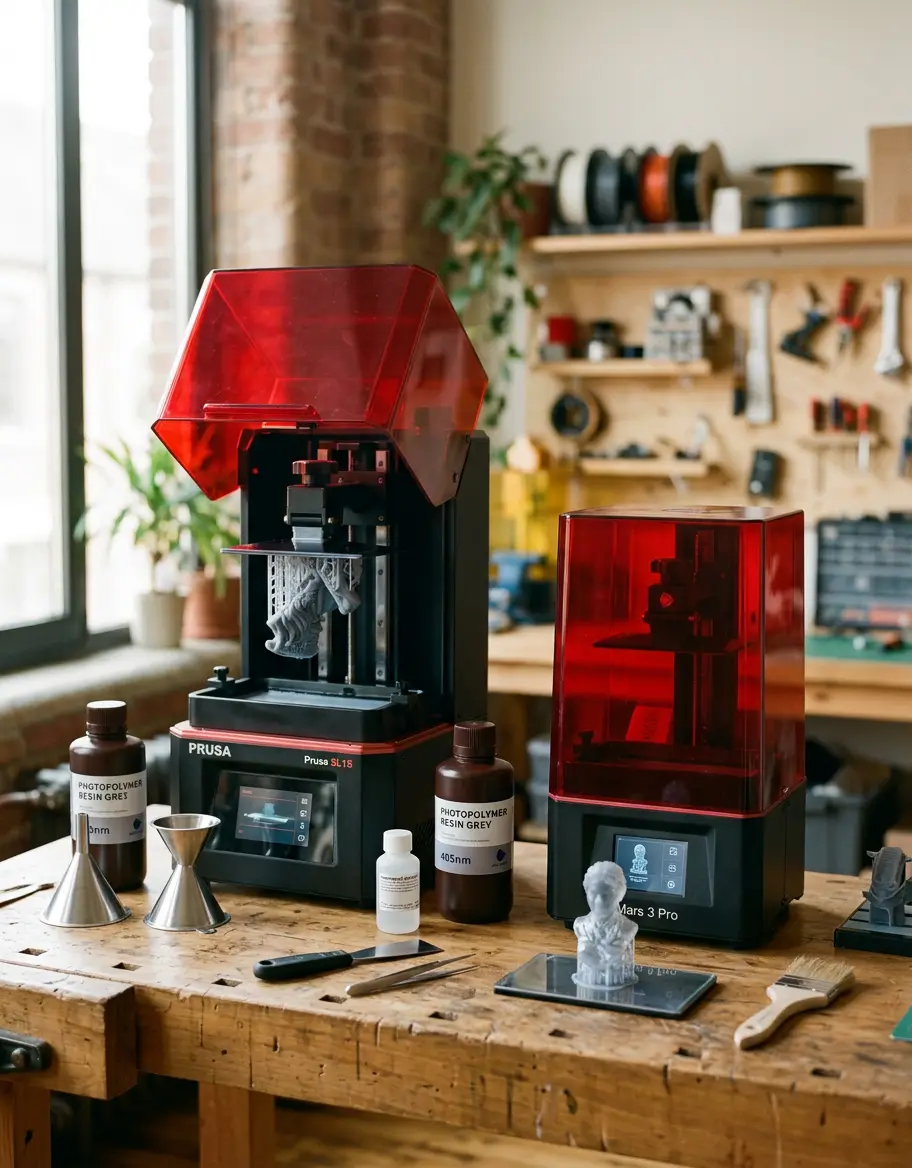
AI-generated editorial illustration; not a product or test photograph.
Short answer
The ELEGOO Saturn 4 Ultra ($519.99) delivers a larger format with a 16K LCD, active 30 °C vat heating, and sensor-driven monitoring for batch production. The ELEGOO Mars 5 Ultra ($356.98) uses a 7-inch 9K screen with an 18-micron pixel pitch, offering identical tilt-release mechanics in a lighter, compact tabletop footprint suited for detailed miniatures.
4
Product listings discussed; not hands-on tests
4/4
Discussed listings with a recorded price
$199.99–$519.99
Recorded listing price range; not a complete setup cost
Key takeaways
The Saturn 4 Ultra features a 16K masking LCD, while the Mars 5 Ultra employs a 7-inch 9K panel with an 18-micron XY pixel pitch.
Both machines integrate a motorized tilt-release vat mechanism that reduces peel forces and enables vertical speeds up to 150 mm/h.
The Saturn 4 Ultra includes an active 30 °C heated resin vat, preventing viscosity fluctuations during cold-weather production runs.
The Mars 5 Ultra weighs 19.36 pounds, compared to the heavier 35.5-pound footprint of the Saturn 4 Ultra.
Both printers feature automated leveling and mechanical residue sensors to prevent LCD damage from cured vat debris.
Products discussed in this article
Editorial scores and recorded prices are reference points, not measurements of suitability for every use. Read each review's specifications and limitations.
ANYCUBIC Photon Mono 4, Resin 3D Printer with 7'' 10K7.6
Recorded price (USD)
ELEGOO Saturn 4 Ultra 16K Resin 3D Printer519.99 USD
ELEGOO Mars 5 Ultra Resin 3D Printer356.98 USD
ELEGOO Mars 5 Resin 3D Printer199.99 USD
ANYCUBIC Photon Mono 4, Resin 3D Printer with 7'' 10K239.99 USD
ELEGOO Saturn 4 Ultra vs Mars 5 Ultra & Lineup Alternatives
Product
Price
Screen Resolution
Release Mechanism
Weight
Customer Rating
ELEGOO Saturn 4 Ultra
$519.99
16K Monochrome LCD
Motorized Tilt-Release
35.5 lbs
4.3 / 5 (349 reviews)
ELEGOO Mars 5 Ultra
$356.98
9K Monochrome LCD (18µm)
Motorized Tilt-Release
19.36 lbs
4.3 / 5 (381 reviews)
ELEGOO Mars 5
$199.99
4K Monochrome LCD
Standard Vertical Peel
14.52 lbs
4.1 / 5 (164 reviews)
ANYCUBIC Photon Mono 4
$239.99
10K Monochrome LCD (17µm)
Standard Vertical Peel
7.7 lbs
4.4 / 5 (666 reviews)
Which Printer Wins the Elegoo Saturn 4 Ultra vs Mars 5 Ultra Matchup?
Choosing between the ELEGOO Saturn 4 Ultra and the ELEGOO Mars 5 Ultra depends on physical footprint, throughput volume, and your project scale. Both machines represent a significant technological upgrade in consumer photopolymer printing by incorporating active tilt-release vats and sensor-managed workflows. However, they target different production requirements.
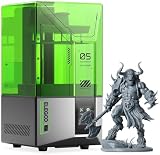
The Saturn 4 Ultra is engineered for medium-format output and batch fabrication. Retailing at $519.99, it incorporates a 16K monochrome LCD masking screen, an automated leveling architecture, and an integrated resin vat heater designed to maintain fluid at 30 °C. It is a substantial machine, weighing 35.5 pounds with external dimensions of 24 by 17 by 15 inches. For makers who produce larger statues, multiple miniatures simultaneously, or functional assemblies, the extra investment provides substantial production capacity.
In contrast, the Mars 5 Ultra retails at $356.98 and targets high-precision desktop miniature fabrication. It utilizes a 7-inch 9K monochrome screen that achieves an 18-micrometer XY pixel pitch, ensuring fine structural edges and micro-detail reproduction. Tipping the scales at 19.36 pounds with dimensions of 15.75 by 18.5 by 9.06 inches, it fits comfortably into smaller hobby spaces. While it lacks the built-in vat heating element of its larger sibling, it preserves the high-speed tilt-release architecture, AI camera monitoring, and mechanical vat residue detection.
For creators focused strictly on tabletop figurines and fine jewelry, the Mars 5 Ultra delivers outstanding precision per dollar. Operators seeking high batch output or larger build volume will find the Saturn 4 Ultra justifies its premium price tag. Review our Maker tools buyer's guide to balance format requirements against your available workshop space.
The core performance differentiator between these two units lies in their optical masking panels. The ELEGOO Saturn 4 Ultra features a high-density 16K monochrome LCD, while the ELEGOO Mars 5 Ultra uses a 7-inch 9K panel.
In masked stereolithography (MSLA), nominal resolution figures can be misleading without evaluating panel size. The Mars 5 Ultra distributes its 9K resolution across a compact 7-inch diagonal panel. This yields an XY resolution of 18 by 18 microns. Such fine pixel pitch ensures smooth skin textures, crisp miniature weaponry, and minimal voxel stepping across curved surfaces. For alternative compact setups, the ANYCUBIC Photon Mono 4 provides a 7-inch 10K screen at 17 microns for $239.99, though it uses traditional vertical lift peeling instead of an automated tilting vat.
The Saturn 4 Ultra scales its optical array to 16K resolution across a significantly wider physical area. This density ensures that even with a broad platform suitable for batch manufacturing, pixel pitch remains competitive with smaller screens. Organic sculpts, armor plates, and architectural details maintain sharp definition across the entirety of the build plate without edge distortion.
Both units use uniform ultraviolet light sources to minimize lateral blooming, which preserves fine positive tabs and negative-space relief channels. When working with fine features, pairing these systems with low-viscosity resins like ELEGOO Upgraded 8K Standard 3D Printer Resin Space Grey ($20.99) will maximize optical fidelity. For broader advice on machine precision and upkeep, check our guide on how to calibrate a 3D printer.
What Are the Mechanics Behind the Tilt-Release Vat?
Both the Saturn 4 Ultra and Mars 5 Ultra abandon traditional vertical Z-axis peeling in favor of an active motorized tilt-release vat mechanism. In classic resin printers, each cured layer is pulled straight up off the release film, creating high perpendicular suction forces that can tear delicate supports or delaminate thin geometry.
The tilt mechanism fundamentally changes this kinetic cycle:
The vat pivots along one side during the layer separation phase, peeling the release film away progressively rather than pulling it vertically all at once.
Lateral shear forces replace direct tensile suction, protecting fine miniature limbs, needle-thin supports, and slender hollow walls.
Mechanical cycle times decrease dramatically, allowing vertical print speeds up to 150 mm/h under optimal resin conditions.
The system integrates mechanical pressure sensors underneath the vat assembly that track resistance and detect un-cured foreign debris.
This architecture directly addresses common resin printing failure vectors. If a cured fragment breaks off and settles on the release film, the integrated mechanical sensor flags the obstruction before the build plate can press down and crack the monochrome LCD panel.
By comparison, baseline entry models like the ELEGOO Mars 5 ($199.99) incorporate residue detection and auto-leveling but rely on a standard vertical release stroke rather than an active tilting vat. For hobbyists seeking fast turnaround times without constant support failures, the tilt mechanism on the Ultra variants provides a measurable mechanical advantage. You can compare additional machine kinematics across our Maker tools reviews.
How Does Vat Heating and Calibration Affect Success Rates?
A critical mechanical advantage found on the ELEGOO Saturn 4 Ultra is its active vat heating system. Photopolymer resins require specific thermal ranges to perform predictably. When ambient temperatures drop below 20 °C (68 °F), resin viscosity spikes, slowing fluid reflow beneath the build plate and causing delamination, micro-voids, or failed base layers.
The Saturn 4 Ultra integrates a heating module designed to maintain the resin at a steady 30 °C. This stable temperature keeps the fluid flowing freely, accelerating cycle times and ensuring dependable layer bonding even in unheated basements or chilly workshops. The Mars 5 Ultra does not include active vat heating, meaning users in cooler environments must warm their resin bottles before printing or rely on external space heaters.
Where both machines excel equally is bed calibration. Both models eliminate manual four-screw or ball-joint leveling plates. First-layer adhesion failure represents the single most common problem across 3D printing, whether on photopolymer units or FDM beds like those on the Bambu Lab P1S 3D Printer. On the Saturn 4 Ultra and Mars 5 Ultra, factory-calibrated automatic leveling maps the plate topology and handles alignment through mechanical sensors.
Furthermore, both Ultra models include an overhead AI camera mounted inside the UV-blocking hood. This sensor monitors the build plate for catastrophic print detachment, allowing operators to pause prints remotely over Wi-Fi. These combined features drastically reduce the time spent fiddling with shims, leveling paper, and failed prints.
What Are the Safety, Exhaust, and Ventilation Requirements?
Regardless of whether you choose the Saturn 4 Ultra or the Mars 5 Ultra, resin printing requires careful planning for workshop safety and ventilation. Photopolymer resins emit volatile organic compounds (VOCs) and chemical odors throughout the printing, washing, and curing stages.
A fundamental guideline across all maker spaces is that buyers must budget for active ventilation with any resin machine. While the UV hood prevents liquid resin from reacting with ambient room lighting, it does not trap escaping airborne chemicals. Because the Saturn 4 Ultra holds a significantly larger vat capacity and exposes greater surface area, it off-gasses more volatile vapors than the compact Mars 5 Ultra.
Setting up a proper resin workstation involves essential investments:
Budget for an active ventilation tent, window exhaust duct, or dedicated carbon filtration system.
Provide an isopropyl alcohol wash station or ultrasonic cleaner for post-print chemical rinsing.
Maintain a dedicated secondary ultraviolet curing station to polymerize the outer surface of rinsed models.
Keep ample personal protective equipment on hand, including chemical-resistant nitrile gloves and eye protection.
These safety protocols mirror the precautions required for laser systems, such as the Twotrees TTS-55 Pro Laser Engraver, which also demands external exhaust planning. Resin printing is an active chemical workflow, not an open-air desktop hobby. Be sure to explore common mistakes to avoid in Maker tools to design a compliant workspace before unboxing your hardware.
Which Machine Offers Better Value for Your Budget?
Evaluating value between these two printers requires looking at purchase price alongside running costs. The Mars 5 Ultra carries a listed price of $356.98, while the Saturn 4 Ultra is priced at $519.99—a $163.01 difference.
The Mars 5 Ultra is an accessible, high-performance platform for tabletop gamers, miniature painters, and jewelers. Its 9K panel provides all the resolution needed for small-scale figurines, and the tilt-release mechanism ensures reliable production right out of the box. Consumable costs remain low because its compact vat consumes less resin per run, and smaller replacement release films are inexpensive. For beginners seeking top-tier features without overspending, it provides balanced economics. For those looking for an even lower barrier to entry, consider our guide on the best 3D printer for beginners.
The Saturn 4 Ultra earns its $519.99 price tag through throughput capacity and integrated thermal management. The 16K screen and spacious build plate allow you to arrange full squads of figurines or print large single-piece display busts in a single session. The integrated 30 °C vat heater prevents ruined prints caused by temperature fluctuations, saving costly resin over time. However, running a medium-format printer requires purchasing larger resin jugs, such as ELEGOO Standard 3D Printer Resin Grey 1000g ($16.99) or multi-bottle bundles, and requires larger wash vats.
If your monthly print queue demands multi-part plates or commercial batches, the Saturn 4 Ultra is well worth the extra investment. If your projects center on individual high-detail characters, the Mars 5 Ultra is the more economical, space-efficient pick. Check our budget planner to calculate your complete startup costs.
Confirm your workspace can accommodate the larger footprint and 35.5 lb weight of the Saturn 4 Ultra
Budget for dedicated safety gear: nitrile gloves, safety goggles, and isopropyl alcohol
Set up an active ventilation duct or enclosure to exhaust volatile organic compounds outside
Determine whether your print volume requires medium-format batch output or compact single-model printing
Acquire a dedicated UV wash-and-cure station scaled to fit your printer's build platform
Stock up on 405nm UV-curing photopolymer resin formulated for high-resolution monochrome screens
Frequently asked questions
Can the Saturn 4 Ultra print faster than the Mars 5 Ultra?
Both models feature tilting vat mechanisms capable of vertical travel speeds up to 150 mm/h under optimal conditions. However, the Saturn 4 Ultra includes an active 30 °C vat heater, which maintains low fluid viscosity consistently, allowing it to sustain faster speeds in cold workspaces where the Mars 5 Ultra might experience slow resin reflow.
Do I need to manually level the build plate on either printer?
No. Both the ELEGOO Saturn 4 Ultra and Mars 5 Ultra feature automated leveling systems that eliminate manual four-screw or ball-joint adjustments. Mechanical pressure sensors calibrate the build surface automatically, addressing the most common failure point in photopolymer 3D printing.
Is the 16K screen on the Saturn 4 Ultra sharper than the Mars 5 Ultra's 9K screen?
Not necessarily in terms of individual pixel size. Because the Mars 5 Ultra has a smaller 7-inch display, its 9K resolution achieves a fine 18-micrometer XY pixel pitch. The Saturn 4 Ultra's 16K resolution is spread across a substantially larger panel, resulting in comparable fine-detail precision over a larger printable area.
What happens if cured resin debris is left in the vat?
Both printers feature mechanical residue detection sensors. If solid cured fragments remain in the resin vat, the sensor identifies the obstruction during the downward homing stroke and halts operation before the build plate presses down, preventing cracked LCD panels.
Which printer is better for tabletop gaming miniatures?
The Mars 5 Ultra ($356.98) is generally ideal for hobbyists printing individual tabletop miniatures due to its compact desktop footprint, 18-micron detail, and lower upfront cost. The Saturn 4 Ultra is better suited for producing full armies, larger monsters, or high-volume print runs in fewer batches.
Amazon links are affiliate links; we may earn a commission at no cost to you.
Sources and limits
This page summarizes our research reviews of Amazon listings, listed specifications and captured buyer ratings. It is not a hands-on test. Scores are editorial assessments, not measured performance; prices are recorded snapshots and may change. A category can include both main products and accessories, so its overall price range is not the cost of a complete setup.
Most recent product record update: September 15, 2026. Individual records may be older; this is not a verification date for every claim.
Choose the product type first. These groups require a match in the listing title; an import search term alone is not enough. Scores rank our recorded research assessments within each group, not independently measured performance.
Values are shown as recorded, without unit conversions or inferred compatibility. Not recorded means unknown, not absent. Prices are snapshots, not current offers. Editorial scores are research judgments, not lab results. Amazon links are affiliate links.
Before treating a comparison as complete
Which details are still unknown?
A specification appearing in a listing is not independent verification. These counts show which shortlisted records contain the same field; a blank record does not mean the product lacks the feature.
Item Weight
Recorded for 2 of 2 shortlisted models
Present in every shortlisted record. Check units, exact variants and the current manufacturer documentation before relying on it.
Product Dimensions
Recorded for 2 of 2 shortlisted models
Present in every shortlisted record. Check units, exact variants and the current manufacturer documentation before relying on it.
Item model number
Recorded for 2 of 2 shortlisted models
Present in every shortlisted record. Check units, exact variants and the current manufacturer documentation before relying on it.
Manufacturer
Recorded for 2 of 2 shortlisted models
Present in every shortlisted record. Check units, exact variants and the current manufacturer documentation before relying on it.
Values are shown as recorded, without unit conversions or inferred compatibility. Not recorded means unknown, not absent. Prices are snapshots, not current offers. Editorial scores are research judgments, not lab results. Amazon links are affiliate links.
For ABS or ASA, confirm enclosure, temperatures and ventilation; an enclosure alone does not establish reliable printing or safe emissions.
Auto bed levelling removes the most common failure mode.
Budget for ventilation with any resin or laser machine.
If a specification, certification or compatibility detail is absent, mark it as unknown and ask the seller or manufacturer. Do not substitute a star rating, an editorial score or a different model's specification.