Design and build
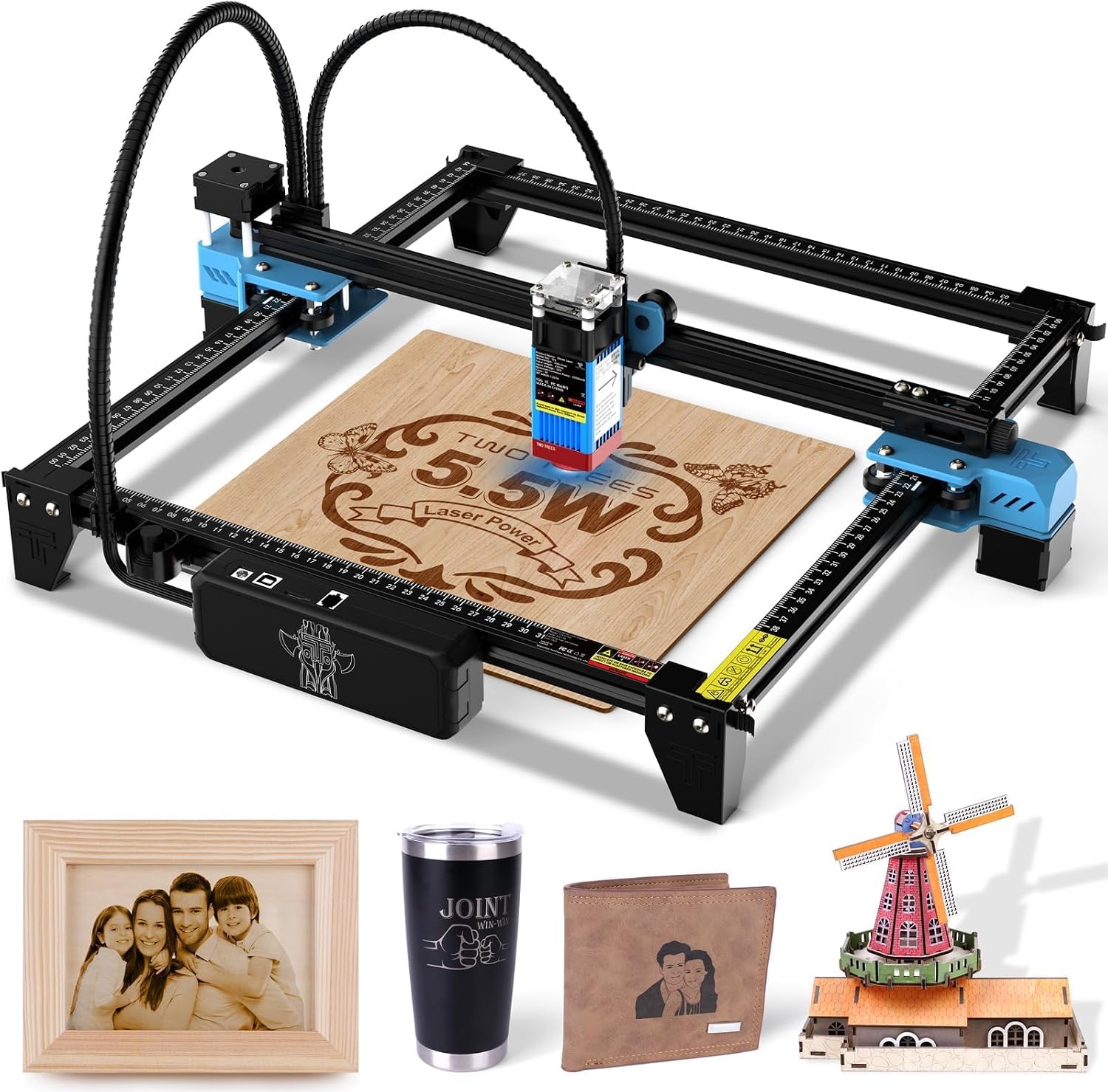
The Twotrees TTS-55 Pro utilizes a minimalist open-frame architecture measuring approximately 19.4 by 6.5 by 6.3 inches in packaging and weighing 8.23 pounds when assembled. The machine provides a usable working envelope of 300x300mm, accommodating typical craft blanks, signage components, and small-batch production sheets. Structural integrity relies on aluminum extrusion profiles driven by a 32-bit dual-core microcontroller. Twotrees integrates a metal air-assist nozzle directly around the laser module alongside a red filtering laser shield designed to diffuse direct beam emissions. However, because this is a completely open gantry system, direct optical reflections and combustion gases are released immediately into the ambient room. Makers must adhere to fundamental tool safety guidelines by budgeting for a third-party filtered enclosure and dedicated mechanical ventilation. While the components provide sufficient rigidity for low-mass diode movement, overall frame stability depends entirely on square manual alignment during the initial assembly phase.
Real-world performance
Operational throughput on the TTS-55 Pro is anchored by a Class II diode delivering 5500mW of optical output. The module employs LD, FAC, and C-lens compression technology to yield an oblong focal spot measuring 0.08 by 0.46mm at a short 23mm focal distance. Twotrees specifies engraving precision up to 0.1mm and theoretical travel rates reaching 30,000mm/min. In practice, the modest 5.5W power reserve means deep cutting tasks require slow travel speeds and multiple passes. Manufacturer specifications cite maximum cutting depths of 5mm in plywood, 3mm in acrylic, and 0.7mm in leather. While the pre-installed metal air nozzle reduces charring and lens contamination, optimal cutting efficiency requires hooking this nozzle to an external air compressor, which is not listed as included in the base package. For surface marking across wood, leather, paper, and treated metals, the compressed spot reliably renders crisp vectors and halftones.
Value for money
Priced at $125.88, the TTS-55 Pro represents an exceptionally low financial threshold for entering laser fabrication. Its market acceptance is evidenced by over 200 units purchased in the past month and an aggregate rating of 4.4 out of 5 stars from 493 customer reviews. The unit supports critical maker-standard software interfaces, operating smoothly with LaserGRBL on Windows as well as LightBurn across macOS, Linux, and Windows environments. The inclusion of offline TF card processing and wireless control via a 32-bit board adds flexibility rare at this price tier. Nevertheless, prospective buyers must evaluate total system expenditure rather than the purchase price in isolation. Maximizing the tool requires purchasing an external air pump to activate the nozzle, dedicated laser eye protection, and an exhaust ducting solution. Even with those secondary outlays factored in, the hardware delivers strong baseline capability for budget-conscious workshops.
Who should skip it
This engraver is not suitable for high-throughput commercial workshops or environments where immediate, enclosed Class 1 safety compliance is mandatory. The 5.5W diode lacks the raw optical power necessary to process dense woods, thick sheets, or clear plastics rapidly, making it inefficient for serious fabrication runs. Users residing in enclosed apartments or small living spaces without dedicated exterior ducting paths must steer clear; the open-frame design vents smoke, volatile organic compounds, and noxious particulate directly into the workspace. Maker purchasing rules dictate budgeting for ventilation with any laser machine, and retrofitting an enclosure to this machine adds logistical overhead that plug-and-play consumers may resent. Additionally, creators requiring fully autonomous workflow setups should look toward units with integrated cameras and autofocus sensors. Production-focused makers requiring rapid cuts through materials exceeding 6mm thickness should bypass this tier entirely for higher-wattage CO2 or enclosed diode alternatives.