Design and build
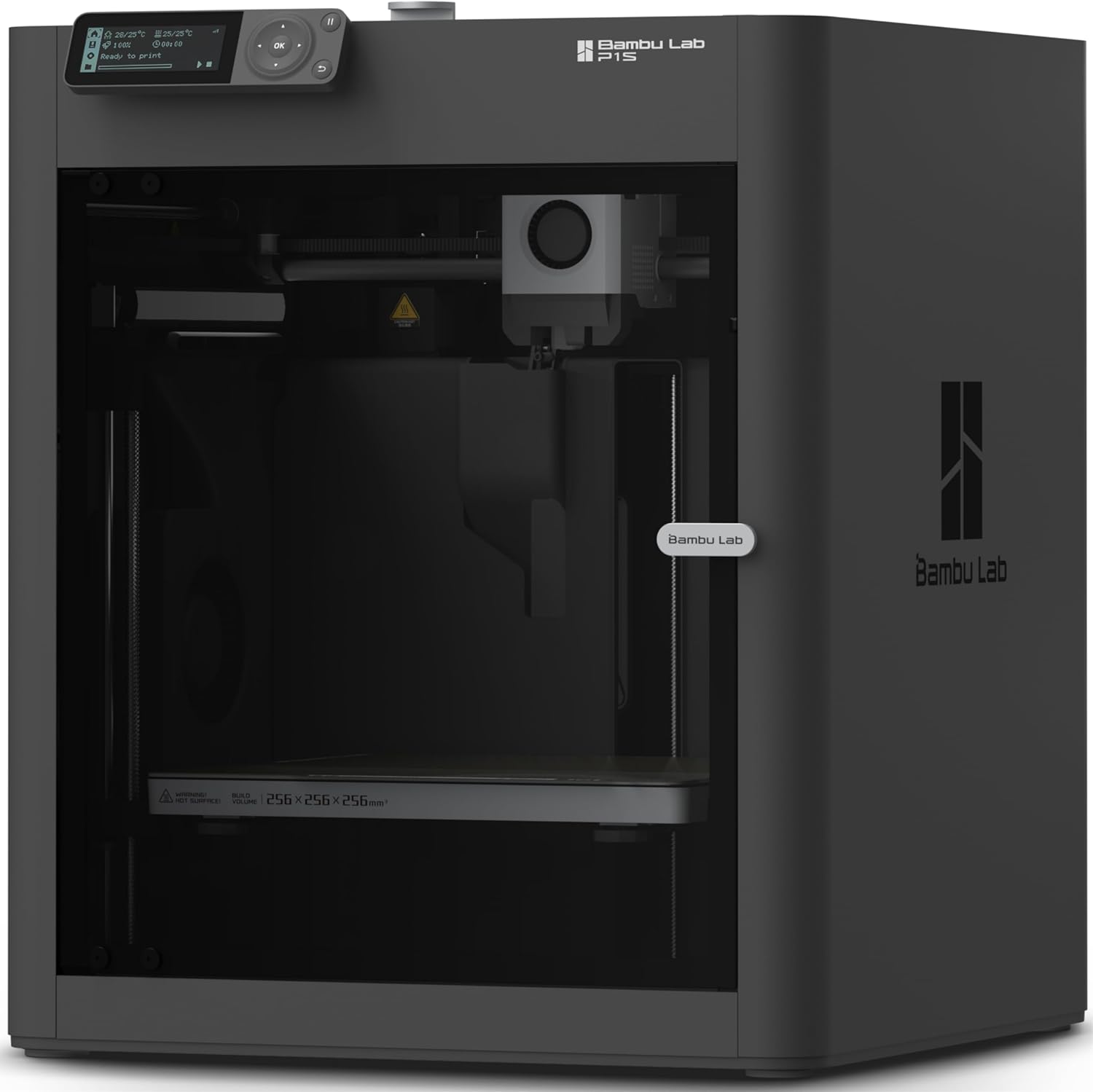
The Bambu Lab P1S is engineered around a rigid CoreXY architecture encased within a factory enclosure, measuring 15.31 x 18.03 x 15.31 inches and weighing 38.9 pounds. This structural mass counteracts the kinetic inertia generated during high-acceleration toolhead shifts. Unlike open-frame desktop units, the enclosed perimeter maintains an elevated ambient chamber temperature. This fulfills a primary operating rule for maker environments: keeping drafts away from warping-prone materials such as ABS and ASA. The internal build plate accommodates items up to 256 x 256 x 256 mm, a practical envelope for functional prototyping and production runs. Cable routing and mechanical components are shielded from user intervention during motion routines. While the stock construction relies on components optimized for standard polymers, prospective users seeking to run abrasive materials should note the standard nozzle and extruder assembly are not configured from the factory for continuous fiber-filled filament deployment.
Real-world performance
Performance is defined by the printer's motion kinematics, capable of velocity targets up to 500 mm/s and acceleration figures reaching 20 m/s². These motion dynamics significantly compress print times compared to legacy Cartesian systems. Critical to daily operation is the automatic bed leveling protocol. By systematically mapping the plate topography prior to extrusion, the system neutralizes bed-tramming errors, which represent the single most common failure vector in fused deposition modeling. Material handling is versatile across typical filaments, with verified support for PLA, PETG, TPU, PVA, PET, ABS, and ASA. It can also manage PA and PC with adjusted process parameters. Setup takes roughly fifteen minutes from unboxing to initial diagnostic extrusion. However, buyers should recognize that multi-material printing requires the proprietary Automatic Material System, which is not supplied with this standalone $399.00 base unit and must be sourced separately.
Value for money
At an entry price of $399.00, backed by a 4.5 out of 5 rating across 394 recorded reviews, the P1S occupies a highly competitive space in the prosumer additive manufacturing category. Most fully enclosed machines historically demanded industrial premiums, forcing hobbyists to build DIY enclosures or accept limited material envelopes. Here, the inclusion of robust automated bed leveling, a proven motion platform, and pre-configured chamber dynamics lowers operational barriers considerably. The absence of the AMS multi-color accessory keeps the base barrier to entry low for users prioritizing technical single-material production over complex multi-hue models. Operating costs remain standard for desktop FDM units, though working extensively with toxic styrene-based polymers like ABS will require users to account for suitable dedicated workshop ventilation, adding a secondary expense to the workspace installation if not already properly equipped.
Who should skip it
Production shops focused primarily on structural composite filaments—such as carbon-fiber-reinforced nylon or glass-filled polymers—should look elsewhere or factor in mandatory component upgrades, as the base P1S extruder and hotend are explicitly not recommended for continuous abrasive use. Additionally, operators seeking out-of-the-box multicolor or multi-material support should skip this specific SKU in favor of the AMS bundle, as purchasing the dispensing module independently later incurs higher shipping and procurement overhead. Users who only require occasional PLA or PETG output on a tight budget could also pass, as cheaper open-frame alternatives can satisfy non-warping filament needs at a lower cost, provided the buyer is willing to forgo enclosed chamber heat retention and rapid print throughput. Finally, those needing expansive print volumes beyond 256 mm³ must evaluate larger format machines.