Design and Material Formulation
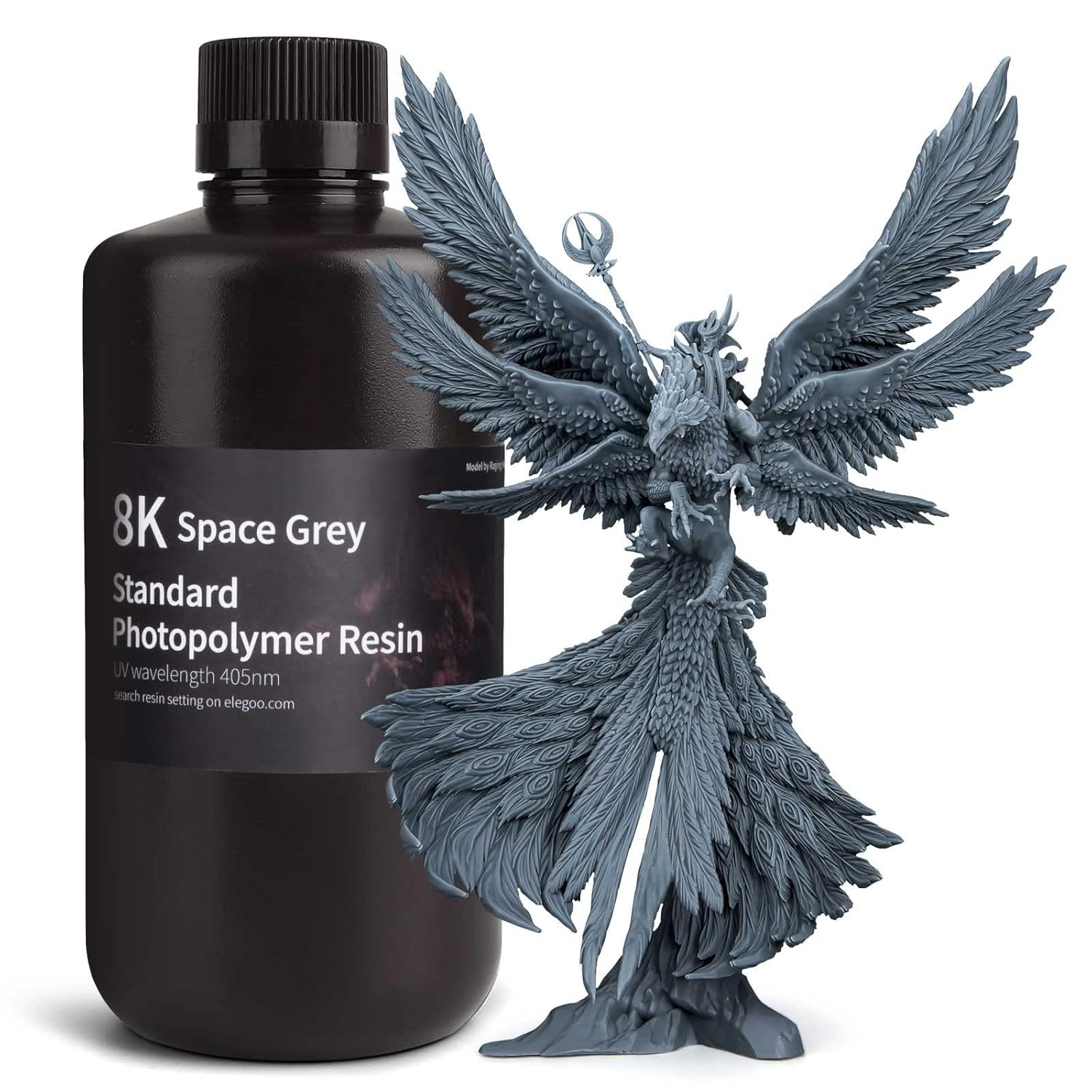
Packaged in a compact 1000g container measuring 3.86 by 3.86 by 9.37 inches with a total mass of 2.64 pounds, this photopolymer is blended for UV-curing systems. The Space Grey pigmentation is engineered to minimize light bleed, supporting the sharp edge transitions demanded by high-density monochrome screens up to 8K resolutions. ELEGOO focuses the chemical mixture on maintaining low viscosity, which directly accelerates the reflow of resin across the release film during the lift-and-retract cycle. This lower resistance reduces mechanical stress on delicate support structures and helps prevent voids in dense geometries. While the packaging is standard opaque plastic with basic labeling, users must note that specific wavelength ranges, exact exposure charts, and mechanical tensile metrics are absent from the product listing; users should verify optimal layer exposure times for their specific machine configuration before committing to large-scale production.
Real-World Performance and Handling
Print success rates in photopolymer workflows depend heavily on resin stability and shrinkage control. ELEGOO addresses this by balancing photo-initiators to minimize volumetric shrinkage during the UV polymerization phase, which helps preserve fine tolerances on miniature components and mechanical fits. The material cures into a rigid state that, once properly washed and fully post-cured, avoids immediate warping or stress fracturing under normal ambient storage. However, standard-grade photopolymers remain inherently brittle compared to engineering-grade ABS-like or tough polyurethanes. The manufacturer highlights reduced odor, and user sentiment across over 10,000 ratings confirms a comparatively mild smell during print cycles. Nevertheless, buying rules for resin hardware require budgeting for dedicated ventilation regardless of manufacturer odor statements; airborne volatile organic compounds require active extraction, negative pressure enclosures, or dedicated filtration systems to ensure a safe maker workshop environment.
Price and Market Value
Priced at $20.99 per 1000g bottle, this resin targets the affordable end of the consumer printing spectrum. High-resolution resin formulations often carry a substantial price premium over basic 405nm standard formulas, yet ELEGOO maintains parity with entry-level offerings. With an aggregate rating of 4.7 out of 5 across more than 10,000 reviews and sustained monthly purchase volumes, broad field verification supports its core performance claims. At this price, the resin is economical for continuous hobby printing, tabletop figurines, visual display models, and basic prototyping. The cost per milliliter remains low enough that test prints, exposure calibration matrices, and occasional print failures do not impose excessive financial overhead. For makers seeking clean visual finishes without the expense of specialty dental, casting, or high-impact engineering resins, the cost-to-output ratio is exceptionally practical.
Limitations and Who Should Skip It
Buyers needing components destined for functional mechanical duty or high-impact environments should skip this standard formulation. Because it lacks elastomer additives found in specialized engineering blends, parts produced with standard 8K resin exhibit low elongation at break, making them susceptible to snapping when dropped or subjected to torsional stress. Furthermore, workshops lacking adequate workspace ventilation should refrain from purchasing this or any other photopolymer resin until extraction infrastructure is funded and installed. While the formula advertises a milder olfactory profile, low odor does not equate to non-toxic air. Finally, operators who primarily build functional enclosures for materials like ABS or ASA should stick to enclosed filament-based FDM machines, as standard photopolymers lack the thermal resilience, structural durability, and outdoor UV resistance required for prolonged mechanical housings under dynamic thermal loads.