How to Clean a Pizza Stone: A Simple Care Guide for Home Bakers
Extend the life of your baking surface with these essential cleaning, maintenance, and thermal management techniques for cordierite and stone materials.
By the Niche Picks editorsUpdated November 8, 202610 min readDrawn from our 35 research-based pizza making reviews
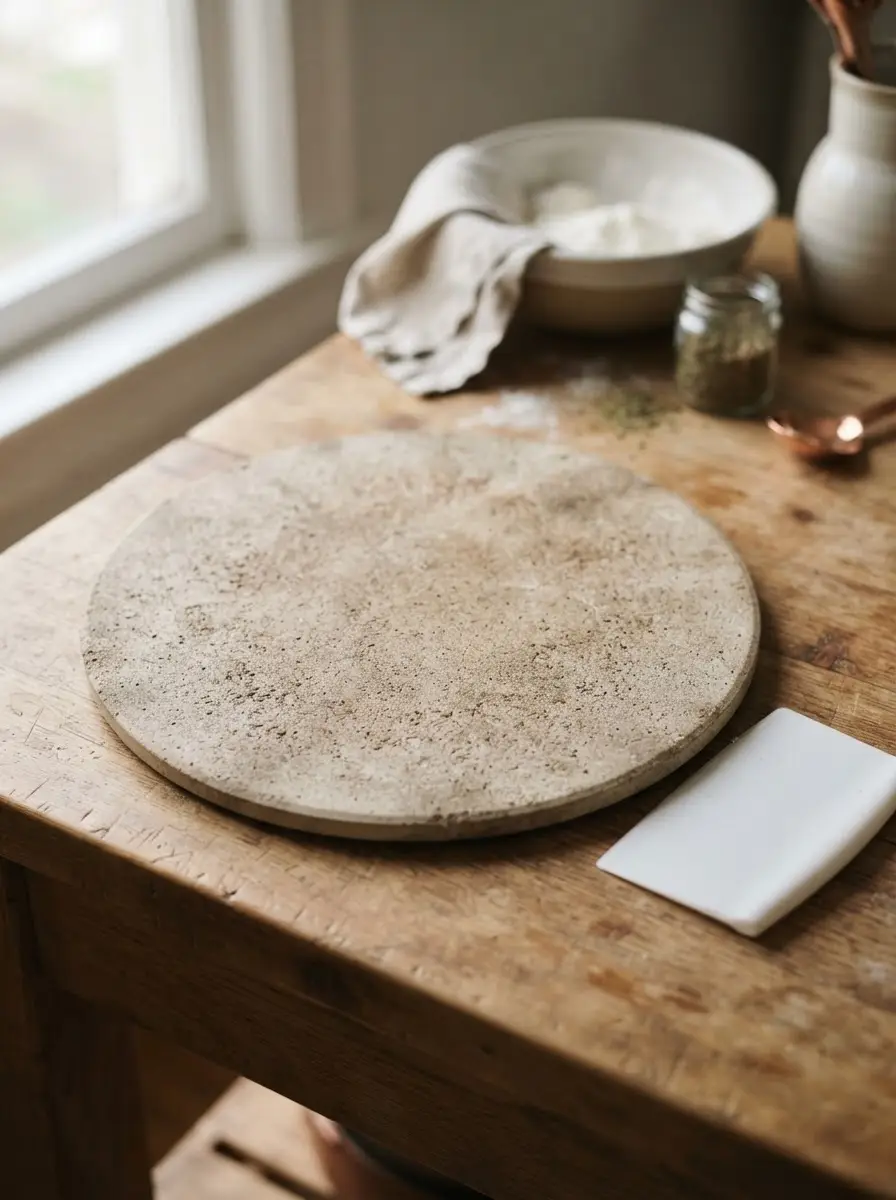
AI-generated editorial illustration; not a product or test photograph.
Short answer
To clean a pizza stone, use only a plastic scraper and warm water once the slab has completely cooled to room temperature. Never use soap or harsh detergents, as the porous material absorbs chemical residues that taint future pizzas. Thoroughly air-dry the stone for at least 24 hours to prevent internal steam buildup.
6
Product listings discussed; not hands-on tests
6/6
Discussed listings with a recorded price
$31.95–$69.97
Recorded listing price range; not a complete setup cost
Key takeaways
Always allow your pizza stone to reach room temperature naturally to prevent thermal shock.
Avoid using dish soap or chemical cleaners because they soak into the porous ceramic material.
Scrape off stubborn burnt food particles with a plastic or wooden scraper after the surface is cool.
Discoloration and dark spots on your stone are normal signs of seasoning and do not need to be scrubbed away.
Ensure the stone is 100% dry before reheating to prevent cracks from internal moisture expansion.
Products discussed in this article
Editorial scores and recorded prices are reference points, not measurements of suitability for every use. Read each review's specifications and limitations.
Hans Grill Rectangular Pizza Stone with Peel, 15 x 127.6
Old Stone Round Pizza Stone, 16-Inch8.5
Hans Grill Pizza Stone PRO XL, Rectangular Baking8.2
16-Inch Pizza Stone Set for Oven and Grill with Peel7.9
Unicook 15 x 12 Inch Rectangular Pizza Stone for Oven8.0
Unicook 20 x 16 Inch Extra Large Pizza Stone for Oven8.3
Recorded price (USD)
Hans Grill Rectangular Pizza Stone with Peel, 15 x 12$49.99
Old Stone Round Pizza Stone, 16-Inch$31.95
Hans Grill Pizza Stone PRO XL, Rectangular Baking$59.99
16-Inch Pizza Stone Set for Oven and Grill with Peel$69.97
Unicook 15 x 12 Inch Rectangular Pizza Stone for Oven$33.99
Unicook 20 x 16 Inch Extra Large Pizza Stone for Oven$67.98
Comparison of reviewed pizza stones
Product
Material
Thickness (in)
Best For
Hans Grill XL
Cordierite
0.59
Budget
Old Stone Round
Cordierite
0.59
Large Pies
Hans Grill PRO
Cordierite
0.6
Starter
KitchenStar 16"
Cordierite
Unspecified
Beginners
Unicook 15x12
Cordierite
0.6
Single Pie
Unicook 20x16
Cordierite
0.6
Consecutive
Understanding the Porous Nature of Cordierite
Most high-quality pizza stones available today, such as those featured in our reviews, are manufactured from cordierite. This mineral is chosen for its exceptional resistance to thermal shock and its micro-porous matrix. This porosity is a functional feature, not a flaw; it actively wicks moisture away from the bottom of your dough during the bake, resulting in the crisp crust that home bakers strive to achieve. However, this same structure makes the stone susceptible to absorbing anything that isn't water. When you use dish soap or chemical cleaners on a stone, the liquid is drawn deep into the capillaries of the material. Once there, it is nearly impossible to rinse out.
Soap residue remains trapped inside the stone and leaches into future pizzas.
Scented detergents can leave chemical odors that intensify when the stone is heated.
Chemical contamination will ruin the flavor of your dough for years to come.
Because of these factors, keeping your stone in top condition requires a different approach than cleaning stainless steel or enameled pans. You should never treat your stone like a dinner plate. If you have any doubt about whether your cleaning technique is damaging the stone, consult the manufacturer's care instructions for your specific model, such as the Unicook 15 x 12 Inch Rectangular Pizza Stone. A clean stone is defined by its ability to hold heat and wick moisture, not by the absence of dark marks or minor stains. Embracing the appearance of a 'used' stone is part of becoming a proficient home pizza baker, as these dark spots represent a natural seasoning patina that builds up over time.
It is entirely normal for a pizza stone to develop dark brown or black spots, especially after several months of regular use. These marks are the byproduct of fats, oils, and cheese that have fused with the stone's surface at high temperatures. Many beginners feel the urge to scrub these spots away, but this is a mistake that often results in surface damage. To clean the stone effectively and safely, you must first ensure it is completely cool. Never attempt to clean a hot stone, as the thermal gradient between the ambient air and the residual heat in the ceramic can lead to instability.
Use a plastic or wooden scraper to work under dried cheese or crust debris.
Avoid using steel wool, wire brushes, or heavy-duty abrasive scrubbers.
If a spot refuses to budge, leave it alone; it will likely carbonize further and disappear or stabilize.
For those utilizing the Hans Grill Pizza Stone PRO XL or similar bundles, you may already have access to basic scraping tools. If not, a simple, inexpensive plastic bench scraper is the perfect implement for the job. If you find yourself needing to scrape your stone after every single pizza, you are likely using too much dusting flour during the launch. By switching to a perforated peel, you can allow the excess flour to fall away from the dough before it ever hits the stone surface. This small change in technique will drastically reduce the frequency with which you need to scrape your stone and will keep the interior of your oven significantly cleaner and free from burnt flour smoke.
Never move a hot pizza stone directly to a cold surface or run it under cold water. Let the stone cool completely inside your turned-off oven to prevent cracks.
Managing Thermal Shock and Structural Integrity
Thermal shock is the primary cause of premature pizza stone failure. Because cordierite stones are dense, they expand and contract significantly when exposed to rapid temperature changes. If you take a hot stone from a 500°F oven and expose it to cold water, the sudden contraction will almost always lead to cracks, fissures, or even a complete structural failure of the slab. Even if the stone does not shatter immediately, micro-fissures can compromise its ability to distribute heat evenly. Always let your stone cool naturally inside the oven for at least two hours after the oven is turned off.
Let the stone sit in the oven until it reaches room temperature.
Never rinse a hot stone with cold water under the tap.
Handle the stone by the edges, ensuring your oven rack is stable to prevent accidental drops.
After you have cleaned the surface with a damp cloth, the most important step is the drying phase. Because the stone is porous and often between 0.5 and 0.6 inches thick, it can hold a significant amount of latent moisture. If you place a stone that is even slightly damp back into a hot oven, that trapped water will instantly flash into steam. Since the steam has no way to escape the dense material of the stone, it creates internal pressure that will likely crack the slab from the inside out. Always give your stone at least 24 hours to air-dry on a wire rack before you consider heating it again. Our faq provides further details on managing your stone's thermal lifecycle for maximum longevity and consistent crust quality.
Pizza stones have a long service life, but they are not immune to damage. Many users wonder if their stone is finished simply because it looks 'dirty' or has darkened with age. However, discoloration is rarely a reason to dispose of a stone. You should only consider purchasing a new unit if the stone has split into two or more distinct pieces, or if it has developed large, deep gouges that prevent your dough from sitting flat on the surface. A stone with minor hairline cracks is often still safe to use, provided the slab remains held together as a single unit when resting on your oven rack.
Hairline cracks that do not separate the stone are common and usually performance-neutral.
Large, deep chips or complete breaks mean the stone is no longer structurally reliable.
If the stone feels 'wobbly' on the rack due to a warped surface, it will cause uneven heat distribution.
If you find yourself hitting the limits of your current stone—especially if you are attempting back-to-back bakes and struggling with temperature recovery—you might be interested in moving up to a pizza steel. Steels are essentially indestructible and provide significantly better conductive heat, though they require a different maintenance protocol involving oil seasoning rather than avoiding moisture. For those who are still outfitting their kitchen, the budget section can help you weigh the costs of replacing a stone against the investment of a steel or a higher-capacity stone like the Unicook 20 x 16 Inch Extra Large Pizza Stone. With proper care, a high-quality cordierite slab can last for hundreds of baking sessions, providing the crisp, hearth-baked texture that is impossible to replicate on a standard baking sheet or generic ceramic tray.
If you must use water to clean your stone, ensure it sits for at least 24 hours before you use it again. Any trapped moisture can turn to steam and shatter the ceramic during the next bake.
Selecting the Right Tool for Your Baking Needs
Not all baking surfaces are created equal. When choosing a stone, consider the size of your oven and the volume of pizza you typically make. A round stone, like the Old Stone Round Pizza Stone, works well for single, large circular pies and fits nicely into round kettles or standard ovens. However, rectangular stones often offer more surface area efficiency within a square-racked oven. Our guide emphasizes that stone thickness is the most important factor for thermal recovery between bakes. A thicker stone, ideally around 0.6 inches, will hold more thermal energy, meaning it will drop less in temperature when you launch a cold, room-temperature pizza dough onto it. This prevents the dreaded 'soggy bottom' that occurs when the deck loses too much heat during the transfer.
Thickness governs heat retention: thicker stones recover faster between pies.
Surface area dictates the maximum pizza size you can comfortably launch.
Material quality, specifically cordierite, ensures resistance against sudden temperature shifts.
Before you commit to a purchase, measure your oven rack to ensure at least an inch of clearance on all sides. This is essential for airflow. If you block the convection currents completely, your top crust will remain pale while the bottom overcooks. By taking the time to pick the right tool for your specific oven dimensions and baking habits, you reduce the likelihood of needing to replace the stone due to poor fit or inadequate performance. Remember that even the best stones, such as the ones listed in our reviews, require consistent, gentle cleaning habits to maintain their efficacy over time. Avoid the temptation to use high-heat cleaning cycles (the 'self-clean' feature on your oven) to burn off residue, as this can sometimes lead to excessive thermal stress even on high-quality cordierite.
Achieving professional results at home is often a matter of avoiding common mistakes. Many new bakers struggle with dough handling during the launch process. Using a wooden peel, which is naturally absorbent, can help with the initial release of the dough, but it cannot fix the issue of excess flour being carried into the oven. Once that flour is on the stone, it is essentially going to burn. Our page on mistakes to avoid highlights how this simple interaction—flour management—affects everything from the taste of the crust to the cleanliness of your stone. Another frequent error is using the wrong cutting tool. Traditional wheel cutters often drag toppings and cheese toward the edge of the slice, whereas a rocker cutter provides clean vertical pressure that keeps your toppings exactly where they belong.
Avoid placing frozen, heavily topped pizzas directly onto a cold stone; the moisture content will hurt the crust.
Do not use metal knives to cut pizza directly on a stone; you will dull your knife and risk chipping the ceramic.
If you are having trouble with sticking, check your hydration level; too-wet dough will always struggle to release.
If your goal is to get closer to Neapolitan-style pizza, you need to be aware of the limitations of domestic hardware. While a high-quality stone will certainly improve your results, true Neapolitan bakes require ambient temperatures of 850°F or higher. Most domestic ovens peak at 500°F to 550°F. While a cordierite stone is rated for temperatures up to 1400°F or more, the stone itself cannot create heat; it can only hold it. Therefore, managing your expectations is vital. By using the right tools—a reliable stone, a properly sized peel, and a good rocker cutter—you can absolutely produce excellent, crispy, artisan-quality pizza in your home oven, provided you handle the maintenance of your gear with care and patience.
1Wait for the pizza stone to cool down completely inside your oven (at least 2 hours).
2Remove the stone from the oven once it is cool to the touch.
3Use a plastic or wooden scraper to gently remove any burnt cheese or dough residue.
4Wipe the surface clean with a slightly damp, lint-free cloth if you need to remove loose crumbs.
5If using water, use only a minimal amount and never submerge the stone.
6Place the stone on a drying rack in a well-ventilated area for at least 24 hours.
Quick checklist
Allow stone to cool completely to room temperature.
Use a plastic or wooden scraper for stuck-on food.
Avoid all soap and detergents during the cleaning process.
Wipe clean with a damp, lint-free cloth only if necessary.
Air-dry the stone for 24 hours before next use.
Check for major cracks before placing in a hot oven.
Ensure at least one inch of clearance around the stone in your oven.
Frequently asked questions
Can I put my pizza stone in the dishwasher?
No, you should never put a pizza stone in the dishwasher. The high pressure of water jets, combined with soap and the intense drying cycle, can crack the stone or leave chemical residues inside the pores that will ruin the flavor of all your future pizzas.
Why is my pizza stone turning black?
Dark spots and black marks are a natural part of a pizza stone's life. They are caused by oil and food particles burning into the porous surface. This is effectively a seasoning process and does not need to be scrubbed off; it will not affect your food quality.
Should I oil my pizza stone?
No, you should never oil a pizza stone. Because the stone is porous, it will absorb the oil, which will then smoke excessively every time you use the oven. A stone does not need to be seasoned like cast iron or pizza steel.
How do I get the smell of burnt food out of my stone?
If the smell is significant, simply keep using the stone. Often, the heat from subsequent bakes will carbonize the remnants, and the scent will eventually fade. Ensure you are using a perforated peel to prevent excess flour from burning on the surface during your next bake.
What if my pizza stone cracks?
If the stone develops small hairline cracks, it is often still safe to use as long as it stays together. However, if the stone breaks into separate pieces, it is unsafe to continue using, as it could cause an uneven surface or become a safety hazard during handling.
Amazon links are affiliate links; we may earn a commission at no cost to you.
Shortlists in this category
Ranked lists from our pizza making reviews, limited to listings whose titles confirm the product type, with budget cuts where enough recorded prices sit on both sides of the line.
This page summarizes our research reviews of Amazon listings, listed specifications and captured buyer ratings. It is not a hands-on test. Scores are editorial assessments, not measured performance; prices are recorded snapshots and may change. A category can include both main products and accessories, so its overall price range is not the cost of a complete setup.
Most recent product record update: October 28, 2026. Individual records may be older; this is not a verification date for every claim. Prices on this page were read from the listings Nov 8, 2026 – Nov 11, 2026.
Choose the product type first. These groups require a match in the listing title; an import search term alone is not enough. Scores rank our recorded research assessments within each group, not independently measured performance.
Values are shown as recorded, without unit conversions or inferred compatibility. Not recorded means unknown, not absent. Prices are snapshots, not current offers. Editorial scores are research judgments, not lab results. Amazon links are affiliate links.
Before treating a comparison as complete
Which details are still unknown?
A specification appearing in a listing is not independent verification. These counts show which shortlisted records contain the same field; a blank record does not mean the product lacks the feature.
Included Components
Recorded for 2 of 2 shortlisted models
Present in every shortlisted record. Check units, exact variants and the current manufacturer documentation before relying on it.
Item Dimensions L x W x Thickness
Recorded for 2 of 2 shortlisted models
Present in every shortlisted record. Check units, exact variants and the current manufacturer documentation before relying on it.
Size
Recorded for 2 of 2 shortlisted models
Present in every shortlisted record. Check units, exact variants and the current manufacturer documentation before relying on it.
Neapolitan needs 850°F+; most ovens quote peak, not recovery.
Perforated peels drop far less flour into the oven floor.
Stone thickness controls recovery between pies.
If a specification, certification or compatibility detail is absent, mark it as unknown and ask the seller or manufacturer. Do not substitute a star rating, an editorial score or a different model's specification.