Best Pizza Peel: The Right Peel for Every Pizza Oven
Our top pick is the Hans Grill Pizza Stone PRO XL set because its perforated aluminum peel sheds excess flour before launch.
By the Niche Picks editorsUpdated October 7, 20268 min readDrawn from our 32 research-based pizza making reviews
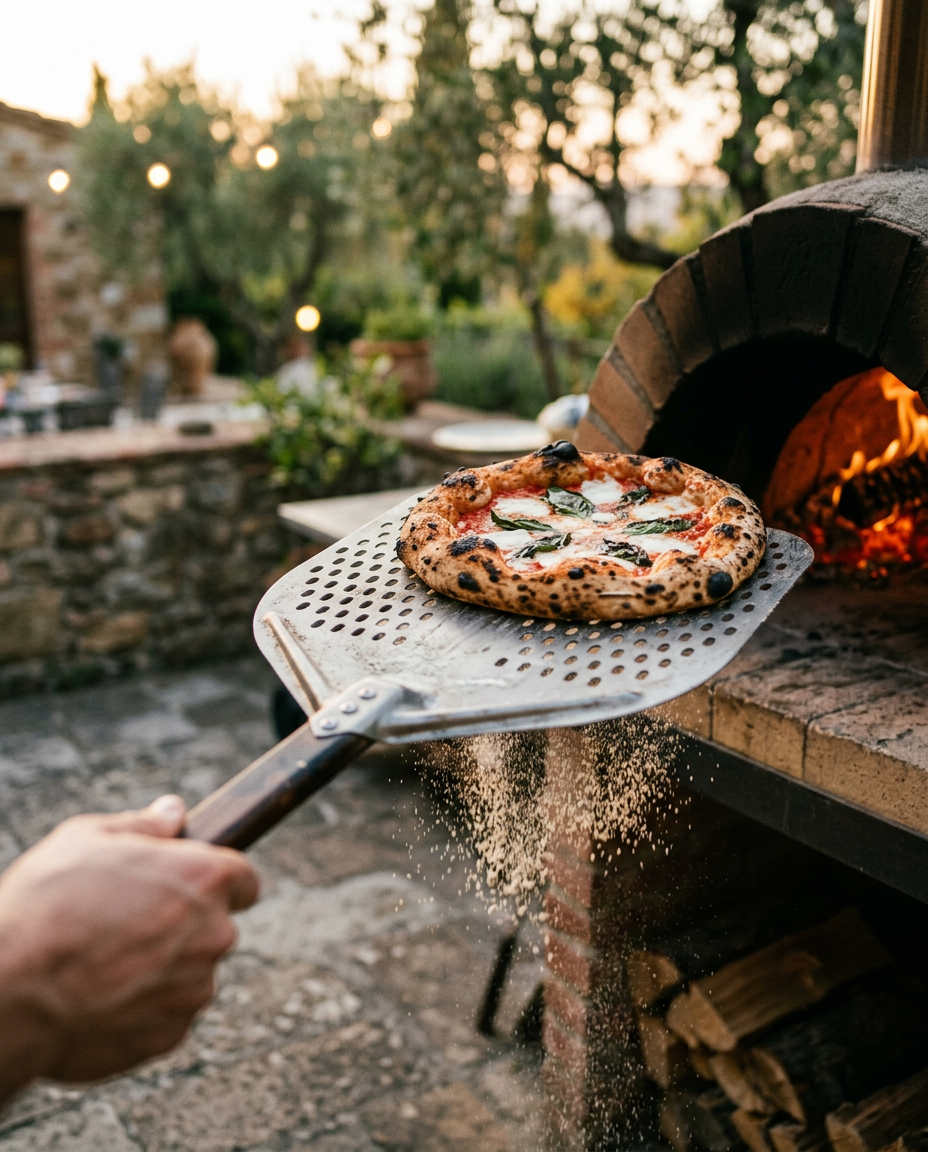
AI-generated editorial illustration; not a product or test photograph.
Short answer
The best pizza peel in our reviews is the Hans Grill Pizza Stone PRO XL set, chiefly because its included perforated aluminum peel lets excess flour fall away before it reaches the hot baking surface. That matters most in 850°F-plus pizza ovens, where loose flour chars almost immediately. For a large wooden prep and serving board, the 16-inch bamboo Pizza Peel is a more suitable secondary choice.
3
Product listings discussed; not hands-on tests
3/3
Discussed listings with a recorded price
$32.99–$50.99
Recorded listing price range; not a complete setup cost
Key takeaways
Choose a perforated launching peel for high-heat pizza because it drops substantially more excess flour before the pizza reaches the oven floor.
The Hans Grill Pizza Stone PRO XL is the strongest overall pick here because it combines a perforated aluminum peel with a 14.9-by-11.8-inch cordierite stone.
A solid wood peel is useful for dough preparation and launching, but it carries loose flour into the oven and is not ideal for Neapolitan-temperature cooking.
Match peel width to the usable oven deck, not merely the oven's advertised pizza capacity; a tight 12-inch chamber leaves little margin for a 12-inch pie.
Use a thin metal peel for retrieval and turning when possible, while a wood peel remains a practical surface for assembling raw dough.
Products discussed in this article
Editorial scores and recorded prices are reference points, not measurements of suitability for every use. Read each review's specifications and limitations.
New Star Foodservice 50165 Aluminum Pizza Peel, 12 x32.99 USD
Pizza peel comparison: the best reviewed options for distinct jobs
Product
Listed price
Blade or board size
Material
Perforated?
Best for
Hans Grill Pizza Stone PRO XL
$50.99
Stone: 14.9 x 11.8 in; 0.6 in thick
Cordierite stone; aluminum peel
Yes
Starter setups in standard domestic ovens
Pizza Peel 16 Inch Bamboo Board
$39.98
24 x 16 x 0.6 in
Bamboo
No
Prep and serving large home pies
New Star Foodservice 50165
$32.99
12 x 14 in blade; 36 in overall
Aluminum blade; basswood handle
No
Standard twelve-inch domestic and outdoor ovens
What is the best pizza peel to buy?
Buy the Hans Grill Pizza Stone PRO XL set if you need a first pizza peel for a home oven or grill setup. Its key advantage is the included perforated aluminum peel: the openings allow loose bench flour or semolina to fall away before loading. That is a meaningful functional edge over the solid wood and solid aluminum alternatives in our reviews.
The set includes a 14.9-by-11.8-inch, 0.6-inch-thick cordierite stone and an aluminum peel with a beechwood handle, listed at $50.99. Its 11.8-inch working width is best suited to smaller pizzas rather than a full 12-inch pie with generous maneuvering room. It is also a home-oven-oriented package, not proof that a domestic range can produce a true Neapolitan bake.
At 850°F and above, a small amount of leftover flour can carbonize rapidly on the deck. A perforated peel will not eliminate the need for careful dough handling, but it gives the baker a way to shed surplus dusting flour. That makes it the technically strongest option in this selection for high-heat launching.
A perforated pizza peel is a launching peel with holes or slots cut into its blade. As you position and shake the pizza before loading, loose flour and semolina can fall through those openings instead of riding under the dough into the oven. Less residual flour on the deck means less burnt residue and less smoke during a session.
This distinction is especially important for Neapolitan-style cooking. That style needs an oven environment of 850°F or more, yet many oven listings quote a peak temperature rather than a verified, sustained deck temperature or recovery rate. At that heat, flour left on the floor burns fast. A solid blade can still work, but it requires stricter flour control and a clean, decisive launch.
The Hans Grill PRO XL is the only reviewed peel selected here with a perforated blade. The 16-inch bamboo board and New Star 12-by-14-inch aluminum peel are both solid, so they transfer residual dusting flour to the baking surface. Their strengths are different: bamboo is helpful for prep, while a thin solid metal blade can be convenient for retrieval.
Avoid assuming that perforations make a peel universally better. Very wet dough can still stick, and every peel has to fit the oven opening and pizza size. Learn the common handling errors in our pizza-making mistakes guide, then compare priorities with our pizza-making FAQ.
Start with the usable width of your oven deck and door opening, then choose a peel that leaves room to steer the pizza. A peel should support the pie without forcing the edge against the oven walls. The practical requirement is not simply a stated oven capacity; it is the clearance available during loading, turning, and retrieval.
The Hans Grill set's stone is 14.9 by 11.8 inches, while its peel is described as matching the stone's width. That makes it a compact choice for home-oven baking and small pies. The New Star Foodservice 50165 has a 12-by-14-inch aluminum blade and a 36-inch overall length. It is proportioned for common 12-inch ovens, but a 12-inch pizza on a 12-inch-wide blade offers virtually no side margin.
For larger home pizzas, the 16-inch bamboo Pizza Peel has a 16-inch-wide surface and measures 24 by 16 inches overall. It is a useful choice for assembling, carrying, slicing, and serving larger pies. Do not interpret its 16-inch width as a reason to use a 16-inch pizza in a compact oven; measure the chamber first.
Before buying, check the oven dimensions, desired pie diameter, and storage space. Our pizza-making buying tips can help organize the decision, and our budget planner is useful when a peel is only one part of a new pizza setup.
Wood and aluminum solve different pizza-handling problems. A smooth wood peel is traditionally useful for building and launching raw dough because wood absorbs a little surface moisture and can help reduce sticking. The 16-inch bamboo Pizza Peel is particularly versatile: it has a 16-inch width, a 0.6-inch thickness, and functions as a prep, cutting, and serving board as well as a paddle.
The trade-off is its thick, solid front edge. It is not the best tool for slipping under a thin cooked crust or turning a pizza in the oven. It also cannot sift away loose flour. Use it for larger home pizzas and lower-intensity home-oven workflows, not as the specialist answer to deck management in a very hot pizza oven.
Aluminum has the opposite advantage. The New Star Foodservice 50165 uses a thin 12-by-14-inch anodized aluminum blade, which is easier to slide under set crusts than a thick wood board. Its three-rivet blade-to-handle attachment is fixed rather than folding, and the total tool length is 36 inches. The limitation remains significant: its blade is solid, so it does not remove excess flour before launch.
Many serious pizza makers ultimately use two tools: wood for dough preparation and a thin metal peel for handling the baked pizza. If buying just one, a perforated aluminum model is the more versatile technical choice for high-heat launching.
A peel manages the transfer of pizza; it does not create the heat profile that determines style. A standard home oven can benefit from a stone or steel because the baking surface improves bottom heat, but it does not normally provide the 850°F-plus ambient conditions associated with true Neapolitan pizza. A stone's maximum temperature rating is also not the same thing as the oven's cooking temperature.
The Hans Grill set is convenient because it includes both a cordierite stone and a perforated peel. Its 0.6-inch stone can provide adequate heat for an initial home-oven bake, but stone thickness and mass govern recovery between pizzas. The review indicates allowing roughly 10 to 15 minutes for this stone to regain heat between launches. If your goal is a series of pizzas, plan for recovery instead of loading one immediately after another.
For dedicated Neapolitan cooking, prioritize an oven capable of the required conditions, then choose a correctly sized perforated launching peel. Peak oven temperatures should be treated cautiously: peak air heat does not establish sustained stone temperature or rapid recovery. See our guide to how long to cook pizza in an oven for style and oven context, or read brick oven vs. portable pizza oven before committing to an outdoor setup.
For a standard kitchen range, a peel and stone set can be a sensible starting point. For an 850°F-plus outdoor oven, launch control, flour management, and room to turn the pie become much more important.
How do you launch pizza without sticking or burning flour?
Reliable launching is more about preparation and speed than using large amounts of flour. Build the pizza on a surface that releases cleanly, confirm it moves before approaching the oven, and make one confident forward-and-back motion to deposit it on the stone. Prolonged hesitation lets moisture soak into the peel and encourages sticking.
Use only enough dusting flour or semolina to keep the dough mobile. Excess creates a second problem: on a solid peel, the surplus travels into the oven. In hot ovens it chars on the deck, producing smoke, residue, and bitterness. A perforated blade such as the one included with the Hans Grill PRO XL lets you shake off some of that material immediately before the launch.
A practical workflow is:
Preheat the baking surface thoroughly according to the oven or stone manufacturer's instructions.
Stretch and top the dough promptly; wet toppings increase the risk of sticking.
Give the peel a short shake to confirm the pizza slides freely.
For a perforated peel, use a gentle shake to shed loose flour before opening the oven.
Launch decisively, then retrieve the pizza with a thin metal edge when it is set.
For more equipment choices, see our comparison hub. Keep manufacturer instructions authoritative for cleaning, seasoning, temperature limits, and any model-specific safety requirements.
Measure the oven opening and cooking deck, then leave maneuvering margin beyond the intended pizza diameter.
Choose a perforated launching peel if you cook in an 850°F-plus oven or want to reduce burnt flour on the deck.
Choose a wood peel mainly for dough prep, launching, and serving rather than for turning a pie during the bake.
Choose a thin metal blade if easy retrieval under cooked crusts is your main concern.
Confirm whether the peel's stated width is the usable blade width, not its overall length.
If buying a stone-and-peel kit, check the stone thickness and plan recovery time between pizzas.
Follow the exact manufacturer's instructions for washing, storage, temperature limits, and maintenance.
Frequently asked questions
Is a perforated pizza peel better than a solid pizza peel?
For high-heat pizza, a perforated peel is usually the better launching tool because it allows excess flour or semolina to fall through before loading. A solid peel can still work well, especially for dough preparation or retrieval, but it carries more loose flour onto the baking surface, where it can burn.
What size pizza peel do I need for a 12-inch pizza?
A 12-inch pizza needs a blade that supports the pie while still fitting comfortably through the oven opening. A 12-inch-wide peel can hold a 12-inch pizza, but it leaves virtually no side margin. Confirm the usable deck, door, and chamber dimensions rather than relying only on an oven's capacity label.
Can I use a wooden pizza peel in a high-heat pizza oven?
You can use a wooden peel to launch dough, but it is less ideal for 850°F-plus cooking because a solid wood surface carries loose bench flour into the oven. That flour can char quickly. Wood is generally more useful as a raw-dough prep and launching surface than as a turning or retrieval tool.
Why does flour burn on a pizza stone?
Loose flour or semolina beneath the dough falls onto the hot stone or oven floor during the launch. At high baking temperatures it carbonizes quickly, which can create smoke, bitter residue, and burnt patches on later pizzas. Use minimal dusting flour and shake a perforated peel before loading when possible.
Do I need a pizza stone if I already have a pizza peel?
A pizza peel and a pizza stone have different roles. The peel transfers the dough into and out of the oven, while the stone stores and delivers bottom heat. A stone can improve bottom-crust baking in a conventional oven, but it does not by itself create the 850°F-plus environment needed for Neapolitan pizza.
How long should a pizza stone recover between pizzas?
Recovery depends on the stone's thickness, mass, oven heat, and the size and temperature of the dough. In our Hans Grill PRO XL review, the 0.6-inch cordierite stone needs an intentional reheat window of roughly 10 to 15 minutes between pizzas. Thicker or heavier surfaces generally retain more heat.
Amazon links are affiliate links; we may earn a commission at no cost to you.
Sources and limits
This page summarizes our research reviews of Amazon listings, listed specifications and captured buyer ratings. It is not a hands-on test. Scores are editorial assessments, not measured performance; prices are recorded snapshots and may change. A category can include both main products and accessories, so its overall price range is not the cost of a complete setup.
Most recent product record update: October 3, 2026. Individual records may be older; this is not a verification date for every claim.
Choose the product type first. These groups require a match in the listing title; an import search term alone is not enough. Scores rank our recorded research assessments within each group, not independently measured performance.
Neapolitan needs 850°F+; most ovens quote peak, not recovery.
Perforated peels drop far less flour into the oven floor.
Stone thickness controls recovery between pies.
If a specification, certification or compatibility detail is absent, mark it as unknown and ask the seller or manufacturer. Do not substitute a star rating, an editorial score or a different model's specification.


 Hans Grill Pizza Stone PRO XL, Rectangular Baking Stone with Aluminium Peel