Are Trekking Poles Worth It? Research-Backed Hiking Benefits
Discover if trekking poles improve your stability, reduce joint strain, and enhance endurance based on current research and field-proven hardware specs.
By the Niche Picks editorsUpdated November 9, 20269 min readDrawn from our 33 research-based hiking footwear & backpacks reviews
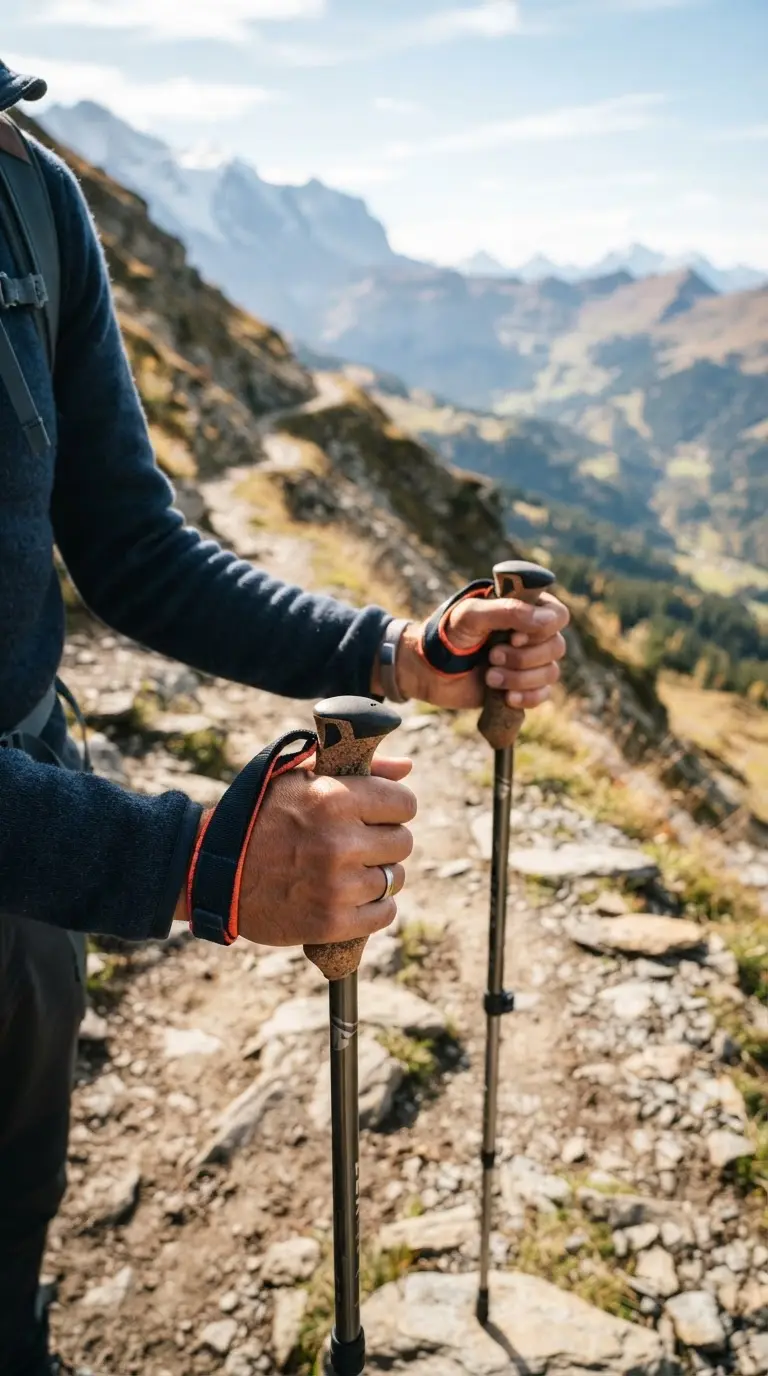
AI-generated editorial illustration; not a product or test photograph.
Short answer
Trekking poles are a valuable tool for hikers of all levels, providing critical stability on technical terrain and significantly reducing impact forces on knees and ankles. By distributing weight and improving your center of gravity, they allow for a more sustainable pace and reduced muscular fatigue during long-distance or high-pack-weight outings.
4
Product listings discussed; not hands-on tests
4/4
Discussed listings with a recorded price
$24.98–$64.99
Recorded listing price range; not a complete setup cost
Key takeaways
Trekking poles effectively distribute weight to reduce knee impact during steep descents.
Aluminum is the preferred material for rocky terrain due to its ability to deform rather than shatter.
Carbon fiber poles significantly reduce swing weight, which helps minimize arm fatigue on long treks.
Correct pole length is best determined by achieving a 90-degree elbow angle on flat ground.
Reliable external lever locks are easier to maintain in the field than internal twist mechanisms.
Products discussed in this article
Editorial scores and recorded prices are reference points, not measurements of suitability for every use. Read each review's specifications and limitations.
Cascade Mountain Tech Trekking Poles - Carbon Fiber$64.99
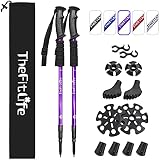
Telescopic Trekking Poles for Hiking, Anti-Shock$24.98
Comparison of Recommended Trekking Poles
Product
Material
Weight (Per Pole)
Best For
TrailBuddy
7075 Aluminum
9.7 oz
General durability
Cascade Aluminum
6061 Aluminum
10 oz
Technical terrain
Cascade Carbon
Carbon Fiber
8.1 oz
Distance/Weight
TheFitLife
Aluminum
9.9 oz
Budget-conscious
Why Invest in Trekking Poles for Trail Stability?
The core argument for trekking poles centers on the biomechanical advantage they provide. When you navigate uneven terrain, your body constantly compensates for shifting weight. A pair of poles adds two extra points of contact, creating a four-legged stability platform that is crucial for maintaining balance. This is especially relevant for hikers who find themselves navigating scree, muddy paths, or stream crossings where footing is unpredictable. By engaging the upper body, you distribute the physical load away from your lower extremities, effectively buffering the knees and hips against the repetitive impact of each stride.
Increases points of contact to four, greatly improving stability on loose rock.
Allows for testing the ground stability before committing your full body weight.
Distributes the mechanical load of a heavy pack away from the spinal column.
In our guide/hiking-footwear-packs, we emphasize that the integration of supportive gear contributes to long-term joint health. While some hikers argue that poles create a dependency, they serve as a dynamic stabilization system that adapts to your environment. Learning how to use trekking poles transforms them from simple walking sticks into performance tools that help you maintain a steady rhythm. When you plant a pole before a challenging step, you gain an anchor point that reduces the risk of ankle rolls or unexpected slips. Whether you are a casual weekend walker or a dedicated backpacker, the ability to offload weight from the joints allows you to extend your range, finish your hikes with less soreness, and maintain a higher level of confidence on demanding trail geometries.
Comparing Aluminum and Carbon Fiber Pole Materials
Deciding between aluminum and carbon fiber involves a trade-off between absolute weight and physical durability. Aluminum poles, such as the TrailBuddy Trekking Poles, are the industry standard for durability. Because aluminum is a ductile metal, it responds to extreme lateral pressure by bending rather than snapping. This is a critical safety feature when you wedge a pole tip between two granite boulders or suffer a hard fall; a bent aluminum pole can often be corrected in the field, allowing you to complete your journey. This reliability makes aluminum the superior choice for rugged, off-trail, or high-impact environments.
Aluminum: High tolerance for lateral stress, bends under pressure, ideal for rocky trails.
Carbon fiber, as found in the Cascade Mountain Tech Carbon Fiber Poles, offers a distinct advantage for weight-conscious users. The reduction in mass translates to lower swing weight, which feels significant over thousands of steps. Less weight in the hand means less energy spent on every plant and lift, resulting in lower arm fatigue at the end of a long day. However, carbon fiber is a rigid, brittle composite. Under intense stress, it may snap cleanly, rendering the pole unusable for the remainder of the hike. For those who prioritize efficiency, these savings are worth the price premium, but for those who value longevity and field-repairability, the robust 7075 aluminum found in our tested articles/best-hiking-poles is often the more pragmatic, long-term choice for variable backcountry conditions.
Many hikers let the wrist straps dangle, but using them correctly allows you to rest your hands while the pole supports your weight. Slide your hand up through the bottom of the loop and grip the strap against the handle.
The Role of Pack Weight in Pole Selection
Your backpack weight and torso length play a larger role in your hiking experience than many realize. When carrying a heavy load, your center of gravity rises and shifts, making you susceptible to balance loss. Trekking poles serve as an essential stabilizer in this context. While we suggest reading our articles/best-hiking-backpack to ensure your gear fits your torso correctly, poles provide the final layer of control that a pack harness cannot offer. If you encounter steep sections, the ability to shorten your poles allows you to maintain an upright posture, preventing the 'hunch' that often occurs under heavy weight. When descending, lengthening them helps you absorb the weight that would otherwise crush your patella.
Provides leverage for steep uphill pushes with heavy base weights.
Prevents excessive leaning, which keeps your pack weight centered.
Acts as a balancing aid for hikers using front-loading or top-heavy pack configurations.
Many hikers assume that poles are meant only for steep mountaineering, yet they offer substantial value on flat, long-distance treks as well. By training your body to use your arms for movement, you share the caloric burden across a larger set of muscle groups. If you are experiencing discomfort, ensure you aren't committing common mistakes/hiking-footwear-packs, such as ignoring proper wrist strap usage or failing to tighten your lever locks before a climb. The Cascade Mountain Tech Aluminum Poles offer a solid, reliable platform for those looking to start using poles without overcommitting financially. By incorporating them into your gear system, you are essentially increasing your 'active' footprint, which reduces the reliance on your legs alone and fosters a more balanced, sustainable full-body hiking motion.
Maintaining your trekking poles ensures they stay functional for years, rather than seasons. The most frequent failure point in entry-level and mid-range poles is the locking mechanism. The Telescopic Trekking Poles utilize standard internal twist-locks, which are effective but require more attention in wet conditions. Moisture can permeate these seals, and grit from the trail can grind down the internal threading. It is vital to break down your poles fully after every trip, wipe the individual sections clean with a dry cloth, and ensure the interior of the shaft is completely dry before storage. This prevents oxidation and ensures the expansion mechanisms continue to hold securely under pressure.
Regularly test the tension of your locking levers to prevent slippage.
Clean and dry poles after every use to prevent internal seizing.
Replace rubber tips frequently if you walk on pavement to protect the carbide tips.
Additionally, consider the accessories that come with your kit. The included mud and snow baskets prevent the poles from sinking into soft ground or getting wedged between rocks. If you are switching between environments, don't leave your snow baskets on during a summer hike; they add unnecessary surface area that snags on brush and debris. For those who choose aluminum, keep an eye on the shaft for minor dings or bends. If a pole suffers a minor bend, it can often be gently worked back to shape using a sturdy workbench or a vice. By treating your poles as a precision instrument rather than a disposable item, you ensure consistent safety. Always verify your tip condition before a big climb; if the carbide tip is worn flat, your grip on smooth rock surfaces will suffer significantly.
Internal twist-locking mechanisms are prone to failing in cold or wet conditions. Prioritize poles with external lever locks, which offer more reliable clamping pressure and are easier to adjust with gloves on.
Optimizing Your Grip and Ergonomics
The grip is the primary interface between you and your poles, and it heavily influences comfort during all-day trekking. Many budget-friendly options, such as the TrailBuddy Trekking Poles, use cork handles, which are superior for moisture management. Cork naturally wicks perspiration, which is ideal during warm summer hikes, and it gradually compresses to mirror the unique shape of your palm. Some hikers prefer EVA foam, which offers a slightly softer 'tack' but may degrade faster over years of heavy use. Regardless of the material, the key to ergonomic success is in the wrist straps. Many beginners ignore them or leave them loose, but the strap is designed to support the downward load of your body.
Thread your hand up from the bottom of the loop to ensure the strap rests on your wrist.
Use the strap to carry the load, allowing your hands to relax their grip on the handle.
Adjust the length of the strap so the pole follows your hand movement naturally.
Properly using the straps prevents the 'death grip' that leads to hand fatigue and forearm tension. If you feel your hands tiring, check your strap tension; you should be able to press your weight through the strap and feel it pull against the heel of your hand. For those traversing variable terrain, look for poles with an 'extended grip'—a longer sleeve of foam below the primary handle. This is an invaluable feature for steep switchbacks. Instead of stopping to adjust the pole length, you can simply drop your hand down the shaft to the lower grip area. This efficiency allows you to navigate rapid changes in elevation without breaking your stride, which is a significant contributor to overall trail endurance.
A recurring question in the hiking community is whether poles are just 'fancy sticks.' While it is true that you can walk without them, the research on joint preservation and balance is clear. Poles are not merely an aesthetic choice; they are a functional upgrade. Some hikers fear that using them will 'weaken' their legs, but the reality is that the extra stability allows you to go further, faster, and more safely, which in turn leads to more trail time and stronger cardiovascular fitness. By removing the fear of slipping or knee strain, you can focus on the trail ahead, potentially allowing you to navigate miles that you might otherwise avoid.
They are not a replacement for fundamental balance skills, but a complement to them.
Poles do not prevent all falls, but they provide the recovery speed needed to avoid them.
Using poles does not stunt muscle growth; it balances the load across the entire kinetic chain.
If you are on the fence, we recommend checking out our blog/hiking-footwear-packs for more tips on building your gear system. Start with a cost-effective, durable set like the Cascade Mountain Tech Aluminum Poles to test the concept. Most users find that once they adapt to the rhythm of using poles, they rarely go back. The 'best' trekking pole is the one that you actually pack and use, which is why we emphasize reliability over complex features. By keeping the system simple—a robust shaft, a comfortable handle, and a reliable lock—you remove the barrier to entry. The value isn't just in the gear, but in the confidence and physical health you gain over hundreds of miles of diverse trail conditions.
Remember that hiking pack fit depends on torso length, not just liters. Ensure your backpack fits correctly first so that your pole usage is focused on stability rather than compensating for an ill-fitting load.
Step by step
1Loosen the lever lock mechanism to extend the shaft.
2Set the pole length so your elbow forms a 90-degree angle while standing on flat ground.
3Tighten the locking levers to secure the height.
4Slide your hand up through the wrist strap loop from the bottom.
5Grip the handle firmly, capturing the strap between your hand and the grip.
6Plant the poles slightly behind you on flat ground to push yourself forward.
7Adjust lengths shorter for steep uphill sections and longer for descents.
Quick checklist
Check all lever lock tensions before hitting the trail.
Verify the carbide tips have rubber tips installed for pavement.
Ensure your pack load is distributed correctly before relying on poles.
Practice adjusting pole height for both steep climbs and descents.
Inspect shafts for deep scratches or cracks after rocky hikes.
Use mud or snow baskets appropriate for the current season.
Frequently asked questions
Are trekking poles necessary for beginners?
While not strictly necessary, they are highly recommended for beginners. They provide extra stability, increase confidence on uneven terrain, and reduce the learning curve when navigating technical trails while your body adjusts to the demands of hiking.
Can trekking poles replace a good pair of boots?
No, poles are an accessory, not a replacement for footwear. A sturdy, properly fitted pair of boots or shoes from our reviews is essential for traction and protection; poles improve your efficiency and stability during movement.
Do I need to maintain my trekking poles?
Yes. Keep the shafts clean and dry after every trip to prevent oxidation. Periodically check the tension on your locking levers to ensure they remain secure under pressure during your hikes.
Are carbon poles worth the extra cost?
Carbon poles are worth it if your main goal is reducing weight and minimizing arm fatigue on long, multi-day treks. However, if you hike primarily on rocky, technical trails, aluminum’s durability makes it a more practical choice.
How do I know if my trekking poles are the right length?
On flat ground, your poles are the correct length when your elbow forms a 90-degree angle while holding the grip. Shorten them slightly for steep ascents and lengthen them for descents to maintain comfortable, efficient posture.
Amazon links are affiliate links; we may earn a commission at no cost to you.
Shortlists in this category
Ranked lists from our hiking footwear & backpacks reviews, limited to listings whose titles confirm the product type, with budget cuts where enough recorded prices sit on both sides of the line.
This page summarizes our research reviews of Amazon listings, listed specifications and captured buyer ratings. It is not a hands-on test. Scores are editorial assessments, not measured performance; prices are recorded snapshots and may change. A category can include both main products and accessories, so its overall price range is not the cost of a complete setup.
Most recent product record update: November 8, 2026. Individual records may be older; this is not a verification date for every claim. Prices on this page were read from the listings Nov 8, 2026 – Nov 11, 2026.
Compare the same kind of hiking footwear & backpacks
Choose the product type first. These groups require a match in the listing title; an import search term alone is not enough. Scores rank our recorded research assessments within each group, not independently measured performance.
Values are shown as recorded, without unit conversions or inferred compatibility. Not recorded means unknown, not absent. Prices are snapshots, not current offers. Editorial scores are research judgments, not lab results. Amazon links are affiliate links.
Before treating a comparison as complete
Which details are still unknown?
A specification appearing in a listing is not independent verification. These counts show which shortlisted records contain the same field; a blank record does not mean the product lacks the feature.
Shaft Material
Recorded for 2 of 2 shortlisted models
Present in every shortlisted record. Check units, exact variants and the current manufacturer documentation before relying on it.
Waterproof liners trap sweat — skip them in dry climates.
Torso length, not pack litres, determines fit.
Carbon poles save grams; aluminium survives a fall.
If a specification, certification or compatibility detail is absent, mark it as unknown and ask the seller or manufacturer. Do not substitute a star rating, an editorial score or a different model's specification.