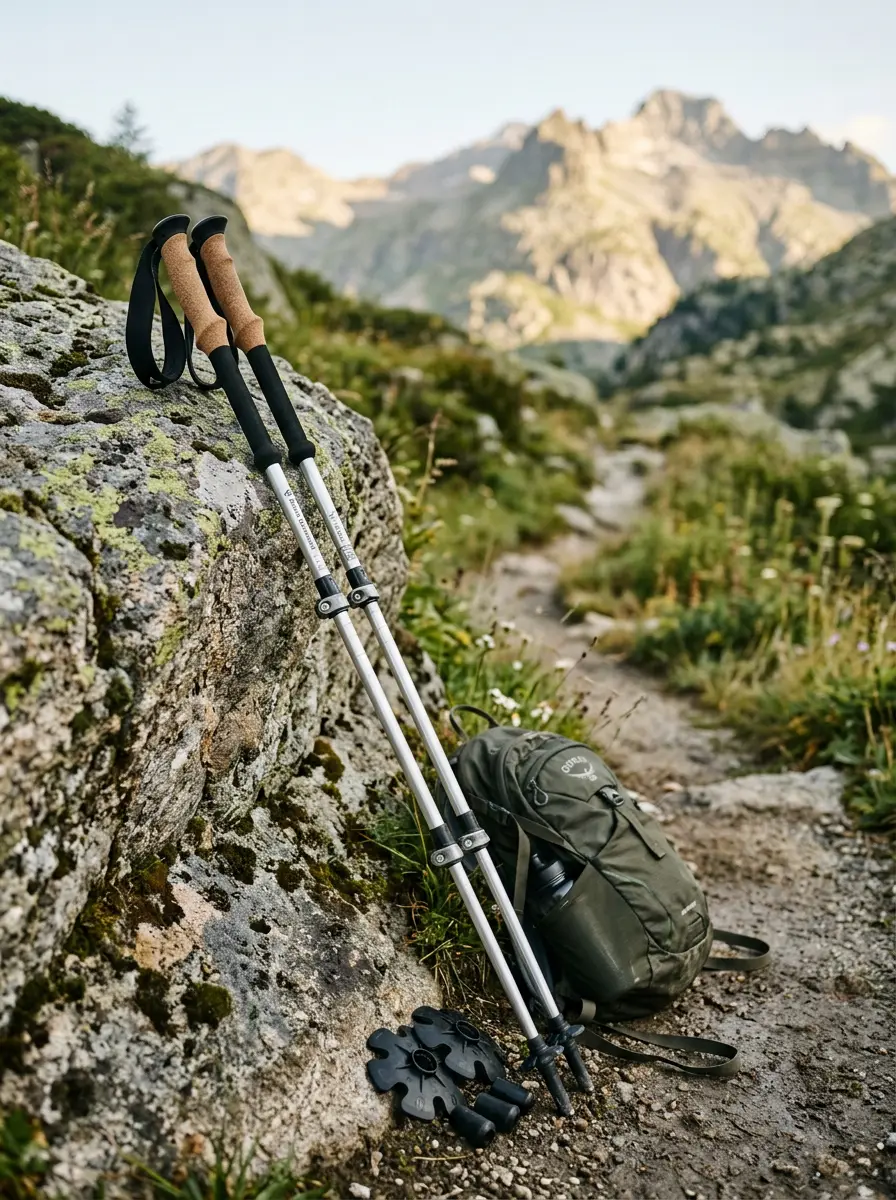
Best Hiking Poles: Top Aluminum Picks for Rugged Trails
Durable aluminum shafts survive trail wedging and sudden falls where brittle carbon fails. Here are the top telescoping poles built for stability and long-distance comfort.
By the Niche Picks editorsUpdated November 2, 202610 min readDrawn from our 29 research-based hiking footwear & backpacks reviews
AI-generated editorial illustration; not a product or test photograph.
Short answer
The best hiking poles balance impact durability, secure locking clamps, and moisture-wicking cork grips. For general trail use, the TrailBuddy Trekking Poles stand out with resilient 7075 aircraft aluminum that resists snapping under stress, while the Cascade Mountain Tech Aluminum Poles offer an extended down-grip for fast switchback navigation at an accessible price.
2
Product listings discussed; not hands-on tests
2/2
Discussed listings with a recorded price
$29.99–$39.89
Recorded listing price range; not a complete setup cost
Key takeaways
Aluminum shafts deform and bend under lateral loads, whereas carbon fiber poles are prone to sudden brittle fracture when wedged.
Natural cork grips wick moisture and contour to palm anatomy over long ascents better than synthetic rubber.
External quick-lever locks provide reliable clamping tension that you can adjust easily in the field compared to internal twist locks.
The TrailBuddy Trekking Poles offer high-strength 7075 aluminum and compact breakdown sizing for $39.89.
Cascade Mountain Tech's $29.99 poles feature an extended EVA lower grip, making choke-ups on steep ascents effortless.
Products discussed in this article
Editorial scores and recorded prices are reference points, not measurements of suitability for every use. Read each review's specifications and limitations.
Which hiking poles provide the best balance of strength and value?
Selecting the right trekking poles comes down to mechanical reliability, ergonomic comfort, and practical affordability. While elite mountaineers sometimes chase ultralight composites, most day hikers and backpackers are best served by resilient aluminum tubing that can withstand the rigors of rocky paths, unexpected slips, and steep descents. In our evaluation of the category within our Hiking footwear & backpacks catalog, two standout models deliver proven trail stability without the inflated pricing of boutique outdoor brands: the TrailBuddy Trekking Poles and the Cascade Mountain Tech Aluminum Trekking Poles.
Both of these options eschew fragile internal twist mechanisms in favor of robust external lever clamps. They feature natural cork main handles that absorb hand moisture during sweaty ascents, preventing the friction hotspots and blisters often caused by hard molded rubber. Where they diverge is in their metallurgy, grip design, and packable dimensions:
TrailBuddy Trekking Poles ($39.89): Built from dense 7075 aircraft aluminum, these poles weigh 1.2 pounds per pair, collapse to 24.5 inches, and disassemble to 21 inches for tight luggage stowage.
Cascade Mountain Tech Trekking Poles ($29.99): Engineered with 6061 aluminum tubing, these poles feature an extended EVA lower grip sleeve, tungsten carbide tips, and an extensive accessory tip kit.
Rather than stocking dozens of nearly identical rebadged imports, our focused reviews highlight these two distinct designs because they solve the primary mechanical failure points that plague budget walking sticks. Understanding the differences between their structural alloys and clamp assemblies will help you determine which set best suits your terrain, pack space, and personal gait.
Why does aluminum survive trail accidents where carbon fiber fails?
When shopping for trekking gear, one foundational guideline governs pole selection: carbon poles save grams; aluminium survives a fall. Composite carbon fiber shafts are celebrated for minimal swing weight and trail stiffness, but carbon exhibits high brittleness under lateral shear stress. When a pole tip wedges between jagged boulders, exposed roots, or scree fissures during an unexpected stumble, your falling body weight exerts intense leverage against the lower shaft. Under these conditions, carbon fiber often shatters with sudden, catastrophic failure, leaving you stranded miles into a descent without a usable crutch.
In contrast, aircraft-grade aluminum alloys deform plastically rather than fracturing cleanly. When subjected to severe lateral bending moments, an aluminum shaft yields and bends. While a warped shaft is no longer factory-true, it usually retains enough structural integrity to serve as an emergency stabilizer for the remainder of a trip. In many cases, careful hikers can gently straighten a slightly bowed aluminum section by hand to limp back to the trailhead.
Our hiking gear guide emphasizes that weight savings on walking sticks often provide diminishing returns for recreational trail users. A pair of ultralight carbon sticks might save two to four ounces overall, but they command prices up to four times higher while introducing fragility in technical terrain. Aluminum tubing—particularly 7075 and 6061 formulations—offers the necessary bend tolerance, impact resistance, and durability required for rugged mountain trails, heavy river crossings, and scree descents where equipment failure is not an option.
How do TrailBuddy 7075 aluminum poles perform on the trail?
The TrailBuddy Trekking Poles retail for $39.89 and represent one of the most widely vetted pieces of hardware in outdoor recreation, boasting over 63,000 recorded consumer reviews with a 4.7 out of 5-star aggregate. The backbone of this model is its 7075 aircraft-grade aluminum alloy, a formulation known for superior tensile strength compared to baseline 6000-series metals. Weighing in at 9.7 ounces per pole (1.2 pounds for the complete pair), the TrailBuddy provides confidence under vertical load while remaining manageable over high-mileage day treks.
Adjustability is handled through external aluminum lever locks that secure three telescoping segments. These quick-release clamps eliminate the slipping and sticking issues notorious in internal expansion plugs. In the field, users can adjust length anywhere between 24.5 inches fully collapsed and 54 inches fully extended. If you need to fit the poles inside a carry-on duffel or compact daypack, the individual sections can be completely separated down to a tidy 21 inches.
Contact ergonomics are anchored by contoured natural cork handles paired with padded, ambidextrous wrist straps. Cork naturally wicks palm sweat away from the surface during sweltering summer climbs and gradually conforms to the specific contours of your hands over time. The complete bundle includes four rubber trail tips, two mud baskets, two snow powder baskets, and a protective nylon carry bag. If you want to compare specifications against alternative designs, TrailBuddy’s inclusion of spare wear parts and metal locking levers establishes an impressive baseline for sub-forty-dollar trail gear.
What makes the Cascade Mountain Tech poles a budget favorite?
At a listed price of $29.99, the Cascade Mountain Tech Lightweight Aircraft-Grade Aluminum Trekking Poles offer exceptional value. Backed by more than 14,000 user evaluations and a 4.6-star rating, this system is constructed from dependable 6061 aluminum. While slightly softer than 7075 alloy, 6061 aluminum delivers excellent bend resistance and vibration damping, making it resilient across rocky steps, talus slopes, and uneven forest paths.
One defining feature of the Cascade Mountain Tech pole is its hybrid grip architecture. Below the ergonomic cork main handle, the manufacturer integrates an extended down-grip made from dense ethylene-vinyl acetate (EVA) foam. This extended choke-up sleeve proves invaluable on steep mountain ascents and rapid switchbacks: instead of stopping to shorten your telescoping shafts at every gradient change, you simply slide your hands down to the lower foam section for instant mechanical leverage.
The poles adjust between 26 and 54 inches (66 to 137 centimeters) via single-handed quick-lock clamps, providing ample height range for uphill pushes and descending knee relief. Underneath, durable tungsten carbide tips bite firmly into hard-packed dirt and slick rock surfaces. Cascade Mountain Tech also includes an exhaustive accessory kit right out of the box, comprising mud baskets, snow baskets, rounded rubber pavement boots, standard protective tip caps, and a zippered storage sack. For hikers reviewing their gear budget, getting a complete, dual-grip pole setup for under thirty dollars eliminates the need to buy secondary accessories or expensive add-on tip kits.
How do grip materials and locking mechanisms compare?
The usability of a hiking pole relies almost entirely on two mechanical touchpoints: the grip in your hand and the locking mechanism securing each shaft segment. Understanding how these components behave under load and across changing temperatures prevents trailside frustration:
Cork vs. Foam vs. Rubber: Natural cork handles are the gold standard for warm-weather hiking. Unlike non-porous molded rubber, which traps perspiration and creates slick surfaces that induce blisters, cork wicks moisture away and molds gradually to your palm. Dense EVA foam, seen on extended lower sleeves, is soft, insulating against cold metal in chilly weather, and non-slip when hands are wet.
External Lever Locks vs. Twist Locks: Older trekking poles relied heavily on internal twist-and-expand friction plugs. These plugs frequently bind when trail grit enters the tubes or slip when cold temperatures cause metal contraction. External aluminum and composite quick-release lever locks provide direct, visible mechanical compression. They allow instantaneous height adjustments with gloves on and feature knurled thumbscrews to fine-tune clamping tension without tools.
Wrist Strap Ergonomics: Padded, adjustable wrist straps allow you to push downward through the strap cradle using your skeletal structure rather than white-knuckling the grip. This technique drastically reduces forearm fatigue on long ascents.
In our outdoor gear blog, we emphasize that minor mechanical adjustments dictate long-term satisfaction. Choosing poles with external lever clamps and cork contact points ensures that your hands remain comfortable and your pole shafts stay firmly locked at your desired height through hours of continuous trail pounding.
How do hiking poles integrate with footwear and backpack fitting?
Trekking poles do not operate in isolation; they are part of a coordinated biomechanical system that includes your footwear and pack suspension. Using two poles transfers up to twenty percent of downward kinetic force away from your knees, hips, and lower lumbar spine into your upper body. However, maximizing trail efficiency requires avoiding common equipment mismatches.
A frequent oversight detailed in our guide to gear mistakes to avoid involves footwear breathability. Many casual hikers automatically choose waterproof footwear regardless of the season. However, footwear principles dictate that waterproof liners trap sweat; in hot or arid climates, you should skip impermeable membranes because they prevent foot perspiration from venting, causing saturated socks and painful friction blisters. Breathable, non-waterproof footwear keeps feet cooler and drier during high-exertion pole trekking.
Similarly, pack ergonomics directly influence how your poles feel over distance:
Torso Length Dictates Fit: Torso length, not pack litres, determines fit and proper load distribution. An ill-fitted daypack places dead weight squarely on your trapezius muscles and clavicles, inducing upper-body hunching that disrupts your natural pole planting rhythm.
Arm Clearance: Bulky, unstructured daypacks without proper hip stabilization sway laterally, forcing your elbows outward and altering your pole strike angle.
External Stashing: When negotiating third-class scrambles where both hands are required, ensure your daypack features dedicated side cinch straps or bungee loops that can securely lash folded aluminum poles without snagging brush.
Aligning your pole height to maintain a 90-degree elbow bend, pairing them with breathable trail shoes in dry environments, and wearing a pack matched to your torso creates a harmonious stride that mitigates fatigue across all terrain.
How should you maintain and tune telescoping hiking poles?
Telescoping aluminum hiking poles require straightforward, regular maintenance to retain their clamping power and structural longevity. Because aluminum shafts slide within one another, dirt, silt, and moisture inevitably find their way into the joints during wet crossings or dusty trail scrambles.
Follow these practical maintenance guidelines after demanding outings:
Disassemble and Dry: After trekking in rain or crossing streams, pull the three pole segments completely apart. Wipe the interior and exterior tubing clean with a dry microfiber cloth and allow them to air dry before reassembly to prevent aluminum oxidation and surface pitting.
Never Lubricate the Tubes: Never apply WD-40, silicone spray, or grease inside telescoping shafts. Lever locks depend entirely on dry mechanical friction to hold vertical weight. Adding lubricants will cause the clamps to slip disastrously under your body weight.
Tune Lever Tension: If a pole segment begins to slide under pressure, open the quick-lock lever and tighten the knurled metal or plastic thumbscrew clockwise by a quarter-turn. Close the lever firmly; it should require positive thumb force to snap shut.
Inspect Tips and Baskets: Tungsten carbide tips will eventually wear down or loosen after hundreds of miles on hard granite. Regularly inspect the carbide insert for chips. In soft mud or wet snow, swap to wider accessory baskets to prevent the shafts from sinking deep into the ground.
By taking five minutes to clean your poles and verify clamping tension after every major expedition, you ensure your aluminum trekking poles remain dependable safety tools rather than trail liabilities.
Verify that pole shaft material matches your route: choose resilient aluminum for rocky scrambles and talus.
Check that clamping hardware uses external quick-release lever locks rather than slip-prone twist locks.
Confirm that the main handles are natural cork to wick sweat and prevent warm-weather palm blisters.
Ensure the extended height reaches high enough to maintain a 90-degree elbow bend on flat ground.
Test the collapsed length against your daypack's external lash points or luggage dimensions.
Inspect the tip kit to confirm it includes rubber tips for hard rock and baskets for mud or loose snow.
Tighten clamp thumbscrews before your first ascent so levers close with firm, positive thumb pressure.
Frequently asked questions
Why should I choose aluminum hiking poles over carbon fiber?
Carbon poles save grams, but aluminum survives a fall. While carbon fiber offers lower swing weight, it is brittle and prone to sudden shattering if wedged in rocks under lateral stress. In contrast, 7075 and 6061 aluminum alloys deform and bend gradually, allowing you to straighten the shaft gently in an emergency to safely finish your descent.
How do I set the correct height on telescoping poles?
Stand on flat ground wearing your standard hiking footwear and hold the grips. Adjust the telescoping segments until your elbow forms a clean 90-degree right angle with your forearm parallel to the ground. When trekking sustained uphill slopes, shorten both poles by two to three inches; on long descents, lengthen them by two to three inches for better balance.
Are cork grips worth the extra cost over rubber handles?
Yes. Natural cork grips absorb hand perspiration and wick moisture away during warm, high-output climbs, significantly reducing the friction hotspots that cause blisters. Over time, cork gradually compresses and contours to the unique shape of your palms. Molded rubber grips do not breathe, making them slippery when wet, though they insulate well in freezing winter conditions.
Why are external lever locks preferred over internal twist locks?
External lever locks use mechanical clamps tightened by thumbscrews, providing reliable clamping power that you can adjust with one hand while wearing gloves. Older twist locks rely on internal plastic expanders that frequently fail when trail dust enters the shaft or when low temperatures cause metal tubing to contract, resulting in dangerous, unexpected collapses.
What should I do if my hiking pole slides down while walking?
Clamping slippage usually stems from loose lever tension rather than mechanical failure. Simply flip the quick-release lever into the open position, turn the knurled tension thumbscrew clockwise by a quarter-turn, and snap the lever shut. It should close with firm thumb resistance. Never apply lubricants inside the tubing, as locks rely entirely on clean, dry friction.
When should I install the included mud or snow baskets?
Screw on mud baskets when hiking through soft soil, marshland, or loose scree to prevent the narrow pole tips from penetrating deeply into the ground and sticking. Switch to wider snow baskets for winter snowshoeing or snowfield traverses to maintain surface flotation. Leave baskets off when navigating dense brush to prevent snagging.
Amazon links are affiliate links; we may earn a commission at no cost to you.
Sources and limits
This page summarizes our research reviews of Amazon listings, listed specifications and captured buyer ratings. It is not a hands-on test. Scores are editorial assessments, not measured performance; prices are recorded snapshots and may change. A category can include both main products and accessories, so its overall price range is not the cost of a complete setup.
Most recent product record update: October 28, 2026. Individual records may be older; this is not a verification date for every claim.
Compare the same kind of hiking footwear & backpacks
Choose the product type first. These groups require a match in the listing title; an import search term alone is not enough. Scores rank our recorded research assessments within each group, not independently measured performance.
Values are shown as recorded, without unit conversions or inferred compatibility. Not recorded means unknown, not absent. Prices are snapshots, not current offers. Editorial scores are research judgments, not lab results. Amazon links are affiliate links.
Before treating a comparison as complete
Which details are still unknown?
A specification appearing in a listing is not independent verification. These counts show which shortlisted records contain the same field; a blank record does not mean the product lacks the feature.
Shaft Material
Recorded for 2 of 2 shortlisted models
Present in every shortlisted record. Check units, exact variants and the current manufacturer documentation before relying on it.
Waterproof liners trap sweat — skip them in dry climates.
Torso length, not pack litres, determines fit.
Carbon poles save grams; aluminium survives a fall.
If a specification, certification or compatibility detail is absent, mark it as unknown and ask the seller or manufacturer. Do not substitute a star rating, an editorial score or a different model's specification.