The Best Adjustable Weight Bench for Your Home Gym in 2026
We analyze the most reliable adjustable weight benches to help you find a stable, space-saving foundation for your home training sessions.
By the Niche Picks editorsUpdated November 8, 202610 min readDrawn from our 35 research-based home gym equipment reviews
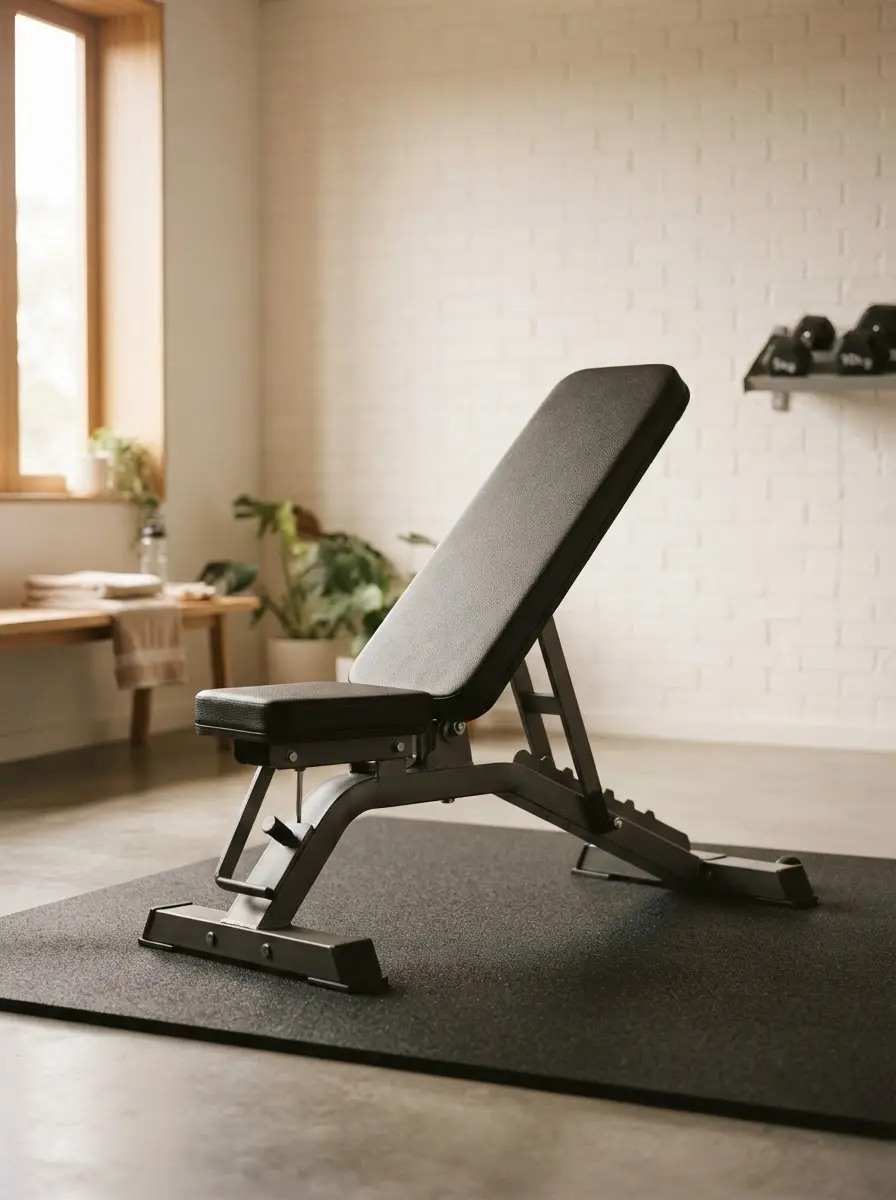
AI-generated editorial illustration; not a product or test photograph.
Short answer
The best adjustable weight bench balances structural rigidity with your specific space constraints. For most home lifters, the YOLEO Adjustable Weight Bench is a top choice for its versatile incline/decline positions and 827-pound static capacity. If you require maximum floor-space efficiency, the FLYBIRD WB5 remains a standout pick for its reliable hinge architecture and rapid adjustments.
6
Product listings discussed; not hands-on tests
5/6
Discussed listings with a recorded price
$44.32–$149.98
Recorded listing price range; not a complete setup cost
Key takeaways
Always verify your ceiling height before choosing an adjustable bench to ensure safe overhead pressing.
Folding mechanisms offer essential space savings but can introduce subtle structural play compared to heavy, fixed-welded frames.
Look for a true 90-degree backrest angle if you prioritize seated dumbbell shoulder presses in your routine.
Check for ASTM-certified load ratings, but always remember to include your own body weight in the total load calculation.
High-density foam upholstery prevents unwanted sinking during heavy sets, which is critical for maintaining scapular stability.
Products discussed in this article
Editorial scores and recorded prices are reference points, not measurements of suitability for every use. Read each review's specifications and limitations.
FLYBIRD Adjustable Weight Bench, Full Body Workout$104.46
FitinOne Adjustable Folding Weight Bench for Home Gym$59.98
Adjustable Weight Bench for Home Gym, Foldable Workout$44.32
Comparison of reviewed adjustable weight benches by price and core capacity.
Product
Price
Max Capacity
Foldable
Best For
YOLEO Bench
$89.99
827 lbs
Yes
General Strength
FLYBIRD WB5
$149.98
800 lbs
Yes
Versatility
FLYBIRD 99
$104.46
750 lbs
Yes
Portability
FitinOne
$59.98
660 lbs
Yes
Apartment Gyms
VUSIGN Bench
$44.32
600 lbs
Yes
Light Training
Rockvale
N/A
660 lbs
Yes
Immediate Setup
Understanding structural integrity and weight capacity
When evaluating an adjustable weight bench, it is vital to distinguish between marketing claims and actual operational stability. Manufacturers often display impressive static weight ratings—sometimes reaching 800 or 1,000 pounds—that represent the maximum force the unit can withstand before failure. However, dynamic movements like dumbbell presses or rows generate lateral and rotational forces that test the bench's frame far more than a static weight would. Bench designs that utilize a triangular bracing architecture, such as the YOLEO Adjustable Weight Bench, do a superior job of dispersing downward pressure away from the folding hinges.
Pay attention to the bench's total unit weight: frames weighing under 25 pounds may shift on smooth concrete or wood floors during intense training.
Look for wide stabilizer feet with rubber caps, which provide necessary traction on slick basement or garage flooring.
Avoid benches that lack detailed steel tube dimensions, as thinner, lower-gauge metal is more prone to frame flex during heavy work.
While high-end commercial benches utilize 11-gauge steel, most residential units rely on lighter alloy configurations to keep costs low and portability high. As a buyer, your responsibility is to ensure that your chosen equipment matches your training intensity. If you are working with weights that exceed 50 pounds per hand, prioritize benches with a heavier frame mass over those that offer extreme folding speed. For broader context on how to balance budget and structural needs, our guide to home gym equipment offers a deep dive into these material standards. Always remember that the safety of your setup is only as strong as your weakest link, whether that is the locking pin or the pivot point.
Why adjustment mechanics determine your training tempo
The primary reason to invest in an adjustable bench is to consolidate multiple stations into one. A high-quality FID (Flat, Incline, Decline) bench should allow you to transition between angles rapidly, keeping your heart rate up during circuit sessions. The FLYBIRD Adjustable Weight Bench excels here by integrating a ladder-style adjustment rack with a reinforced auxiliary safety pull pin. This setup not only prevents the backrest from slipping under tension but also allows you to find the exact angle needed to hit different muscle heads without tedious re-bolting.
Ensure the bench has at least three distinct seat-angle selections to keep your hips from sliding during heavy inclines.
Verify that the decline settings lock securely, as accidental disengagement during an abdominal workout can cause sudden, painful contact with the floor.
Check for high-density foam padding; soft cushions might feel comfortable initially but fail to provide the firm base needed to lock in your shoulders during heavy pressing.
When choosing between different adjustment styles, consider your training environment. If you are working out alone in a home gym, simplicity is an asset. Complex, spring-loaded levers can become points of mechanical failure over several years of high-frequency use. A robust, ladder-style steel support, as found on many of our top-rated benches, is significantly easier to repair or maintain than a concealed, gear-driven system. You can find more advice on matching bench features to your fitness goals in our workout bench review section. For those who enjoy testing different configurations, ensure the bench's weight distribution remains stable even when the backrest is set to its highest vertical position.
Measure Your Ceiling Clearance
Always measure the distance from the floor to your ceiling while seated on your bench. Ensure you have at least 12-18 inches of overhead clearance for the full extension of your arms when holding dumbbells.
The space-saving vs. stability trade-off
For apartment dwellers or those using a spare room, the decision often comes down to the foldable bench. Models like the FitinOne Adjustable Folding Weight Bench are designed for rapid stowage, making them perfect for environments where floor space is at a premium. However, it is important to recognize that hinges and folding points are inherent failure points. Every pivot creates a potential for 'play'—a small amount of movement or wiggle that you might notice during your final reps of a heavy chest press. This is a common characteristic of budget-tier foldable units and does not necessarily indicate a defective product.
Folding benches are ideal for moderate dumbbell work, typically under 40-50 pounds per hand.
Fixed-frame benches provide an unmatched sense of security, as they avoid hinge movement entirely and often last longer.
If you choose a folding unit, prioritize models that arrive largely pre-assembled, like the Rockvale Adjustable Weight Bench, to avoid initial tolerance errors from DIY assembly.
If your lifting routine involves significant weight, you might consider a fixed-frame alternative like the Marcy Flat Utility Weight Bench. While it loses the incline/decline versatility, its solid, welded construction eliminates hinge rattle and provides a rock-solid platform for heavier loads. This is an excellent compromise for lifters who do most of their work on a flat plane. You can explore how this comparison shifts for users on a specific financial plan in our budget planner or by viewing our list of the best home gym equipment on a budget. Balancing your need for space with your need for a rock-solid foundation is the cornerstone of a safe, long-term home lifting setup.
Safety considerations for overhead pressing
One of the most neglected factors when purchasing a weight bench is overhead clearance. When performing seated shoulder presses at a 90-degree angle, your torso height plus your arm reach can quickly eat into the vertical space of a residential ceiling. Before you make a purchase, measure the distance from the floor to your ceiling, and then subtract the seat height of the bench plus your seated height. A bench like the FLYBIRD WB5 offers an upright position that is perfect for shoulder work, but only if you have the necessary space to extend your arms fully without grazing fixtures or the ceiling itself.
Check the bench's upright height: some models reach 48 inches or more, which significantly impacts your required clearance.
Be wary of benches that offer 'incline' but do not reach a true vertical position, as this forces your spine into an awkward angle during presses.
If your ceilings are low, consider opting for a slightly lower incline setting (e.g., 75 degrees) to save space, provided it still targets the desired shoulder musculature.
Beyond physical space, remember to verify the stability of your floor. Even the best-reviewed bench will shift if your flooring is uneven or slippery. Placing your bench on a rubber mat not only protects your floor from scuffing but also adds a crucial layer of friction that prevents the frame from sliding forward during heavy exertion. We cover the importance of selecting the right flooring surface in our FAQ on home gym equipment, which includes tips for both hardwood and concrete environments. Taking these simple steps before your first workout ensures that your focus remains on your form and muscle contraction, not on the stability of your gear. If you are looking for a comprehensive guide to building your sanctuary, visit our must-have home gym equipment article.
Inspect Pivot Points
If you use a foldable bench, check that all hinge bolts are tight before every heavy session. Vibration from regular use can loosen hardware, leading to unwanted wobble.
Maintenance for long-term reliability
Even the highest-rated weight bench requires routine maintenance to ensure it stays safe and stable over the years. Vibrations from hundreds of workouts can eventually loosen the nuts and bolts at pivot points, leading to an increase in frame wobble. We strongly recommend that you perform a 'torque check' on your bench every three to six months. Tighten all accessible fasteners, but be careful not to overtighten bolts at hinge points, as this can restrict smooth movement or strip threads.
Inspect the upholstery for tears or signs of wear, especially at the edges where friction is most frequent during back-and-forth movements.
Keep the adjustment ladder and locking pin clean and lightly lubricated; sweat and debris can accumulate in these mechanisms, leading to stiffness.
If your bench includes resistance band attachments, check for any fraying on the clips or anchor loops to prevent unexpected snapping during use.
The upholstery on budget-friendly benches can be especially prone to wear. To preserve the longevity of the vinyl cover, wipe the bench down with a damp cloth and a mild, non-abrasive soap after every sweat-heavy session. Avoid using harsh chemical cleaners, which can cause the synthetic leather to crack or dry out prematurely. These small, consistent habits turn a budget purchase into a lasting piece of equipment. If you feel like your current setup isn't providing the level of security you need, our compare tool can help you identify when it might be time to upgrade to a more rigid model. For more common pitfalls to avoid when setting up your first space, see our article on mistakes to avoid in your home gym. Consistent care is the difference between a bench that lasts for years and one that needs replacement within a single season.
Is a power rack necessary for your bench?
Many new lifters ask if they should buy a power rack to go with their adjustable bench. The answer depends entirely on your lifting style. If your primary goal is to build strength using heavy barbell movements like the bench press, a power rack is not just a luxury; it is a safety essential. A rack with adjustable spotter arms provides a safety net, allowing you to train to failure without the risk of being pinned under a heavy load. However, if your training is limited to dumbbells, you can often get by with a simple, well-made bench.
If you add a rack later, ensure it matches the dimensions of your bench; standard home benches fit comfortably within most four-post cages.
When picking a cage, consider if you need integrated pulley systems, which can expand your exercise library to include lat pulldowns and seated rows.
Always measure your floor footprint for both the bench and the cage; a full power cage setup can easily require a 6-by-6 foot area to allow for safe entry and exit.
For those who are space-constrained, a full cage might not be an option. In that case, consider open squat stands, which take up significantly less room while still offering basic safety. The SPORTSROYALS Power Rack provides a great middle-ground with its multi-functional design, allowing you to perform barbell squats, bench presses, and pull-ups. If you are undecided about the long-term layout of your home gym, start with a high-quality bench and a set of adjustable dumbbells to see how your training evolves. Once you are comfortable with your routine, you can expand into a full power rack setup. For detailed reviews of cage systems that pair perfectly with your home bench, check our best power rack guide. Building your gym is a process, and starting with a rock-solid bench is the best first step you can take.
Step by step
1Place the bench on a flat, level, and non-slip surface.
2Unfold the frame and ensure all stabilizer feet are fully extended.
3Insert the locking pin firmly into the desired backrest angle slot.
4Sit down slowly to check for any lateral shifting or hinge wobble.
5Perform a warm-up set with light weights to ensure your positioning is comfortable.
6Begin your full workout, keeping movements slow and controlled.
Quick checklist
Measure the total floor footprint of your designated workout space.
Verify your ceiling height to allow for overhead dumbbell extensions.
Check the weight capacity to ensure it safely covers your body weight plus your planned dumbbells.
Confirm the backrest offers a true 90-degree vertical setting for shoulder presses.
Choose a bench with at least three seat angle positions to prevent sliding during incline sets.
Place the bench on a rubber floor mat to provide a high-friction, stable base.
Test the locking pins and safety mechanisms for any mechanical play before applying full load.
Frequently asked questions
How much weight can an adjustable bench safely handle?
Most residential adjustable benches are rated for between 600 and 800 pounds of combined weight, which includes you and your dumbbells. Always aim to keep your working load well below this maximum to account for dynamic force, particularly on folding models.
Is an FID bench better than a flat bench?
An FID (Flat, Incline, Decline) bench is more versatile for general strength training because it allows for chest and shoulder isolation. A flat, fixed-frame bench is often more stable and durable, making it the better choice if you strictly focus on heavy, flat-plane pressing.
Do I need to bolt my bench to the floor?
Adjustable benches for home gyms are typically designed to be portable and are rarely bolted down. If your bench slides on the floor during a set, the best solution is to place it on a high-friction rubber gym mat rather than attempting to anchor it.
Can I use an adjustable bench for heavy barbell training?
Yes, provided you have a robust power rack with safety spotter arms. Ensure your bench is wide enough to provide a stable base for your back, and always check that the bench is positioned squarely under the barbell to ensure even distribution.
Why does my bench wobble during my lifts?
Wobble is usually caused by loose hardware at the hinge points or an uneven floor surface. Check all bolts periodically to ensure they are snug, and use a thick rubber mat to compensate for minor floor irregularities.
Amazon links are affiliate links; we may earn a commission at no cost to you.
Shortlists in this category
Ranked lists from our home gym equipment reviews, limited to listings whose titles confirm the product type, with budget cuts where enough recorded prices sit on both sides of the line.
This page summarizes our research reviews of Amazon listings, listed specifications and captured buyer ratings. It is not a hands-on test. Scores are editorial assessments, not measured performance; prices are recorded snapshots and may change. A category can include both main products and accessories, so its overall price range is not the cost of a complete setup.
Most recent product record update: October 28, 2026. Individual records may be older; this is not a verification date for every claim. Prices on this page were read from the listings Nov 8, 2026 – Nov 12, 2026.
Choose the product type first. These groups require a match in the listing title; an import search term alone is not enough. Scores rank our recorded research assessments within each group, not independently measured performance.
Values are shown as recorded, without unit conversions or inferred compatibility. Not recorded means unknown, not absent. Prices are snapshots, not current offers. Editorial scores are research judgments, not lab results. Amazon links are affiliate links.
Before treating a comparison as complete
Which details are still unknown?
A specification appearing in a listing is not independent verification. These counts show which shortlisted records contain the same field; a blank record does not mean the product lacks the feature.
Item Weight
Recorded for 2 of 2 shortlisted models
Present in every shortlisted record. Check units, exact variants and the current manufacturer documentation before relying on it.
Weight Capacity Maximum
Recorded for 2 of 2 shortlisted models
Present in every shortlisted record. Check units, exact variants and the current manufacturer documentation before relying on it.
Check documented load ratings, steel gauge, anchoring and attachment compatibility; upright dimensions alone do not establish safety.
Adjustable dumbbells fail at the selector — check the mechanism.
Measure ceiling height before anything you plan to press overhead.
If a specification, certification or compatibility detail is absent, mark it as unknown and ask the seller or manufacturer. Do not substitute a star rating, an editorial score or a different model's specification.