What Sketchbook Paper Is Best for Alcohol Markers?
Learn what paper weight, surface sizing, and barrier sheets are required to blend alcohol markers smoothly without feathering, bleeding, or structural buckling.
By the Niche Picks editorsUpdated October 22, 20267 min readDrawn from our 30 research-based art supplies & tablets reviews
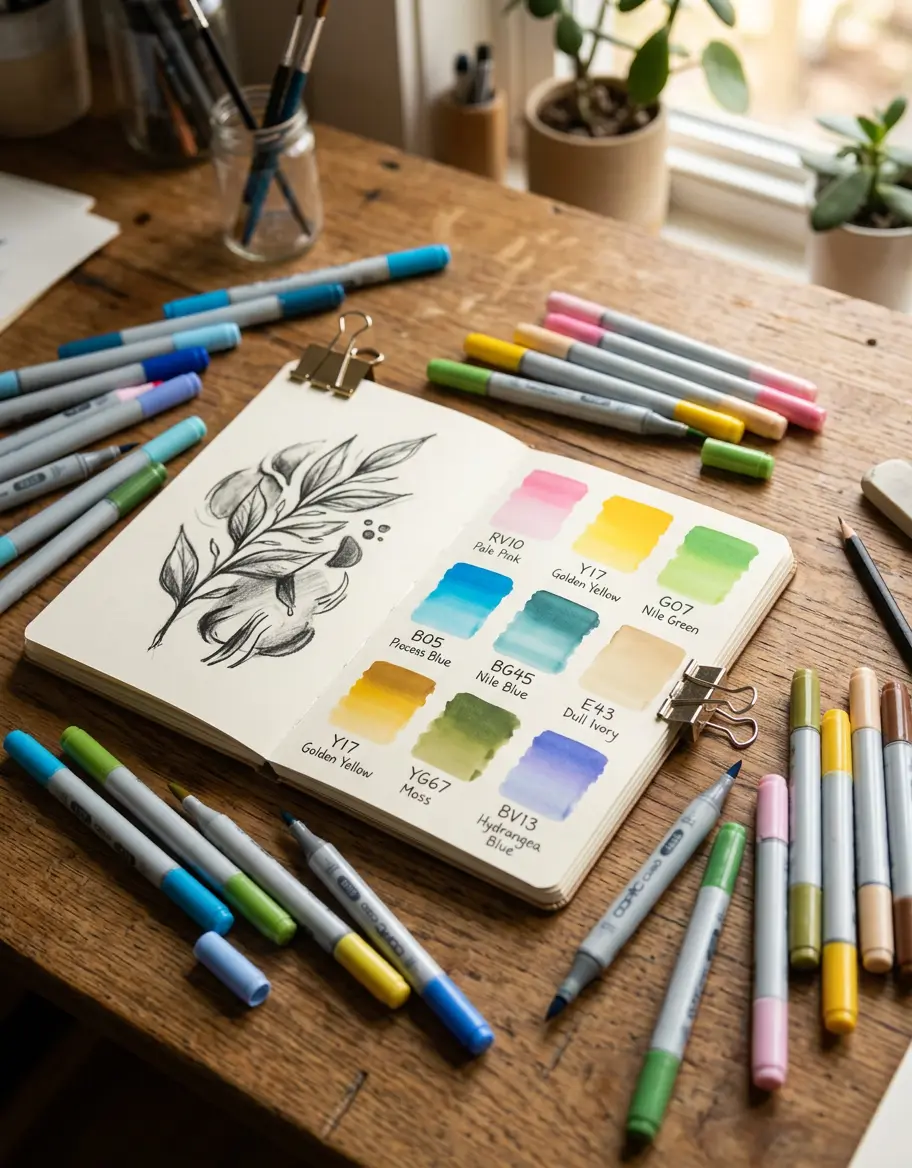
AI-generated editorial illustration; not a product or test photograph.
Short answer
The best sketchbook paper for alcohol markers is heavyweight, smooth paper exceeding 240 to 300 gsm or purpose-built bleedproof marker paper treated with an impermeable barrier coating. Standard sketch paper (89–100 gsm) and mid-weight mixed media pads (160 gsm) allow rapid solvent strike-through, leading to heavy bleeding and uneven color blending.
4
Product listings discussed; not hands-on tests
4/4
Discussed listings with a recorded price
$15.96–$39.99
Recorded listing price range; not a complete setup cost
Key takeaways
Alcohol marker dye relies on fast-evaporating solvent carriers that penetrate cellulose fibers much faster than water-based ink.
Standard sketchbooks rated at 60 lb (89 gsm) or 68 lb (100 gsm) will instantly bleed through and feather under alcohol ink saturation.
Mid-weight mixed media papers at 160 gsm offer reasonable surface sizing for dry tools, but still permit strike-through with heavy marker pooling.
Smooth bristol board or coated barrier stocks above 300 gsm provide the fluid capacity needed to blend wet-in-wet without destroying the sheet beneath.
Always position an impervious silicone or plastic barrier sheet behind active working pages to catch inevitable strike-through.
Products discussed in this article
Editorial scores and recorded prices are reference points, not measurements of suitability for every use. Read each review's specifications and limitations.
How Does Alcohol Marker Ink Interact with Paper Fibers?
Alcohol-based illustration markers differ fundamentally from standard water-based markers and acrylic pens. Tools like the Caliart Alcohol Markers 100 Colors and Ohuhu Alcohol Markers 40 Colors utilize an alcohol solvent carrier combined with soluble dye. This formulation has very low surface tension, allowing the dye to flow rapidly through chisel or fine nibs and saturate cellulose fibers almost instantaneously.
When alcohol ink hits standard paper, the solvent begins evaporating immediately while capillary action pulls the wet dye outward through the paper matrix. If the paper has loose fibers, excessive tooth, or insufficient sizing, the ink feathers beyond your intended linework. Conversely, when applied to tightly compressed, smooth paper stock, the dye pools briefly on the surface, granting an illustrator several seconds to lay down adjacent values and blend seamless wet-in-wet gradations without visible stroke seams.
Because alcohol dyes are translucent and non-granulating, building up rich depth requires layering. Every subsequent pass introduces more solvent into the page. If the substrate lacks the necessary structural density, the re-wetted fibers will soften, leading to fiber pilling, bleeding, and complete strike-through to the opposite side of the page. Understanding these chemical mechanics is vital when consulting our art supplies buyer's guide.
What Paper Weight Do Alcohol Markers Actually Require?
Paper weight dictates how much fluid saturation a sheet can endure before structural failure. In standard fine art workflows, a core benchmark applies: paper weights above 300 gsm handle heavy fluid applications without buckling. While alcohol solvent evaporates considerably faster than water and does not distort paper fibers as severely as acrylic washes, it permeates deeply into low-density sheets.
Standard student sketchbooks typically feature 60 lb (approximately 89 gsm) or 68 lb (100 gsm) paper. These lightweight sheets are engineered strictly for dry graphite, charcoal, or light colored pencil work. Applying juicy alcohol markers to 89–100 gsm sheets results in immediate strike-through, bleeding through three to four sheets beneath your active artwork. Even mid-weight sheets like the 98 lb (160 gsm) stock found in the Canson XL Mix Media Pad 9X12 cannot fully prevent reverse bleed-through under heavy, saturated shading passes.
For general illustration, the best paper profiles fall into two distinct camps:
Heavyweight Cardstock or Smooth Bristol (240 to 300+ gsm): Heavy paper absorbs the solvent vehicle without tearing or immediately leaking through, providing a sturdy surface for multiple blending passes.
Coated Marker Paper (70 to 100 gsm): These specialized sheets utilize a microscopic chemical barrier on the reverse side. The coating halts solvent migration, locking the ink on the front plane while using minimal page thickness.
If you regularly use dry tools alongside ink, check our overview of mistakes to avoid in art supplies when matching weights to media.
Why Does Paper Sizing and Texture Dictate Blending Quality?
Surface texture and internal sizing govern how pen nibs travel and how smoothly alcohol dyes merge. Sizing refers to chemical starches or synthetic polymers added to paper pulp during manufacturing to regulate liquid absorbency. Unsized paper acts like a paper towel, drinking up fluid instantaneously and leaving ragged, blotchy edges.
Alcohol markers perform best on ultra-smooth paper surfaces. Rough textures, such as cold-press watercolor paper or coarse sketch paper, introduce two major problems:
Premature Nib Wear: High tooth physically abrades synthetic fine bullet and chisel nibs, causing delicate tips to fray and lose their sharp edge profile.
Uneven Color Transitions: Pronounced grain creates microscopic peaks and valleys. Ink settles heavily in the depressions while leaving peaks pale, preventing the uniform, photographic blending that alcohol dyes are prized for.
In pads like the Canson XL Mix Media Pad 7X10, the medium fine-tooth texture accepts dry media cleanly, but it pulls marker ink inward more aggressively than an ultra-smooth plate bristol would. For detailed illustrative work, opt for hot-press, smooth, or vellum-finish papers. These allow chisel edges and bullet tips to glide across the page without snagging, distributing a continuous film of solvent that remains workable for seamless transitions. You can explore broader substrate options in our art supplies and tablets category.
Can You Use Mix Media Sketchbooks for Alcohol Markers?
Mix media sketchbooks are widely popular among student illustrators because of their versatile multi-tool positioning. Pads like the Canson XL Mix Media Pad 9X12, priced at $16.83 for 60 sheets, and the smaller Canson XL Mix Media Pad 7X10, listed at $15.96, use 98 lb (160 gsm) paper. These are rated for drawing, pen, pencil, and light washes.
While 160 gsm paper is twice as thick as standard 89 gsm sketch paper, it operates as an intermediate compromise. In real-world marker testing, a 160 gsm sheet holds up well against single-pass ink applications and preliminary line rendering. The internal sizing prevents immediate feathering, allowing linework from sets like the Caliart Alcohol Markers 100 Colors to maintain crisp, defined contours.
However, limitations appear when executing advanced wet-in-wet blending or using colorless blenders. Saturated layering on 160 gsm stock will eventually soak through the reverse of the sheet. Furthermore, the light tooth of mixed media paper drinks ink faster than slick marker board, depleting marker reservoirs sooner. If you choose to work in a mixed media pad, treat it as a single-sided sketchbook: never draw on both sides of a page, and always position an impermeable barrier sheet underneath to protect subsequent sheets.
How Do You Prevent Bleed-Through on Sketchbook Pages?
Because alcohol solvent has an exceptionally small molecular profile and low viscosity, complete strike-through is virtually inevitable on uncoated sketchbook papers. Even when using heavy cardstock, sustained wet-on-wet blending deposits enough carrier liquid to penetrate the back of the sheet.
To safeguard your sketchbook and maintain a clean workflow, implement these practical studio precautions:
Insert a Flexible Barrier Sheet: Always place an impervious sheet behind the page you are working on. A thin sheet of silicone, smooth polypropylene plastic, or heavy laminated cardstock stops solvent from staining the next clean page in the book.
Avoid Standard Scrap Paper as a Shield: Placing ordinary copy paper behind your active page is insufficient; alcohol ink will easily pass through multiple layers of standard paper before stopping.
Work Exclusively Single-Sided: Accept that the back of an alcohol marker illustration is unusable. Trying to draw double-sided in a bound journal will result in ghosting and muddy color interference.
Manage Nib Dwell Time: Never hold your marker stationary on the paper. A paused chisel or fine nib continuously pumps solvent into that focal point, creating an expanding halo of bleed that ruins outlines.
What Are the Archival Limitations of Alcohol Marker Art?
When choosing paper and setting expectations for your sketchbook, keep in mind the longevity of the medium itself. Alcohol markers rely on organic dyes dissolved in solvent rather than finely ground mineral pigments suspended in acrylic or gum binders. Our buying criteria emphasize that lightfastness ratings determine whether artwork survives a decade without fading or shifting in tone.
Sets such as the Ohuhu Alcohol Markers 40 Colors and Caliart Alcohol Markers 100 Colors are engineered for rapid conceptualization, comic illustration, fashion layouts, and coloring. Because they utilize soluble dyes, their lightfastness rating is effectively zero. When hung on a wall or exposed to ambient indoor lighting and direct UV rays, alcohol dye ink will fade significantly within months.
For this reason, pairing alcohol markers with high-cost 100% cotton archival rag papers is generally counterproductive and uneconomical. The substrate will outlive the dye by centuries. The ideal pairing for alcohol markers is an acid-free, high-density cellulose sheet or bleedproof marker pad. Acid-free paper ensures that the paper itself will not yellow or become brittle over time, keeping your sketchbook studies preserved cleanly inside closed portfolios away from UV degradation. Read our comprehensive art supplies FAQ for more storage recommendations.
Step by step
1Choose an ultra-smooth cardstock, plate bristol, or bleedproof marker sketchbook.
2Insert an impermeable silicone or plastic barrier sheet directly behind your active page.
3Lay down preliminary pencil guidelines lightly so they do not trap marker dye underneath.
4Work from light values to dark values, applying even, continuous strokes without pausing.
5Blend overlapping colors while the ink is still wet on the surface for seamless gradients.
6Allow the sheet to dry completely before removing your barrier sheet to close the book.
Quick checklist
Select smooth, plate-finish, or coated paper to minimize abrasive nib wear.
Ensure paper weight is at least 160 gsm for light rendering, or 240–300+ gsm for heavy blending.
Check that the paper is acid-free to prevent substrate yellowing over time.
Verify you have an impermeable plastic or silicone barrier sheet for your sketchbook.
Choose dual-tip markers with secure, airtight caps to prevent premature solvent evaporation.
Plan your sketchbook layouts for single-sided drawing only.
Frequently asked questions
Why do alcohol markers bleed through sketchbook paper so easily?
Alcohol marker solvent has low surface tension and low viscosity compared to water. This causes the fluid vehicle to travel rapidly through cellulose fibers via capillary action, penetrating deep into porous sheets before evaporating.
Can I use watercolor paper for alcohol markers?
Watercolor paper is generally poor for alcohol markers. Cold-press surfaces have a heavy tooth that quickly frays marker nibs, while high absorbency soaks up vast amounts of ink, draining your pens rapidly and causing streaky blends.
What is the difference between marker paper and bristol board?
Marker paper is typically thin (around 70 to 100 gsm) and treated with a special coating on the back to prevent strike-through. Bristol board is thicker (240 to 300+ gsm) uncoated cardstock, relying on sheer density to manage ink saturation.
Will alcohol marker ink fade over time in a sketchbook?
Alcohol markers use soluble dyes rather than lightfast mineral pigments. While pages kept closed inside a sketchbook are protected from UV rays and will last for years, any work displayed under room light or sunlight will fade relatively quickly.
How do I stop alcohol markers from feathering at the edges of my lines?
Feathering occurs when paper sizing is loose or when ink is applied too slowly. To keep crisp edges, use smooth, tightly compressed paper, maintain a steady hand speed, and leave a microscopic margin inside outlines for natural capillary spread.
Amazon links are affiliate links; we may earn a commission at no cost to you.
Sources and limits
This page summarizes our research reviews of Amazon listings, listed specifications and captured buyer ratings. It is not a hands-on test. Scores are editorial assessments, not measured performance; prices are recorded snapshots and may change. A category can include both main products and accessories, so its overall price range is not the cost of a complete setup.
Most recent product record update: September 29, 2026. Individual records may be older; this is not a verification date for every claim.
Choose the product type first. These groups require a match in the listing title; an import search term alone is not enough. Scores rank our recorded research assessments within each group, not independently measured performance.
Values are shown as recorded, without unit conversions or inferred compatibility. Not recorded means unknown, not absent. Prices are snapshots, not current offers. Editorial scores are research judgments, not lab results. Amazon links are affiliate links.
Before treating a comparison as complete
Which details are still unknown?
A specification appearing in a listing is not independent verification. These counts show which shortlisted records contain the same field; a blank record does not mean the product lacks the feature.
Included Components
Recorded for 2 of 2 shortlisted models
Present in every shortlisted record. Check units, exact variants and the current manufacturer documentation before relying on it.
Item Dimensions
Recorded for 2 of 2 shortlisted models
Present in every shortlisted record. Check units, exact variants and the current manufacturer documentation before relying on it.
Item Weight
Recorded for 2 of 2 shortlisted models
Present in every shortlisted record. Check units, exact variants and the current manufacturer documentation before relying on it.
Age Range Description
Recorded for 2 of 2 shortlisted models
Present in every shortlisted record. Check units, exact variants and the current manufacturer documentation before relying on it.
Marker Type
Recorded for 2 of 2 shortlisted models
Present in every shortlisted record. Check units, exact variants and the current manufacturer documentation before relying on it.
Number of Pieces
Recorded for 2 of 2 shortlisted models
Present in every shortlisted record. Check units, exact variants and the current manufacturer documentation before relying on it.
Pressure levels plateau; parallax and texture are what you feel.
For wet media, check paper sizing, composition and format as well as weight; even heavy paper can buckle depending on water use and stretching.
Lightfastness ratings decide whether work survives a decade.
If a specification, certification or compatibility detail is absent, mark it as unknown and ask the seller or manufacturer. Do not substitute a star rating, an editorial score or a different model's specification.