Design and build
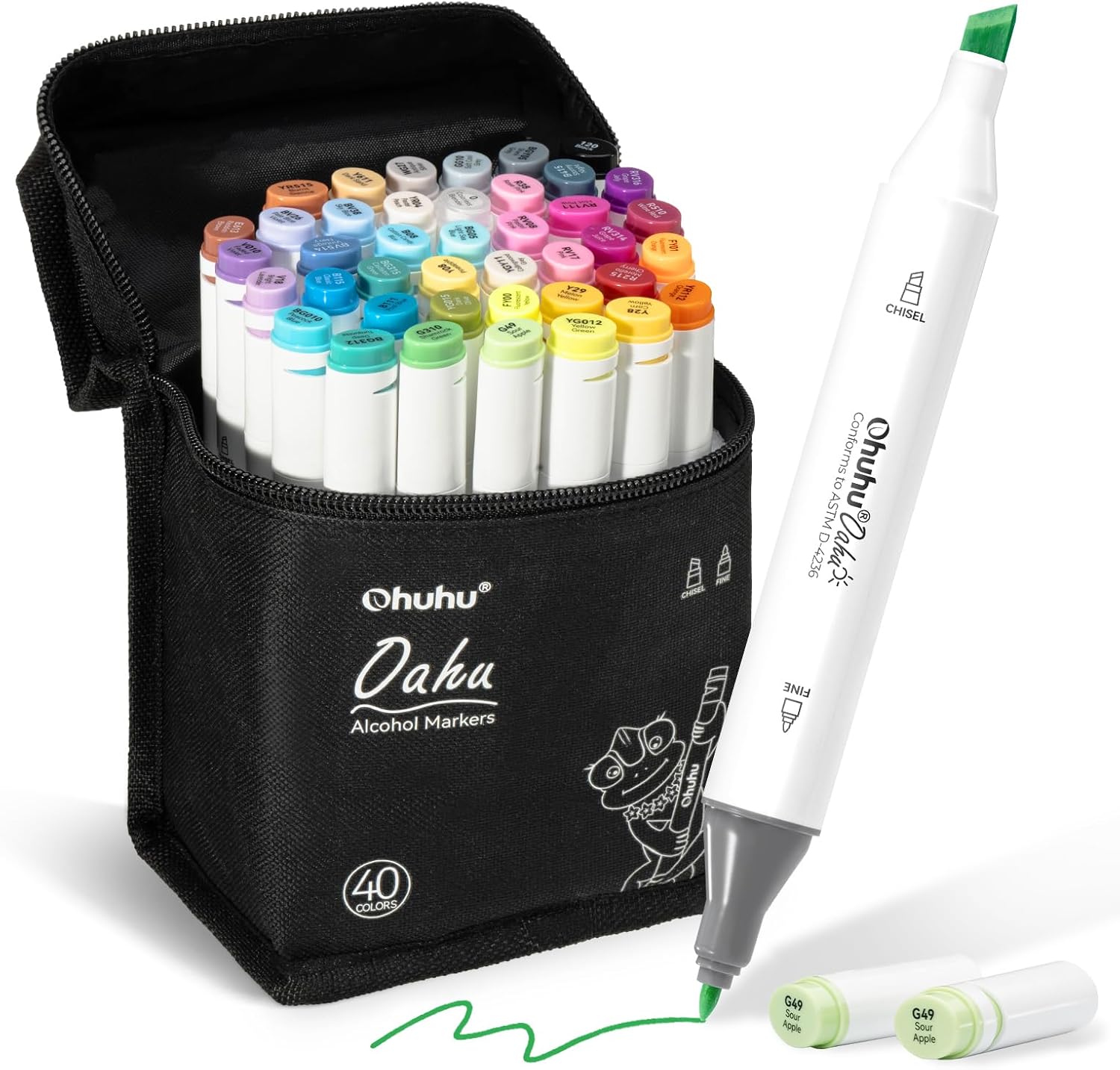
The Ohuhu marker set comes in a compact footprint measuring 6.1 by 4.13 by 4.13 inches and weighing 16 ounces, housed in a fabric zippered carrying case. Each marker incorporates a dual-ended layout featuring a broad chisel tip on one end and a bullet-style fine tip on the opposite pole. Plastic barrels carry color-coded caps to facilitate identification, though users should produce a swatch sheet on their working surface since plastic molding rarely mirrors true dried pigment. The caps seat firmly to inhibit evaporation, a critical mechanical failure point for volatile solvent tools. The inclusion of a dedicated colorless blender expands intermediate mixing capabilities. Physical construction aligns with functional studio standards, utilizing durable polypropylene housings that endure routine handling. Furthermore, the brand supports refilling across 101 catalog hues, transforming what is typically a disposable plastic cylinder into a serviceable tool body. While the included soft-sided case tends to sag when partially emptied, it keeps the 41 implements contained during transport.
Real-world performance
Operating with alcohol-based dye ink, these markers prioritize fast evaporation and continuous color dispersion. When applied to standard multi-media stocks, the ink saturates evenly, allowing wet-on-wet transitions without leaving defined streak lines or patchy pigment aggregation. The included colorless blender assists in softening tonal edges, though users must manage pigment displacement actively. Potential buyers must respect standard media constraints: because alcohol solvents permeate standard drawing papers aggressively, media under 300 gsm will invariably experience reverse bleed-through and lateral feathering. Heavyweight bristol board or specialized bleed-proof marker papers are mandatory to prevent underlying sheet spoilage. Line control through the fine nib handles precision line work and cross-hatching, whereas the wedge chisel quickly washes broad expanses. However, buyers should note that dye-based formulas do not possess lightfast permanence. Without documented ASTM lightfastness certification, finished pieces will fade under ultraviolet exposure over time, rendering these markers best suited for sketchbook studies, design ideation, and digital scanning workflows rather than framed exposure.
Value for money
Priced at $25.49 for 40 colored markers and one blender, the set costs roughly sixty cents per unit. This pricing sits significantly below traditional professional Japanese and European alcohol graphic markers, making it accessible for art students, illustrators, and hobbyists. The 4.7 out of 5 rating across more than 15,000 recorded customer reviews indicates consistent production reliability and low defect rates out of the box. A notable financial advantage lies in Ohuhu’s expansion into liquid refills. In typical budget marker lines, a depleted barrel necessitates purchasing an entirely new marker or complete boxed assortment; here, the ability to recharge common core shades amortizes the initial purchase over sustained studio use. Provided the buyer accepts the trade-off of a bullet fine nib instead of an elastomeric flexible brush tip, the volume of usable ink per dollar remains exceptionally competitive. For conceptual drafts, study books, and rapid color roughs, the cost-to-output ratio is quantitatively superior to heritage graphic brands.
Who should skip it
Fine artists planning gallery-bound original pieces or archival commissions intended to survive decades should bypass this marker set entirely. Like most solvent-based dye solutions, these pigments break down when subjected to sunlight and indoor lighting; art exposed without strict UV protection will visibly degrade. Those who require certified lightfastness ratings must look to pigment-based acrylic markers or traditional archival media instead. Additionally, illustrators whose techniques rely strictly on flexible, dynamic brush nibs will find the stiff fine bullet nib limiting for expressive calligraphic swells or delicate feathering. In such scenarios, exploring Ohuhu’s brush-tipped variants or competing brush-nib graphic systems will yield better gestural control. Finally, creators unwilling to invest in dedicated bleed-proof surfaces or paper stocks weighing 300 gsm and above will encounter continuous frustration with bleeding on everyday lightweight paper. If your workflow centers on non-scanned, permanent fine art or demands flexible brush physics, this specific chisel and fine configuration is the wrong match.