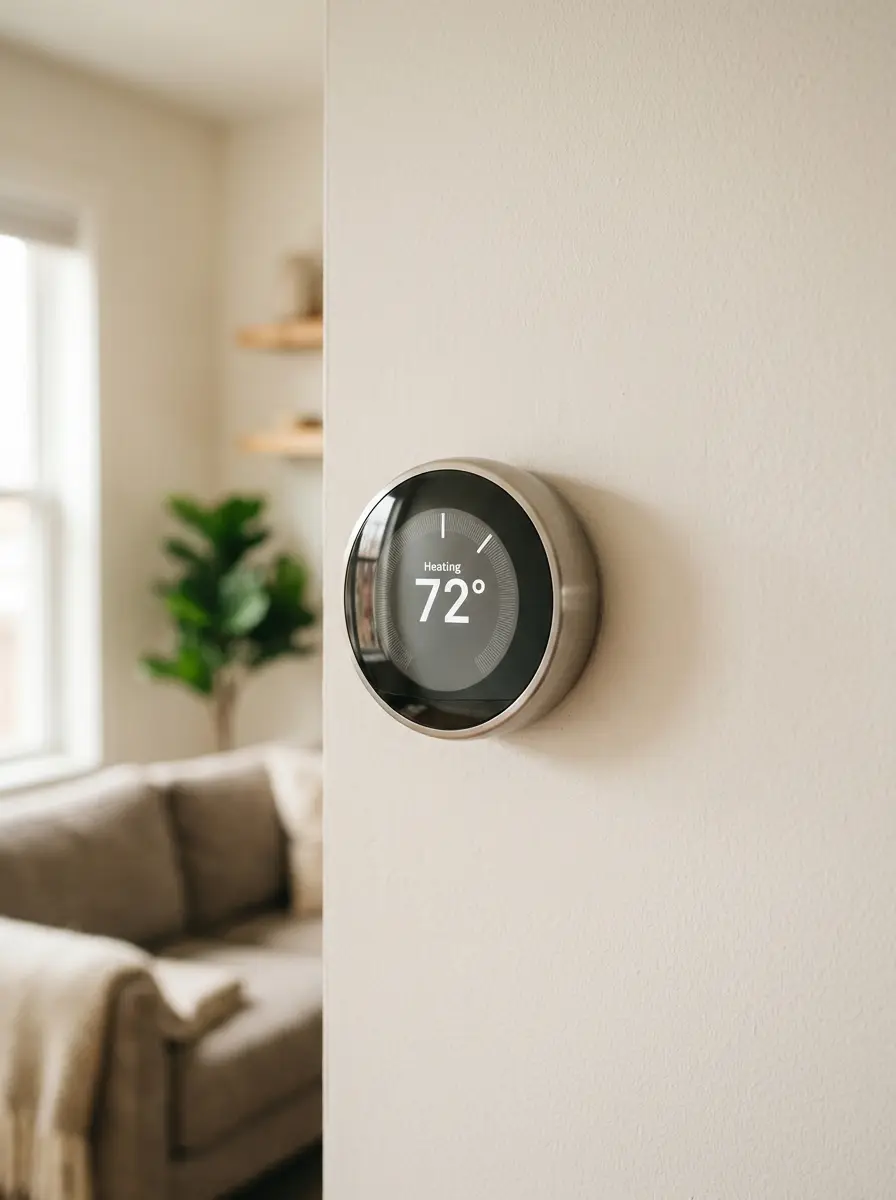
Discover how smart thermostats work, how they differ from standard programmable units, wiring requirements like C-wires, and how to choose the right one.
By the Niche Picks editorsUpdated November 4, 20269 min readDrawn from our 35 research-based smart home devices reviews
AI-generated editorial illustration; not a product or test photograph.
Short answer
A smart thermostat is an internet-connected climate control device that automates residential heating and cooling. Unlike conventional manual or basic programmable units, it connects via Wi-Fi to mobile apps, home automation platforms, and occupancy sensors to dynamically adjust temperatures, track historical energy consumption, and manage HVAC equipment remotely to lower utility costs while maintaining household comfort.
4
Product listings discussed; not hands-on tests
4/4
Discussed listings with a recorded price
$56.99–$238.99
Recorded listing price range; not a complete setup cost
Key takeaways
Smart thermostats connect your HVAC system to Wi-Fi for mobile control, automated scheduling, and occupancy-based setbacks.
Unlike standard programmable thermostats, smart models can adapt dynamically using external sensors, weather feeds, and geofencing.
Most smart models require a 24-volt common wire (C-wire) or an adapter kit to deliver continuous power to digital displays and radios.
Platform compatibility varies: some units integrate natively with Apple HomeKit, Alexa, or Google Assistant, while others rely on Matter bridging.
Many connected thermostats carry Energy Star certifications that qualify homeowners for municipal and utility provider cash rebates.
Products discussed in this article
Editorial scores and recorded prices are reference points, not measurements of suitability for every use. Read each review's specifications and limitations.
ecobee Smart Thermostat Premium - WiFi, Siri & Alexa8.2
Google Nest Thermostat - Smart Thermostat for Home7.4
Sensi Smart Thermostat, Wi-Fi, DIY, Alexa, Energy Star7.6
Amazon Smart Thermostat, Save money and energy, Works6.8
Recorded price (USD)
ecobee Smart Thermostat Premium - WiFi, Siri & Alexa$238.99
Google Nest Thermostat - Smart Thermostat for Home$104.00
Sensi Smart Thermostat, Wi-Fi, DIY, Alexa, Energy Star$89.99
Amazon Smart Thermostat, Save money and energy, Works$56.99
Smart Thermostat Comparison: Specifications and Platform Support
Product
Listed Price
Power Source
Ecosystem Compatibility
User Rating
ecobee Smart Thermostat Premium
$209.99
24V Corded Electric (PEK included)
Apple HomeKit, Alexa, Google Assistant
4.3 / 5 (4,177 reviews)
Google Nest Thermostat
$117.45
24V / 2 AAA Backup Batteries
Google Assistant, Alexa, Matter-ready
4.1 / 5 (29,631 reviews)
Sensi Smart Thermostat ST55
$79.99
Battery or 24V C-wire
Amazon Alexa
4.4 / 5 (23,051 reviews)
Amazon Smart Thermostat
$56.99
24V C-wire Required
Amazon Alexa, Ring
4.0 / 5 (25,518 reviews)
How Does a Smart Thermostat Actually Work?
At its mechanical foundation, a smart thermostat performs the same fundamental task as any traditional thermostat: it acts as a low-voltage switch that opens and closes electrical circuits to operate your heating and cooling equipment. Where conventional mechanical thermostats rely on physical bimetallic strips or basic digital relays responding strictly to ambient temperature in a single hallway, a smart thermostat integrates solid-state electronic relays, microprocessors, wireless communication radios, and onboard firmware.
Once connected to a residential 2.4 GHz Wi-Fi network, the device communicates with cloud servers and mobile applications, converting remote instructions or scheduled routines into electrical switching commands for your furnace, heat pump, or central air conditioner. Inside the unit, modern thermal sensors sample ambient room air continuously. Advanced models, such as the ecobee Smart Thermostat Premium listed at $209.99, go beyond basic temperature sampling by incorporating digital radar presence sensors and indoor air quality monitoring for volatile organic compounds directly into the wall unit.
In addition to onboard electronics, smart thermostats communicate with external telemetry sources. They pull local weather forecasts over the internet to anticipate extreme heating or cooling demands before indoor temperatures drift. Furthermore, many models communicate with wireless satellite accessories. For instance, ecobee pairs with standalone SmartSensors to monitor remote bedrooms or home offices, allowing the central thermostat to balance temperatures across uneven living zones. Because these devices process automated commands through scheduled rules or mobile apps, they eliminate the need to manually walk to a hallway wall to adjust comfort setpoints. You can review detailed equipment configurations in our smart home devices buyer's guide to see how connected climate gear fits into broader home automation networks.
While both programmable and smart thermostats allow you to establish automated heating and cooling schedules, their internal architectures and operational behaviors differ substantially. A traditional programmable thermostat requires manual configuration directly on a rigid physical keypad. Users program fixed target temperatures for specific blocks of time, such as weekday mornings or weekend evenings. If your daily schedule fluctuates, or if you leave home unexpectedly, a standard programmable unit blindly executes its static routine, heating or cooling an entirely empty house until someone physically presses an override button.
In contrast, smart thermostats feature adaptive automation. A connected unit utilizes algorithms, mobile geofencing, and auxiliary occupancy sensors to determine whether the home is actually occupied. When an occupant departs, devices like the Google Nest Thermostat (listed at $117.45) or the Amazon Smart Thermostat (priced at $56.99) trigger automated setback profiles, dropping energy usage without requiring manual intervention. These adjustments happen seamlessly through mobile platforms, whether you control them through Apple Home, Google Assistant, or Amazon Alexa.
Another fundamental difference is connectivity and diagnostic reporting. Traditional programmable thermostats cannot alert you if an HVAC compressor fails, nor can they track historical runtimes. Smart thermostats generate historical usage reports, notifying homeowners of maintenance intervals like clogged air filters or abnormal system cycling. Units like the Sensi Smart Thermostat ST55, retailing at $79.99, log cumulative running hours and push diagnostic alerts directly to your smartphone. For budget-conscious homeowners planning upgrades, exploring our budget planner helps clarify how quickly these automated runtime reductions offset upfront hardware expenses.
Before removing an existing thermostat, switch off power to your furnace and air handler at the main breaker panel. Low-voltage 24V HVAC wires can short-circuit if they touch, blowing the internal transformer fuse.
Why Do Smart Thermostats Need a C-Wire?
The single most common obstacle encountered during smart thermostat installation is the 24-volt common wire, universally designated as the C-wire. Older mechanical and non-programmable thermostats functioned as passive mechanical switches powered by simple mercury bulbs or AA batteries, requiring only two to four wires: heating control (W), cooling control (Y), fan control (G), and 24-volt alternating current power (R).
Smart thermostats, however, are sophisticated embedded computers. They drive continuous Wi-Fi radios, color touchscreens or LED segment readouts, and onboard microchips. This digital hardware requires a steady, continuous return path for electrical current to complete the 24-volt circuit. The C-wire provides that dedicated electrical return path directly from the low-voltage transformer inside your HVAC furnace or air handler.
When a home lacks a dedicated C-wire, equipment compatibility varies sharply:
The Amazon Smart Thermostat explicitly mandates a dedicated C-wire connection; it does not support power harvesting or simple battery bypasses, meaning homes without one require a separate power adapter.
The Sensi ST55 measures 5.875 by 3.75 inches and includes internal battery operation for conventional heating and cooling setups, allowing it to function without a C-wire on standard systems.
The ecobee Smart Thermostat Premium bundles a dedicated Power Extender Kit (PEK) directly in the box, providing a reliable four-to-five-wire conversion solution installed at the furnace control board.
The Google Nest Thermostat uses two AAA alkaline cells for backup power and is marketed to harvest power over existing wiring in basic setups, though Google notes that heat pumps and complex systems still require a dedicated common wire or Nest Power Connector.
Failing to verify wiring is one of the most frequent installation pitfalls detailed in our guide on mistakes to avoid when modernizing home appliances.
The primary financial argument for adopting a smart thermostat is utility bill reduction achieved through disciplined runtime management. By lowering heating output or reducing air conditioning cycles while residents are asleep or away from the home, these devices reduce the cumulative hours that high-draw mechanical compressors and gas burners operate. The Environmental Protection Agency projects that certified smart thermostats save homeowners an average of $90 annually on utility expenses.
Independent efficiency ratings provide concrete benchmarks. Devices such as the Sensi ST55, Google Nest Thermostat, and Amazon Smart Thermostat carry official Energy Star certifications. In its technical materials, Emerson notes that scheduled programming on the Sensi ST55 can deliver average HVAC runtime reductions of up to 23 percent. Similarly, ecobee claims potential energy savings reaching 26 percent when pairing its Smart Thermostat Premium with disciplined setback schedules and remote SmartSensor room monitoring.
Beyond direct thermodynamic savings, smart thermostats unlock regional financial incentives. Because these devices help smooth electrical grid loads during peak demand events, numerous electric and natural gas utilities across the United States offer instant purchase rebates or bill credits. For example, the Amazon Smart Thermostat's low entry price of $56.99 is frequently offset partially or entirely through municipal energy efficiency programs. Advanced platforms also integrate grid-balancing software; the Google Nest Thermostat incorporates Nest Renew, a feature designed to shift domestic heating and cooling cycles toward times when cleaner or more affordable energy is available on the regional grid. To see how these cost efficiencies compare against other connected hardware, visit our Smart home devices FAQ for utility rebate guidance.
Many regional gas and electric utility providers offer instant point-of-sale discounts or bill credits between $25 and $100 for purchasing an Energy Star-certified smart thermostat.
Ecosystem Compatibility and Local Control Realities
When integrating climate controls into a larger smart home framework, ecosystem compatibility and protocol support determine long-term reliability. A major consideration in smart home design is avoiding vendor lock-in. Devices that rely strictly on proprietary cloud servers can suffer operational degradation if the manufacturer updates its software platform, changes subscription policies, or experiences service outages.
Different smart thermostats address ecosystem integration and local command in distinct ways:
Amazon Smart Thermostat: Built in partnership with Resideo and Honeywell Home technology, this unit retails for $56.99 and operates natively within the Alexa and Ring software environments. However, routine management and remote triggers route through Amazon's cloud architecture, limiting its utility across third-party ecosystems.
Google Nest Thermostat: Operating at $117.45 with a 1.07-inch mirrored display, it connects with Google Assistant and Amazon Alexa. It supports Matter-certified assistant bridging, giving it forward compatibility across modern automation setups, though cloud access remains central for advanced scheduling.
ecobee Smart Thermostat Premium: Priced at $209.99, it incorporates direct support for Apple HomeKit, Amazon Alexa, and Google Assistant. Notably, HomeKit integration allows a degree of local local-network command execution via compatible Apple hubs, preserving basic responsive switching if external broadband connectivity drops.
Sensi ST55: Focuses on standard 2.4 GHz Wi-Fi connectivity and Alexa voice compatibility, combining traditional push-button aesthetics with app-based control.
For households managing multi-device environments with smart locks, switches, and sensors, you can compare two products or explore our standalone roundup of the best smart home hub models to ensure your central bridge handles climate equipment alongside lighting and perimeter security.
How to Choose the Right Smart Thermostat for Your Home
Selecting the best smart thermostat requires evaluating your existing mechanical HVAC system, household wiring, and primary software platform. The first step is inspecting your wall baseplate. If your home has an older two-wire or four-wire bundle lacking a 24V common wire, you must choose a model that includes an adapter or supports battery operation. The Sensi ST55, at $79.99, is an ideal retrofit for older homes because its 5.875 by 3.75-inch enclosure covers legacy wall footprints without repainting, and it supports battery-powered operation on standard systems.
If you prefer high-end materials, expansive platform support, and multi-room monitoring, the ecobee Smart Thermostat Premium ($209.99) justifies its premium cost. It features a glass-and-metal housing, onboard radar presence sensing, an air quality monitor, and an included Power Extender Kit for C-wire-deficient setups. It also bundles a remote SmartSensor, making it particularly effective for multi-story residences where central hallway temperatures do not reflect conditions in upstairs bedrooms.
For households prioritizing affordability and basic automation within mainstream voice ecosystems, entry-tier models offer exceptional value. The Google Nest Thermostat ($117.45) offers sleek minimalist styling in Snow with a mirrored 1.07-inch display, smooth Google Assistant integration, and Energy Star scheduling. Meanwhile, the Amazon Smart Thermostat ($56.99) delivers Energy Star-certified Honeywell Home circuitry for dedicated Alexa users with verified C-wire wiring. To see our detailed performance rankings across top models, read our dedicated review of the best smart thermostat options or browse the broader Smart home devices directory.
Take a clear photograph of your current wall plate and labeled terminal letters (R, W, Y, G, C) before disconnecting any wires to ensure correct terminal mapping on your new device.
Step by step
1Shut down electrical power to your heating and cooling equipment at the primary electrical breaker panel.
2Detach your old thermostat faceplate and use labeled masking stickers to identify each wire by its current terminal letter.
3Photograph the existing wiring layout as a visual reference before loosening the terminal screws.
4Unscrew the old wall plate, taking care to secure the wire bundle so it does not slip back into the wall cavity.
5Position the new smart thermostat backplate, level it using an integrated or handheld bubble level, and screw it into the drywall.
6Insert each labeled wire firmly into its corresponding terminal block on the new baseplate (R, C, W, Y, G).
7Snap the smart thermostat display housing onto the mounted baseplate until it clicks into place.
8Restore electrical power at the circuit breaker, launch the manufacturer companion app, and complete the Wi-Fi pairing setup.
Quick checklist
Turn off electrical power to your HVAC furnace and air handler at the circuit breaker.
Remove the existing thermostat cover and photograph all connected terminal wires.
Verify the presence of a 24-volt C-wire, or confirm your chosen smart model includes an adapter kit.
Confirm compatibility with your HVAC type (conventional forced air, heat pump, boiler, or electric baseboard).
Check whether your home Wi-Fi network provides strong 2.4 GHz signal strength at the thermostat wall location.
Review local utility websites to identify available energy efficiency rebates for Energy Star models.
Verify whether the thermostat supports your preferred voice platform (Apple HomeKit, Alexa, or Google Assistant).
Frequently asked questions
Can I install a smart thermostat myself?
Yes, most homeowners can install a smart thermostat in 30 to 45 minutes using standard screwdrivers. Models like the Sensi ST55 include built-in bubble levels on the baseplate to simplify alignment. However, if your system lacks a C-wire and requires complex control board rewiring at the furnace, hiring a licensed HVAC technician is recommended.
Will a smart thermostat work if the internet goes down?
Yes. When an internet outage occurs, smart thermostats continue regulating indoor temperature based on the last stored setpoints and schedules programmed into their onboard memory. However, remote smartphone control, weather updates, and voice assistant routines remain inactive until Wi-Fi connectivity is restored.
What is the difference between a C-wire and an adapter kit?
A C-wire (common wire) is a physical copper wire running continuously from your HVAC transformer to the thermostat wall plate to supply 24-volt power. An adapter kit, such as ecobee's Power Extender Kit, splits power over existing four-wire bundles without requiring you to fish new wiring through walls.
Are smart thermostats compatible with high-voltage electric baseboards?
Most mainstream smart thermostats (including models from Google, ecobee, and Amazon) are designed strictly for low-voltage 24-volt systems. High-voltage 120V or 240V electric baseboard heaters require specialized line-voltage smart thermostats to handle the heavy electrical load safely.
Can a smart thermostat monitor more than one room?
A standalone wall thermostat only senses temperature at its specific physical mounting point. However, models like the ecobee Smart Thermostat Premium connect wirelessly to satellite SmartSensors, averaging temperatures across multiple occupied rooms or prioritizing specific areas like bedrooms during sleep schedules.
Amazon links are affiliate links; we may earn a commission at no cost to you.
Shortlists in this category
Ranked lists from our smart home devices reviews, limited to listings whose titles confirm the product type, with budget cuts where enough recorded prices sit on both sides of the line.
This page summarizes our research reviews of Amazon listings, listed specifications and captured buyer ratings. It is not a hands-on test. Scores are editorial assessments, not measured performance; prices are recorded snapshots and may change. A category can include both main products and accessories, so its overall price range is not the cost of a complete setup.
Most recent product record update: October 3, 2026. Individual records may be older; this is not a verification date for every claim. Prices on this page were read from the listings Nov 8, 2026 – Nov 12, 2026.
Choose the product type first. These groups require a match in the listing title; an import search term alone is not enough. Scores rank our recorded research assessments within each group, not independently measured performance.
Values are shown as recorded, without unit conversions or inferred compatibility. Not recorded means unknown, not absent. Prices are snapshots, not current offers. Editorial scores are research judgments, not lab results. Amazon links are affiliate links.
Before treating a comparison as complete
Which details are still unknown?
A specification appearing in a listing is not independent verification. These counts show which shortlisted records contain the same field; a blank record does not mean the product lacks the feature.
Connectivity Technology
Recorded for 2 of 2 shortlisted models
Present in every shortlisted record. Check units, exact variants and the current manufacturer documentation before relying on it.
Power Source
Recorded for 2 of 2 shortlisted models
Present in every shortlisted record. Check units, exact variants and the current manufacturer documentation before relying on it.
Voltage
Recorded for 2 of 2 shortlisted models
Present in every shortlisted record. Check units, exact variants and the current manufacturer documentation before relying on it.
Check Matter compatibility and whether Thread requires a border router; ecosystem support and local-control features vary by device.
Prefer local control; cloud-only devices die with their service.
Read the subscription terms before buying any camera.
If a specification, certification or compatibility detail is absent, mark it as unknown and ask the seller or manufacturer. Do not substitute a star rating, an editorial score or a different model's specification.