 Sony Alpha a6400 Mirrorless Camera: Compact APS-C Interchangeable Lens Digital Camera
Recorded price: $814.91 · Editorial score: 8/10
- Compatible Mountings
- Sony E (NEX), Sony Mirrorless
- Photo Sensor Resolution
- 20.1 mp
The DJI Osmo Pocket 3 is the best compact vlogging camera, while the Sony a6400 is the stronger choice for creators building an interchangeable-lens system.
By the Niche Picks editorsUpdated October 7, 20268 min readDrawn from our 30 research-based photography & videography reviews
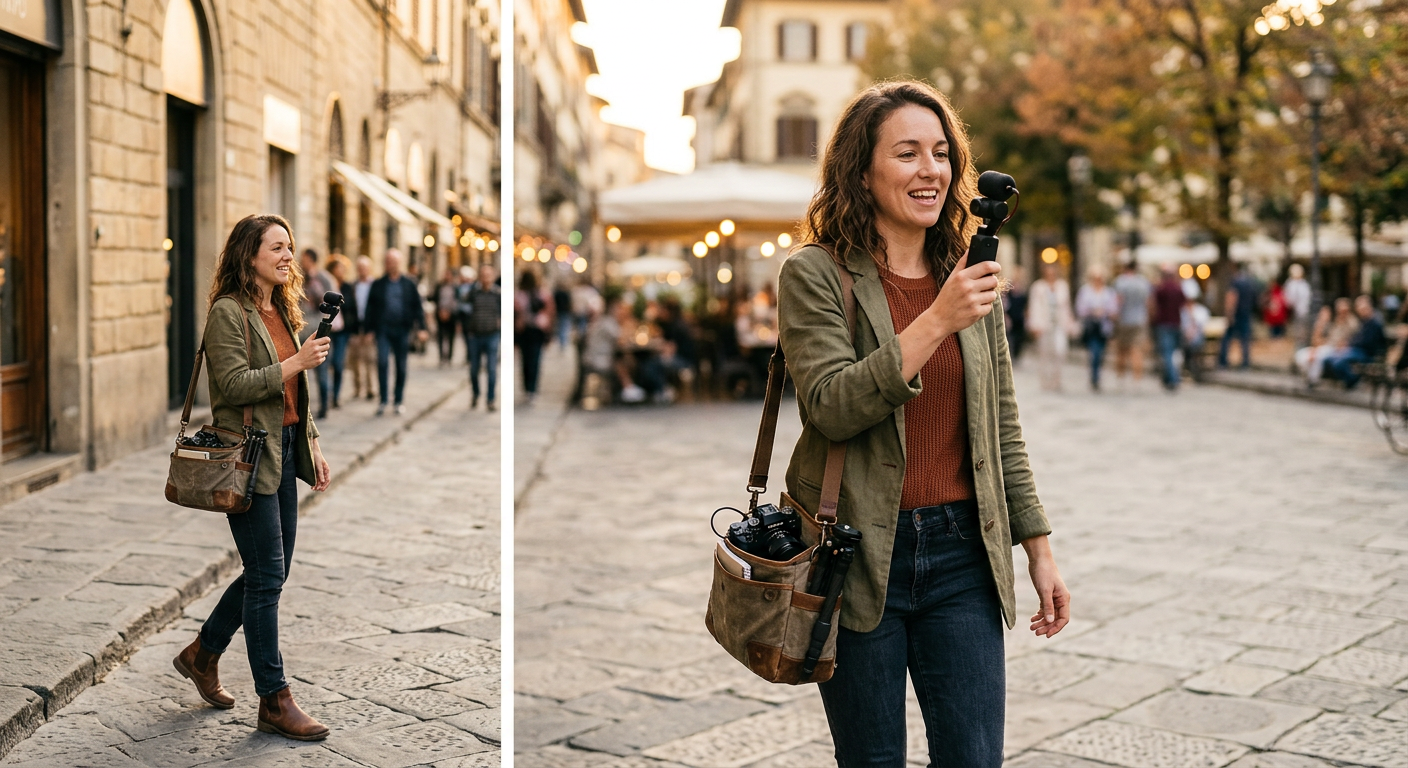
The DJI Osmo Pocket 3 is our best vlogging camera pick for most solo creators because its 1-inch sensor, built-in three-axis mechanical gimbal, rotating screen, and 4K/120fps capability come in a 179g pocketable body. Choose the Sony a6400 instead if interchangeable lenses matter more: it has a 180-degree screen, strong subject tracking, and access to Sony E-mount lenses.
Editorial scores and recorded prices are reference points, not measurements of suitability for every use. Read each review's specifications and limitations.
 DJI Osmo Pocket 3 Vlogging Camera with 1'' CMOS & 4K/120fps Video4.5$439.00Our score 7.9/10Best for Compact run-and-gun handheld filmingSony Alpha a6400 Mirrorless Camera: Compact APS-C Interchangeable Lens Digital Camera with Real-Time Eye Auto Focus, 4K Video, Flip Screen & 16-50mm Lens - E Mount Compatible - ILCE-6400L/B, Black4.6$814.91Our score 8/10
| Product | Listed price | Sensor | Video | Stabilization and screen |
|---|---|---|---|---|
| DJI Osmo Pocket 3 | $439.00 | 1-inch CMOS | 4K up to 120fps; 10-bit D-Log M | Three-axis mechanical gimbal; 2-inch rotatable touchscreen |
| Sony Alpha a6400 | $814.91 | APS-C CMOS | Internal oversampled 4K | No in-body image stabilization; 180-degree upward-tilting LCD |
The DJI Osmo Pocket 3 is the best vlogging camera in this comparison for a creator who wants to start recording quickly with minimal equipment. At a listed $439, it combines a 1-inch CMOS sensor, 4K capture up to 120fps, a 2-inch rotatable touchscreen, autofocus with ActiveTrack 6.0, and a three-axis mechanical gimbal in a 179g camera measuring 1.3 by 1.7 by 5.5 inches.
That integrated gimbal is the central advantage for walking, handheld updates, travel clips, and direct-to-camera videos. It stabilizes mechanically rather than relying solely on electronic stabilization, and the rotating screen supports fast shifts between horizontal and vertical shooting. Its attachable handle also has a 1/4-inch thread for tripod mounting.
There are meaningful trade-offs. The lens is fixed and wide, so you cannot swap lenses or optically tighten a shot. The chassis has no certified water-resistance rating. High-frame-rate 4K can create heat, so do not judge a camera only by its headline mode; check exact sustained-recording behavior in the conditions where you shoot. Serious voice work also requires budgeting for audio accessories separately.
For a broader look at formats and system choices, start with our Photography & videography buyer's guide and our explainer on what a mirrorless camera is.
Read the reviews: DJI Osmo Pocket 3 Vlogging Camera with 1'' CMOS
Choose the Sony Alpha a6400 when vlogging is part of a larger interchangeable-lens plan. The listed $814.91 kit includes a 16-50mm lens, and the camera uses Sony E mount. That gives a creator a route to change focal lengths later rather than being committed to one built-in wide lens. As a practical rule, lenses generally outlive camera bodies, so system buyers should give that flexibility real weight.
The a6400 is well suited to self-filming because its LCD tilts upward 180 degrees for front-facing monitoring. Its Real-Time Tracking autofocus uses 425 phase-detection and 425 contrast-detection points across 84% of the frame, while internal 4K is derived from an oversampled readout. These are useful foundations for talking-head videos, tutorials, and videos where a subject moves through the frame.
Its limitations matter for vlogging. The body does not have in-body image stabilization, so handheld stability depends on the lens or an external support solution. The kit 16-50mm lens provides optical stabilization and compact wide-to-normal coverage, but it is not the only lens a growing creator may want. Also, a microphone mounted to the multi-interface hot shoe can partially obstruct the raised screen.
If you are deciding whether an interchangeable-lens body is worth the added cost and complexity, see our best budget mirrorless cameras and best camera for beginners.
Read the reviews: Sony Alpha a6400 Mirrorless Camera: Compact APS-C
The choice is primarily about workflow, not a simple quality ranking. A fixed-lens gimbal camera such as the Pocket 3 concentrates stabilization, screen, lens, and sensor into one small device. It weighs 179g, has a rotatable screen, and avoids the time and bulk of selecting lenses for every outing. That makes it the more direct choice for a solo traveler or creator whose priority is spontaneous handheld video.
The a6400 is the more expandable choice. Sony E mount means you can select lenses around your style and keep those lenses through a future body upgrade, provided compatibility remains appropriate. Its included 16-50mm lens offers a compact starting point, but a lens change can alter framing and low-light options in ways a fixed-lens camera cannot.
Use this short decision rule:
Before committing, use our camera comparison tool and review common photography and video mistakes to avoid.
Read the reviews: DJI Osmo Pocket 3 Vlogging Camera with 1'' CMOS, Sony Alpha a6400 Mirrorless Camera: Compact APS-C
Read speed is not the number that protects a video recording. For vlogging, the key specification is the card's minimum sustained write speed: the amount of data it can continuously accept while the camera records. A V30 rating guarantees at least 30MB/s, or 240Mbps, sustained writing. This is why V30 or V90 ratings matter far more than a large “up to” read-speed claim.
For the Pocket 3, high-bitrate 4K capture calls for a quality V30 or V90 microSD card. For the a6400, our review likewise identifies U3 or V30 as the minimum class for continuous 4K. Neither statement removes the need to consult the exact camera manual: a mode using a bitrate above a card's sustained capability can stop recording, drop frames, or be unavailable.
A relevant budget option is the 128GB Amazon Basics microSDXC card, which is rated U3 and V30 and lists a 30MB/s minimum continuous write speed. It is a practical fit only for devices that accept microSD or can appropriately use its included full-size adapter. The 64GB SanDisk Extreme PRO SD card is also V30-rated, though its smaller capacity can be restrictive for longer shoots.
Avoid treating U1 or V10 cards as 4K upgrades simply because their packaging advertises fast reads. Our Photography & videography FAQ explains more buying terminology, while our budget planner can help reserve money for media, batteries, and audio.
Read the reviews: DJI Osmo Pocket 3 Vlogging Camera with 1'' CMOS, Sony Alpha a6400 Mirrorless Camera: Compact APS-C, Amazon Basics microSDXC Memory Card with Full Size
A usable vlogging setup needs more than a camera body. Prioritize the items that solve an actual recording problem: stable support for stationary shots, reliable storage, enough power for the intended session, audible voice capture, and controlled light. The Pocket 3's standard package does not include the extended battery handle or separate serious-audio accessories, so its lower listed price should not be mistaken for a complete production budget.
For stable static framing, the K&F Concept 64-inch tripod is a sensible low-cost support option for a mirrorless kit or phone setup. It has a listed 17.6-pound load capacity, a 36mm ball head, smartphone holder, quick-release plate, and travel bag. As with lightweight tripods generally, use its rated capacity conservatively and expect more vibration when thin lower leg sections are fully extended or when wind is present.
Indoor light can improve a talking-head clip more predictably than chasing a minor camera specification. The NiceVeedi two-panel kit includes two 15W LED panels with three color-temperature presets—2800K, 4800K, and 6500K—and is intended for close indoor setups rather than large spaces. Its lightweight stands should be stabilized as needed.
Spend deliberately: a good lens is often the more durable investment in an interchangeable-lens system, but storage, support, sound, and lighting determine whether you can reliably record the project you planned.
Read the reviews: K&F Concept 64 inch/163cm Lightweight Aluminum Travel, 2-Pack LED Video Light Kit, NiceVeedi Studio Light
The best vlogging camera is the one that can record your planned format reliably, not merely the one with the most impressive mode on its spec sheet. Set up a short repeatable pre-record check, particularly before an interview, travel segment, or one-time event. It reduces preventable issues such as a full card, unsupported recording mode, unstable framing, and unusable dialogue.
First, select the intended orientation. The Pocket 3's rotatable display quickly switches between horizontal and vertical framing; the a6400's upward-tilting screen is designed for front-facing monitoring. Then verify focus behavior, composition, available card space, battery level, and that any microphone does not interfere with the a6400 screen.
Next, match settings to the job. 4K/120fps is available on the Pocket 3, but high frame rates and maximum bitrates increase demands on card performance and heat management. Record a short sample at the exact resolution, frame rate, and recording profile you expect to use, then confirm that recording continues normally. For the a6400, keep its lack of in-body stabilization in mind if you are planning handheld movement.
Finally, make a backup plan. Carry appropriate recording media, protect the fixed-lens Pocket 3 from rain because no water-resistance rating is stated, and use stable support for locked-off takes. More practical photography and video buying tips can help refine a first kit without buying unnecessary extras.
Read the reviews: DJI Osmo Pocket 3 Vlogging Camera with 1'' CMOS, Sony Alpha a6400 Mirrorless Camera: Compact APS-C
Amazon links are affiliate links; we may earn a commission at no cost to you.
This page summarizes our research reviews of Amazon listings, listed specifications and captured buyer ratings. It is not a hands-on test. Scores are editorial assessments, not measured performance; prices are recorded snapshots and may change. A category can include both main products and accessories, so its overall price range is not the cost of a complete setup.
Most recent product record update: October 3, 2026. Individual records may be older; this is not a verification date for every claim.
Amazon links are affiliate links. We may earn a commission on qualifying purchases, at no extra cost to you.
A more useful shortlist
Choose the product type first. These groups require a match in the listing title; an import search term alone is not enough. Scores rank our recorded research assessments within each group, not independently measured performance.
Sony Alpha a6400 Mirrorless Camera: Compact APS-C Interchangeable Lens Digital CameraRecorded price: $814.91 · Editorial score: 8/10
Sony Alpha a6400 Mirrorless Camera: Compact APS-C Interchangeable Lens Digital CameraRecorded price: $814.91 · Editorial score: 8/10
If a specification, certification or compatibility detail is absent, mark it as unknown and ask the seller or manufacturer. Do not substitute a star rating, an editorial score or a different model's specification.