 Sony Alpha a6400 Mirrorless Camera: Compact APS-C Interchangeable Lens Digital Camera
Recorded price: $814.91 · Editorial score: 8/10
- Compatible Mountings
- Sony E (NEX), Sony Mirrorless
- Photo Sensor Resolution
- 20.1 mp
For most beginners, the Sony a6400 is the strongest all-around pick here; choose the Canon T7 for a traditional DSLR or DJI Pocket 3 for pocket video.
By the Niche Picks editorsUpdated October 7, 20269 min readDrawn from our 30 research-based photography & videography reviews
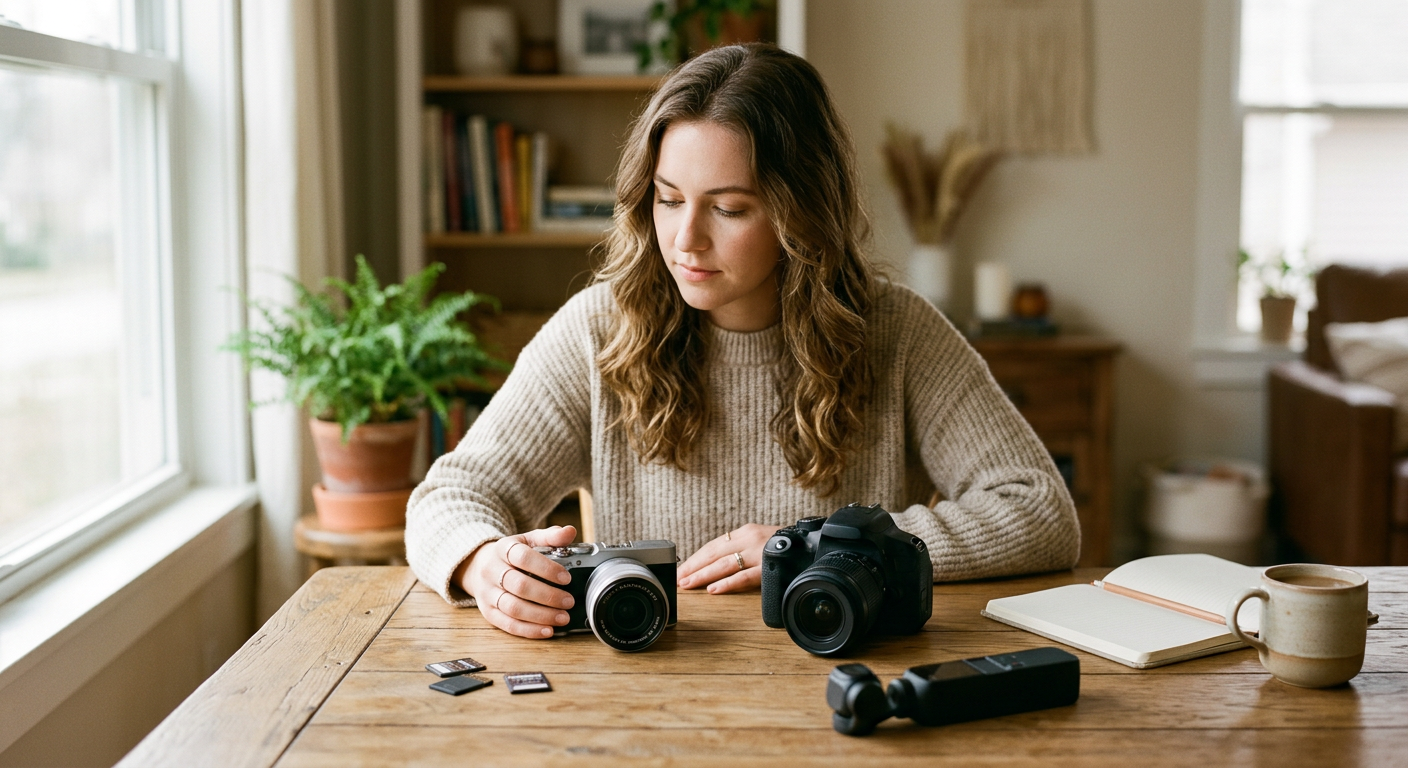
The best camera for beginners in our reviews is the Sony Alpha a6400 at $814.91 because it combines an APS-C sensor, extensive Sony E-mount lens options, dependable subject tracking, 11 fps shooting, and oversampled 4K video. The Canon Rebel T7 is the simpler $499 DSLR route, while the $439 DJI Osmo Pocket 3 is the better specialized choice for stabilized handheld video, not interchangeable-lens photography.
Editorial scores and recorded prices are reference points, not measurements of suitability for every use. Read each review's specifications and limitations.
Sony Alpha a6400 Mirrorless Camera: Compact APS-C Interchangeable Lens Digital Camera with Real-Time Eye Auto Focus, 4K Video, Flip Screen & 16-50mm Lens - E Mount Compatible - ILCE-6400L/B, Black4.6$814.91Our score 8/10 Canon EOS Rebel T7 DSLR Camera EF-S 18-55mm f/3.5-5.6 is II Lens Kit4.7$499.00Our score 6.5/10Best for Students learning traditional DSLR manual photography
 DJI Osmo Pocket 3 Vlogging Camera with 1'' CMOS & 4K/120fps Video4.5$439.00Our score 7.9/10Best for Compact run-and-gun handheld filming
| Product | Listed price | Sensor / format | Lens approach | Best fit |
|---|---|---|---|---|
| Sony Alpha a6400 | $814.91 | APS-C CMOS | Interchangeable Sony E-mount; 16-50mm kit lens | All-around beginner photo and 4K video |
| Canon EOS Rebel T7 kit | $499.00 | 24.1MP APS-C CMOS | Interchangeable Canon EF mount; EF-S 18-55mm IS II included | Stills-first DSLR learning |
| DJI Osmo Pocket 3 | $439.00 | 1-inch CMOS | Fixed wide lens | Compact stabilized handheld video |
The Sony Alpha a6400 is our best camera for beginners overall from these reviews. Listed at $814.91 with a 16-50mm lens, it gives a new photographer an APS-C interchangeable-lens platform rather than locking them into one fixed lens. Its Sony E mount is the bigger long-term advantage: the body may eventually change, but compatible lenses can remain part of the system.
The a6400 also has the performance headroom that helps a beginner grow. Its Real-Time Tracking system uses 425 phase-detection and 425 contrast-detection points across 84% of the frame, and it can shoot at up to 11 frames per second with tracking and auto exposure. For video, it records internal 4K from an oversampled readout. The upward-tilting 180-degree screen is useful for low angles and self-facing framing.
There are trade-offs. The body does not have in-body image stabilization, so stabilization depends on the lens. The compact 16-50mm kit zoom has useful wide-to-normal coverage and optical stabilization, but it has soft corners wide open and relies on software correction for noticeable barrel distortion. Its menus also take deliberate setup.
Read our guide to what a mirrorless camera is before deciding whether this compact mirrorless format fits your priorities. If the a6400 stretches your spending limit, our best budget mirrorless cameras guide is the logical next stop.
For a beginner who wants photos, family events, travel, and credible 4K in one system, its blend of autofocus, lens ecosystem, and room to learn makes the a6400 the most complete choice here.
Read the reviews: Sony Alpha a6400 Mirrorless Camera: Compact APS-C
Choose the Canon EOS Rebel T7 kit if you specifically want a conventional DSLR learning experience and a lower initial price. At $499, it includes an EF-S 18-55mm f/3.5-5.6 IS II lens. The camera has a 24.1-megapixel APS-C CMOS sensor, RAW capture, a physical mode dial, an optical pentamirror viewfinder, and manual exposure controls. Those fundamentals make it a straightforward platform for learning aperture, shutter speed, ISO, composition, and RAW processing.
Its lens mount is a major reason to consider it. Canon EF and EF-S have a broad catalog, and a beginner can later add compatible lenses without replacing the body. For example, Canon’s EF 50mm f/1.8 STM is a $169 prime with a fast f/1.8 maximum aperture, although it is a separate purchase. That is often a smarter upgrade path than immediately replacing a functional camera body.
The T7 is not the best option for every beginner. It has only nine phase-detection autofocus points, with the center point cross-type, so it is less suited to inconsistent, fast subject tracking. Its fixed rear LCD is not touch-enabled, and its video specifications are dated: it does not offer 4K. The included lens has optical stabilization, but its f/3.5-5.6 maximum aperture is relatively dim for indoor shooting.
See our full Canon Rebel T7 review for the detail behind this recommendation, and review these photography and video mistakes to avoid before buying your first extra lens. Pick the T7 for stills-first learning and EF/EF-S lens access—not for modern hybrid video work.
Read the reviews: Canon EOS Rebel T7 DSLR Camera EF-S 18-55mm f/3.5-5.6
Yes—if your priority is portable, stabilized video rather than building an interchangeable-lens photography system. The standalone DJI Osmo Pocket 3 costs $439, weighs 179 g, and combines a 1-inch CMOS sensor with a three-axis mechanical gimbal. It records up to 4K/120fps, has a rotatable 2-inch touchscreen for horizontal or vertical use, and includes ActiveTrack 6.0 for subject tracking. These features make it a focused choice for walk-and-talk clips, travel footage, and quick run-and-gun capture.
It is important to understand what you give up. The Pocket 3 has a fixed wide lens. You cannot add a portrait prime, wide zoom, or telephoto lens later, so it does not follow the usual advice to invest in lenses that outlast bodies. Serious voice work also requires separately budgeting for audio accessories, and the listed standalone package lacks the extended battery handle included with the Creator Combo.
High-frame-rate recording is not automatically a guarantee of unlimited recording. The camera can generate notable heat when shooting 4K at high frame rates, so check sustained record behavior in the temperature and mode you plan to use. It also has no certified water-resistance rating, which matters for travel and outdoor work.
The Pocket 3 needs a suitable microSD card. A V30 or V90-rated card is recommended for high-bitrate 4K capture; the inexpensive SanDisk Ultra U1 cards in our reviews do not provide that assurance. For more help choosing media and accessories, visit our Photography & videography buyer’s guide.
Read the reviews: DJI Osmo Pocket 3 Vlogging Camera with 1'' CMOS
Start with a total-system budget, not just the camera price. Among these picks, the Canon T7 kit is $499, the DJI Osmo Pocket 3 is $439, and the Sony a6400 kit is $814.91. Each price gets you shooting, but each system creates different follow-up needs. The T7 and a6400 invite future lens purchases; the Pocket 3 may prompt purchases of audio accessories, charging equipment, and high-grade microSD media.
A sensible priority order is camera and usable starter lens first, then one purposeful upgrade, then support and storage. In an interchangeable-lens system, a lens can be more enduring than the body. A fast prime, for example, changes low-light capability and depth-of-field control in ways that a modest body refresh may not. Avoid buying a pile of inexpensive accessories before you know what you actually photograph.
Use these broad planning questions:
The a6400’s kit lens offers a compact starting range, while the T7’s included 18-55mm stabilized lens provides a conventional learning zoom. The Pocket 3 instead concentrates its budget on a fixed lens and mechanical stabilization. Use our budget planner to map these required purchases before committing, and browse all Photography & videography reviews when you are ready to compare the wider system.
Read the reviews: Sony Alpha a6400 Mirrorless Camera: Compact APS-C, Canon EOS Rebel T7 DSLR Camera EF-S 18-55mm f/3.5-5.6, DJI Osmo Pocket 3 Vlogging Camera with 1'' CMOS
For video, the important card specification is sustained write speed, not the large maximum read-speed number on the package. A V30 card guarantees at least 30 MB/s of sustained writes, equal to 240 Mbps. That is the baseline worth seeking for standard moderate-bitrate 4K workflows when the exact camera manual supports it. V60 and V90 cards provide higher guaranteed sustained write floors for more demanding codecs, but you should match the card to the exact camera mode rather than automatically paying for the highest rating.
This matters for the Sony a6400 and DJI Osmo Pocket 3. The a6400 requires at least U3 or V30-class media for continuous 4K capture. The Pocket 3 can record up to 4K/120fps, and its high-bitrate 4K modes call for V30 or V90 microSD cards. Regardless of the label, consult the camera manufacturer’s current supported-card list and the selected recording mode.
Avoid confusing read speed with write speed. The SanDisk 128GB Ultra SDXC card is labeled up to 100 MB/s read but only carries a U1 rating, which guarantees just 10 MB/s sustained write speed. That suits Full HD and basic still photography better than demanding 4K. By contrast, the SanDisk 64GB Extreme PRO SDXC is rated V30 and is intended for moderate-bitrate 4K, although 64GB can fill quickly.
Also check your camera’s physical slot. The a6400 and T7 use full-size SD cards. The Pocket 3 uses microSD. An adapter can be useful but introduces another small mechanical point of failure. For a broader explanation of recording media and capture choices, read our Photography & videography FAQ.
The best beginner camera is the one you will carry, understand, and use regularly. Before upgrading the body, build a repeatable workflow: select a shooting mode, set a practical shutter speed, learn how aperture affects exposure and background blur, watch ISO in low light, and review your images after each outing. Both the Sony a6400 and Canon T7 can record RAW files, giving you more editing latitude than JPEG alone.
Start simple. Use the kit zoom for several types of subjects—people, landscapes, close details, indoor scenes, and movement—before assuming you need more focal length. This tells you whether your next lens should be wider, longer, brighter, or simply better suited to close focusing. The T7’s optical viewfinder and physical DSLR controls can make exposure practice feel direct. The a6400’s tracking autofocus and tilting screen can reduce technical friction for moving subjects and self-framing.
For video, stabilize the camera, prioritize clean audio and usable light, and then consider resolution or slow motion. The Pocket 3’s mechanical gimbal solves a particular problem—handheld movement—but its fixed wide lens shapes every framing decision. Its 10-bit D-Log M mode is available for post-production workflows, but beginners do not need to begin there. Standard recording and consistent exposure are a better starting point.
When you are ready to weigh two options with your own priorities, use our camera comparison tool. The goal is not to buy the most feature-packed body; it is to choose a system that leaves room for the lens, card, and practice that will improve your work.
Read the reviews: Sony Alpha a6400 Mirrorless Camera: Compact APS-C, Canon EOS Rebel T7 DSLR Camera EF-S 18-55mm f/3.5-5.6, DJI Osmo Pocket 3 Vlogging Camera with 1'' CMOS
Amazon links are affiliate links; we may earn a commission at no cost to you.
This page summarizes our research reviews of Amazon listings, listed specifications and captured buyer ratings. It is not a hands-on test. Scores are editorial assessments, not measured performance; prices are recorded snapshots and may change. A category can include both main products and accessories, so its overall price range is not the cost of a complete setup.
Most recent product record update: October 3, 2026. Individual records may be older; this is not a verification date for every claim.
Amazon links are affiliate links. We may earn a commission on qualifying purchases, at no extra cost to you.
A more useful shortlist
Choose the product type first. These groups require a match in the listing title; an import search term alone is not enough. Scores rank our recorded research assessments within each group, not independently measured performance.
Sony Alpha a6400 Mirrorless Camera: Compact APS-C Interchangeable Lens Digital CameraRecorded price: $814.91 · Editorial score: 8/10
Sony Alpha a6400 Mirrorless Camera: Compact APS-C Interchangeable Lens Digital CameraRecorded price: $814.91 · Editorial score: 8/10
Canon EOS Rebel T7 DSLR Camera EF-S 18-55mm f/3.5-5.6 is II Lens KitRecorded price: $499.00 · Editorial score: 6.5/10
If a specification, certification or compatibility detail is absent, mark it as unknown and ask the seller or manufacturer. Do not substitute a star rating, an editorial score or a different model's specification.