Photography & videography

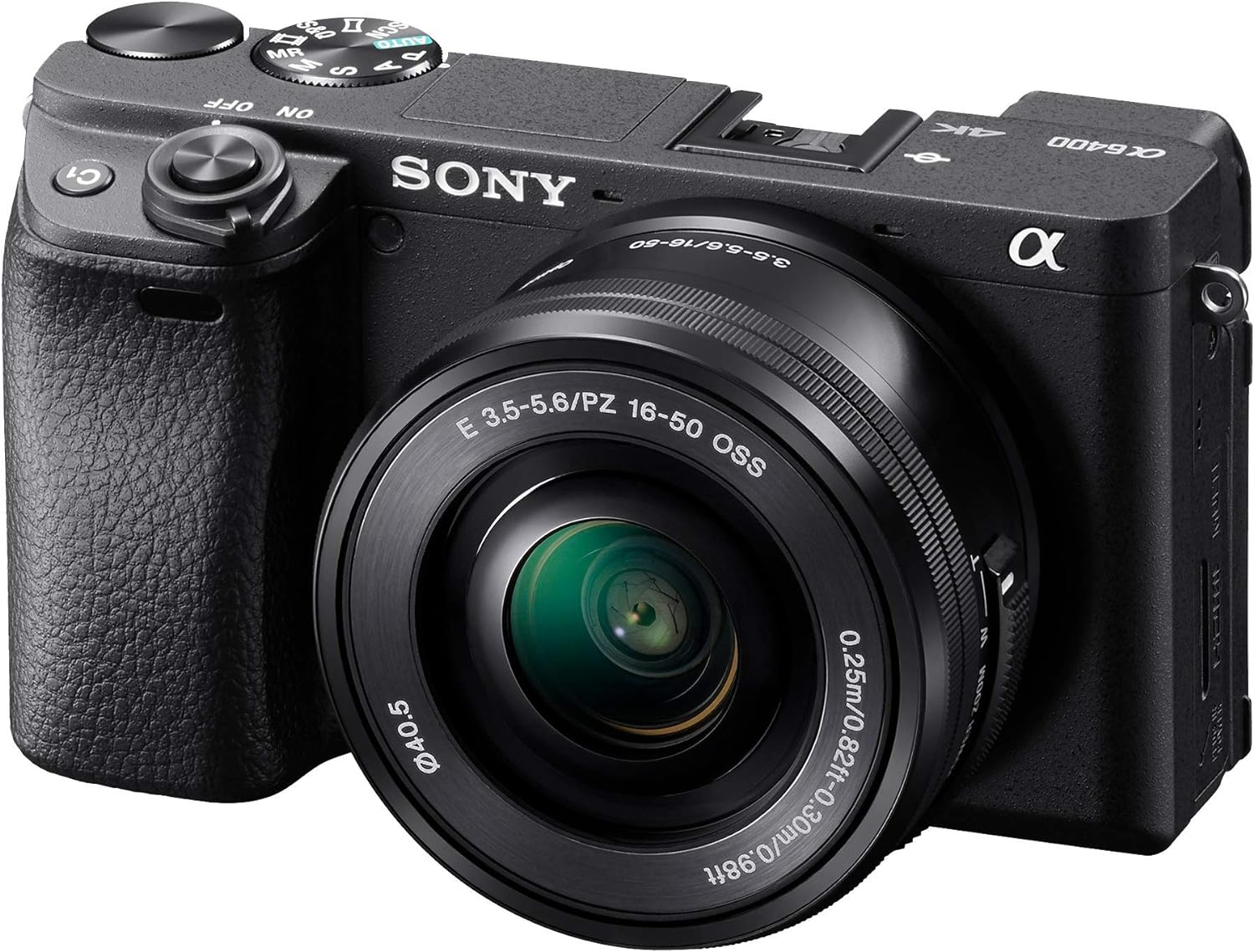
Sony Alpha a6400 Mirrorless Camera: Compact APS-C Interchangeable Lens Digital Camera with Real-Time Eye Auto Focus, 4K Video, Flip Screen & 16-50mm Lens - E Mount Compatible - ILCE-6400L/B, Black

The Sony Alpha a6400 pairs an established APS-C platform with an industry-standard autofocus tracking engine at an accessible mid-tier price point. Sold here with the retractable 16-50mm kit lens, it serves primarily as an entry point into the broad Sony E-mount ecosystem.

Research review based on the manufacturer's listing, published specifications and buyer ratings, updated 03/10/2026. Not a hands-on test — see how we review.

Sony Alpha a6400 Mirrorless Camera: Compact APS-C Interchangeable Lens Digital Camera with Real-Time Eye Auto Focus, 4K Video, Flip Screen & 16-50mm Lens - E Mount Compatible - ILCE-6400L/B, Black
Price

$814.91

Amazon rating

4.6

4.6
Ratings

1,054

Check today's price on Amazon

Price and rating were captured on 03/10/2026 and change often. We earn a commission on qualifying purchases.

Our scorecard

Weighted against our category rules
8.0out of 10
Overall
  • Autofocus tracking9.2

    Real-Time Tracking and 425 phase-detection points deliver consistent subject acquisition.

  • Optics and kit lens6.8

    The included 16-50mm power zoom is compact but optically unremarkable.

  • Video capabilities7.9

    Clean 4K output, though card write speeds dictate sustained recording reliability.

  • Ergonomics and display7.4

    The 180-degree flip screen helps framing, but the grip remains shallow.

  • System value8.5

    Solid gateway to E-mount glass at an $814.91 entry price point.

The full review

Design and physical handling

The Sony Alpha a6400 maintains the flat-topped rangefinder profile typical of the a6000 series, constructed around a compact magnesium-alloy chassis. At an operating envelope rated from 32 to 104 degrees Fahrenheit (0 to 40 degrees Celsius), the body balances portability against thermal mass. The control layout relies on a rear thumb dial, a top command wheel, and customizable buttons that require deliberate configuration to navigate menus efficiently. A standout mechanical feature is the 180-degree upward-tilting LCD screen, designed to accommodate front-facing monitoring for vlogging or low-angle framing. However, mounting a microphone directly to the multi-interface hot shoe can partially obstruct the display when fully inverted. The camera utilizes the older NP-FW50 battery pack, which keeps the body profile slim at the expense of runtime. The bundled 16-50mm f/3.5-5.6 power zoom collapses flat for transport, though users prioritizing manual focus rings or mechanical zoom feedback will find the motorized barrel less tactile during precise adjustments.

Real-world autofocus and image capture

Performance is defined by Sony's Real-Time Tracking autofocus, utilizing 425 phase-detection and 425 contrast-detection points covering 84 percent of the sensor frame. Subject acquisition remains dependable across continuous shooting bursts up to 11 frames per second with auto exposure and tracking active. Metering relies on a 1200-zone evaluative system that yields balanced exposures across high-contrast environments. For video capture, the a6400 records internal 4K derived from an oversampled readout, eliminating pixel binning for fine detail capture. Buyers must remember that card write speeds govern performance: recording continuous 4K footage requires minimum UHS Speed Class 3 (U3) or V30 cards to prevent buffer saturation and frame drops. Furthermore, sustained video runs demand careful thermal management. Extended recording in high ambient temperatures can trigger thermal shutdown warnings, so disabling auto power-off temperature limits and positioning the LCD screen away from the rear body are necessary operational precautions for prolonged takes.

Kit valuation and optical considerations

Priced at $814.91 with the 16-50mm optic, the ILCE-6400L package targets buyers stepping up from fixed-lens cameras or smartphones. In photographic gear, lenses outlive camera bodies, meaning the primary long-term value lies in access to the extensive Sony E-mount catalog rather than the bundled zoom. The included 16-50mm f/3.5-5.6 optic provides optical image stabilization and useful wide-to-normal coverage in a pocketable pancake form factor, but it yields soft corner resolution wide open and exhibits noticeable barrel distortion corrected primarily through software profiles. The camera body itself lacks in-body image stabilization (IBIS), placing the stabilization burden entirely on optical steady shot (OSS) lenses or external gimbals. Investing early in faster, optically superior prime lenses or constant-aperture zooms will realize the true resolving potential of the APS-C sensor far better than relying solely on the bundled glass over several hardware upgrade cycles.

Who should look elsewhere

Photographers and filmmakers requiring built-in mechanical sensor stabilization should bypass the a6400 in favor of bodies featuring five-axis in-body image stabilization, such as the a6600 or alternative stabilized platforms. Handheld video shooters using non-stabilized lenses will encounter micro-jitters that software stabilization cannot completely eliminate without severe cropping. Production environments requiring all-day continuous 4K recording in hot outdoor conditions should also exercise caution, as the compact body lacks active cooling fans found on cinema-oriented models. Creators heavily invested in run-and-gun audio will find the top-hinged screen awkward when shotgun microphones occupy the shoe, requiring third-party relocation brackets. Finally, users with larger hands may find the shallow right-hand grip uncomfortable during prolonged shooting sessions with heavier telephoto lenses, making larger SLR-style bodies or add-on battery grips a more ergonomic choice for sustained studio or field assignments.
Specifications

As listed by the manufacturer
Compatible MountingsSony E (NEX), Sony Mirrorless
Aspect Ratio16:9, 3:2
Sensor TypeCMOS
File FormatJPEG, Raw
Image stabilizationOptical
Maximum Aperture3.5 f_stop
Expanded ISO Minimum100
Photo Sensor Resolution20.1 mp
Photo Sensor SizeAPS-C
Maximum Shutter Speed1/4000 seconds
Minimum Shutter Speed1/4000 seconds
Exposure ControlAutomatic
Form FactorMirrorless
Effective Still Resolution25 mp
Special FeatureShockproof, Temperature Extremes, Waterproof, X-Ray Proof
ColorBlack

What the maker claims

  • 20.1MP stacked back illuminated 1" Exmor RS CMOS sensor w/ DRAM, large aperture 24-70mm1 F1.8-2.8 ZEISS Vario-Sonnar T lens
  • Enhanced subject capture: wide 425 Phase/ 425 contrast detection points over 84 percent of the sensor
  • Fast and accurate: Up to 11Fps continuous shooting at 24.2 MP raw with crisp, clear natural colors
  • Multiple movie functions: Make time lapse movies or slow/quick motion videos without post processing
  • Tiltable LCD screen: customizable for vlogging, still photography or recording a professional film
  • In the box: rechargeable battery (NP FW50) AC adaptor (ac uud12), shoulder strap, body cap, accessory shoe cap, eyepiece cup, micro USB cable. Metering Type: 1200 zone evaluative metering

How it compares

Same category
ProductPriceRatingRatings countOur score
Sony Alpha a6400 Mirrorless Camera: Compact APS-C Interchang (this one)$814.914.61,054 ratings8.0
Amazon Basics 50-inch Lightweight Portable Camera Tripod Sta$20.994.5191,675 ratings7.2
Canon EF 50mm f/1.8 STM Lens, Black, Compatible with Canon E$169.004.818,524 ratings8.1
75" Camera Tripod,Aluminum Tripod for Camera Phone/Monopod w$32.994.611,339 ratings7.7
K&F Concept 64 inch/163cm Lightweight Aluminum Travel Camera$49.994.64,399 ratings7.8

Common questions

Does the Sony a6400 have in-body image stabilization?
No. The a6400 lacks sensor-shift in-body stabilization. Any stabilization must come directly from optically stabilized lenses, such as the included 16-50mm OSS zoom, or external motorized gimbals. Handheld shooting with non-stabilized lenses will require stable handling or higher shutter speeds to minimize blur.
What memory card rating is required for 4K video recording?
To record internal 4K video without dropped frames, use an SDXC card rated at least UHS Speed Class 3 (U3) or Video Speed Class 30 (V30). Slower Class 10 cards risk buffer overruns, interrupted recording, and premature write failure during continuous high-bitrate video workflows.
How does the a6400 manage overheating during long video takes?
The camera lacks internal cooling fans. For extended recording sessions, pull the LCD screen away from the back chassis to dissipate heat and set the Auto Power OFF Temp setting to High. Sustained capture limits depend heavily on ambient room temperature and continuous record settings.
Is the bundled 16-50mm lens sufficient for professional work?
The 16-50mm f/3.5-5.6 lens is designed for portability rather than critical optical performance. While adequate for casual shooting, serious practitioners should invest in dedicated prime lenses or constant-aperture zooms. Lenses outlast camera bodies, making optical glass upgrades the most significant factor in long-term image quality.

How we judge photography & videography

  1. Rule 01

    Lenses outlive bodies — invest there first.

  2. Rule 02

    Check sustained record limits and overheating, not headline codecs.

  3. Rule 03

    V30/V90 card ratings decide whether high-bitrate video drops frames.

Ready to buy?

Prices move daily. Check the current listing before you decide — the figures above were captured on 03/10/2026.

View on Amazon