We compare the Audio-Technica AT2020 and RØDE NT1 Signature Series on self-noise, capsule architecture, tracking requirements, and real-world vocal performance.
By the Niche Picks editorsUpdated October 17, 20268 min readDrawn from our 30 research-based music production reviews
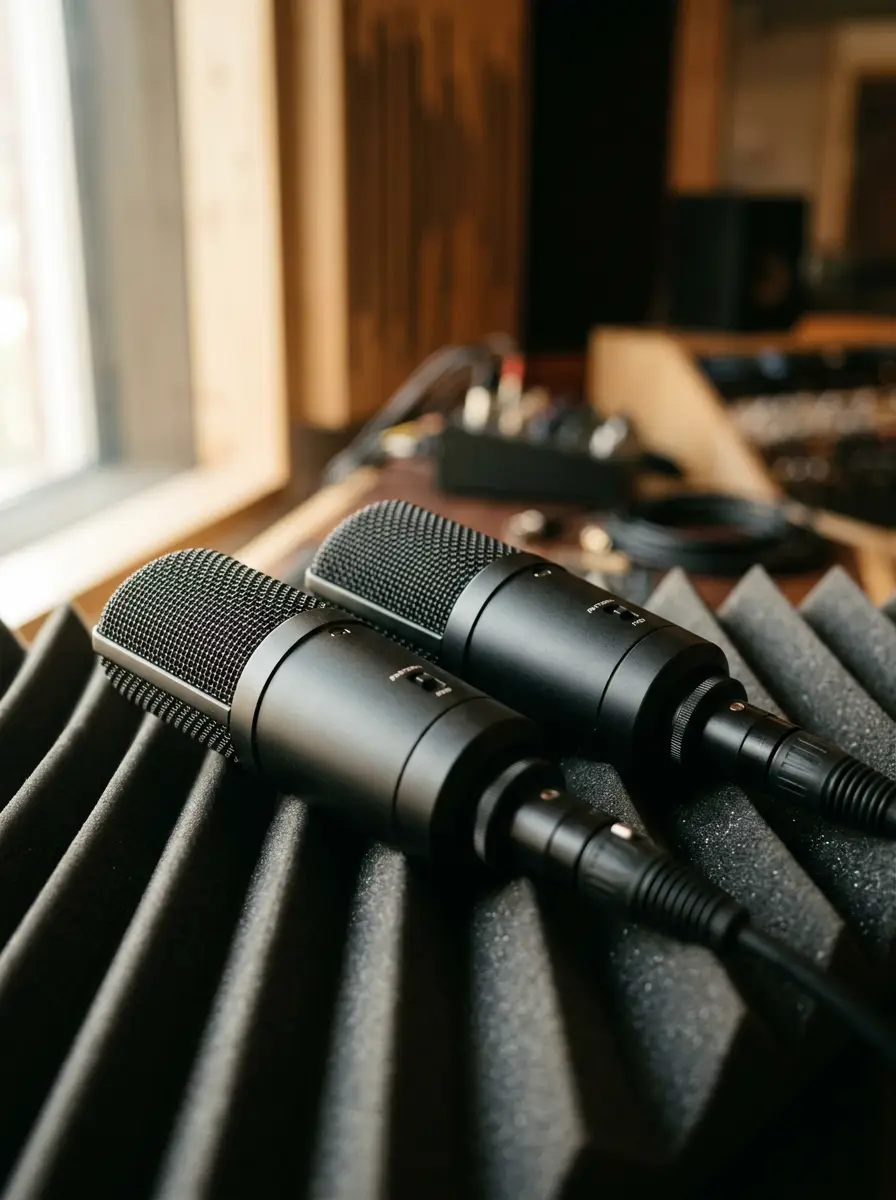
AI-generated editorial illustration; not a product or test photograph.
Short answer
For tracking studio vocals, the RØDE NT1 Signature Series outperforms the Audio-Technica AT2020 due to its ultra-low 4 dBA self-noise floor, true one-inch HF6 condenser capsule, and bundled SM6 shock mount with integrated pop filter. The AT2020 remains a durable entry-level option at $119.00, but its 20 dBA self-noise and lack of included isolation hardware make the $135.00 NT1 the superior long-term vocal investment.
2
Product listings discussed; not hands-on tests
2/2
Discussed listings with a recorded price
$119.00–$135.00
Recorded listing price range; not a complete setup cost
Key takeaways
The RØDE NT1 Signature Series features an exceptionally low 4 dBA self-noise floor compared to the AT2020's 20 dBA rating.
RØDE includes the SM6 suspension shock mount and integrated pop filter, while the AT2020 provides only a basic threaded stand mount.
Both microphones utilize fixed cardioid polar patterns and require 48V phantom power from a dedicated audio interface.
Acoustic room treatment is essential for both models, as sensitive condenser capsules readily capture flutter echo and ambient reflections.
Tracking with either microphone demands closed-back headphones to eliminate backing track bleed into the vocal take.
Products discussed in this article
Editorial scores and recorded prices are reference points, not measurements of suitability for every use. Read each review's specifications and limitations.
RØDE NT1 Signature Series Studio Condenser Microphone8.7
Audio-Technica AT2020 Cardioid Condenser Studio XLR7.9
Recorded price (USD)
RØDE NT1 Signature Series Studio Condenser Microphone135 USD
Audio-Technica AT2020 Cardioid Condenser Studio XLR119 USD
Audio-Technica AT2020 vs RØDE NT1 Signature Series Technical Comparison
Product
Price
Self-Noise
Capsule Architecture
Included Accessories
Warranty
RØDE NT1 Signature
$135.00
4 dBA
1-inch HF6 true condenser
SM6 shockmount, pop filter, XLR cable
10-year manufacturer warranty
Audio-Technica AT2020
$119.00
20 dBA
Custom low-mass diaphragm
Pivoting stand mount, pouch
Standard manufacturer warranty
Which microphone delivers cleaner vocal clarity?
When comparing the RØDE NT1 Signature Series and the Audio-Technica AT2020 for lead and backing vocals, the primary acoustic difference originates at the capsule level. The RØDE NT1 Signature Series utilizes the HF6 one-inch edge-terminated true condenser capsule, tuned to deliver a neutral, balanced frequency response across the audible spectrum. This large diaphragm captures vocal transients smoothly without imparting an aggressive midrange spike. Vocal takes recorded through the NT1 capture body and top-end detail with minimal coloration, giving mixing engineers maximum headroom to apply equalization and dynamic compression in digital audio workstations.
In contrast, the Audio-Technica AT2020 employs a smaller, custom-engineered low-mass diaphragm encased in a dual-stage wire mesh basket. While Audio-Technica rates the microphone for 200 ohms impedance and a 37 dB sensitivity rating, the reduced capsule surface area alters transient handling. The low-mass diaphragm reacts rapidly to fast percussive consonants and articulate vocal attacks, producing an articulate capture that easily cuts through dense instrumental arrangements. However, this voiced presentation can sound leaner in the lower registers compared to the full-bodied capture of a true one-inch condenser.
Neither microphone includes onboard equalization switches or high-pass filters on its chassis. Because both units capture an unattenuated signal directly from their capsules, rumble suppression and frequency shaping must occur at the preamp stage or inside your recording software. For vocalists seeking an honest, natural vocal capture that takes well to downstream processing, the NT1 provides a smoother baseline, whereas the AT2020 offers an immediate, forward presence.
How do self-noise and sensitivity impact vocal takes?
The starkest technical divide between these two studio microphones lies in their internal electronic noise performance. The RØDE NT1 Signature Series is famous for its exceptionally low self-noise figure of just 4 dBA. This near-silent operational noise floor makes the microphone particularly capable during delicate acoustic performances, quiet breathy vocal passes, and intimate spoken-word delivery. When applying heavy digital compression, serial saturation, or high-shelf equalization boosts during vocal mixing, the NT1 does not inject noticeable background hiss into the processing chain.
The Audio-Technica AT2020, on the other hand, lists a self-noise specification of 20 dBA alongside a 74 dB signal-to-noise ratio. In practical tracking sessions, a 20 dBA noise floor is audible during quiet musical rests or dynamic spoken passages. If a production calls for significant upward compression or dynamic expansion, the cumulative ambient hiss from multiple stacked vocal layers can become an issue. While the AT2020 handles moderately loud singing and rap vocals without any noise penalties, it lacks the surgical transparency required for soft, dynamic vocal performances.
Sensitivity specifications also impact how these units interact with your gain staging. The AT2020 sits at 37 dB sensitivity, requiring a solid amount of clean gain from your interface preamps. While standard entry-level preamps easily supply adequate power, pushing budget preamps toward their ceiling can introduce analog circuit noise. The NT1 provides a healthier output level, allowing you to keep preamp gain dials in their linear sweet spots. If your vocal style leans into subtle dynamics or requires layered backing harmonies, the 16 dBA noise advantage of the NT1 represents an enormous acoustic benefit.
What acoustic room treatment do these condensers require?
A fundamental rule in home recording is that you must treat the room before spending excessive money on hardware upgrades. Large-diaphragm studio condensers like the NT1 and sensitive electret designs like the AT2020 are engineered to capture subtle acoustic nuances. Unfortunately, that same sensitivity ensures they will capture room reverberation, slapback flutter echoes, computer fan noise, and street traffic if operated in an untreated environment.
Many emerging artists fall into common mistakes to avoid in music production by purchasing a high-fidelity condenser microphone while leaving their tracking space completely reflective. Neither the AT2020 nor the NT1 can ignore the boundaries of an untreated bedroom. Both microphones utilize a fixed cardioid directivity pattern, which attenuates sound arriving from 180 degrees off-axis directly behind the microphone body. However, reflections bouncing off bare drywall, hard floors, and desktop surfaces will enter the front and sides of the capsule unhindered.
Because the NT1 exhibits higher overall sensitivity and captures extended low-end frequencies down through deep vocal fundamentals, it can actually reveal acoustic deficiencies in a poorly tuned space more aggressively than a darker microphone. Squeezing full value out of the NT1's 4 dBA noise floor requires at least minimal acoustic absorption around the tracking zone, such as broadband absorption panels placed behind the vocalist. If you are working on a strict budget, allocating funds toward DIY rockwool panels or dense acoustic blankets should take precedence over buying secondary accessories. Reviewing our music production buyer's guide will help you balance room treatment costs against hardware acquisition.
Why do driver latency and closed-back headphones matter?
A successful vocal session relies on tracking discipline just as much as microphone selection. In studio workflows, two rules are paramount: round-trip latency and driver quality beat preamp marketing, and closed-back headphones are mandatory for tracking. Both the AT2020 and RØDE NT1 are pure analog XLR microphones, meaning neither contains an internal audio interface, analog-to-digital converter, or headphone output.
To record vocals into your computer, you must connect these microphones to an external audio interface supplying 48-volt phantom power, such as an entry-level Focusrite Scarlett Solo 3rd Gen. When choosing an interface, prospective buyers should look beyond flashy preamplifier branding and prioritize low-latency driver stability. If your audio interface suffers from high round-trip latency, the vocalist will hear a disorienting delay in their monitor mix, destroying phrasing and pitch accuracy. Stable drivers that maintain low buffer sizes without audio dropouts are vital for keeping vocal takes tightly in time with the backing instrumental.
Furthermore, when tracking into sensitive condenser capsules like the NT1 or AT2020, performers must use closed-back headphones rather than open-back models. Closed-back cans feature sealed earcups that physically isolate the monitor mix, preventing click tracks and loud instrumental backing from leaking out and bleeding into the open microphone. Using open-back headphones during vocal tracking will permanently pollute the vocal track with acoustic spill that cannot be cleaned up during mixing. For a deeper breakdown of tracking equipment, consult our guide to selecting the best audio interface.
What accessories and hardware come in the box?
When evaluating the financial investment of the $119.00 AT2020 versus the $135.00 NT1 Signature Series, buyers must calculate the out-of-the-box accessory bundle. Raw purchase price can be misleading if one unit requires immediate supplementary spending to function reliably in a vocal tracking setup.
The Audio-Technica AT2020 arrives in minimalist packaging. The microphone is supplied with a basic pivoting stand mount that threads directly onto standard microphone stands, alongside a soft zippered vinyl pouch. The bundled mount provides rigid mechanical coupling, meaning any foot tapping, floor resonance, or desk bumps transfer directly up the stand and into the microphone capsule as low-frequency rumble. To record professional vocals with the AT2020, buyers must independently purchase an elastic suspension shock mount and an external clamp-on pop filter to manage plosive air blasts from hard 'p' and 'b' sounds.
In contrast, the RØDE NT1 Signature Series includes the professional SM6 suspension shock mount assembly straight out of the box. The SM6 features a heavy-duty elastomeric suspension system that isolates the 313-gram metal chassis from structure-borne vibrations. Integrated directly into the front of the SM6 is an adjustable, dual-mesh pop shield that aligns perfectly with the capsule without requiring separate clamping arms. Sourcing a dedicated shock mount and dual-mesh pop filter independently typically costs between $30 and $60. The NT1 also includes a balanced XLR cable and carries RØDE's specified ten-year manufacturer warranty, delivering substantially more functional value on day one.
Which microphone offers the better long-term studio value?
Evaluating overall studio value requires looking at the total hardware lifecycle, modular upgrade potential, and daily reliability. Both microphones sit in an accessible price tier, with the AT2020 priced at $119.00 and the NT1 Signature Series retailing at $135.00. Both feature durable all-metal enclosures engineered to withstand routine project studio handling, and both rely on standard 3-pin XLR terminations that interface with any modern audio interface.
The Audio-Technica AT2020 holds an undeniable commercial legacy, backed by an average rating of 4.7 out of 5 stars across more than 15,000 user reviews. Its mechanical construction is exceptionally rugged, making it an excellent utility microphone for secondary studio tasks such as tracking acoustic guitars, percussion, and guitar amplifiers if vocal duties are later reassigned to higher-tier hardware. However, for dedicated lead vocal tracking, its 20 dBA self-noise floor and bare accessory package create an artificial ceiling.
The RØDE NT1 Signature Series represents the superior value for dedicated vocalists. With an average rating of 4.6 out of 5 stars across over 2,400 user reviews, it pairs class-leading 4 dBA self-noise with the true one-inch HF6 condenser capsule. For a nominal $16 price difference, the NT1 eliminates the need to buy aftermarket shock mounts or pop filters while providing a noticeably quieter noise floor for modern vocal processing chains. While you can browse options in our audio interface under $150 guide to find an ideal companion preamp, the NT1 Signature Series remains the definitive choice between these two contenders for vocal production.
Step by step
1Mount your microphone to a sturdy stand, utilizing a mechanical shock mount to isolate structure-borne floor rumble.
2Position an external mesh pop filter approximately two to three inches directly in front of the capsule.
3Connect the microphone to your audio interface using a balanced 3-pin XLR cable before engaging phantom power.
4Engage the +48V phantom power switch on your interface to energize the condenser capsule.
5Put on a pair of closed-back headphones and adjust your interface buffer settings to achieve low round-trip latency.
6Perform a vocal test pass and set interface gain so signal peaks average between -18 dBFS and -12 dBFS.
Quick checklist
Verify your audio interface supplies true 48V phantom power over XLR.
Inspect your tracking environment and hang broadband acoustic absorption to tame room flutter echo.
Ensure you have closed-back headphones ready to prevent monitor leakage during tracking passes.
Check your audio interface buffer settings to minimize round-trip latency inside your DAW.
Confirm your microphone stand has sufficient base weight to hold an articulated shock mount and pop shield.
Position your pop filter two to three inches away from the capsule to suppress plosive air bursts.
Frequently asked questions
Can I plug the AT2020 or RØDE NT1 directly into a computer USB port?
No. Both the Audio-Technica AT2020 and RØDE NT1 Signature Series are standard analog XLR microphones. They require an external USB audio interface supplying 48-volt phantom power to convert their analog audio signals into digital data for your computer.
Why is self-noise so important when recording vocals?
Microphone self-noise is the baseline electrical hiss generated by internal circuitry. Microphones with low self-noise, like the NT1 at 4 dBA, allow you to record quiet vocal passages and apply aggressive compression or equalization without boosting unwanted background hiss.
Which of these microphones handles loud screaming or rap vocals better?
Both microphones handle loud vocal transients effectively due to robust metal housing and high sound pressure handling. The AT2020's fast low-mass diaphragm excels at articulate consonants, but both require proper gain staging at the interface to prevent digital clipping.
Do I need a cloudlifter or inline preamp for the AT2020 or NT1?
No. Inline preamps like Cloudlifters are designed for low-output passive dynamic or ribbon microphones. Studio condenser microphones like the AT2020 and NT1 contain active internal circuitry powered by 48V phantom power and produce healthy output levels on standard interfaces.
Why shouldn't I use open-back headphones while tracking vocals?
Open-back headphones feature perforated earcups that allow sound to escape freely into the room. When singing into a sensitive condenser microphone, backing track playback from open-back headphones bleeds directly into the capsule, permanently ruining clean vocal isolation.
Amazon links are affiliate links; we may earn a commission at no cost to you.
Sources and limits
This page summarizes our research reviews of Amazon listings, listed specifications and captured buyer ratings. It is not a hands-on test. Scores are editorial assessments, not measured performance; prices are recorded snapshots and may change. A category can include both main products and accessories, so its overall price range is not the cost of a complete setup.
Most recent product record update: September 14, 2026. Individual records may be older; this is not a verification date for every claim.
Choose the product type first. These groups require a match in the listing title; an import search term alone is not enough. Scores rank our recorded research assessments within each group, not independently measured performance.
Values are shown as recorded, without unit conversions or inferred compatibility. Not recorded means unknown, not absent. Prices are snapshots, not current offers. Editorial scores are research judgments, not lab results. Amazon links are affiliate links.
Before treating a comparison as complete
Which details are still unknown?
A specification appearing in a listing is not independent verification. These counts show which shortlisted records contain the same field; a blank record does not mean the product lacks the feature.
Compatible Devices
Recorded for 2 of 2 shortlisted models
Present in every shortlisted record. Check units, exact variants and the current manufacturer documentation before relying on it.
Connectivity Technology
Recorded for 2 of 2 shortlisted models
Present in every shortlisted record. Check units, exact variants and the current manufacturer documentation before relying on it.
Connector Type
Recorded for 2 of 2 shortlisted models
Present in every shortlisted record. Check units, exact variants and the current manufacturer documentation before relying on it.
Enclosure Material
Recorded for 2 of 2 shortlisted models
Present in every shortlisted record. Check units, exact variants and the current manufacturer documentation before relying on it.
Power Source
Recorded for 2 of 2 shortlisted models
Present in every shortlisted record. Check units, exact variants and the current manufacturer documentation before relying on it.
Round-trip latency and driver quality beat preamp marketing.
Treat the room before upgrading the monitors.
Closed-back for tracking, open-back for mixing.
If a specification, certification or compatibility detail is absent, mark it as unknown and ask the seller or manufacturer. Do not substitute a star rating, an editorial score or a different model's specification.