Music production

Focusrite Scarlett Solo 3rd Gen USB-C Audio Interface

The third-generation Focusrite Scarlett Solo offers entry-level desktop recording with a single microphone preamp, a dedicated instrument input, and 24-bit/192kHz conversion. At $119.99, it prioritizes essential inputs and stable class-compliant operation over extensive routing flexibility.

Focusrite Scarlett Solo 3rd Gen USB-C Audio Interface
Price

$119.99

Amazon rating

4.6

4.6
Ratings

29,474

Best for Single-channel vocal or instrument tracking

Focusrite's third-generation Solo relies on mature, low-latency drivers that matter far more during tracking than marketing claims about preamps. Its physical inputs are limited to one microphone and one instrument, preventing simultaneous stereo mic recording. It remains a dependable, low-cost baseline for single-source tracking.

What we like

  • Stable low-latency drivers across major platforms
  • Balanced TRS monitor outputs on rear
  • Straightforward gain halo indicator rings

What to weigh up

  • Only one XLR input available
  • Limited headphone output power for high-impedance loads
Check today's price on Amazon

Price and rating were captured on 14/09/2026 and change often. We earn a commission on qualifying purchases.

Our scorecard

Weighted against our category rules
7.8out of 10
Overall
  • Driver stability and latency7.8

    Reliable drivers under Windows and macOS, though buffer limits require verification.

  • Preamplifier clean headroom7.5

    56dB gain range handles standard condensers but limits quiet dynamic microphones.

  • Hardware build quality8.3

    Compact 12.32-ounce chassis with secure connectors and smooth analog rotary controls.

  • I/O configuration6.8

    One XLR and one Hi-Z input restrict simultaneous stereo acoustic capture.

  • Value proposition8.5

    Competitive pricing backed by an extensive software package and three-year warranty.

The full review

Design and Build

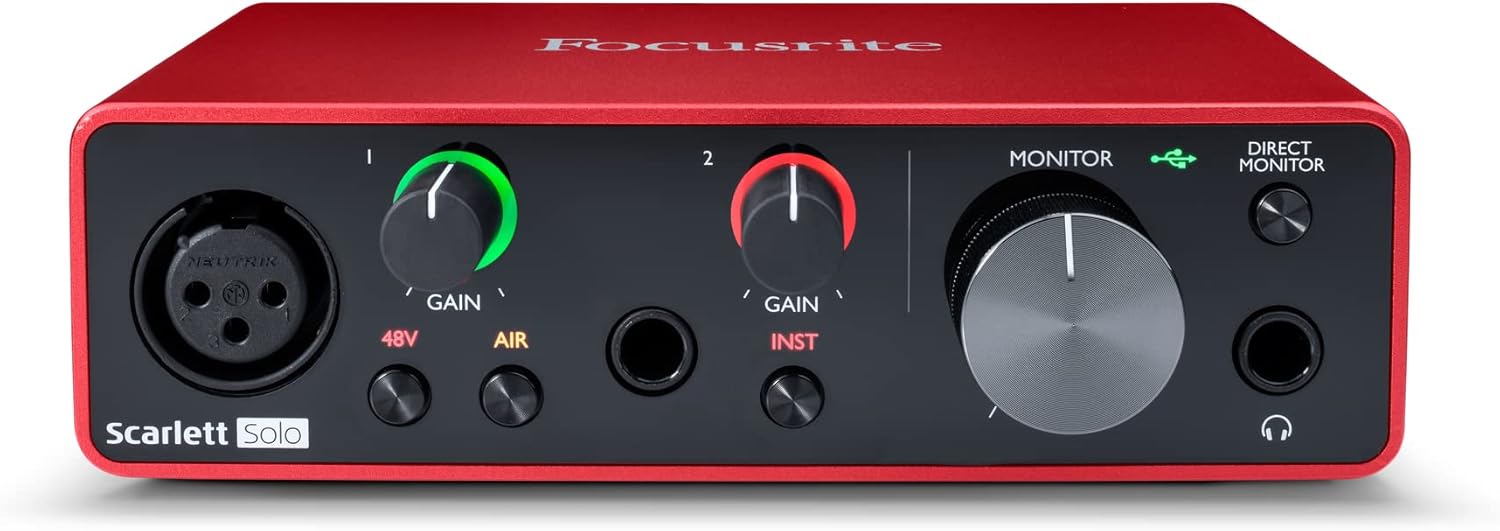
The Scarlett Solo 3rd Gen measures 1.71 by 5.65 by 3.77 inches and weighs 12.32 ounces, housed in an extruded aluminum casing. The front panel layout separates its single XLR microphone input from the 1/4-inch instrument jack, each served by dedicated rotary gain knobs with ring-shaped halo indicators to display signal levels and clipping. The unit draws power entirely through its rear USB-C connection, keeping the footprint manageable on crowded desks. Around the back, two balanced 1/4-inch TRS line outputs send clean signal to active reference monitors without ground hum. The 1/4-inch headphone output sits on the front, sharing the master output path via a direct monitoring toggle switch. While the red metal exterior handles transport well, the plastic potentiometers and toggles require standard care during portable use. Overall, the layout remains strictly functional, prioritizing immediate physical control over submenus or complex internal routing matrices.

Real-World Performance

In production environments, driver stability and round-trip latency are far more critical than preamplifier marketing claims. The Solo delivers reliable performance across macOS and Windows, supporting sample rates up to 192kHz. However, users tracking virtual instruments at low buffer sizes should verify round-trip latency on their specific machine, as the USB bus configuration presents standard real-world floor limits compared to Thunderbolt interfaces. The single preamplifier provides 56dB of available gain. While sufficient for standard studio condensers and active ribbon microphones, this range requires users to push levels near maximum when using low-output dynamic microphones, which introduces audible noise floor. The switchable Air circuit modifies the frequency curve to mimic Focusrite ISA transformer characteristics, subtly boosting upper frequencies. When tracking vocals or acoustic instruments, producers must use closed-back headphones to avoid monitor bleed into the single live microphone channel.

Value for Money

Priced at $119.99 and holding a 4.6 out of 5 rating across 29,474 reviews, the Solo 3rd Gen sits in the entry-level bracket. Focusrite balances the modest hardware I/O with an extensive software bundle, including Ableton Live Lite, Pro Tools Intro+, and the Hitmaker Expansion suite. The included three-year manufacturer warranty adds long-term security uncommon at this price point. The balanced outputs ensure that clean, uncolored signals reach your studio monitors, but acoustic room treatment remains significantly more important to mix accuracy than converter metrics or small monitor upgrades. For self-recording musicians tracking one element at a time, the interface delivers solid conversion without redundant hardware overhead. The price-to-feature ratio remains strong, provided your recording workflow does not exceed one microphone and one direct instrument channel.

Who Should Skip It

Engineers and multi-instrumentalists requiring stereo microphone setups should avoid the Solo, as its single XLR input cannot record coincident pairs, spaced pairs, or stereo keyboard outputs. The interface lacks independent volume controls for the headphone output and the rear monitor outputs, meaning adjustments alter the general listening environment unless hardware monitors are manually powered down or attenuated downstream. Podcasters requiring multiple simultaneous in-person vocal channels must step up to the Scarlett 2i2 or an interface with secondary preamplifiers. Users relying on low-sensitivity dynamic microphones like the Shure SM7B without an auxiliary in-line preamplifier should also look elsewhere, as the 56dB gain range proves marginal in quiet speaking applications. Finally, operations requiring integrated MIDI hardware I/O must seek alternatives, as the Solo provides audio connectivity exclusively.
Specifications

As listed by the manufacturer
Compatible DevicesMicrophone, Instrument, Personal Computer, Headphones, Studio Monitors
Supported SoftwareAll audio recording software
Connectivity TechnologyUSB
Number of Channels2
Frequency Response20 KHz
Operating SystemMac OS, Windows OS, iOS
Audio InputXLR, Instrument
Maximum Sample Rate192 KHz
Item Dimensions D x W x H1.71"D x 5.65"W x 3.77"H
Item Weight12.32 ounces
Brand NameFocusrite
Number of Items1
Item Highlight1 XLR Mic Preamp, 1 Hi-Z Instrument Input, 24-Bit/192kHz, 56dB Gain Range, Air Mode, macOS/Windows/iPadOS Compatible
ManufacturerFocusrite
UPC815301005179
Global Trade Identification Number00815301005179

What the maker claims

  • Pro performance with great pre-amps - Achieve a brighter recording thanks to the high performing mic pre-amps of the Scarlett 3rd Gen. A switchable Air mode will add extra clarity to your acoustic instruments when recording with your Solo 3rd Gen
  • Get the perfect guitar and vocal take with - With two high-headroom instrument inputs to plug in your guitar or bass so that they shine through. Capture your voice and instruments without any unwanted clipping or distortion thanks to our Gain Halos
  • Studio quality recording for your music & podcasts - Achieve pro sounding recordings with Scarlett 3rd Gen’s high-performance converters enabling you to record and mix at up to 24-bit/192kHz. Your recordings will retain all of their sonic qualities
  • Low-noise for crystal clear listening - 2 low-noise balanced outputs provide clean audio playback with 3rd Gen. Hear all the nuances of your tracks or music from Spotify, Apple & Amazon Music. Plug-in headphones for private listening in high-fidelity
  • Everything in the box: Includes Pro Tools Intro+, Ableton Live Lite, Cubase LE, and Hitmaker Expansion: a suite of essential effects, powerful software instruments, and easy-to-use mastering tools
  • With Scarlett 3rd Gen, you have all the tools you need to start recording right, now - We’ve partnered with our favorite industry partners to provide you with plenty of sound content and software so that you can create and record music right away
  • Enjoy three years of warranty - Wherever you happen to be in the world, you can rely on a three-year warranty if any Focusrite hardware needs repairing or replacing due to a manufacturing fault

How it compares

Same category
ProductPriceRatingRatings countOur score
Focusrite Scarlett Solo 3rd Gen USB-C Audio Interface (this one)$119.994.629,474 ratings7.8
Logitech Creators Blue Yeti USB Microphone for PC, Mac, Gami$99.344.657,065 ratings7.5
FIFINE K669B USB Microphone, Condenser Recording Mic for Voc$29.994.534,557 ratings6.4
Audio-Technica AT2020 Cardioid Condenser Studio XLR Micropho$119.004.715,091 ratings7.9
M-AUDIO M-Track Duo USB Audio Interface$69.004.46,528 ratings7.1

Common questions

Can the Scarlett Solo power low-output dynamic microphones without an external booster?
With 56dB of maximum gain, the Solo can struggle with quiet vocal sources on low-output dynamic microphones. While adequate for loud singers or close-mic applications, spoken-word recordings typically require an external in-line preamplifier to reach standard broadcast levels without pushing the internal preamplifier into audible hiss.
How does round-trip latency affect software monitoring on this interface?
Round-trip latency depends on operating system drivers and selected buffer sizes. Focusrite provides stable ASIO and Core Audio drivers, but monitoring complex virtual instruments or heavy plugin chains at 192kHz can tax system resources. Using direct monitoring bypasses software latency entirely during live instrument and vocal takes.
Can studio monitors and headphones be controlled with separate volume knobs?
No. The Scarlett Solo 3rd Gen features a single main monitor dial that governs the master stereo bus. It lacks an independent headphone level knob, requiring you to turn off or lower your studio monitors manually when tracking through headphones to prevent acoustic feedback.
What headphone design should be paired with the Scarlett Solo?
For tracking vocals or acoustic guitar through the Solo's open microphone, closed-back headphones are mandatory to prevent backing track bleed into the take. For balancing and final mixing sessions, open-back headphones provide superior spatial separation and transient accuracy, assuming you work in a quiet environment.

How we judge music production

  1. Rule 01

    Round-trip latency and driver quality beat preamp marketing.

  2. Rule 02

    Treat the room before upgrading the monitors.

  3. Rule 03

    Closed-back for tracking, open-back for mixing.

Ready to buy?

Prices move daily. Check the current listing before you decide — the figures above were captured on 14/09/2026.

View on Amazon