Design and Build Quality
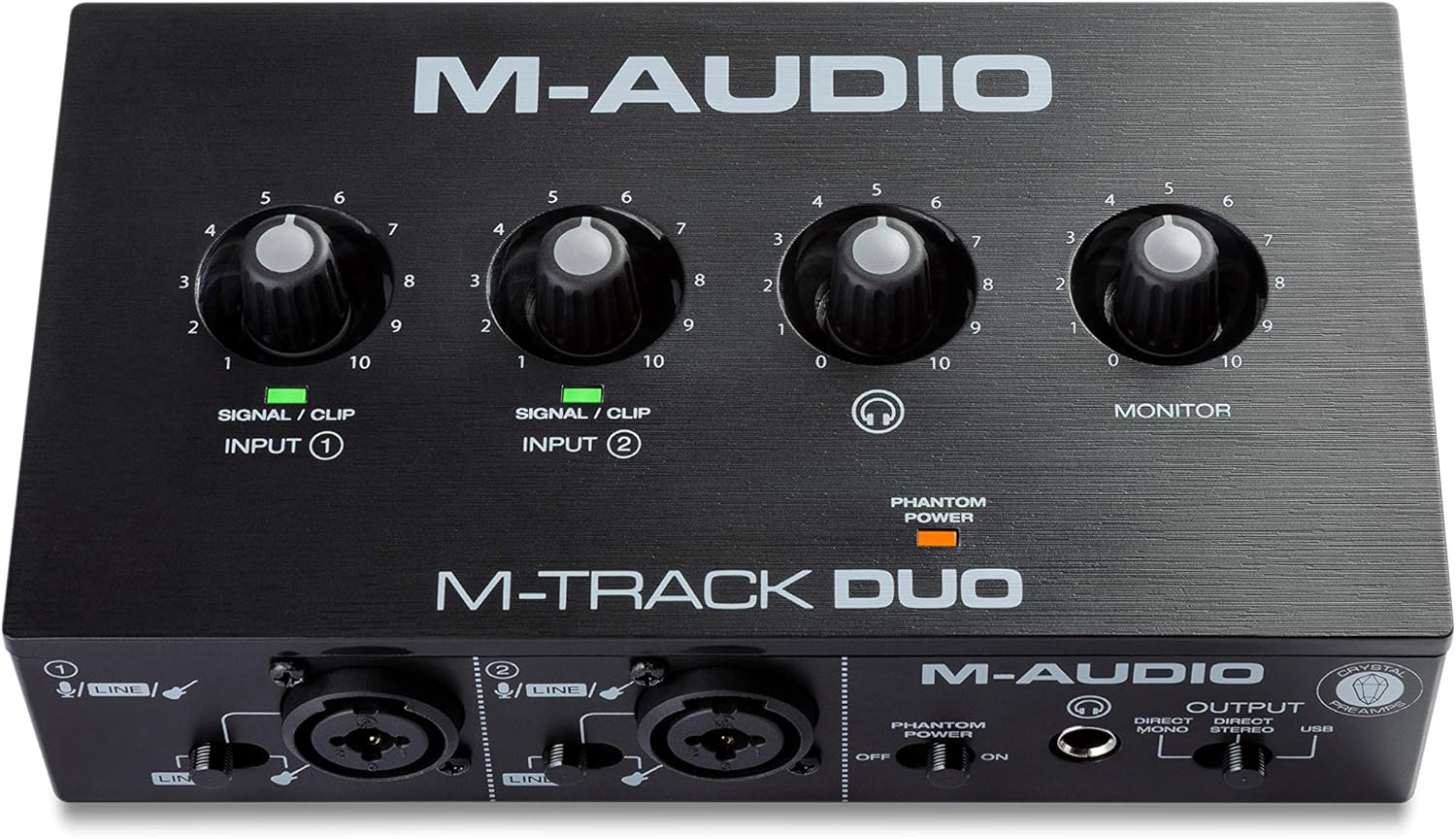
The M-Track Duo is constructed with a lightweight footprint, measuring 4.34 inches deep, 7.5 inches wide, and 2.13 inches tall, with an overall weight of 0.3 kg. This mass confirms an all-plastic housing rather than the metal chassis found on more expensive studio interfaces. The front face accommodates two combo XLR and 1/4-inch inputs, independent gain potentiometers, line/instrument selector switches, a phantom power switch, and a 1/4-inch headphone output. Rear connectivity consists of a USB Type-B port and impedance-balanced 1/4-inch TRS main left and right stereo outputs. The inclusion of dedicated switches for high-impedance DI signals simplifies connecting passive guitar pickups without requiring an external direct box. However, because the unit weighs barely over half a pound, heavy instrument cables can pull the interface across a desk surface. Prospective buyers should plan to secure the chassis or exercise caution during active studio use.
Real-World Tracking and Driver Performance
In recording workflows, driver stability and round-trip latency govern tracking viability far more than preamp naming conventions. M-Audio labels its inputs Crystal Preamps, yet the core metric for tracking remains conversion and latency management. The M-Track Duo is constrained to a 48 kHz maximum sample rate, which is adequate for standard digital audio and streaming work, though below contemporary studio standards of 96 kHz or 192 kHz. To navigate round-trip latency constraints over USB, M-Audio implemented a physical USB/Direct monitoring switch. This control feeds the input signal directly to the monitor outputs before system processing, allowing performers to track without audible delay. For monitoring during vocal or instrument tracking, closed-back headphones are necessary to prevent monitor feed from leaking back into the live microphones. While basic operation functions reliably across macOS and Windows, users reliant on software monitoring through heavy DAW plugin chains should verify driver latency figures first.
Value and Software Integration
Priced at $69.00 with an aggregate score of 4.4 out of 5 across 6,528 reviews, the M-Track Duo represents one of the lowest financial barriers to multitrack computer recording. The package includes software licenses for Ableton Live Lite and MPC Beats, offering functional sequencing and recording tools straight out of the box. For podcasters, home recordists, and educators on tight budgets, this combination provides two balanced outputs, two microphone inputs, and dedicated high-impedance DI inputs at minimal cost. Producers working within limited funds should recognize that spending excess money on entry-level interface upgrades rarely transforms a mix; capital is far better allocated toward acoustic room treatment before investing in costlier converters or studio monitors. Viewed as a utilitarian utility box, the M-Track Duo delivers straightforward audio I/O that justifies its price tag, provided its technical boundaries are acknowledged.
Who Should Skip It
Producers requiring high-sample-rate workflows must bypass the M-Track Duo, as its hardware limits conversion to 48 kHz. Engineers operating complex virtual instrument setups or software-based guitar amp modeling will also find the unit limiting, as relying on the physical direct monitor switch bypasses all DAW insert processing. In those scenarios, dependable low-buffer ASIO drivers with documented sub-five-millisecond round-trip latency are essential, which this budget unit does not guarantee. Touring musicians and field recordists should also hesitate; the 0.3 kg plastic housing lacks the structural reinforcement necessary for life on the road. Finally, critical mixing engineers using demanding open-back headphones should note that M-Audio does not publish the output impedance or milliwatt ratings for the integrated headphone amplifier, meaning high-impedance studio reference headphones may struggle to achieve clean, undistorted listening volumes.