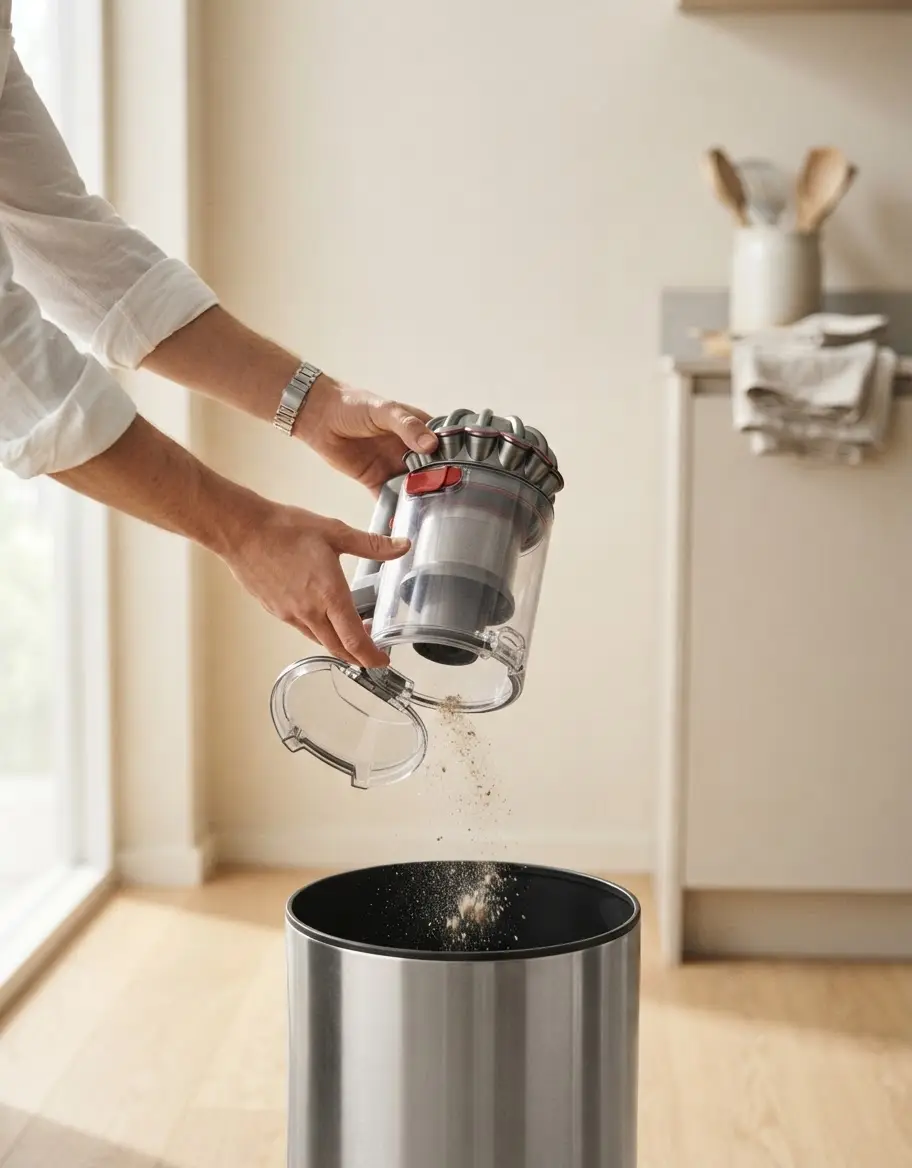
Master the essential techniques for emptying your cordless vacuum dustbin to maintain powerful suction and ensure long-term machine reliability.
By the Niche Picks editorsUpdated November 9, 202611 min readDrawn from our 30 research-based robot & cordless vacuums reviews
AI-generated editorial illustration; not a product or test photograph.
Short answer
To empty most cordless stick vacuums, position the dustbin over a waste receptacle and engage the release latch to open the bottom door. For the cleanest experience, place the bin deep within a trash bag to trap airborne dust, then wipe the internal cyclonic shroud with a dry microfiber cloth.
5
Product listings discussed; not hands-on tests
5/5
Discussed listings with a recorded price
$99.99–$299.99
Recorded listing price range; not a complete setup cost
Key takeaways
Always power off the device and detach the handheld unit before initiating any bin maintenance.
Do not exceed the designated 'Max' fill line to ensure the cyclonic air path remains unrestricted.
Using a plastic trash bag to enclose the bin during release prevents fine dust from circulating back into your home.
Manual cleaning of the internal shroud prevents debris buildup that leads to premature loss of suction.
Only wash bin components if explicitly permitted by the manufacturer, as internal seals and sensors are often moisture-sensitive.
Products discussed in this article
Editorial scores and recorded prices are reference points, not measurements of suitability for every use. Read each review's specifications and limitations.
Levoit Cordless Vacuum Cleaner, Anti-Tangle for Pet7.3
Shark Cordless Vacuum Cleaner, Red, IZ362H7.3
Shark PowerPro Reveal Plus Cordless Vacuum Cleaner7.7
Tikom V500 Cordless Vacuum Cleaner for Home7.6
Shark Pet Cordless Stick Vacuum, 40-Min Runtime7.0
Recorded price (USD)
Levoit Cordless Vacuum Cleaner, Anti-Tangle for Pet$139.94
Shark Cordless Vacuum Cleaner, Red, IZ362H$299.99
Shark PowerPro Reveal Plus Cordless Vacuum Cleaner$299.34
Tikom V500 Cordless Vacuum Cleaner for Home$99.99
Shark Pet Cordless Stick Vacuum, 40-Min Runtime$179.99
Cordless Vacuum Bin Characteristics
Product
Capacity
Filter Type
Emptying Mechanism
Levoit Cordless
0.75 Liters
Foam
Single-button drop
Shark IZ362H
0.34 Quarts
HEPA
CleanTouch Ejector
Shark PowerPro
0.79 Quarts
HEPA
Single-latch drop
Tikom V500
1.3 Liters
HEPA
Bottom-release latch
Shark IX141
0.34 Quarts
HEPA/Foam
CleanTouch Ejector
Why Bin Maintenance Dictates Performance
The efficiency of your cordless vacuum relies on its ability to maintain constant airflow. As debris collects in the dust cup, it naturally occupies space that should be reserved for cyclonic air movement. When the bin reaches its capacity, the vacuum motor must work significantly harder to pull air through the packed dust, which directly impacts battery runtime and long-term motor health. Our research into best cordless vacuum options emphasizes that while modern machines feature advanced suction, the collection canister remains the primary point of failure if kept overfilled.
For units like the Levoit Cordless Vacuum, maintaining the bin cleanliness is vital for the five-stage filtration system to operate within ASTM F1977-22 standards. When you allow dust to pack tightly against the internal shroud, you risk causing an artificial blockage that mimics a broken motor. By emptying the cup before it hits the maximum fill threshold, you ensure the internal vortex keeps heavier debris away from the filter, protecting the fine-particle capture rate. Regular maintenance is the most effective way to avoid the common mistakes to avoid that lead to performance drops and costly repairs.
Beyond suction, hygiene is a major factor for allergy-conscious households. Many stick vacuums, including the Tikom V500, feature cyclonic systems that spin debris away from the air path. However, if this assembly is coated in fine dust or hair, the vacuum will eventually exhaust those same allergens back into your living space. Taking thirty seconds to clear the canister properly is a small investment that guarantees the air expelled by your machine remains as clean as the day you unboxed it. Consult our vacuums FAQ to learn how specific filter designs interact with bin capacity.
Empty the bin after every session to prevent dust compaction.
Monitor the internal shroud for hair that can tether debris.
Keep the bin exterior clean to ensure a tight seal with the motor housing.
The most effective way to empty a cordless vacuum is to prioritize containment. Fine dust is easily agitated, meaning that if you empty the bin too high above a trash can, you will likely inhale or redistribute the dust you just collected. A highly effective 'bag trick' involves placing the bin opening deep inside a standard plastic trash bag before pulling the release latch. This creates a seal that traps the dust plume inside the bag rather than your living room.
For models like the Shark Cordless Vacuum, the CleanTouch ejector is designed for quick, one-handed disposal. However, users should still exercise caution. If you notice debris clinging to the interior walls, it is often due to static electricity. A light tap on the outer shell—rather than reaching inside with wet hands—usually dislodges the remaining particulate. If you have a Shark PowerPro Reveal, remember that the anti-allergen seal depends on a perfectly clean rim. Even a thin layer of fine dust can prevent the gasket from creating an airtight seal, which will immediately decrease the machine's static pressure.
If you find that your bin frequently requires manual scraping, consider the type of debris you are collecting. Households with long human hair or thick pet fur often struggle with binding around the inner cyclone. Instead of using your fingers, use a long, blunt, dry tool to gently sweep away tangles. Never use water to clean the interior of the dustbin unless the manufacturer explicitly states it is safe, as moisture can cause dust to form a stubborn paste that blocks air vents and promotes bacterial growth within the cyclonic housing.
Position the bin nozzle as low as possible in the trash container.
Utilize a plastic bag to capture the initial dust cloud during release.
Use a soft-bristled brush to clean dust from the rubber gasket rim.
For dust-free emptying, place the entire vacuum bin deep into a plastic grocery bag before popping the lid. This traps the cloud of fine dust inside the bag, keeping your hands and floors clean.
Troubleshooting Bin-Related Suction Loss
If you notice a sudden drop in suction, a full bin is only the first thing to check. Often, the issue lies in the cyclonic shroud—the cylindrical mesh or plastic housing inside the bin that filters air before it reaches the HEPA unit. Over time, a thin layer of fine, grey dust can bake onto this shroud, effectively choking the machine. Even if the bin itself is empty, this internal blockage prevents air from cycling properly, making the vacuum feel weak or sluggish during operation.
Owners of the Shark Pet Cordless Stick Vacuum frequently notice this when cleaning up fine dander. To address it, remove the dustbin assembly entirely. Using a dry, soft cloth, wipe down the exterior of the internal shroud until all visible fine dust is removed. If the shroud is removable, you can often gently tap it against the inside of your trash bin to vibrate loose fine dust out of the mesh pores. Never use an air compressor or compressed air canisters for this, as the high pressure can force fine dust past the mesh and into the internal motor assembly, which may lead to catastrophic failure over time.
Another common indicator of a bin-related issue is if the release latch feels 'crunchy' or fails to snap shut. Small pebbles or grit from hardwood flooring can get lodged in the hinge pins, preventing the door from creating an airtight seal. Inspect the hinge area after every few empties. If the door does not click into place, your vacuum will leak suction, significantly reducing its effectiveness on carpeted surfaces where deep agitation is required. Consistent maintenance of the hinge and seals is a core aspect of our vacuums buying tips for long-term ownership.
Inspect the hinge area for trapped grit that prevents a firm seal.
Periodically wipe the internal shroud with a dry cloth to clear pores.
Ensure the vacuum power is fully off before removing the bin assembly.
While emptying the bin is a daily necessity, comprehensive vacuum care involves looking at the entire filtration path. The bin is the first stage of a multi-part process. If your vacuum continues to struggle after you have thoroughly cleared the canister, the issue has likely migrated to the filter. Our vacuums buyer's guide explains that most cordless models use a foam or HEPA filter designed to capture 99.9% of particles. When these filters are saturated with fine dust, even an empty bin will not restore suction.
Establish a quarterly maintenance rhythm. Every three months, remove your primary and exhaust filters. If they are washable, rinse them under cold water only—no soap, as detergent residue can clog the fibers and prevent proper airflow. Allow them to air-dry for at least 24 hours. A damp filter will not only attract dust and clog instantly, but it can also lead to mildew formation inside the motor chamber. By aligning your filter cleaning with your regular bin emptying habits, you create a system where your vacuum maintains its performance profile throughout its operational life. For those choosing between systems, it is worth exploring our category of vacuums to see how various brands approach modular maintenance.
It is also beneficial to check the brush roll whenever you empty the bin. Modern anti-tangle designs, such as those found on our top-rated cordless picks, drastically reduce maintenance. However, they are not infallible. If you see hair wrapped around the roller, clearing it at the same time you empty your bin prevents hair from being pulled back into the internal intake track. This synergy between bin, brush, and filter maintenance is the hallmark of a user who gets the maximum value out of their appliance budget. Remember, consistent light maintenance is always superior to a single heavy, reactive repair session.
Wash washable filters every three months under cold, running water.
Air-dry filters for 24-48 hours before reinserting into the unit.
Combine brush roll checks with bin emptying to save time.
Avoid Water Unless Specified
Unless your user manual explicitly states the dustbin is fully washable, avoid using water on the bin housing. Moisture can cake dust against the cyclonic vents and damage sensitive internal seals.
Storage and Long-Term Care Strategies
Proper storage significantly influences how easy your vacuum is to maintain. If you store your vacuum in a humid environment like a garage or laundry room, the moisture can interact with fine dust left inside the bin and filters. This combination creates a caked-on sludge that is difficult to remove without thorough scrubbing. Always aim to store your vacuum in a cool, dry area. If you use a wall-mounted dock, ensure the area is free of debris that could be pulled into the motor intake.
If you have a robot vacuum as a secondary cleaner, it requires a different emptying strategy. Robots with best robot vacuum capabilities often use self-emptying docks, which trade manual bin emptying for the ongoing cost of disposable bags. If you prefer a bagless setup to avoid recurring expenses, you must commit to manually clearing the bin in the base station. Our analysis in are robot vacuums worth it? suggests that for many households, the time saved by self-emptying is worth the bag cost. However, if you choose a cordless stick, you retain more control over your machine's mechanical state by manually checking the bin after every session.
Finally, document your maintenance schedule. If you use a budget planner to manage home expenses, consider adding vacuum maintenance as a recurring task. Knowing when you last replaced a filter or deep-cleaned your dustbin helps prevent performance loss from sneaking up on you. A well-maintained vacuum consistently produces better cleaning results, lasts longer, and maintains higher resale value should you decide to upgrade. For deep cleaning of the actual bin canister, use a dry, soft-bristled brush to reach into corners where fine dust hides, ensuring that every cycle starts with a fresh, empty container ready for use.
Store the vacuum in a climate-controlled, dry room.
Periodically inspect the base station (if applicable) for dust clogs.
Maintain a schedule to track filter replacement and cleaning frequency.
Understanding Filtration and Sealing
The final component of bin maintenance is understanding your vacuum's 'Complete Seal' technology. Many budget models vent air through non-HEPA filters, which essentially turns your vacuum into a dust duster. The bin is the first line of defense in this process. When you empty it, you are not just removing dirt; you are preventing the accumulation of allergens. Models that feature a HEPA seal, like those seen in our best cordless vacuum selection, require the bin to be locked tight to ensure all intake air is forced through the filtration media.
If you notice dust escaping from the vacuum body during use, check the bin's seal immediately. A compromised gasket on the bin door is a frequent cause of poor indoor air quality. If the gasket is dirty, wipe it with a slightly damp cloth, then ensure it is perfectly dry before snapping it back into place. Keeping these seals supple and free of grit is essential. If the seal becomes cracked or brittle, it is often worth sourcing a replacement part immediately to restore the vacuum's intended efficiency. In our best robot vacuum and mop reviews, we emphasize that these same principles apply to robotic bins—if the seals are not airtight, the suction efficiency drops regardless of the pascal rating.
Ultimately, your bin maintenance is a direct reflection of how well your vacuum will perform over its lifetime. By treating the dustbin as a high-precision component rather than a simple trash bucket, you extend the life of your motor, protect your home's air quality, and keep your maintenance costs at zero. Take pride in your process; a clean vacuum is a high-performing tool that makes the chore of floor care significantly less demanding. Follow the manufacturer's model-specific instructions for disassembly if your bin requires a more intensive wash, and always ensure every single part is bone-dry before the next use to prevent motor damage or foul odors.
Keep bin seals clean to maintain airtight suction.
Replace worn gaskets if the vacuum leaks dust during use.
Prioritize models with sealed HEPA filtration for cleaner air output.
Step by step
1Power down the vacuum and remove it from the charging dock.
2Detach the handheld motor assembly for better maneuvering.
3Position the dust cup nozzle deep inside your trash bag.
4Press the release lever to drop the bottom door.
5Gently tap the bin against the bag to dislodge compacted hair.
6Clear the cyclonic shroud of any remaining fine dust using a dry cloth.
7Push the door firmly until it snaps into an airtight, locked position.
Quick checklist
Power down the vacuum before bin removal.
Detach the handheld motor unit from the wand.
Position the bin deep inside a waste container.
Engage the release latch to open the floor door.
Gently tap to dislodge stubborn hair or debris.
Check the rim and seals for remaining dust.
Close the bin door until it produces an audible click.
Frequently asked questions
How often should I empty my vacuum bin?
You should empty your vacuum bin whenever it reaches the 'Max' fill line. In households with pets or high-shedding carpets, frequent emptying—often after every session—is necessary to prevent suction-choking clogs and to protect the motor from unnecessary strain.
Is it safe to wash my vacuum bin with water?
Only if your user manual specifically confirms it is safe. Many bins contain electronic sensors or non-removable seals that water will ruin. If in doubt, use a dry, soft-bristled brush or a microfiber cloth to clean the interior instead.
Why does my vacuum lose suction immediately after emptying?
If suction remains poor, your filter or the internal cyclonic shroud is likely clogged with fine dust. Emptying the bin removes large debris, but it does not clear the filter pores. Inspect your filter and wash it if it is saturated.
What is the best way to remove hair tangled in the bin?
Avoid using your hands if the bin is dusty. Use a long, thin, dry tool like a wooden chopstick or a soft brush to pull hair out of the center shroud. Avoid metal tools, as they can scratch the plastic chamber.
Can I use compressed air to clean my vacuum bin?
While effective at blowing out dust, compressed air can force fine particles past the filtration mesh and into the motor assembly. This can cause long-term mechanical damage. Stick to manual wiping or light vacuuming with another device.
Amazon links are affiliate links; we may earn a commission at no cost to you.
Shortlists in this category
Ranked lists from our robot & cordless vacuums reviews, limited to listings whose titles confirm the product type, with budget cuts where enough recorded prices sit on both sides of the line.
This page summarizes our research reviews of Amazon listings, listed specifications and captured buyer ratings. It is not a hands-on test. Scores are editorial assessments, not measured performance; prices are recorded snapshots and may change. A category can include both main products and accessories, so its overall price range is not the cost of a complete setup.
Most recent product record update: October 3, 2026. Individual records may be older; this is not a verification date for every claim. Prices on this page were read from the listings Nov 8, 2026 – Nov 13, 2026.
Choose the product type first. These groups require a match in the listing title; an import search term alone is not enough. Scores rank our recorded research assessments within each group, not independently measured performance.
Values are shown as recorded, without unit conversions or inferred compatibility. Not recorded means unknown, not absent. Prices are snapshots, not current offers. Editorial scores are research judgments, not lab results. Amazon links are affiliate links.
Before treating a comparison as complete
Which details are still unknown?
A specification appearing in a listing is not independent verification. These counts show which shortlisted records contain the same field; a blank record does not mean the product lacks the feature.
Capacity
Recorded for 2 of 2 shortlisted models
Present in every shortlisted record. Check units, exact variants and the current manufacturer documentation before relying on it.
Number of Power Levels
Recorded for 2 of 2 shortlisted models
Present in every shortlisted record. Check units, exact variants and the current manufacturer documentation before relying on it.
Power Source
Recorded for 2 of 2 shortlisted models
Present in every shortlisted record. Check units, exact variants and the current manufacturer documentation before relying on it.
Check navigation and obstacle performance for the model; dark-floor behavior also depends on cliff sensors and floor material, not LiDAR alone.
Brush design beats pascal numbers on carpet and hair.
Self-empty bases trade noise and bag cost for convenience.
If a specification, certification or compatibility detail is absent, mark it as unknown and ask the seller or manufacturer. Do not substitute a star rating, an editorial score or a different model's specification.