How to Choose the Right Espresso Distributor Size for Consistency
Matching your distributor diameter to your portafilter basket is the most effective way to eliminate channeling and ensure uniform puck density.
By the Niche Picks editorsUpdated November 9, 202610 min readDrawn from our 35 research-based espresso accessories reviews
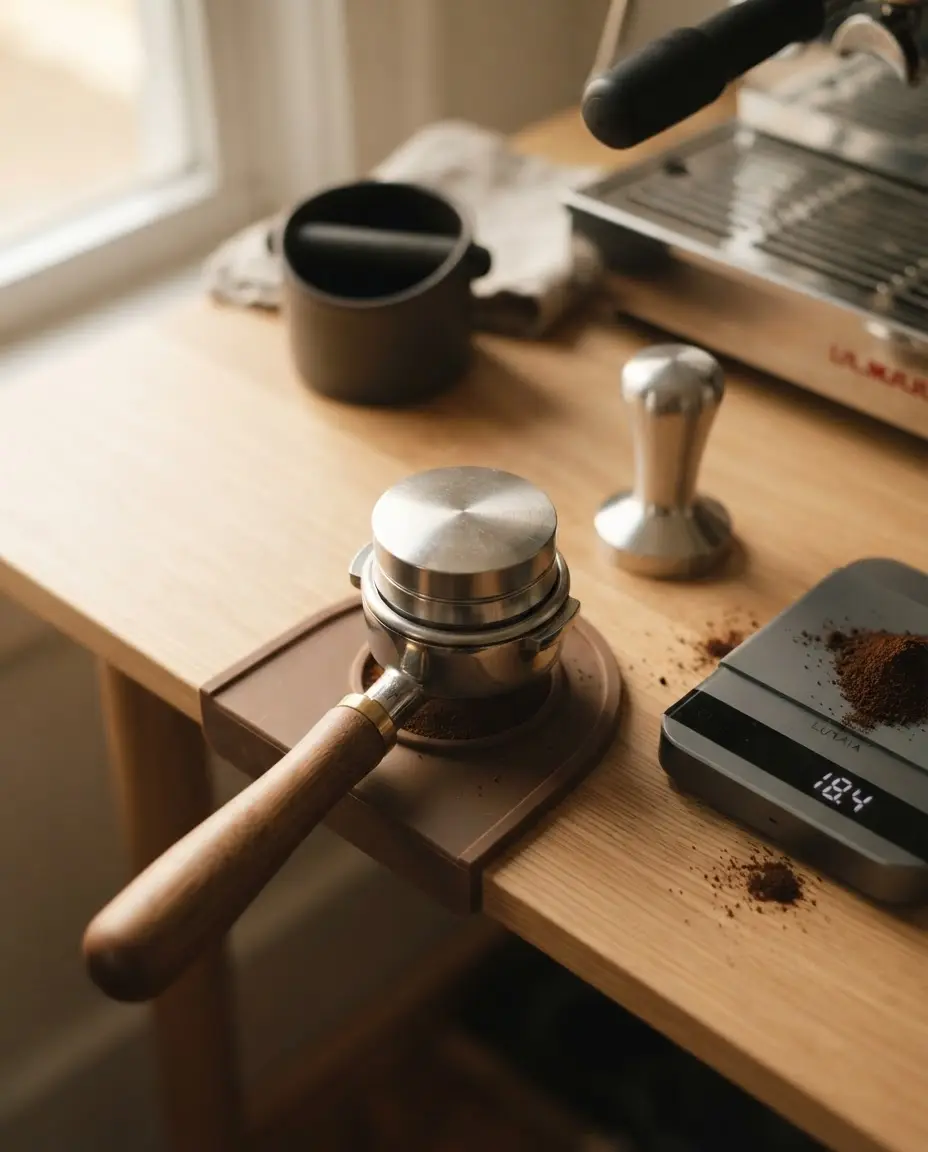
AI-generated editorial illustration; not a product or test photograph.
Short answer
To choose the right espresso distributor size, you must match your tool's diameter to your specific basket's internal diameter within a 0.2 mm tolerance. Most professional and commercial setups require a 58 mm tool, while common domestic machines like Breville often necessitate 53 mm or 53.3 mm distributors. Always use digital calipers to measure your actual basket rather than relying on nominal specs, as undersized tools inevitably create edge channeling.
6
Product listings discussed; not hands-on tests
6/6
Discussed listings with a recorded price
$17.99–$42.00
Recorded listing price range; not a complete setup cost
Key takeaways
Always match your distributor diameter to your basket inner diameter within a 0.2 mm tolerance.
A distributor levels the surface, but it cannot fix deep-bed density; combine it with a WDT tool for total homogenization.
Stock portafilters often have wider manufacturing variances than precision baskets, making measurement essential before you buy.
Standardizing your puck preparation ensures that every shot pulls with consistent resistance and clarity.
Always verify basket depth to ensure your distributor's blades don't bottom out on the filter screen.
Products discussed in this article
Editorial scores and recorded prices are reference points, not measurements of suitability for every use. Read each review's specifications and limitations.
De'Longhi DLSC080 Black Wood Espresso Coffee Tamper$29.04
Comparison of Key Espresso Distribution and Tamping Tools
Product
Size
Best For
Key Material
Apexstone 58mm
58 mm
Commercial
Stainless Steel
Apexstone 53mm
53 mm
Breville 54mm
Stainless Steel
Normcore V4
53.3 mm
Breville Precision
Stainless Steel
Nessus WDT
0.35 mm needles
Declumping
Stainless Steel
Y-Step 51mm
51 mm
Entry-level
Stainless Steel
De'Longhi DLSC080
51 mm
De'Longhi Owners
Stainless Steel
Why Distributor Diameter Is The Most Critical Factor
The primary objective of any distribution tool is to create a perfectly level and uniform coffee bed before you apply your final tamp. If your distributor is even slightly undersized for your basket, you will leave a circular ring of loose, uncompressed grounds around the outer edge. During a high-pressure extraction, water will always follow the path of least resistance. This means the water will bypass the tightly packed center of your coffee puck and rush through that loose outer perimeter, a common failure known as edge channeling.
Precise sizing prevents hydraulic bypass at the basket walls.
A 58 mm tool typically fits most commercial baskets, though precision baskets often require a 58.5 mm diameter.
Specialized domestic machines frequently use 53 mm or 54 mm baskets, which demand tools like the Apexstone 53mm Distributor for proper edge coverage.
Our espresso accessories guide clarifies that failure to match diameter to the basket is the most frequent reason for inconsistent, sour, or watery shots. When you use a bottomless portafilter, this channeling becomes painfully obvious, as the liquid stream will spray or emerge unevenly from the sides of the basket. Even a 0.5 mm discrepancy creates an annular gap that can ruin the extraction geometry of your shot. Always measure your specific basket internal diameter with digital calipers if you are unsure, as factory-supplied baskets can differ from industry standards by several tenths of a millimeter. Precision is not just for professionals; it is the fundamental requirement for home consistency. For those transitioning from the flimsy plastic tools bundled with entry-level machines, upgrading to a rigid, properly sized steel distributor is the single most effective step toward café-quality results.
Distributor vs. WDT: Mastering Your Puck Prep Workflow
While choosing the correct distributor size is essential for surface leveling, many home baristas mistakenly confuse surface distribution with deep-bed homogenization. A blade-style leveler, such as the Apexstone 58mm Distributor, is highly effective at flattening the peak of the coffee mound left by your grinder. However, it does not rearrange grounds deep down near the filter mesh. If your grinder produces static-clumped coffee, a blade leveler will simply press those clumps into the puck, which causes internal dry pockets and inconsistent resistance that lead to micro-channeling.
Blade levelers fix the top-level flatness after dosing.
WDT tools (Weiss Distribution Technique) break up clumps throughout the full depth of the coffee bed.
Pairing a leveler with a dedicated declumper like the Nessus WDT Tool creates a near-perfect preparation routine.
By using thin 0.35 mm needles, you can gently stir the grounds, which is far more effective at preventing channeling than relying solely on surface agitation. If you find your shots are still spurting despite using a perfectly sized distributor, it is time to reassess your declumping process. Review our common espresso accessory mistakes to avoid when refining your station. Many enthusiasts adopt a two-stage workflow: they use a WDT tool to fluff and homogenize the bed, then follow up with a blade-style distributor to create a perfectly flat plane for the tamper. This two-stage approach removes the most variables from your morning workflow. While purchasing multiple tools might seem like an unnecessary expenditure, the small investment in a high-quality WDT tool pays dividends in extraction consistency, especially when you are using light-roast coffees that are notoriously difficult to dial in at home.
Never rely solely on nominal basket sizing printed on the box. A digital caliper is an essential, inexpensive tool that removes all guesswork, ensuring you buy the exact diameter needed to hit that 0.2 mm tolerance.
Evaluating Basket Compatibility and Tolerances
Your portafilter basket is arguably the most important component of your espresso machine. Many users assume a "54 mm" basket is exactly 54 mm, but manufacturing tolerances fluctuate between brands and production runs. A Normcore V4 Tamper or a similar precision-sized distributor is designed to sit tightly within these baskets. If you decide to invest in an aftermarket precision basket, you must ensure your distributor and tamper diameters are matched to that specific insert, as these baskets are built to much tighter standards than standard-issue factory versions.
Always measure your current basket's inner diameter using a digital caliper to check for clearance.
Precision baskets represent the most cost-effective upgrade you can purchase to improve overall extraction quality.
A perfect-fitting tool eliminates the need for aggressive, potentially uneven tamping.
When you are comparing items, check our comparison tool if you are torn between two different sizing options. It is almost always better to have a tool that is slightly undersized by 0.1 mm than one that is oversized, as an oversized tool that binds in the basket will pull up the grounds as you lift it, destroying your carefully prepared puck. Furthermore, you must verify the depth of your basket. Some distributors have depth-adjustment collars, like the Y-Step Tamper and Distributor Set, which allow you to set the blades to work specifically with your dose volume. This prevents the tool from bottoming out on the filter screen or failing to reach the coffee level altogether. Consistency in your dosage is the final piece of the puzzle; if you decide to change your dose weight, you may need to recalibrate the depth of your distributor to maintain the same level of compression and surface flatness every single time.
Why Calibrated Pressure Matters for Modern Espresso
Once you have successfully leveled your coffee bed with a properly sized distributor, the next variable to address is the consistency of your downward force. Even a perfectly flat puck can be ruined if you tamp unevenly or with insufficient force. Calibrated spring-loaded tampers, such as the Normcore V4 53.3mm Tamper, provide a mechanical stop at a specific pressure (e.g., 25lb or 30lb), which removes human error from the equation. When you move to a more consistent workflow, you will notice that shots pull with similar resistance, allowing you to focus on the variables that actually change the flavor, such as grind size and water temperature.
Calibrated tampers prevent under-compression or over-compression of the puck.
Internal springs ensure that compaction is perfectly vertical, preventing the tilt that leads to channeling.
Interchangeable springs allow you to experiment with different compaction levels.
In our best spring-loaded coffee tamper reviews, we emphasize that consistent pressure is not just a luxury; it is a way to diagnose if your coffee is too fine or too coarse. If you find your shots are consistently too fast despite a perfect 30lb tamp, you know exactly where to make your adjustment. Conversely, relying on manual pressure makes it nearly impossible to determine if the failure was the grind or your own arm strength. For owners of machines that came with a cheap, hollow plastic tool, a calibrated tamper represents an immediate upgrade in both tactile feedback and shot performance. When paired with a precision basket and a properly sized distributor, you effectively create a professional-grade extraction environment that is repeatable every morning. This stability is the hallmark of a skilled barista, and it is entirely achievable at home without the high costs of commercial-grade machinery or specialized training. Simply prioritize these mechanical fundamentals before attempting to adjust more complex variables in your brew recipe.
Many entry-level machines include hollow plastic tampers. These lack the gravitational mass needed for consistent compaction and often fail to fit the basket properly, actively promoting the edge channeling you are trying to solve.
The Role of Bottomless Portafilters in Your Diagnostic Workflow
The final element in verifying your distributor size is the use of a bottomless (or "naked") portafilter. A standard, spouted portafilter is designed to hide puck preparation flaws by funneling all the liquid into two neat streams, even if the puck is actually channeling. In contrast, a naked portafilter is the ultimate diagnostic tool because it exposes every mistake, from uneven tamping to poor distribution. If you notice spraying, spurting, or slow streaks appearing on the sides of the basket, your puck prep needs refinement.
Bottomless portafilters provide a direct window into the bottom of your filter basket.
They highlight where uneven density is occurring in real-time.
Normcore's bottomless portafilter is a popular choice for Breville owners to observe their extraction progress.
When you pair a naked portafilter with a well-fitted distributor, you will quickly see a clean, uniform droplet formation across the entire underside of the basket. If your distributor is the wrong size, the edges of the puck will blond (become light and watery) much faster than the center. This "donut" extraction pattern is a classic indicator that water is finding a path around your coffee puck. Using this tool allows you to observe these failures and adjust your workflow accordingly. It can be a humbling experience to pull your first few shots with a naked portafilter, but it is the fastest way to improve your technique. Once you achieve a perfectly even extraction, you can feel confident that your distribution and tamping methods are working in harmony. Remember that any change to your equipment, such as switching to a new coffee roast or a different basket manufacturer, may require a fresh diagnostic pass using your naked portafilter to ensure your distributor remains effective.
When building an espresso station, it is easy to overspend on aesthetic tools while ignoring the fundamentals. Our budget planner suggests focusing funds on equipment that directly improves in-cup consistency. A high-end, branded tamper that doesn't fit your basket correctly is effectively worthless compared to a budget-friendly stainless steel tool that matches your basket perfectly. Espresso economics are simple: precision baskets are the most cost-effective hardware upgrade you can buy, followed by tools that guarantee consistent distribution and tamping pressure.
Always prioritize a precision basket upgrade to resolve your base extraction geometry.
Invest in a properly sized, weighted tamper to ensure uniform compaction.
Use mid-range tools for distribution if the stainless steel base quality meets your needs.
Many users find that high-end distributors with complex planetary gears are unnecessary for domestic workflows when a simple, well-made blade distributor provides the same flatness. Avoid paying for exotic materials that do not add to the mechanical accuracy of the tool. Instead, allocate that budget toward high-quality coffee beans or a better grinder, which will have a far larger impact on your final cup. If you are operating on a tight budget, look for kits that bundle essential tools together, such as the Reoszeank Accessories Kit, which often provides a better return on investment than purchasing each component separately. By staying disciplined and choosing tools based on their compatibility rather than their price tag or marketing claims, you can achieve professional results at a fraction of the cost. Always remember that your distributor's size is a hard physical requirement for success, while its price, material finish, and brand name are secondary to its ability to sit flush within your chosen basket and create a perfectly level surface for your espresso.
1Dose your coffee grounds into the portafilter basket using a digital scale for maximum consistency.
2Use a WDT needle tool to stir the grounds thoroughly, breaking all visible clumps from the bottom up.
3Place the distributor tool on top of the portafilter, ensuring it rests squarely on the basket rim.
4Adjust the distributor's internal collar so the blades reach the desired working depth of your coffee bed.
5Rotate the distributor in a smooth, clockwise motion 3-4 times to create a perfectly flat bed surface.
6Lift the distributor tool vertically away from the basket to avoid disturbing the leveled surface.
7Tamp the compacted coffee bed with a calibrated tamper to ensure even, level compression.
Quick checklist
Measure the precise internal diameter of your portafilter basket with a digital caliper.
Verify if your basket is a standard factory model or an aftermarket precision basket.
Choose a distributor or tamper within 0.2 mm of your basket's measured diameter.
Select a distribution tool that features depth adjustment to match your typical dose weight.
Use a WDT needle tool to declump your grounds thoroughly before using a surface-leveling distributor.
Inspect the basket rim and filter mesh for any wear or debris before starting your puck preparation.
Always place your portafilter on a flat, stable surface during the leveling and tamping process.
Frequently asked questions
Does my tamper have to be the exact same size as my basket?
Yes, for the best results, your tamper or distributor should be within 0.2 mm of the internal diameter of your portafilter basket. If the tool is smaller, you will leave a ring of loose, uncompressed grounds around the edges, which invites water to channel around the puck rather than through it, resulting in poor flavor extraction.
Can I use a 58 mm distributor in a 58.5 mm basket?
Technically yes, but it is not ideal. A 0.5 mm gap is large enough to create an uncompressed edge that may lead to channeling. If you are using a precision basket that measures 58.5 mm, look for a distributor or tamper specifically sized at 58.5 mm to ensure the best possible seal against the basket walls.
Why do some distributors have adjustable depth?
Depth-adjustable distributors allow you to change how far the blades reach into the coffee puck. This is useful because different coffee roast levels have different densities, and you may adjust your dose size frequently. By locking the depth, you ensure you are consistently leveling the surface of the grounds at your target volume every time.
What is the difference between a distributor and a WDT tool?
A distributor (or leveler) is a tool with metal blades used to flatten the top surface of the grounds after they are in the basket. A WDT (Weiss Distribution Technique) tool uses thin needles to declump the grounds throughout the entire depth of the basket. Both are often used together for the most consistent, channeling-free espresso.
Do I need a calibrated tamper if I have a distributor?
A distributor ensures the bed is flat, but a calibrated tamper ensures you are applying the same amount of pressure every time. While you can learn to tamp level by hand, a calibrated spring-loaded tamper removes human error from the equation, making it easier to replicate your results from shot to shot.
Amazon links are affiliate links; we may earn a commission at no cost to you.
Shortlists in this category
Ranked lists from our espresso accessories reviews, limited to listings whose titles confirm the product type, with budget cuts where enough recorded prices sit on both sides of the line.
This page summarizes our research reviews of Amazon listings, listed specifications and captured buyer ratings. It is not a hands-on test. Scores are editorial assessments, not measured performance; prices are recorded snapshots and may change. A category can include both main products and accessories, so its overall price range is not the cost of a complete setup.
Most recent product record update: September 28, 2026. Individual records may be older; this is not a verification date for every claim. Prices on this page were read from the listings Nov 8, 2026 – Nov 10, 2026.
Choose the product type first. These groups require a match in the listing title; an import search term alone is not enough. Scores rank our recorded research assessments within each group, not independently measured performance.
Values are shown as recorded, without unit conversions or inferred compatibility. Not recorded means unknown, not absent. Prices are snapshots, not current offers. Editorial scores are research judgments, not lab results. Amazon links are affiliate links.
Before treating a comparison as complete
Which details are still unknown?
A specification appearing in a listing is not independent verification. These counts show which shortlisted records contain the same field; a blank record does not mean the product lacks the feature.
Item Weight
Recorded for 2 of 2 shortlisted models
Present in every shortlisted record. Check units, exact variants and the current manufacturer documentation before relying on it.
Values are shown as recorded, without unit conversions or inferred compatibility. Not recorded means unknown, not absent. Prices are snapshots, not current offers. Editorial scores are research judgments, not lab results. Amazon links are affiliate links.
Match tamper diameter to your basket within 0.2 mm.
A bottomless portafilter exposes every prep mistake — that's the point.
Check basket diameter, depth, dose range and machine compatibility before upgrading; a precision basket is not a guaranteed improvement.
If a specification, certification or compatibility detail is absent, mark it as unknown and ask the seller or manufacturer. Do not substitute a star rating, an editorial score or a different model's specification.