Best Spring Loaded Coffee Tamper for Consistent Pressure
Discover how calibrated spring-loaded coffee tampers eliminate wrist tilt and uneven force, stabilizing your espresso extraction shot after shot.
By the Niche Picks editorsUpdated October 28, 20269 min readDrawn from our 30 research-based espresso accessories reviews
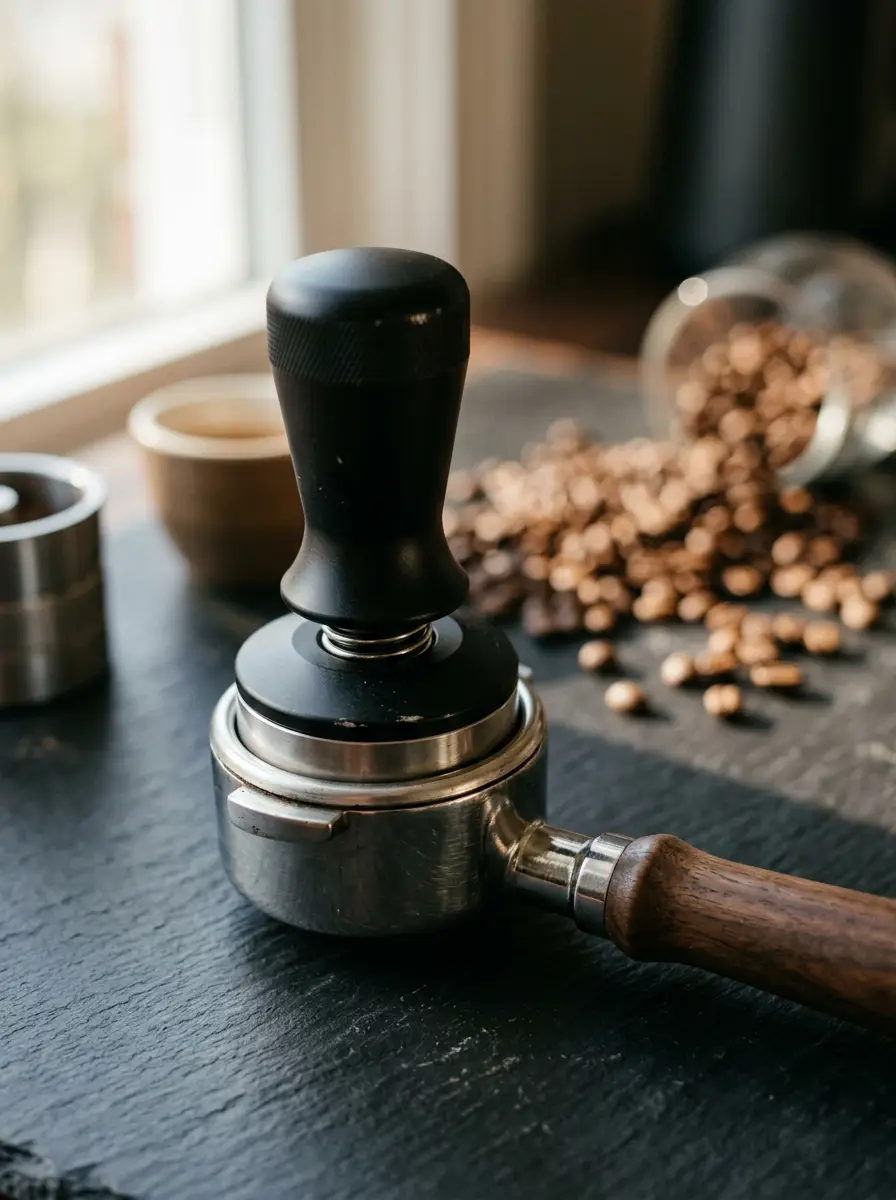
AI-generated editorial illustration; not a product or test photograph.
Short answer
The best spring loaded coffee tamper for consistent pressure is the Normcore V4 series, available in 53.3mm, 58mm, and 58.5mm sizes. It utilizes an outer self-leveling flange to guarantee a perfectly flat coffee bed while housing swappable 15 lb, 25 lb, and 30 lb springs that standardize downward force regardless of user technique.
6
Product listings discussed; not hands-on tests
6/6
Discussed listings with a recorded price
$19.99–$49.99
Recorded listing price range; not a complete setup cost
Key takeaways
A self-leveling collar is just as critical as calibrated springs because puck tilt causes more severe channeling than minor variations in pressure.
Always match your tamper diameter to your filter basket within 0.2 mm to prevent loose perimeter coffee and edge channeling.
Spring-loaded tampers eliminate human fatigue and guesswork by applying a repeatable mechanical resistance ceiling across every shot.
Precision baskets remain the most cost-effective hardware upgrade for extraction clarity, but they require properly sized tampers to perform.
A bottomless portafilter is the best diagnostic tool to visually verify whether your leveled spring tamper has eliminated puck defects.
Products discussed in this article
Editorial scores and recorded prices are reference points, not measurements of suitability for every use. Read each review's specifications and limitations.
Why Does Consistent Pressure Matter in Espresso Puck Prep?
Achieving steady, repeatable espresso extractions requires removing human variation from every step of your preparation. When water is forced through a coffee puck at high pressures, it naturally seeks out paths of least resistance. If one extraction is compressed with 15 pounds of force and the next with 35 pounds, the overall density and air volume inside the puck fluctuate significantly.
While water pressure from the machine pump plays a major role, human application of downforce introduces unexpected inconsistencies. Baristas often struggle with wrist fatigue or varying grip angles throughout the day. A spring-loaded coffee tamper solves this issue by incorporating a mechanically calibrated internal spring. Once the spring compresses to its rated threshold, the user receives clear tactile feedback that optimal compaction has occurred.
However, downward pressure is only one half of the equation. Standard manual tampers require the operator to balance the base perpendicular to the basket walls purely by feel. If your wrist tilts by even two degrees, water will bypass the denser side and rush through the shallower edge. Review our tips in how hard to tamp espresso to understand why consistent resistance matters far more than maximum muscle exertion. Utilizing a calibrated spring allows you to standardize your compaction stroke, providing a stable foundation so your grinder adjustments translate into predictable shot times.
Which Normcore V4 Models Deliver the Best Leveled Compression?
The Normcore V4 line represents the gold standard in mechanical consistency for home and prosumer setups. Unlike basic tampers, the V4 features a floating outer collar that rests directly on the lip of the filter basket. This physical registration mechanically locks the downward travel at a flat 90-degree angle, entirely removing operator tilt from your morning routine.
For owners of commercial 58mm group heads, the Normcore 58.5mm Coffee Tamper V4 ($43.99) delivers exceptional edge coverage. Sized specifically for competition baskets that measure roughly 58.5 mm internally, it prevents loose grounds from remaining along the perimeter. If your machine features a standard factory portafilter with an internal wall taper, the Normcore 58mm Coffee Tamper ($43.99) provides the same mechanical leveling with a true 58.0 mm flat base.
Both models feature a two-piece chassis pairing an anodized aluminum handle with a flat 304 stainless steel base, weighing between 13.9 ounces and 1.1 pounds. Central to their versatility is the inclusion of three interchangeable primary springs rated at 15 lb, 25 lb, and 30 lb. By simply unthreading the handle, users can customize the exact physical resistance of their compaction stroke. For deeper insights into selecting accessories across different brands, explore our all Espresso accessories reviews.
What Are the Best Spring-Loaded Tampers for 54mm Breville Baskets?
Owners of Breville domestic espresso appliances—such as the Barista Express, Barista Pro, and Bambino—often struggle with the lightweight plastic or loose metal tools included in the box. Because standard factory Breville baskets measure between 53.5 mm and 53.8 mm, using an undersized 53 mm tamper leaves an uncompressed ring of coffee that washes away under pump pressure.
To resolve this, the Normcore V4 Coffee Tamper 53.3mm ($42.00) is engineered specifically to match the internal diameter of 54mm portafilters. Weighing 1.03 pounds, it utilizes a dual-spring architecture: one light spring keeps the outer leveling plate flush against the basket rim, while the primary spring regulates compressive force. Like its 58mm siblings, it comes equipped with swappable 15 lb, 25 lb, and 30 lb springs. Read our detailed guide on what size tamper fits Breville 54mm portafilter for exact measurements.
Another alternative is the Normcore 53.3mm Titanium Ripple Base Tamper ($49.99). This variant features the same internal spring assembly and leveling collar but replaces the mirror-polished face with a titanium PVD-coated concentric ripple plate. While the rippled design creates distinct circular impressions on the puck, buyers should note that concentric grooves can occasionally retain dry coffee fines. For those who want mechanical consistency on a tighter budget, the IKAPE 53.3mm Espresso Tamper ($30.61) delivers a solid 13.7-ounce stainless steel build and a 30 lb internal spring.
How Do 51mm Spring Tampers Perform on Compact Domestic Machines?
Budget espresso machines featuring 51mm portafilters present distinct challenges for puck preparation. Stock accessories bundled with sub-$200 appliances are almost universally flimsy plastic combination scoop-tampers that flex under pressure. Upgrading to a dedicated metal tool is essential to establish baseline compaction, but finding a calibrated spring mechanism at this size requires careful evaluation.
The Y-Step 51mm Espresso Tamper Set ($19.99) provides an accessible entry point. Priced under twenty dollars, the package includes a 51mm spring-loaded tamper calibrated to deliver 30 pounds of pressure, alongside a walnut-encased needle distributor and a silicone resting dock. The tamper combines a rosewood handle with a 304 food-grade stainless steel flat base. In total, the set weighs 13.1 ounces, offering meaningful heft compared to factory plastic accessories.
However, shoppers must heed our strict category rule: match your tamper diameter to your basket within 0.2 mm. Many domestic 51mm baskets feature variable factory tolerances ranging between 51.0 mm and 51.5 mm. If your specific basket measures closer to 51.5 mm, a nominal 51mm base will leave a slight gap along the rim. To avoid early extraction flaws, check your equipment dimensions carefully and read our overview of common mistakes to avoid before ordering entry-level kits.
Why Is Basket Diameter Matching within 0.2 mm Non-Negotiable?
One of the most common pitfalls in espresso puck preparation is focusing exclusively on tamping force while neglecting tool diameter. Even if you purchase a tamper with a medical-grade calibrated spring, an undersized base creates an annular ring of loose, uncompressed coffee grounds around the basket perimeter. When brewing water enters under 9 bars of pressure, it naturally migrates to this path of minimal hydraulic resistance.
Our buying criteria require that you match your tamper diameter to your basket within 0.2 mm. For example, commercial 58mm precision baskets typically feature an internal cylinder of 58.4 mm to 58.5 mm. Using a traditional 58.0 mm tamper leaves up to 0.5 mm of loose space around the edges. This annular bypass promotes edge channeling, leading to sour, under-extracted liquid entering your cup before the dense center of the puck can yield balanced solubles.
This principle applies across all machine classes. If you own a Breville 54mm machine, standard 53mm levelers or tampers leave between 0.5 mm and 1.0 mm of clearance. Opting for a dedicated 53.3 mm base tightens that tolerance, eliminating peripheral uncompressed coffee. Before spending on high-end accessories, measure your basket with digital calipers. Understanding the geometry of your portafilter basket is essential, as detailed in our comprehensive Espresso accessories buyer's guide.
How Does a Bottomless Portafilter Expose Tamping Flaws?
Spouted portafilters conceal prep mistakes by channeling all emerging liquid into two uniform spouts. The resulting stream might appear rich and steady, but inside the basket, water could be tunneling through catastrophic fissures in the puck. A bottomless portafilter exposes every prep mistake—that is its entire purpose as a diagnostic instrument.
When pulling a shot through a naked portafilter, any prep defect manifests in real time. If a tamper was pressed with an accidental two-degree tilt, water rushes to the low side, resulting in uneven liquid convergence and early blonding on the thinner edge. If the tamper diameter was too narrow for the basket, fine high-pressure jets—known as channeling spray—will shoot out horizontally from the perimeter holes, leaving a mess on your counter and astringency in your cup.
Pairing a spring-loaded self-leveling tamper with a naked portafilter allows you to verify your technique immediately. A properly leveled puck compressed with calibrated spring force produces a uniform beads-of-sweat pattern across the entire mesh, cleanly converging into a single centered extraction stream. If you want to refine your workflow further, check our tutorial on how to tamp espresso properly.
Should You Invest in Precision Baskets Alongside a Calibrated Tamper?
When budgeting for espresso upgrades, hardware sequence is crucial. Precision baskets are the cheapest real upgrade you can buy to fundamentally elevate extraction quality. Factory baskets stamped for entry-level machines often have inconsistent hole spacing, irregular diameters, and slight wall tapers that compromise flow uniformity. Specialty precision baskets utilize CNC machining to ensure consistent hole geometry across the entire exit plate.
However, a precision basket is not a guaranteed improvement if your prep tools are mismatched. Because precision baskets have completely vertical sidewalls and broader hole patterns extending to the extreme edge, pairing one with a loose, uncalibrated tamper actually magnifies channeling. If you invest in an aftermarket basket, you must pair it with a base that fits within 0.2 mm—such as a 58.5mm tamper for a commercial basket or a 53.3mm tamper for a 54mm setup.
Furthermore, mechanical tamping only consolidates grounds; it does not eliminate density clumps deeper in the puck bed. Combining a calibrated tamper with needle distribution (WDT) ensures that internal clumping is resolved before the calibrated spring applies downward force. To compare prices and prioritize your accessory budget rationally, visit our budget planner.
Step by step
1Distribute dry grounds evenly across the basket volume using a fine needle distribution tool to remove internal clumps.
2Seat the portafilter flat on a stable tamping mat or firm counter edge.
3Rest the spring-loaded tamper gently inside the basket, allowing the leveling rim to sit flush against the basket lip.
4Apply smooth, vertical palm downforce until the internal spring fully compresses to its mechanical threshold.
5Release vertical pressure smoothly without twisting or spinning the base against the compressed coffee bed.
6Lift the tamper vertically to inspect the puck surface for an unslanted, smooth finish free of edge gaps.
Quick checklist
Measure your portafilter basket inner diameter using calipers before buying.
Ensure your tamper base clears the basket walls within 0.2 mm.
Confirm whether your filter basket has straight walls or an internal taper.
Verify whether the tamper includes an outer self-leveling registration rim.
Check if the unit provides interchangeable resistance springs (15, 25, or 30 lb).
Inspect the base face material to ensure food-grade 304 stainless steel construction.
Use a bottomless portafilter to diagnose post-tamp extraction uniformity.
Frequently asked questions
What is the primary benefit of a spring-loaded coffee tamper?
A spring-loaded tamper regulates the compressive force applied to the coffee puck. Rather than relying on operator guesswork, the internal spring mechanism provides consistent mechanical resistance across every shot, eliminating extraction variations caused by human fatigue or differing hand strength.
Does higher tamping pressure extract better espresso?
No. Modern espresso research shows that once coffee grounds are fully consolidated and air pockets are evacuated, additional force does not significantly change puck density. A consistent 15 lb to 30 lb press is more than sufficient; maintaining a flat, level bed is much more important than heavy force.
Why do some calibrated tampers include multiple springs?
Models like the Normcore V4 supply 15 lb, 25 lb, and 30 lb springs so baristas can customize hand effort. Lower tension springs minimize wrist strain during high-volume prep, while heavier springs provide firmer tactile feedback, even though extraction flow rates remain nearly identical once the puck is fully compressed.
What size tamper fits standard Breville 54mm portafilters?
Breville 54mm baskets have an internal diameter around 53.5 mm to 53.8 mm. Standard 53mm tampers leave up to 1 mm of perimeter clearance, causing edge channeling. A 53.3mm base satisfies the 0.2 mm tolerance rule, providing complete coverage across the coffee bed.
Does a rippled tamper base improve espresso flavor?
While concentric ripple bases leave attractive geometric rings on the puck, our reviews and testing principles show they offer no proven extraction advantage over flat bases. Additionally, the grooved channels can trap loose grounds, requiring more frequent wiping and maintenance.
Can a spring-loaded tamper fix bad coffee grinding?
No. A calibrated tamper only regularizes vertical compaction. If coffee grounds enter the basket clumpy, unevenly distributed, or ground on an inconsistent grinder, compressing them simply locks those density defects into place, resulting in channeling regardless of spring force.
Amazon links are affiliate links; we may earn a commission at no cost to you.
Sources and limits
This page summarizes our research reviews of Amazon listings, listed specifications and captured buyer ratings. It is not a hands-on test. Scores are editorial assessments, not measured performance; prices are recorded snapshots and may change. A category can include both main products and accessories, so its overall price range is not the cost of a complete setup.
Most recent product record update: September 28, 2026. Individual records may be older; this is not a verification date for every claim.
Choose the product type first. These groups require a match in the listing title; an import search term alone is not enough. Scores rank our recorded research assessments within each group, not independently measured performance.
Values are shown as recorded, without unit conversions or inferred compatibility. Not recorded means unknown, not absent. Prices are snapshots, not current offers. Editorial scores are research judgments, not lab results. Amazon links are affiliate links.
Before treating a comparison as complete
Which details are still unknown?
A specification appearing in a listing is not independent verification. These counts show which shortlisted records contain the same field; a blank record does not mean the product lacks the feature.
Item Weight
Recorded for 2 of 2 shortlisted models
Present in every shortlisted record. Check units, exact variants and the current manufacturer documentation before relying on it.
Match tamper diameter to your basket within 0.2 mm.
A bottomless portafilter exposes every prep mistake — that's the point.
Check basket diameter, depth, dose range and machine compatibility before upgrading; a precision basket is not a guaranteed improvement.
If a specification, certification or compatibility detail is absent, mark it as unknown and ask the seller or manufacturer. Do not substitute a star rating, an editorial score or a different model's specification.