Design and build
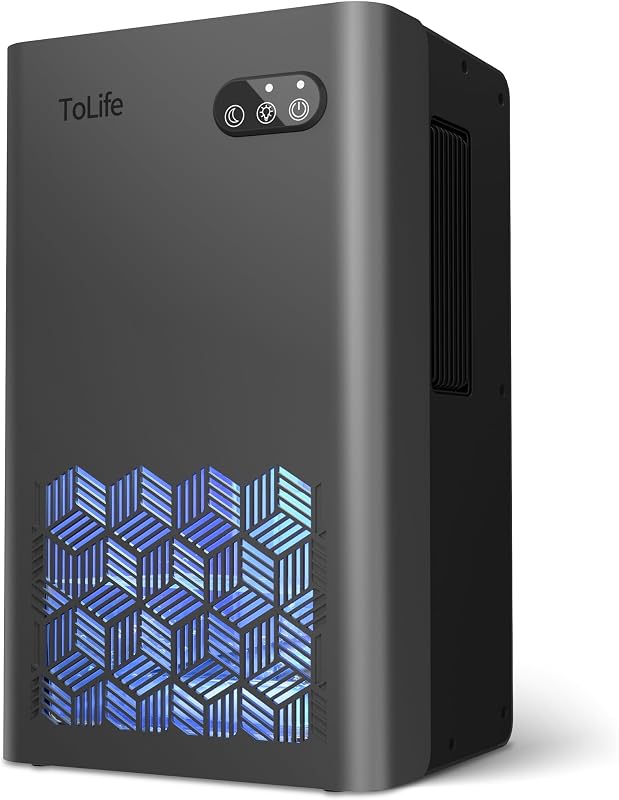
Measuring 8.27 inches deep by 5.55 inches wide and 13.78 inches tall, the ToLife dehumidifier is engineered for small footprints. The unit weighs 2.66 kilograms, incorporating an integrated handle that facilitates straightforward movement between rooms. Its chassis is constructed from standard molded plastic in a neutral grey finish, housing a 95-fluid-ounce (approximately 2.8-liter) clear drainage tank at the base. Operational controls are top-mounted, providing toggles between two operating speeds alongside controls for the integrated seven-color ambient LED lighting. A physical float mechanism ensures automatic shutdown whenever the reservoir reaches maximum capacity or becomes misaligned, preventing accidental spillage. The overall fit and finish align with entry-level consumer electronics, lacking structural reinforcement but proving adequate for stationary shelving or countertop duty. Prospective buyers should inspect the product labeling upon arrival, as the provided specification indicates 220-volt operation, necessitating verification of whether a compatible low-voltage transformer or regional power adapter is supplied in the retail packaging.
Real-world performance
The primary performance bottleneck centers on the reliance on semiconductor (Peltier) condensation rather than a traditional refrigeration compressor. While this design facilitates low operating noise—registering under 30 decibels in the dedicated sleep setting—it yields a maximum extraction capacity of only one liter (approximately 33.8 fluid ounces) per day under optimal conditions. Running at 93 watts, the unit processes moisture at a modest rate of 95 gallons per minute of airflow. While adequate for localized humidity mitigation in unventilated powder rooms, laundry alcoves, or reach-in closets, the hardware cannot reasonably regulate a 1,000-square-foot space as claimed in marketing materials. Even in an enclosed master bedroom, extracting one single liter every 24 hours will struggle to overcome typical outdoor air infiltration or daily human respiration. Where subtle, near-silent dehumidification is required for tight enclosures, the unit functions consistently, but it lacks the thermal mass and condenser power to lower elevated ambient humidity across entire residential levels.
Value for money
Retailing at $59.99, the ToLife dehumidifier enters the market at a fraction of the cost commanded by entry-level compressor models, which typically start around $150 to $200. For light-duty tasks, such as moderating moisture inside a damp clothes closet, the initial expenditure is minimal. However, calculating efficiency reveals a less favorable financial equation over time. Drawing 93 watts while capturing only one liter of moisture daily results in a comparatively high energy consumption per liter of water extracted. Compressor units, while consuming 200 to 400 watts, routinely remove 15 to 25 liters daily, yielding far superior electrical efficiency per unit of moisture gathered. The long-term running costs may offset the initial purchase savings if the machine operates continuously throughout the year. The unit does not use consumable filters, avoiding ongoing media replacement expenses, but prospective buyers should balance low entry pricing against limited structural extraction capacity and ongoing electrical draw.
Who should skip it
Consumers managing active mold outbreaks, crawlspace dampness, or chronic basement humidity should strictly skip this appliance. A single liter of daily water extraction cannot mitigate severe ambient moisture loads, nor can it process the massive air volumes found across standard 1,000-square-foot floorplans. Similarly, buyers living in high-humidity geographic regions who need whole-home climate stabilization must invest in a dedicated compressor-driven dehumidifier rated according to Association of Home Appliance Manufacturers (AHAM) standards. Those who require automated drain hose attachments for unattended continuous operation should also look elsewhere, as the ToLife relies entirely on manual emptying of its 95-ounce internal reservoir. Finally, purchasers unwilling to manually verify plug configurations and domestic electrical voltage compatibility—given the stated 220-volt specification—should opt for units explicitly rated for regional domestic wall outlets to avoid power delivery issues.