Design and Build Quality
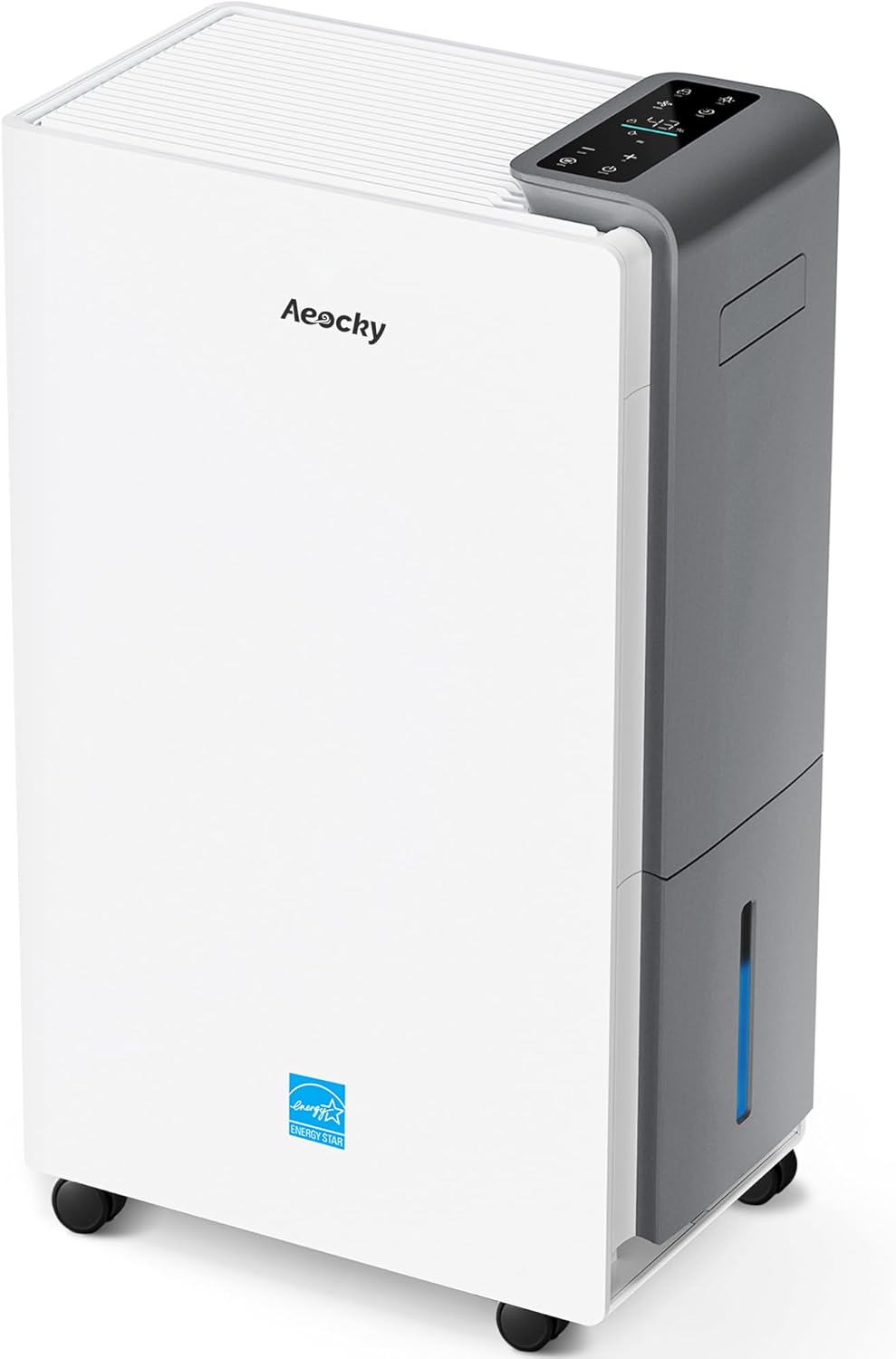
The AEOCKY RHEA-001 distinguishes itself from the commodity plastic dehumidifiers dominating the lower price tiers by employing a metal exterior shell. Measuring 14.45 inches deep by 8.66 inches wide and standing 24.09 inches tall, the 31-pound unit maintains a relatively compact footprint given its rated capacity. Internally, the engineering avoids cost-cutting measures such as aluminum tubing; instead, the manufacturer utilizes 7-millimeter diameter internally threaded pure copper tubing paired with a 3+2 row evaporator and condenser configuration. The heat exchanger incorporates hydrophilic aluminum foil to facilitate condensation run-off. Air movement is handled by a plastic-sealed AC motor paired with a proprietary rotary compressor. Water management relies on either a modest 1.45-gallon removable reservoir or a continuous gravity drainage port, for which AEOCKY supplies both a drain hose and a garden hose adapter. Overall fit and finish appear robust, reinforced by a three-year manufacturer warranty that exceeds typical single-year appliance coverage.
Real-World Performance and Capacity
Prospective buyers must evaluate the 80-pint headline rating with caution. This capacity is recorded under extreme test parameters of 95 degrees Fahrenheit and 95 percent relative humidity. Under warmer basement conditions (86 degrees Fahrenheit at 80 percent relative humidity), extraction drops to 56 pints per day. The listing lacks explicit standard Department of Energy (DOE) metrics, which test at 65 degrees Fahrenheit and 60 percent relative humidity; buyers should anticipate a lower yield under those typical basement conditions. However, the 280-watt rated power draw is remarkably conservative for this volume of airflow, corroborating its Energy Star Most Efficient 2025 designation. Low-temperature operational thresholds benefit from active defrost sensors designed to manage coil icing below 65 degrees Fahrenheit. Acoustic output is rated at 44 decibels on the lowest fan setting, making it suitable for main-floor living areas where harsh compressor vibration and aggressive fan turbulence would otherwise prove disruptive.
Value for Money
Priced at $224.97, the RHEA-001 occupies a highly competitive bracket, particularly when viewed alongside its 4.5-star aggregate rating across more than 6,600 customer entries. Dehumidifiers running continuously can accrue electricity costs that rapidly surpass their original retail price. By drawing only 280 watts while maintaining a high moisture extraction rate, the unit offsets ongoing utility expenses more effectively than older non-rated compressors. Factoring in the included garden hose adapter, flexible drain line, and standard three-year warranty protection, the upfront investment is well balanced against long-term maintenance expectations. The inclusion of internal copper piping provides reassurance against the refrigerant leaks that frequently disable aluminum-tubed budget units after one to two seasons. For homeowners aiming to treat damp crawlspaces or open-plan living areas up to the claimed 5,500 square feet without incurring high monthly power bills, the RHEA-001 delivers verifiable economic return.
Who Should Skip It
Homeowners needing automated moisture removal in rooms lacking a floor drain should exercise caution. With an internal tank capacity of only 1.45 gallons (approximately 11.6 pints), extracting moisture in high-humidity basements will necessitate emptying the reservoir several times per day. Without a built-in internal condensation pump, elevating the drained water into a sink or window is impossible without purchasing third-party pump accessories. Users seeking wireless connectivity should also reconsider; the unit features power-off memory for external smart switches but provides no integrated Wi-Fi app control. Finally, buyers expecting a true 80-pint yield in chilly, subterranean spaces under 60 degrees Fahrenheit should look toward commercial desiccant units or heavy-duty commercial refrigerant models with dedicated hot-gas bypass defrosting systems, as consumer compressor designs experience diminished performance as ambient temperatures decline toward baseline freezing points.