Design and build
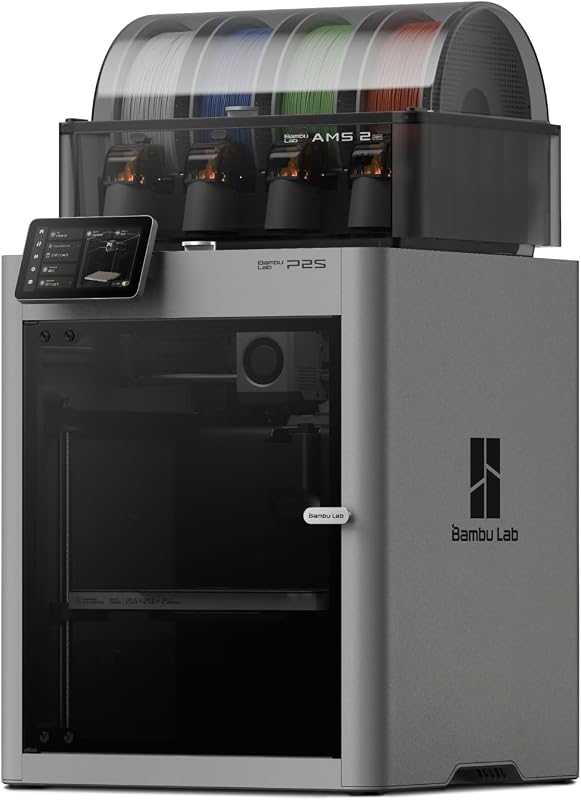
The Bambu Lab P2S Combo presents a compact footprint of 18 by 22 by 18 inches and a substantial weight of 46.3 pounds, reflecting its rigid structural assembly. Unlike budget open-frame architectures, this platform is fully enclosed. Following fundamental Maker tooling principles, this enclosure is essential for handling warp-prone engineering materials such as ABS and ASA. The chassis incorporates an Adaptive Airflow System with a dedicated carbon filter, regulating internal temperatures up to a specified 50 °C chamber threshold while mitigating airborne particulate output. The companion AMS 2 Pro module sits external to the main frame, introducing integrated spool management and active heated drying up to 65 °C. Component access is practical, highlighted by quick-swap nozzles that mitigate routine hotend maintenance downtime. Build quality appears robust throughout the motion assembly, though buyers must note that Shenzhen Tuozhu Technology relies heavily on a tightly coupled proprietary ecosystem rather than off-the-shelf reprap parts.
Real-world performance
Operational speed is rated up to 600 mm/s, managed by a PMSM servo extruder and real-time active flowrate compensation. In desktop additive manufacturing, bed adhesion and first-layer inconsistencies represent the most common operational failure points; the P2S mitigates this directly through automated calibration and bed levelling routines. The integrated sensor suite is further augmented by onboard AI failure detection, designed to flag spaghetti failures or layer anomalies before material is wasted. With the AMS 2 Pro connected, the system coordinates automated spool changes for multi-colour or soluble support geometries. The internal 65 °C filament drying capability of the feeder addresses hygroscopic filaments, maintaining consistent extrusion dynamics across extended print cycles. Across the 124 recorded user evaluations yielding a 4.6 out of 5 rating, execution consistency remains a core baseline, though print speeds approaching the 600 mm/s limit naturally demand premium filaments with verified volumetric flow profiles to prevent under-extrusion.
Value for money
Priced at $769.00, the P2S Combo occupies a distinct tier between entry-level bed slingers and dedicated industrial machines. Factoring in the included AMS 2 Pro system, the capital outlay accounts for both automated material switching and dedicated active filament drying. Sourcing an aftermarket heated dry box, coreXY motion enclosure, auto-levelling sensors, and an internal filtration system separately routinely matches or exceeds this total cost while introducing software integration hurdles. The cohesive operation between Bambu Studio slicing software, the Bambu Handy interface, and MakerWorld repositories removes technical friction that traditionally drives up setup hours. While consumable parts like proprietary hotends and proprietary drive gears introduce long-term platform lock-in, the immediate out-of-the-box readiness—advertised at roughly 15 minutes to initial print—offers measurable labor savings. For small workshops or production-focused individuals, the balance of enclosed thermal stability and material versatility presents a commercially viable hardware investment.
Who should skip it
Users whose workflows exclusively center on large single-color models using standard PLA or PETG should consider skipping the P2S Combo. The multi-material AMS 2 Pro and active chamber management add cost overhead unnecessary for basic prototyping tasks. Furthermore, while the physical unit spans 18 by 22 by 18 inches, the manufacturer specifications do not state the exact internal build volume; buyers requiring expansive print envelopes should verify specific build plate dimensions against their component sizes before purchasing. Enthusiasts dedicated to open-source firmware platforms, custom microcontrollers, and non-proprietary hardware configurations will find Bambu Lab’s walled ecosystem restrictive. Additionally, individuals seeking large-format resin or subtractive laser capabilities must look elsewhere—and as with all such chemical or laser platforms, separate ventilation systems must be factored into those alternative workshop budgets. If your priority is rapid, open repairability with generic hardware store components, this closed architecture may prove frustrating.