Design and Build Quality
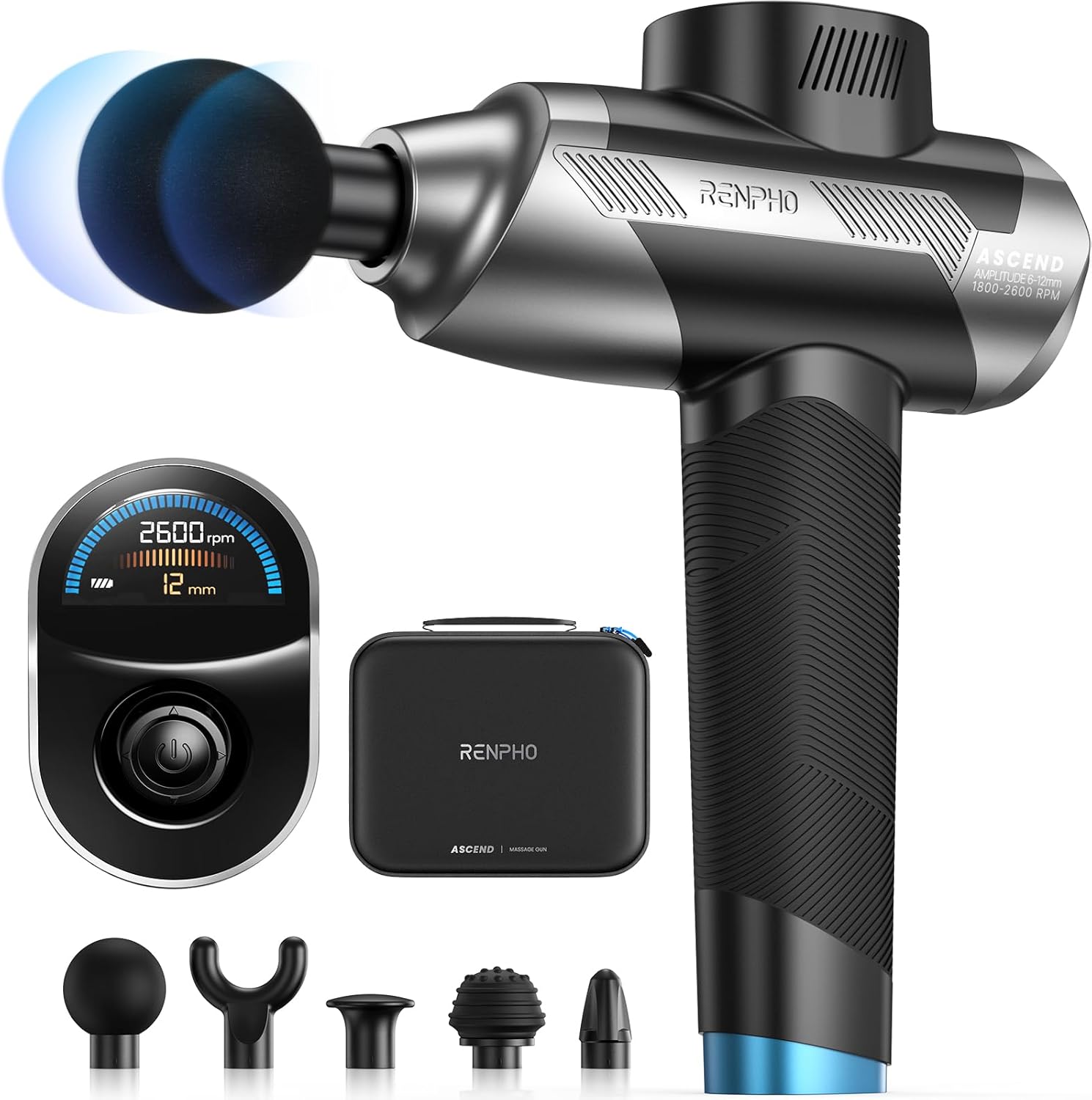
The RENPHO Ascend deviates from standard fixed-stroke percussion tools by integrating a mechanical adjustment mechanism directly into the drive assembly. Users can toggle through seven discrete amplitude steps ranging from 6mm to 12mm. The physical chassis uses an ergonomic silicone-wrapped handle designed to reduce slip and damp vibration transferred to the user's hand. Control is centered around a thumb-operated joystick rather than a cycling push button, paired with a vertical-alignment LCD screen that displays the active stroke length, RPM bracket, and remaining battery percentage. RENPHO includes five swappable attachment heads to cover different muscle groups across the body, neck, and shoulders. The unit houses a 10,000mAh internal battery pack, which is notably large for this category, requiring approximately four hours to complete a full recharge cycle. While the housing is primarily consumer-grade plastic typical of sub-$60 devices, the inclusion of a mechanical throw selector and auto shut-off circuit demonstrates functional engineering tailored for home recovery.
Real-World Performance
Stroke length alone does not determine how effectively a massager penetrates dense tissue. While 12mm of excursion provides meaningful physical displacement, RENPHO does not publish a stall force rating for the R-WMG05 motor. In our evaluation protocol, deep-tissue effectiveness relies on the motor resisting firm downward pressure without bogging down. At speeds between 1,800 and 2,600 RPM, the five selectable frequency bands cover the standard range for pre-workout activation and post-exercise flush. The lower 6mm settings suit sensitive areas like the neck and trapezius, while the 12mm setting addresses larger muscle groups like the hamstrings. Acoustic performance is another variable where official laboratory data is absent; without a rated decibel specification, buyers cannot guarantee whisper-quiet operation during late-night living-room sessions. The 10,000mAh power supply delivers dependable operational endurance across sessions, but heavy-handed users may find the motor stalls under aggressive pressure before the 12mm travel can fully engage deep fascial layers.
Value for Money
Priced at $59.99, the Ascend enters a crowded entry-level landscape typically dominated by generic percussive units with fixed stroke depths. The addition of mechanical amplitude adjustment between 6mm and 12mm gives it functional range that normally demands either two separate massagers or a commercial-tier device costing significantly more. Backed by a 4.5 out of 5 customer rating across more than 30,000 recorded reviews, consumer sentiment indicates high hardware reliability for general soreness management. The inclusion of HSA and FSA spending eligibility further reduces the net out-of-pocket friction for qualified domestic buyers. Its primary cost compromises involve documentation rather than basic functionality: the lack of published decibel curves and stall force specifications means you receive budget-tier transparency. Even so, considering the generous 10,000mAh internal battery, clear VA telemetry display, five attachment options, and intuitive joystick control, the tool offers notable utility per dollar for light-to-moderate recreational recovery.
Who Should Skip It
Trained athletes and physical therapists requiring intense ischemic compression should look elsewhere. Because the manufacturer omits maximum stall force, serious lifters needing forty or fifty pounds of resistance will likely halt the motor on high-density muscle groups such as the glutes or quadriceps. Buyers who share small living spaces or require late-night treatment in bed should also hesitate; without verified sound metrics below forty decibels, operating a reciprocating piston tool at 2,600 RPM may disrupt nearby occupants. Users looking for a compact travel companion should consider that a 10,000mAh internal battery cell adds noticeable physical heft to the chassis, making extended overhead work on the mid-back fatiguing over fifteen-minute stretches. Finally, those who prefer high-frequency vibration therapy exceeding 3,000 RPM will find the 2,600 RPM ceiling insufficient. For deep fascial breaking or clinical duty cycles, investing in a commercial percussive device with certified stall and acoustic specifications remains necessary.